Page 1 :
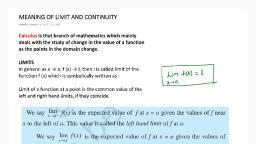
Limits and Derivatives, Introduction, •, , Calculus is that branch of mathematics which mainly deals with the study of change in the, value of a function as the points in the domain change., , Limits, •, , In general as x → a, f(x) → l, then l is called limit of the function f(x), , •, •, •, , Symbolically written as, For all the limits, function should assume at a given point x = a, The two ways x could approach a number an either from left or from right, i.e., all the values, of x near a could be less than a or could be greater than a., The two types of limits, o Right hand limit, ▪ Value of f(x) which is dictated by values of f(x) when x tends to from the right., o Left hand limit., ▪ Value of f(x) which is dictated by values of f(x) when x tends to from the left., In this case the right and left hand limits are different, and hence we say that the limit of f(x), as x tends to zero does not exist (even though the function is defined at 0)., , •, , •, , Algebra of limits, Theorem 1, Let f and g be two functions such that both, , exist, then, , o, , Limit of sum of two functions is sum of the limits of the function s,i.e, , o, , Limit of difference of two functions is difference of the limits of the functions, i.e., , o, , Limit of product of two functions is product of the limits of the functions, i.e.,, , o, , Limit of quotient of two functions is quotient of the limits of the functions (whenever, the denominator is non zero), i.e.,, , o, , In particular as a special case of (iii), when g is the constant function such that g(x) = λ, for, some real number λ, we have, , Limits of polynomials and rational functions, •, , A function f is said to be a polynomial function if f(x) is zero function or if f(x) =, where aiS is are real numbers such that an ≠ 0 for some natural, number n.
Page 2 :
•, , We know that, Hence,, , •, , Let, , •, , A function f is said to be a rational function, if f(x) =, such that h(x) ≠ 0., Then, , •, , However, if h(a) = 0, there are two scenarios –, o when g(a) ≠ 0, ▪ limit does not exist, o When g (a) = 0., ▪ g(x) = (x – a)k g1(x), where k is the maximum of powers of (x – a) in g(x), ▪ Similarly, h(x) = (x – a)l h1 (x) as h (a) = 0. Now, if k ≥ l, we have, , be a polynomial function, , If k < l, the limit is not defined., Theorem 2, For any positive integer n, , where g(x) and h(x) are polynomials
Page 3 :
Proof, , Note:, The expression in the above, rational number and a is positive., , theorem, , for, , the, , limit, , is, , true, , even, , if, , n, , is, , any, , Limits of Trigonometric Functions, Theorem 3, Let f and g be two real valued functions with the same domain such that f(x) ≤ g(x) for all x in the, domain of definition,, , For some a, if both, , Theorem 4 (Sandwich Theorem), Let f, g and h be real functions such that f(x) ≤ g(x) ≤ h(x) for all x in the common domain of, definition., For some real number
Page 4 :
To Prove:, , Proof:, We know that sin (– x) = – sin x and cos (– x) = cos x. Hence, it is sufficient to prove the, inequality for, , •, •, •, , is the centre of the unit circle such that the angle AOC is x radians and, Line segments B A and CD are perpendiculars to OA. Further, join AC. Then, Area of ∆OAC < Area of sector OAC < Area of ∆ OAB
Page 5 :
Hence Proved, The following are two important limits, , Proof:, The function, takes value 1., , is sandwiched between the function cos x and the constant function which, , Since, , , also we know that
Page 6 :
Using the fact that x → 0 is equivalent to, , . This may be justified by putting y=, , Derivatives, •, , •, •, , •, , Some Real time Applications, o People maintaining a reservoir need to know when will a reservoir overflow knowing the, depth of the water at several instances of time, o Rocket Scientists need to compute the precise velocity with which the satellite needs to, be shot out from the rocket knowing the height of the rocket at various times., o Financial institutions need to predict the changes in the value of a particular stock, knowing its present value., o Helpful to know how a particular parameter is changing with respect to some other, parameter., Derivative of a function at a given point in its domain of definition., Definition 1, o Suppose f is a real valued function and a is a point in its domain of definition., o The derivative of f at a is defined by, , Provided this limit exists., o Derivative of f(x) at a is denoted by f′(a), Definition 2, o Suppose f is a real valued function, the function defined by, , o, o, , Wherever limit exists is defined to be derivative of f at x, Denoted by f′(x)., This definition of derivative is also called the first principle of derivative., , Thus, o, o, o, o, , f′(x) is denoted by, or if y = f(x), it is denoted by dy/dx., This is referred to as derivative of f(x) or y with respect to x., It is also denoted by D (f(x))., Further, derivative of f at x = a, , is also denoted by, , o, , Theorem 5, Let f and g be two functions such that their derivatives are defined in a common domain. Then, o Derivative of sum of two functions is sum of the derivatives of the functions., , o, , Derivative of difference of, the functions., , two functions, , is difference of the derivatives of
Page 7 :
o, , Derivative of product of two functions is given by following product rule., , o, , Derivative of quotient of two functions, rule (whenever the denominator is non–zero)., , o, , Let u =f (x) = and v = g (x)., ▪ Product Rule:, • (uv) ′ = u’ v+ uv′., • Also referred as Leibnitz rule for differentiating product of functions, ▪ Quotient rule, , is, , •, o, , o, o, , Derivative of the function f(x) = x is the constant, , Theorem 6, Derivative of f(x) = xn is nxn-1 for any positive integer n., Proof, o By definition of the derivative function, we have, , o, , This can be proved as below alternatively, , given by, , the, , following, , quotient
Page 8 :
Theorem 7, o, , Let, be a polynomial function, where ais are all real, numbers and an ≠ 0. Then, the derivative function is given by, , Quick Reference:, •, , For functions f and g the following holds:, , •, , Following are some of the standard limits, , •, , Derivatives, o The derivative of a function f at a is defined by
Page 9 :
o, , Derivative of a function f at any point x is defined by, , •, , For functions u and v the following holds:, , •, , Following are some of the standard derivatives