Notes of Class 11th, Maths Hyperbola (R.D.).pdf - Study Material
Page 1 :
HYPERBOLA, , , , a INTRODUCTION, , We have discussed in earlier chapters that a hyperbola is the particular case of the conic, e+ ay + by” + 2gx + 2fy +c =Owhen abe + 2/gh—af? ~bg? — ch? # Oand h > ab. The analytical definition of a hyperbola is as follows:, , aYPERBOLA A hyperbola is the locus of a point in a plane which moves in the plane in such a way that, sje ratio of its distance ‘from a fixed point (called focus) in the same plane to its distance from a fixed line, (called directrix) is always constant which is always greater than unity., , The constant ratio is generally denoted by e and is known as the eccentricity of the hyperbola., IfSis the focus, Z Z' is the directrix and P is any point on the hyperbola, then by definition, SP ee > sp = e.PM, PM, , , , *s(Focus), , Directrix, , Zz, Fig. 27.1, , lLLUSTRATION Find the equation of the hyperbola whose focus is (1, 2), directrix the line, *+¥+1=Oand eccentricity 3/2., SOLUTION Let S(1, 2) be the focus and let P (x, y) be a point on the hyperbola. Draw, , Perpendicular PM from P on the directrix x + y + 1=0. Then,, SP = ePM [By definition], , , , > 8,2, 8x: +8y2 ~16x—32y +40 = 9x? + 9y? +9 +18xy + 18x + 18y, , Scanned with CamScanner
Page 2 :
ie., , eas MATHEMATICS, , => x + y? + 18xy + 34x + 50y — 31 = 0, which is the required equation of the hyperbgy, a,, , 27.2 EQUATION OF THE HYPERBOLA IN STANDARD FORM, Let S be the focus, ZK be the directrix and e be the eccentricity of the hyperbola whose equat;, , is required. Draw SK perpendicular from S on the directrix ZK and divide SK internal} ion, externally at A and A’ (on SK produced) respectively in the ratio ¢ : 1. Then, Y and, , SA = e AK, , and, SA’ = eA'K 7, Since A and A’ are such points that their distances from the focus bear constant ratio e (> ) C, their respective distances from the directrix. Therefore, these points lie on the hyperbola, a, , , , , x, , , , 5" (ae, 0):, , x=-a/e, , , , y, Fig. 27.3, , , , Let AA’ =2 aand C be the middle point of AA’. Then, CA = CA’ =a., Adding (i) and (ii), we get, SA + SA’ = e(AK+A'K), CS —- CA + CS + CA’ = e(CA-CK+CA'+CK), 2CS = 2ae, CS = ae, Subtracting (i) from (ii), we get, SA' — SA = e(A'K-AK), (CS' + SA’) -(CS+CA) = e(CA'+CK-CA+CK), , =, =, =>, , a, , => AA! = 2e(CK), = 2a = 2e(CK), > ck =4, , e, Let C be the origin, CSX the axis of x and a straight line CY through C perpendicular to CXas the, , axis of Y. Let P (x, y) be any point on the hyperbola and PM, PN be the perpendiculars from Pon, KZ and KX. By definition of hyperbola, , SP =e PM, s sp2 = e2 PM2, > sp? = e2 KN?, , __—, , Scanned with CamScanner
Page 3 :
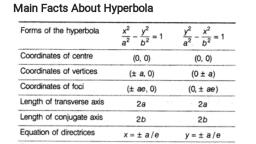
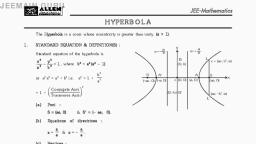
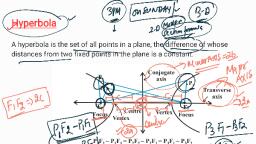
yveenBorh, , sp? = e? (CN ~CK)? ora, 3, , (x-ae)> +y? = e? (x-2), a 4 e, » VED = Pep, , 2 2, , 2 iv,, a aw a (e*-1), , 2 2, , xv 2, 2 fa b? 1, where b* = q? (e? -1), , this is the equation of the hyperbola in the standard form, 97.24 TRACING OF HYPERBOLA ., The equation of hyperbola is, , , , 2., , ab i), b, , yous (i) and, x= + Sy? 43? =, , Inorder to trace the graph of the hyperbola (i), we observe the following points:, , (a) Symmetry: For every value of x there are equal and opposite values of y [sec (ii)]. Similarly,, for every value of y there are equal and opposite values of x [See (iii)]. So, the curve is, symmetric about both the axes., , (b) Origin: The curve does not pass through the origin., , () Intersection with the axes: The curve meets x-axis at y = 0. Putting y= 0 in (iii), we get x=+a., So ,the curve meets x-axis at A (a, 0) and A’ (=a, 0)., , Putting x = 0 in (ii), we get imaginary values of y. So ,the curve does not meet y-axis., , (4) Region: From (ii), we find that for—a<x<a, the values of y are imaginary. So, the curve, does not exist between the lines x = — a and x= 4., , From (ii), we find that y=Oatx=44 and if x increases and is greater than a, the values of y, also increase. Similarly, if decreases and is less than-4,y also increases. the hyperbola, With the help of the above facts and by. joining some convenient points on the hyperbo, , EV ati in Fig. 273., the general shape of the hyperbola a “2 =1 is as shown in Fig., , HE HYPERBOLA, , 27.2.2 SECOND FOCUS AND SECOND DIRECTRIX = ;, i x WV 1 Pad (2-1) has second focus, Similar to ellipse it can be shown that the hyperbola 2 2, a, S' (~ae, 0) and second directrix Z'K’ having equation 7 =~, , 27.23 VARIOUS ELEMENTS OF HYPERBOLA, 2 i ints:, For the hyperbola = = x = 1,we have fine sSand S',are, 2 «ne ioining the foci 5 anao,, , VERTIC ‘ . ints Aand A’ , where the curve meets . meni 0) f spectively., called e In Fig. ae Pole The coordinates of Aand A cle canes the vertices A and A’ is, TRA aan pe Axes In Fig. 27.3, the sir ne ee 2a., , NSVE ONJUGA is generally :, Called the or of the hyperbola. Its length AA’ is 8!, , Scanned with CamScanner
Page 4 :
Ras MATHEMATICg, , The straight line through the centre which is perpendicular to the transverse axis does, the hyperbola in real points. But if B, B' be the points on this line such that CB=cp _ am Not eg, BB’ is called the conjugate axis such that BB' = 2b. the | ling, , FOCI In Fig. 27.3, the points S (ae, 0) and S' (— ae, 0) are the ‘foci of the hyperbola., DIRECTRICES = In Fig. 27.3, ZK and Z'K’ are two directrices of the hyperbola and their equati, x=4andx=-4 respectively., , e é, an elle he tote of he ipertln, 2 “* PSOB TY chord ofthe ype passing ty, 27.2.4 ECCENTRICITY, , 2 2., For the hyperbola 5 = 7 = 1, we have, a, , b? = a? (e? -1), , 2 x =, > = = ———, , “a wy 4 (conjugate axis)* axis)?, *Q ye Wanevane (transverse axis)”, , 27.2.5 LENGTH OF THE LATUS-RECTUM, , In Fig. 27.3, LSL' is the latus-rectum and LS is called the semi latus-rectum. TS'T’ is also a, latus-rectum., , , , y, H, , , , x2 2, The coordinates of L are (ae, SL). As L lies on the hyperbola ~ >- vs = 1 the coordinates of L will, b?, satisfy the equation: of the hyperbola., , (ae)* (SL)? 4, e “pe, > (SL)? = b? (ce? -1), 0? 2, => (SL)? = (5 2b? =a? (2-1) > e-1-b, a a, 2, => SL. = i, a, 2, SL = sit ©, , 2, Hence, length of the latus-rectum = 2 (SL) = abr 2a(e* -1)., a, , 27.2.6 FOCAL DISTANCES OF A POINT, , x2 2., The distances of any point on the hyperbola“ a a =1 from its foci are known as the focal distances, b?, , that point., , 4 the, THEOREM The difference of the focal distances of any point on a hyperbola is constant and equal to, length of the transverse axis of the hyperbola., , A, , Scanned with CamScanner
Page 5 :
ERBOLA, , Hv 27.5, be an i 2, , or Let P (x, y) Y point on the hyperbola 2 _ ¥ ;, , ppook Yperbola 2 po (See Fig. 27,3). Then, by, , inition, we have, , deh sp = ePM and S'P = e py’., , gov, SP=ePM = SP=#(NK)=¢(CN-CK)=6(x-!) - veg, é, , wt, S°P=EPM' = SP =e (NR) =e(CN +CK’) =e(, , xe Q)nexea, S'P - SP =(ex + a) —(ex -a) = 2 a =Transverse axis., , Hence, the difference of the focal distances of a Point on the hi, , erbola i i, the Jength of the transverse axis of the hyperbola. yperbola is constant and is equal to, , ; QED, onaccount of this property, a second definition of the hyperbola may be given as follows:, , Alyperbola is the locus of a point which moves in such a way that the difference of its distances from two, fixed points (foci) is always constant., , 72.7 CONJUGATE HYPERBOLA, , The hyperbola whose transverse and conjugate axes are respectively the conjugate and, transverse axes of a given hyperbola is called the conjugate hyperbola of the given hyperbola., , . x y ¥ x, The conjugate hyperbola of the hyperbola az 2 =1is - a 7 =i, Its shape is as shown in Fig. 27.4., , The eccentricity of the conjugate hyperbola is given by a* =b7(e?-1) and the length of the, _ 2a?, latus-rectum is >, , S (0, be), , B, y=bfe, , , , , , y=-ble, , , , , , nN, , Scanned with CamScanner



 Learn better on this topic