Notes of Rbi 11 2021-22, Maths Conic Sections.pdf - Study Material
Page 1 :
1|Page, , Maths Class 11 Chapter 11 Conic section part-1 Circles, Circles, Circle is defined as the locus of a point which moves in a plane such that its distance from a, fixed point in that plane is constant., , Standard Forms of a Circle, (i) Equation of circle having centre (h, k) and radius (x — h)2 + (y — k)2 = a2., If centre is (0, 0), then equation of circle is x2 + y2 = a2., (ii) When the circle passes through the origin, then equation of the circle is x 2 + y2 — 2hx —, 2ky = 0., , (iii) When the circle touches the X-axis, the equation is x2 + y2 — 2hx — 2ay + h2 = O.
Page 4 :
4|Page, , General Equation of a Circle, The general equation of a circle is given by x2 + y2 + 2gx + 2fy + c = 0, where centre of the, circle = (- g, – f), Radius of the circle = √g2 + f2 – c, 1. If g2 + f2 – c > 0, then the radius of the circle is real and hence the circle is also real., 2. If g2 + f2 – c = 0, then the radius of the circle is 0 and the circle is known as point circle., 3. If g2 + f2 – c< 0, then the radius of the circle is imaginary. Such a circle is imaginary,, which is not possible to draw., Position of a Point with Respect to a Circle, A point (x1, y1) lies outside on or inside a circle, S ≡ x2 + y2 + 2gx + 2fy + c = 0, according as S1 > , = or < 0, where, S1 = x12 + y12 + 2gx1, + 2fy1+ c, Intercepts on the Axes, The length of the intercepts made by the circle x2 + y2 + 2gx + 2fy + c = 0 with X and Y-axes, are, 2√g2 – c and 2√g2 – c., 1. If g2 > c, then the roots of the equation x2 + 2gx + c = 0 are real and distinct, so the circle, x2 + y2 + 2gx + 2fy + c = 0 meets the X-axis in two real and distinct points., 2. If g2 = c, then the roots of the equation x2 + 2gx + c = 0 are real and equal, so the circle, touches X-axis, then intercept on X-axis is O., 3. If g2 < c, then the roots of the equation x2 + 2gx + c = 0 are imaginary, so the given, circle does not meet X-axis in real point. Similarly, the circle x2 + y2 + 2gx + 2fy + c = 0, cuts the Y-axis in real and distinct points touches or does not meet in real point, according to f2 >, = or < c, Equation of Tangent
Page 6 :
6|Page, , The equation of normal to the circle x2 + y2 = r2 at the point (r cos θ, r sin θ) is, (x/r cos θ) = (y/r sin θ), or y = x tan θ., Important Points to be Remembered, (i) The line y = mx + c meets the circle in unique real point or touch the circle, x2 + y2 + r2, if r = |c/√1 + m2, , and the point of contacts are, (ii) The line lx + my + n = 0 touches the circle x2 + y2 = r2, if r2(l2 + m2) = n2., (iii) Tangent at the point P (θ) to the circle x2 + y2 = r2 is x cos θ + y sin θ = r., (iv) The point of intersection of the tangent at the points P(θ1) and Q(θ2) on the circle x2 + y2 =, r2, , (v) Normal at any point on the circle is a straight line which is perpendicular to the tangent to, the curve at the point and it passes through the centre of circle., (vi) Power of a point (x1, y1) with respect to the circle x2 + y2 + 2gx + 2fy + c = 0 is x12 + y12 +, 2gx1 + 2fy1 + c., (vii) If P is a point and C is the centre of a circle of radius r, then the maximum and minimum, distances of P from the circle are CP + r and CP — r , respectively., (viii) If a line is perpendicular to the radius of a circle at its end points on the circle, then the, line is a tangent to the circle and vice-versa., Pair of Tangents, (i) The combined equation of the pair of tangents drawn from a point P(x1, y1) to the circle x2 +, y2 = r2 is
Page 9 :
9|Page, , S2 ≡ x2 + y2 + 2g2x + 2f2y + C2 = 0 are orthogonal, then 2g1g2 + 2f1f2 = c1 + c2, Family of Circles, (i) The equation of a family of circles passing through the intersection of a circle x 2 + y2 + 2gx, + 2fy + c = 0 and line, L = lx + my + n = 0 is S + λL = 0, where, X, is any real number., (ii) The equation of the family of circles passing through the point A(x1, y1) and B (x1, y1) is, , (iii) The equation of the family of -circles touching the circle, S ≡ x2 + y2 + 2gx + 2fy + c = 0 at point P(x1, Y1) is, xx2 + y2 + 2gx + 2fy + c + λ, [xx1 + yy1 + g(x + x1) + f(Y+ Y1) + c] = 0 or S + λL = 0, where L, = 0 is the equation of the tangent to, S = 0 at (x1, y1) and X ∈ R, (iv) Any circle passing through the point of intersection of two circles S 1 and S2 is S1 +λ(S1 —, S2) = 0., Radical Axis, The radical axis of two circles is the locus of a point which moves in such a way that the length, of the tangents drawn from it to the two circles are equal., A system of circles in which every pair has the same radical axis is called a coaxial system of, circles., The radical axis of two circles S1 = 0 and S2 = 0 is given by S1 — S2 = 0.
Page 10 :
10 | P a g e, , 1. The radical axis of two circles is always perpendicular to the line joining the centres of, the circles., 2. The radical axis of three vertices, whose centres are non-collinear taken in pairs of, concurrent., 3. The centre of the circle cutting two given circles orthogonally, lies on their radical axis., 4. Radical Centre The point of intersection of radical axis of three circles whose centre are, non-collinear, taken in pairs, is called their radical centre., Pole and Polar, If through a point P (x1, y1) (within or outside a circle) there be drawn any straight line to meet, the given circle at Q and R, the locus of the point of intersection of tangents at Q and R is, called the polar of P and po.:.at P is called the pole of polar., , 1. Equation of polar to the circle x2 + y2 = r2 is xx1 + yy1 = r2., 2. Equation of polar to the circle x2 + y2 + 2gx + 2fy + c = 0 is xx1 + yy1 + g(x + x1) + f(y +, y1) + c = 0, 3. Conjugate Points Two points A and B are conjugate points with respect to a given circle,, if each lies on the polar of the other with respect to the circle., 4. Conjugate Lines If two lines be such that the pole of one lies on the other, then they are, called conjugate lines with respect to the given circle., Coaxial System of Circles
Page 11 :
11 | P a g e, , A system of circle is said to be coaxial system of circles, if every pair of the circles in the, system has same radical axis., 1. The equation of a system of coaxial circles, when the equation of the radical axis P ≡ lx, + my + n = 0 and one of the circle of the system S = x2 + y2 + 2gx + 2fy + c = 0, is S +, λP = 0., 2. Since, the lines joining the centres of two circles is perpendicular to their radical axis., Therefore, the centres of all circles of a coaxial system lie on a straight line, which is, perpendicular to the common radical axis., Limiting Points, Limiting points of a system of coaxial circles are the centres of the point circles belonging to, the family., Let equation of circle be x2 + y2 + 2gx + c = 0, ∴ Radius of circle = √g2 — c, For limiting point, r = 0, ∴ √g2 — c = 0 ⇒g = ± √c, Thus, limiting points of the given coaxial system as (√c, 0) and (—√c, 0)., Important Points to be Remembered, (i) Circle touching a line L=O at a point (x1, y1) on it is, (x — x1)2 + (y — y1)2 + XL = 0., (ii) Circumcircle of a A with vertices (x1, y1), (x2, y2), (x3, y3) is, , (iii) A line intersect a given circle at two distinct real points, if the length of the perpendicular, from the centre is less than the radius of the circle.
Page 13 :
13 | P a g e, , Diameter of a Circle, The locus of the middle points of a system of parallel chords of a circle is called a diameter of, the circle., (i) The equation of the diameter bisecting parallel chords y = mx + c of the circle x2 + y2 = a2 is, x + my = 0., (ii) The diameter corresponding to a system of parallel chords of a circle always passes through, the centre of the circle and is perpendicular to the parallel chords., Common Tangents of Two Circles, Let the centres and radii of two circles are C1, C2 and r1, r2, respectively., 1. (i) When one circle contains another circle, no common tangent is possible., Condition, C1C2 < r1 – r2, 2. (ii) When two circles touch internally, one common tangent is possible., Condition , C1C2 = r1 – r2, 3. (iii) When two circles intersect, two common tangents are possible., Condition, |r1 — r2| < C1C2 < |r1 + r2|, 4. (iv) When two circles touch externally, three common tangents are possible., Condition, C1C2 = r1 + r2, 5. (v) When two circles are separately, four common tangents are possible., Condition, C1C2 > r1 + r2, Important Points to be Remembered, Let AS is a chord of contact of tangents from C to the circle x2 + y2 = r2. M is the mid-point of, AB.
Page 14 :
1|Page, , Class 11 Maths Chapter 11 Conic Section Part -2 Ellipse, Ellipse is the locus of a point in a plane which moves in such a way that the ratio of the, distance from a fixed point (focus) in the same plane to its distance from a fixed straight line, (directrix) is always constant, which is always less than unity., Major and Minor Axes, The line segment through the foci of the ellipse with its end points on the ellipse, is called its, major axis., The line segment through the centre and perpendicular to the major axis with its end points on, the ellipse, is called its minor axis., Horizontal Ellipse i.e., x2 / a2 + y2 / b2 = 1, 0 < b < a, If the coefficient of x2 has the larger denominator, then its major axis lies along the x-axis, then, it is said to be horizontal ellipse., , (i) Vertices A( a, 0), Al (- a, 0), (ii) Centre (0, 0), (iii) Major axis, AAl = 2a; Minor axis, BBl = 2b, (iv) Foci are S(ae, 0) and Sl(-ae, 0), (v) Directrices are l : x = a / e, l’ ; x = – a / e, (vi) Latusrectum, LLl = L’ Ll‘ = 2b2 / a, (vii) Eccentricity, e = √1 – b2 / a2 < 1, (viii) Focal distances are SP and SlP i.e., a – ex and a + ex. Also, SP + SlP = 2a = major axis.
Page 16 :
3|Page, , Let P be any point on the ellipse and PN be perpendicular to the major axis AA’, such that PN, produced meets the ellipse at P’. Then, PN is called the ordinate of P and PNP’ is the double, ordinate of P ., Special Form of Ellipse, If centre of the ellipse is (h, k) and the direction of the axes are parallel to the coordinate axes,, then its equation is (x – h)2 / a2 + (y – k)2 / b2 = 1, Position of a Point with Respect to an Ellipse, The point (x1, y1) lies outside, on or inside the ellipse x2 / a2 + y2 / b2 = 1 according as x21 / a2 + y21 / b2 – 1 > 0, = or < 0., Auxiliary Circle, the ellipse x2 / a2 + y2 / b2 = 1, becomes the ellipse x2 + y2 = a2, if b = a. This is called auxiliary, circle of the ellipse. i. e. , the circle described on the major axis of an ellipse as diameter is, called auxiliary circle., Director Circle, The locus of the point of intersection of perpendicular tangents to an ellipse is a director circle., If equation of an ellipse is x2 / a2 + y2 / b2 = 1, then equation of director circle is x2 + y2 = a2 +, b2., Eccentric Angle of a Point, Let P be any point on the ellipse x2 / a2 + y2 / b2 = 1. Draw PM perpendicular a b from P on the, major axis of the ellipse and produce MP to the auxiliary circle in Q. Join CQ. The ∠ ACQ = φ, is called the eccentric angle of the point P on the ellipse., , Parametric Equation, The equation x = a cos φ, y = b sin φ, taken together are called the parametric equations of the, ellipse x2 / a2 + y2 / b2 = 1 , where φ is any parameter.
Page 20 :
7|Page, , (i) The eccentric angles of the ends of a pair of conjugate diameters of an ellipse differ by a, right angle., (ii) The sum of the squares of any two conjugate semi-diameters of an ellipse is constant and, equal to the sum of the squares of the semi-axis of the ellipse i. e., CP2 + CD2 = a2 + b2., (iii) If CP, CQ are two conjugate semi-diameters of an ellipse x2 / a2 + y2 / b2 = 1 and S, S1 be, two foci of an ellipse, then, SP * S1P = CQ2, , (iv) The tangent at the ends of a pair of conjugate diameters of an ellipse form a parallelogram., (v) The area of the parallelogram formed by the tangents at the ends of conjugate diameters of, an ellipse is constant and is equal to the product of the axis., Important Points, 1. The point P(x1 y1) lies outside, on or inside the ellipse x2 / a2 + y2 / b2 = 1 according as x21 /, a2 + y21 / b2 – 1 > 0, or < 0., 2. The line y = mx + c touches the ellipse, x2 / a2 + y2 / b2 = 1, if c2 = a2m2 + b2, 3. The combined equation of the pair of tangents drawn from a point (x 1 y1) to the ellipse x2 /, a2 + y2 / b2 = 1 is, (x2 / a2 + y2 / b2 – 1) (x21 / a2 + y21 / b2 – 1) = (xx1 / a2 + yy1 / b2 – 1)2, i.e, SS1 = T2, 4. The tangent and normal at any point of an ellipse bisect the external and internal angles, between the focal radii to the point., 5. If SM and S’ M’ are perpendiculars from the foci upon the tangent at any point of the ellipse,, then SM x S’ M’ = b2 and M, M’ lie on the auxiliary circle.
Page 22 :
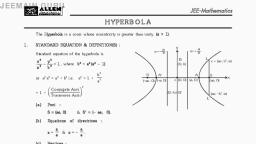
1|Page, , Class 11 Maths Chapter 11 Conic Section Part -2 Hyperbola, A hyperbola is the locus of a point in a plane which moves in the plane in such a way that the, ratio of its distance from a fixed point in the same plane to its distance from a fixed line is, always constant, which is always greater than unity., The fixed point is called the focus and the fixed line is directrix and the ratio is the eccentricity., Transverse and Conjugate Axes, The line through the foci of the hyperbola is called its transverse axis., The line through the centre and perpendicular to the transverse axis of the hyperbola is called, its conjugate axis., , 1., 2., 3., 4., 5., 6., 7., , Centre O(0, 0), Foci are S(ae,0),S1(-ae, 0), Vertices A(a, 0), A1(-a, 0), Directrices / : x = a/e, l’ : x = -a/e, Length of latusrectum LL1 = L’L’1 = 2b2/a, Length of transverse axis 2a., Length of conjugate axis 2b., , 8. Eccentricity, or b2 = a2(e2 – 1), 9. Distance between foci =2ae, 10. Distance between directrices = 2a/e, Conjugate Hyperbola
Page 23 :
2|Page, , 1., 2., 3., 4., 5., 6., 7., 8., , (i) Centre O(0, 0), (ii) Foci are S (0, be), S1(0, — be), (iii) Vertices A(0, b) , A1(0, — b), (iv) Directrices, l:y = b/e, l’ : y = —b/e, (v) Length of latusrectum, LL1 = L’ L’1 = 2a2/b, (vi) Length of transverse axis 2b., (vii) Length of conjugate axis 2a., (viii) Eccentricity, , 9. (ix) Distance between foci = 2be, 10. (x) Distance between directrices = 2b/e, Focal Distance of a Point, The distance of a point on the hyperbola from the focus is called it focal distance. The, difference of the focal distance of any point on a, hyperbola is constant and is equal to the, length of transverse axis the hyperbola i.e.,, S1P — SP = 2a, where, S and S1 are the foci and P is any point or P the hyperbola., Equation of Hyperbola in Different Form, 1 If the centre of the hyperbola is (h, k) and the directions of the axes are parallel to the, coordinate axes, then the equation of the hyperbola, whose transverse and conjugate axes are 2a, and 2b is
Page 24 :
3|Page, , 2. If a point P(x, y) moves in the plane of two perpendicular straight lines a 1x + b1y + c1 = 0, and b1x – a1y + c2 = 0 in such a way that, , Then, the locus of P is hyperbola whose transverse axis lies along b1x – a1y + c2 = 0 and, conjugate axis along the line a1x + b1y + c1 = 0. The length of transverse and conjugate axes are, 2a and 2b, respectively., Parametric Equations, (i) Parametric equations of the hyperbola, x = a sec θ, y = b tan θ, or x = a cosh θ, y = b sinhθ, (ii) The equations, the hyperbola., , are also the parametric equations of, , Equation of Chord, (i) Equations of chord joining two points P(a sec θ1, b tan θ1,) and Q(a sec θ2, b tan θ2) on the, hyperbola, , (ii) Equations of chord of contact of tangents drawn from a point (x1, y1) to the, hyperbola
Page 25 :
4|Page, , (iii) The equation of the chord of the hyperbola, by, , bisected at point (x1, y1) is given, , Equation of Tangent Hyperbola, (i) Point Form The equation of the tangent to the, hyperbola, (ii) Parametric Form The equation of the tangent to the, hyperbola, (iii) Slope Form The equation of the tangents of slope m to, the hyperbola, The coordinates of the point of contact are, , (iv) The tangent at the points P(a sec θ1 , b tan θ1) and Q (a sec θ2, b tan θ2) intersect at the, point, , (v) Two tangents drawn from P are real and distinct, coincident or imaginary according as the, roots of the equation m2(h2 – a2) – 2khm + k2 + b2 = 0. are real and distinct, coincident or, imaginary., (vi) The line y = mx + c touches the hyperbola, if c2 = a2m2 – b2 the point of, contacts, Normal Equation of Hyperbola, (i) Point Form The equation of the normal to the, hyperbola
Page 26 :
5|Page, , (ii) Parametric Form The equation of the normal at (a sec θ, b tan θ) to the, hyperbola, is ax cos θ + by cot θ = a2 + b2., , (iii) Slope Form The equations of the normal of slope m to the hyperbola, given by, , are, , The coordinates of the point of contact are, , (iv) The line y = mx + c will be normal to the hyperbola, , if,, , (v) Maximum four normals can be drawn from a point (x1, y1) to the hyperbola, Conormal Points, Points on the hyperbola, the normals at which passes through a given point are called conormal, points., 1. The sum of the eccentric angles of conormal points is an odd ion multiple of π., 2. If θ1 , θ2 , θ3 and θ4 are eccentric angles of four points on the hyperbola, then normal at which they are concurrent, then, (a) ∑cos( θ1 + θ2) = 0, (b) ∑sin( θ1 + θ2) = 0, , ,, , 3. If θ1 , θ2 and θ3 are the eccentric angles of three points on the hyperbola, ,, such that sin(θ1 + θ2) + sin(θ2 + θ3) + sin(θ3 + θ1) = 0. Then, the normals at these points, are concurrent.
Page 27 :
6|Page, , 4. If the normals at four points P(x1, y1), Q(x2, y2), R(x3 , y3) and S(X4, y4) on the, hyperbola, , are concurrent, then, , Conjugate Points and Conjugate Lines, 1. Two points are said to be conjugate points with respect to a hyperbola, if each lies on the, polar of the other., 2. Two lines are said to be conjugate lines with respect to a hyperbola, each passes through the pole of the other., , , if, , Diameter and Conjugate Diameter, 1. Diameter The locus of the mid-points of a system of parallel chords of a hyperbola is, called a diameter.>, The equation of the diameter bisecting a system of parallel chord of slope m to the, hyperbola, , is, , 2. Conjugate Diameter The diameters of a hyperbola are sal to be conjugate diameter, if, each bisect the chords parallel to th other., The diameters y = m1x and y = m2x are conjugate, if m1 m2 = b2/a2., 3. In a pair of conjugate diameters of a hyperbola, only one mee the hyperbola in real, points., Asymptote, An asymptote to a curve is a straight line, at a finite distance from the origin, to which the, tangent to a curve tends as the point of contact goes to infinity., 1. The equation of two asymptotes of the hyperbola, are, 2. The combined equation of the asymptotes to the hyperbola, 3. When b = a, i.e., the asymptotes of rectangular hyperbola x2 – y2 = a2 are y = ± x which, are at right angle., 4. A hyperbola and its conjugate hyperbola have the same asymptotes., 5. The equation of the pair of asymptotes differ the hyperbola and the conjugate hyperbola, by the same constant only i.e., Hyperbola — Asymptotes = Asymptotes — Conjugate, hyperbola
Page 28 :
7|Page, , 6. The asymptotes pass through the centre of the hyperbola., 7. The bisectors of angle between the asymptotes are the coordinate axes., 8. The angle between the asymptotes of, , is 2 tan-1(b/a) or 2 sec-1(e)., , Director Circle, The locus of the point of intersection of the tangents to the hyperbolo, , which are, perpendicular to each other, is called a director circle. The equation of director circle is x 2 +, y2 = a2 – b2., , Rectangular Hyperbola, A hyperbola whose asymptotes include a right angle is said to I rectangular hyperbola or we, can say that, if the lengths of transver: and conjugate axes of any hyperbola be equal, then it is, said to be rectangular hyperbola., i.e., In a hyperbola, , . if b = a, then it said to be rectangular hyperbola., , The eccentricity of a rectangular hyperbola is always √2., Rectangular Hyperbola of the Form x2 – y2 = a2, , 1., 2., 3., 4., 5., , Asymptotes are perpendicular lines i.e., x ± y = 0, Eccentricity e = √2., Centre (0, 0), Foci (± -√2 a, 0), Vertices A(a, 0) and A1 (—a, 0)
Page 30 :
9|Page, , 1. The point (x1, y1) lies outside, on or inside the hyperbola, , according, , as, 2. The combined equation of the pairs of tangent drawn from a point P(x1, y1) lying outside, 3., , 4., 5., 6., 7., , the hyperbola, The equation of the chord of the hyperbola xy = c2 whose mid-point is (x1, y1) is, xy1 + yx1 = 2x1y1, or t = S1, Equation of the chord joining t1, t2 on xy = t2 is, x + yt1t2 = c(t1 + t2), Eccentricity of the rectangular hyperbola is √2 and the angle between asymptotes is 90°., If a triangle is inscribed in a rectangular hyperbola, then its orthocentre lies on the, hyperbola., Any straight line parallel to an asymptotes of a hyperbola intersects the



 Learn better on this topic