Page 1 :
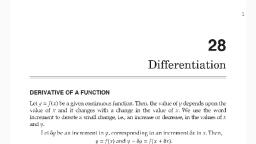
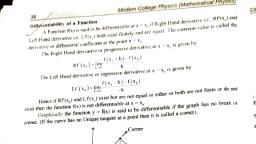
Introduction, , The rate of change of one quantity with respect to some another quantity has a great, importance. For example, the rate of change of displacement of a particle with respect to time is, called its velocity and the rate of change of velocity is called its acceleration., , The rate of change of a quantity ‘y’ with respect to another quantity ‘x’ is called the, , derivative or differential coefficient of y with respect to x., , 3.1 Derivative at a Point, , The derivative of a function at a point x=a is defined by f'(a@=lim (provided the, hoo, , . fla+h)- fla), h> h, limit exists and is finite), The above definition of derivative is also called derivative by first principle., (1) Geometrical meaning of derivatives at a point: Consider the curve y= (f(x). Let f(x) be, differentiable at x=c. Let P(c, f(c)) be a point on the curve and Q(x, f(x)) be a neighbouring point, , on the curve. Then,, , Slope of the chord PQ = . Taking limit as Q>P,i.e., x >, , Sx)— fo), x-Cc, lim LO-LO, , xe x-C, , we get int (slope of the chord PQ) =, , , , As Q-»P, chord PQ becomes tangent at P., , Therefore from (i), we have, , Slope of the tangent at P = lim, roe X-€, , , , fO)=f) _ (2), ae x, ., , Nete : Q Thus, the derivatives of a function at a point x=c is the slope of the tangent to, curve, y = f(x) at point (c, f(c))., , (2) Physical interpretation at a point : Let a particle moves in a straight line OX starting, , from O towards X. Clearly, the position of the particle at any instant would depend upon the, , time elapsed. In other words, the distance of the particle from O will be some function f of time, t.


Page 2 :
Differentiation 129, , Let at any time +=7,, the particle be at P and after a further time h, it is at Q so that OP =, f(t) and OQ = f(t, +h). Hence, the average speed of the particle during the journey from P to Q is, PQ ig flo + Wf), , ?, , 3 5 = f(t),h). Taking the limit of f(t),h) as h—0, we get its instantaneous, , speed to be lim MoD), which is simply /‘(‘,). Thus, if f() gives the distance of a moving, particle at time t, then the derivative of f at t=t, represents the instantaneous speed of the, , particle at the point P, i.e., at time r=1)., , Important Tips, , , , dy d d, = a is Ee in which = is simply a symbol of operation and not ‘d’ divided by dx., ix Ix, , = If f(x9)=~*, the function is said to have an infinite derivative at the point xo. In this case the line tangent to the, , curve of y = f(x) at the point xo is perpendicular to the x-axis, , , , sf Q)~2flx) _, , Example: 1 If f(2)=4, f(2)=1, then lim a, rod ox, , [Rajasthan PET 1995, 2000], , (a) 1 (b) 2 (c) 3 (d) -2, Solution: (b) Given /(2)=4,f(2)=1, tim FQ=2f), , x2 42, , tim 2f@= 2/2), , x2 x= 2), , , , = fim LO 2F@)+ 2f2)— 2A) _ ji @ = oe —, , +2 #2 x20 X—, , fRO-f2, , , , = f2)-2 lim = fQ)-2fQ)=4-20)=4-2=2, , L2)-2F2) 9,, , Trick : Applying L-Hospital rule, we get lim i, , Example: 2 If f(x+y)=f().fQ) for all x and y and f(5)=2, f(0)=3, then f'(5) will be, [IIT 1981; Karnataka CET 2000; UPSEAT 2002; MP PET 2002; AIEEE 2002], (a) 2 (b) 4 (c) 6 (a) 8, Solution: (c) Let x=5,y=0 > f(5+0)=f(5).f), , => f6)= fS)fO) > fO)=1, , £5+9- 10) _ tim LOM FS) _ jim 2| 20=1] (<f8)=2), h, , Therefore, 6) in eee EP, , = 2lim|, =), , [S2-20)- 2x poy=203 <6., , Example: 3 If fla)=3,/(@=-2,2@=-le(@=4, then lim S2L@O= sf) _, , IMP PET 1997], a x-a, , (a) -5 (b) 10 (c) - 10 (a) 5