Page 1 :
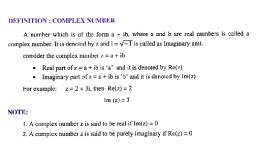
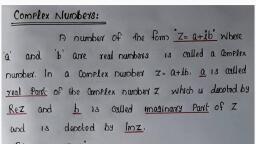
Chapter, , 5, , COMPLEX NUMBERS AND, QUADRATIC EQUATIONS, vMathematics is the Queen of Sciences and Arithmetic is the Queen of, Mathematics. – GAUSS v, 5.1 Introduction, In earlier classes, we have studied linear equations in one, and two variables and quadratic equations in one variable., We have seen that the equation x2 + 1 = 0 has no real, solution as x2 + 1 = 0 gives x2 = – 1 and square of every, real number is non-negative. So, we need to extend the, real number system to a larger system so that we can, find the solution of the equation x2 = – 1. In fact, the main, objective is to solve the equation ax2 + bx + c = 0, where, D = b2 – 4ac < 0, which is not possible in the system of, real numbers., W. R. Hamilton, (1805-1865), , 5.2 Complex Numbers, , Let us denote −1 by the symbol i. Then, we have i = −1 . This means that i is a, solution of the equation x2 + 1 = 0., A number of the form a + ib, where a and b are real numbers, is defined to be a, 2, , −1 , complex number. For example, 2 + i3, (– 1) + i 3 , 4 + i are complex numbers., 11 , For the complex number z = a + ib, a is called the real part, denoted by Re z and, b is called the imaginary part denoted by Im z of the complex number z. For example,, if z = 2 + i5, then Re z = 2 and Im z = 5., Two complex numbers z1 = a + ib and z2 = c + id are equal if a = c and b = d., , 2020-21
Page 2 :
98, , MATHEMATICS, , Example 1 If 4x + i(3x – y) = 3 + i (– 6), where x and y are real numbers, then find, the values of x and y., Solution We have, 4x + i (3x – y) = 3 + i (–6), Equating the real and the imaginary parts of (1), we get, 4x = 3, 3x – y = – 6,, which, on solving simultaneously, give x =, , ... (1), , 3, 33, and y = ., 4, 4, , 5.3 Algebra of Complex Numbers, In this Section, we shall develop the algebra of complex numbers., 5.3.1 Addition of two complex numbers Let z1 = a + ib and z2 = c + id be any two, complex numbers. Then, the sum z1 + z2 is defined as follows:, z1 + z2 = (a + c) + i (b + d), which is again a complex number., For example, (2 + i3) + (– 6 +i5) = (2 – 6) + i (3 + 5) = – 4 + i 8, The addition of complex numbers satisfy the following properties:, (i) The closure law The sum of two complex numbers is a complex, number, i.e., z1 + z2 is a complex number for all complex numbers, z1 and z2., (ii) The commutative law For any two complex numbers z 1 and z 2 ,, z1 + z2 = z2 + z1, (iii) The associative law For any three complex numbers z 1, z 2, z 3 ,, (z1 + z2) + z3 = z1 + (z2 + z3)., (iv) The existence of additive identity There exists the complex number, 0 + i 0 (denoted as 0), called the additive identity or the zero complex, number, such that, for every complex number z, z + 0 = z., (v) The existence of additive inverse To every complex number, z = a + ib, we have the complex number – a + i(– b) (denoted as – z),, called the additive inverse or negative of z. We observe that z + (–z) = 0, (the additive identity)., 5.3.2 Difference of two complex numbers Given any two complex numbers z1 and, z2, the difference z1 – z2 is defined as follows:, z1 – z2 = z1 + (– z2)., For example,, (6 + 3i) – (2 – i) = (6 + 3i) + (– 2 + i ) = 4 + 4i, and, , (2 – i) – (6 + 3i) = (2 – i) + ( – 6 – 3i) = – 4 – 4i, , 2020-21
Page 3 :
COMPLEX NUMBERS AND QUADRATIC EQUATIONS, , 99, , 5.3.3 Multiplication of two complex numbers Let z1 = a + ib and z2 = c + id be any, two complex numbers. Then, the product z1 z2 is defined as follows:, z1 z2 = (ac – bd) + i(ad + bc), For example, (3 + i5) (2 + i6) = (3 × 2 – 5 × 6) + i(3 × 6 + 5 × 2) = – 24 + i28, The multiplication of complex numbers possesses the following properties, which, we state without proofs., (i) The closure law The product of two complex numbers is a complex number,, the product z1 z2 is a complex number for all complex numbers z1 and z2., (ii) The commutative law For any two complex numbers z1 and z2,, z1 z2 = z2 z1 ., (iii) The associative law For any three complex numbers z 1 , z 2 , z 3 ,, (z1 z2) z3 = z1 (z2 z3)., (iv) The existence of multiplicative identity There exists the complex number, 1 + i 0 (denoted as 1), called the multiplicative identity such that z.1 = z,, for every complex number z., (v) The existence of multiplicative inverse For every non-zero complex, number z = a + ib or a + bi(a ≠ 0, b ≠ 0), we have the complex number, , a, –b, 1, +i 2, or z–1 ), called the multiplicative inverse, 2, 2 (denoted by, a +b, a +b, z, of z such that, 2, , 1, z. = 1 (the multiplicative identity)., z, (vi) The distributive law For any three complex numbers z1, z2, z3,, (a) z1 (z2 + z3) = z1 z2 + z1 z3, (b) (z1 + z2) z3 = z1 z3 + z2 z3, 5.3.4 Division of two complex numbers Given any two complex numbers z1 and z2,, z1, , where z2 ≠ 0 , the quotient z is defined by, 2, z1, 1, = z1, z2, z2, , For example, let, , z1 = 6 + 3i and z2 = 2 – i, , Then, , z1 , 1 , = (6 + 3i) ×, = 6 + 3i ), z2 , 2−i (, , 2020-21, , , − ( −1) , 2, , , +, i, 2, 2 , 2, 22 + ( −1), 2, +, −, 1, (, ), ,
Page 4 :
100, , MATHEMATICS, , 2+i 1, 1, = ( 6 + 3i ), = 12 − 3 + i (6 + 6 ) = (9 + 12i ), 5, 5 5, 5.3.5 Power of i we know that, , ( ), , i 3 = i 2 i = ( −1) i = −i ,, , i4 = i2, , ( ) i = (−1) i = i ,, , i5 = i 2, , 2, , ( ), , 2, , Also, we have, , 2, , i6 = i2, , = ( −1) = 1, , 3, , 2, , = ( − 1) = −1 , etc., , 1 i i, i −1 = × =, = − i,, i i −1, , 3, , i− 2 =, , 1, 1, =, = − 1,, 2, −1, i, , 1 1 i i, 1 1, = × = = i, i −4 = 4 = = 1, 3, −i i 1, 1, i, i, 4k, 4k + 1, 4k + 2, 4k + 3, In general, for any integer k, i = 1, i, = i, i, = –1, i, =–i, i −3 =, , 5.3.6 The square roots of a negative real number, Note that i2 = –1 and ( – i)2 = i2 = – 1, Therefore, the square roots of – 1 are i, – i. However, by the symbol −1 , we would, mean i only., Now, we can see that i and –i both are the solutions of the equation x2 + 1 = 0 or, 2, x = –1., , ( 3 i) = ( 3), 2, , Similarly, , 2, , i2 = 3 (– 1) = – 3, , (− 3 i) = (− 3 ), 2, , 2, , Therefore, the square roots of –3 are, Again, the symbol, , i2 = – 3, , 3 i and − 3 i ., , −3 is meant to represent, , Generally, if a is a positive real number,, We already know that, , −a =, , 3 i only, i.e.,, a, , −1 =, , −3 =, , 3i ., , a i,, , a × b = ab for all positive real number a and b. This, , result also holds true when either a > 0, b < 0 or a < 0, b > 0. What if a < 0, b < 0?, Let us examine., Note that, , 2020-21
Page 6 :
102, , MATHEMATICS, , Example 3 Express (5 – 3i)3 in the form a + ib., Solution We have, (5 – 3i)3 = 53 – 3 × 52 × (3i) + 3 × 5 (3i)2 – (3i)3, = 125 – 225i – 135 + 27i = – 10 – 198i., , (, , )(, , (, , ) (2, , ), , Example 4 Express − 3 + −2 2 3 − i in the form of a + ib, Solution We have, − 3 + −2, , ) = (− 3 + 2 i ) (2 3 − i ), 2 i = ( −6 + 2 ) + 3 (1 + 2 2 ) i, , 3 −i, , = −6 + 3i + 2 6i −, , 2, , 5.4 The Modulus and the Conjugate of a Complex Number, Let z = a + ib be a complex number. Then, the modulus of z, denoted by | z |, is defined, to be the non-negative real number, , a 2 + b 2 , i.e., | z | = a 2 + b 2 and the conjugate, , of z, denoted as z , is the complex number a – ib, i.e., z = a – ib., , 3 + i = 32 + 12 = 10 ,, , For example,, , 2 − 5i = 22 + ( − 5)2 = 29 ,, , 3 + i = 3 − i , 2 − 5 i = 2 + 5 i , −3i − 5 = 3i – 5, Observe that the multiplicative inverse of the non-zero complex number z is, given by, , and, , z–1 =, , a, −b, a − ib, 1, +i 2, = 2, =, 2, 2 =, a +b, a +b, a 2 + b2, a + ib, , z z= z, , or, , z, z, , 2, , 2, , Furthermore, the following results can easily be derived., For any two compex numbers z1 and z2 , we have, , (i), , (iii), , z1 z2 = z1 z2, , z1 z2 = z1 z2, , (ii), , (iv), , z, z1, = 1 provided z ≠ 0, 2, z2, z2, z1 z1, z1 ± z2 = z1 ± z2 (v) z = z provided z2 ≠ 0., 2, 2, , 2020-21
Page 7 :
COMPLEX NUMBERS AND QUADRATIC EQUATIONS, , 103, , Example 5 Find the multiplicative inverse of 2 – 3i., Solution, , Let z = 2 – 3i, , Then, , z = 2 + 3i and, , 2, , z, , = 22 + ( − 3) 2 = 13, , Therefore, the multiplicative inverse of 2 − 3i is given by, , z, , z–1 =, , 2, , z, , 2 + 3i 2 3, = + i, 13, 13 13, , =, , The above working can be reproduced in the following manner also,, z–1 =, , =, , 1, 2 + 3i, =, 2 − 3i (2 − 3i )(2 + 3i), , 2 + 3i, 2 + 3i 2 3, =, = + i, 2, 13, 13 13, 2 − (3i), 2, , Example 6 Express the following in the form a + ib, (i), , 5 + 2i, 1 − 2i, , (ii) i–35, , Solution (i) We have,, , 5 + 2i, 1 − 2i, , =, −35, (ii) i =, , 1, i, , 35, , =, , =, , 5 + 2i 1 + 2i, ×, 1 − 2i 1 + 2i, , =, , 5 + 5 2i + 2i − 2, 1−, , ( 2i ), , 2, , 3 + 6 2i 3(1 + 2 2i ), =, = 1 + 2 2i ., 1+ 2, 3, , 1, , (i ), 2, , 17, , =, i, , i, 1 i, × = 2 =i, −i, −i i, , EXERCISE 5.1, Express each of the complex number given in the Exercises 1 to 10 in the, form a + ib., 1., , (5i ) −, , 3 , i, 5 , , 2. i 9 + i 19, , 2020-21, , 3. i −39
Page 8 :
104, , MATHEMATICS, , 4. 3(7 + i7) + i (7 + i7), 6., , 5. (1 – i) – ( –1 + i6), , 5, 1 2 , +i −4+i , 2, 5 5 , 4, , 8. (1 – i), , 7., , 1 7 , 1 4 , 3 + i 3 + 4 + i 3 − − 3 + i , , , , , , 1, , 9. + 3i , 3, , , , 3, , 1 , , 10. −2 − i , 3 , , , 3, , Find the multiplicative inverse of each of the complex numbers given in the, Exercises 11 to 13., 13. – i, 5 + 3i, 14. Express the following expression in the form of a + ib :, 11. 4 – 3i, , 12., , (3 + i 5 ) (3 − i 5 ), ( 3 + 2 i) − ( 3 − i 2 ), 5.5 Argand Plane and Polar Representation, We already know that corresponding to, each ordered pair of real numbers, (x, y), we get a unique point in the XYplane and vice-versa with reference to a, set of mutually perpendicular lines known, as the x-axis and the y-axis. The complex, number x + iy which corresponds to the, ordered pair (x, y) can be represented, geometrically as the unique point P(x, y), in the XY-plane and vice-versa., Some complex numbers such as, 2 + 4i, – 2 + 3i, 0 + 1i, 2 + 0i, – 5 –2i and, Fig 5.1, 1 – 2i which correspond to the ordered, pairs (2, 4), ( – 2, 3), (0, 1), (2, 0), ( –5, –2), and (1, – 2), respectively, have been, represented geometrically by the points A, B, C, D, E, and F, respectively in, the Fig 5.1., The plane having a complex number assigned to each of its point is called the, complex plane or the Argand plane., , 2020-21
Page 9 :
COMPLEX NUMBERS AND QUADRATIC EQUATIONS, , 105, , Obviously, in the Argand plane, the modulus of the complex number, x + iy =, , x 2 + y 2 is the distance between the point P(x, y) and the origin O (0, 0), , (Fig 5.2). The points on the x-axis corresponds to the complex numbers of the form, a + i 0 and the points on the y-axis corresponds to the complex numbers of the form, , Fig 5.2, , 0 + i b. The x-axis and y-axis in the Argand plane are called, respectively, the real axis, and the imaginary axis., The representation of a complex number z = x + iy and its conjugate, z = x – iy in the Argand plane are, respectively, the points P (x, y) and Q (x, – y)., Geometrically, the point (x, – y) is the mirror image of the point (x, y) on the real, axis (Fig 5.3)., , Fig 5.3, , 2020-21
Page 10 :
106, , MATHEMATICS, , 5.5.1 Polar representation of a complex, number Let the point P represent the nonzero complex number z = x + iy. Let the, directed line segment OP be of length r and, θ be the angle which OP makes with the, positive direction of x-axis (Fig 5.4)., We may note that the point P is, uniquely determined by the ordered pair of, real numbers (r, θ), called the polar, coordinates of the point P. We consider, the origin as the pole and the positive, Fig 5.4, direction of the x axis as the initial line., We have, x = r cos θ, y = r sin θ and therefore, z = r (cos θ + i sin θ). The latter, is said to be the polar form of the complex number. Here r = x 2 + y 2 = z is the, modulus of z and θ is called the argument (or amplitude) of z which is denoted by arg z., For any complex number z ≠ 0, there corresponds only one value of θ in, 0 ≤ θ < 2π. However, any other interval of length 2π, for example – π < θ ≤ π, can be, such an interval.We shall take the value of θ such that – π < θ ≤ π, called principal, argument of z and is denoted by arg z, unless specified otherwise. (Figs. 5.5 and 5.6), , Fig 5.5 ( 0 ≤ θ < 2π ), , Fig 5.6 (– π < θ ≤ π ), , 2020-21
Page 11 :
COMPLEX NUMBERS AND QUADRATIC EQUATIONS, , 107, , Example 7 Represent the complex number z = 1 + i 3 in the polar form., Solution Let 1 = r cos θ, 3 = r sin θ, By squaring and adding, we get, , (, , ), , r 2 cos 2 θ + sin 2 θ = 4, , i.e.,, , r = 4 = 2 (conventionally, r >0), , Therefore,, , cos θ =, , π, 1, 3, , sin θ =, , which gives θ =, 2, 2, 3, , π, π, , Therefore, required polar form is z = 2 cos + i sin , 3, 3, , , Fig 5.7, , The complex number z = 1 + i 3 is represented as shown in Fig 5.7., Example 8 Convert the complex number, , Solution The given complex number, , −16, into polar form., 1+ i 3, , −16, 1+ i 3, , =, , −16, , 1− i 3, 1+ i 3 1− i 3, ×, , (, ) = –16 (1 – i 3 ) – 4 1 – i 3 = – 4 + i 4, =, (, ), 1+ 3, 1 – (i 3 ), , –16 1 – i 3, =, , 2, , 3 (Fig 5.8)., , Let, – 4 = r cos θ, 4 3 = r sin θ, By squaring and adding, we get, , (, , 16 + 48 = r 2 cos 2θ + sin 2θ, which gives, Hence, , ), , 2, , r = 64, i.e., r = 8, 1, , 3, , 2, , 2, , cos θ = − , sin θ =, , θ=π–, , π 2π, =, 3 3, , 2π, 2π , , + i sin , Thus, the required polar form is 8 cos, 3, 3 , , , 2020-21, , Fig 5.8
Page 12 :
108, , MATHEMATICS, , EXERCISE 5.2, Find the modulus and the arguments of each of the complex numbers in, Exercises 1 to 2., 1. z = – 1 – i 3, 2. z = – 3 + i, Convert each of the complex numbers given in Exercises 3 to 8 in the polar form:, 3. 1 – i, 4. – 1 + i, 5. – 1 – i, 8. i, 6. – 3, 7., 3 +i, , 5.6 Quadratic Equations, We are already familiar with the quadratic equations and have solved them in the set, of real numbers in the cases where discriminant is non-negative, i.e., ≥ 0,, Let us consider the following quadratic equation:, ax2 + bx + c = 0 with real coefficients a, b, c and a ≠ 0., Also, let us assume that the b2 – 4ac < 0., Now, we know that we can find the square root of negative real numbers in the, set of complex numbers. Therefore, the solutions to the above equation are available in, the set of complex numbers which are given by, x=, , −b ± b 2 − 4ac −b ± 4ac − b 2 i, =, 2a, 2a, , Note At this point of time, some would be interested to know as to how many, A, roots does an equation have? In this regard, the following theorem known as the, Fundamental theorem of Algebra is stated below (without proof)., “A polynomial equation has at least one root.”, As a consequence of this theorem, the following result, which is of immense, importance, is arrived at:, “A polynomial equation of degree n has n roots.”, Example 9 Solve x2 + 2 = 0, Solution We have, x2 + 2 = 0, or, , x2 = – 2 i.e., x = ± −2 = ± 2 i, , Example 10 Solve x2 + x + 1= 0, Solution Here,, , b2 – 4ac = 12 – 4 × 1 × 1 = 1 – 4 = – 3, , 2020-21
Page 13 :
COMPLEX NUMBERS AND QUADRATIC EQUATIONS, , Therefore, the solutions are given by x =, , −1 ± −3 −1 ± 3i, =, 2 ×1, 2, , 5x2 + x + 5 = 0, , Example 11 Solve, , Solution Here, the discriminant of the equation is, , 12 − 4 × 5 × 5 = 1 – 20 = – 19, Therefore, the solutions are, −1 ± −19, , 2 5, , =, , −1 ± 19i, , 2 5, , ., , EXERCISE 5.3, Solve each of the following equations:, 1. x2 + 3 = 0, 2. 2x2 + x + 1 = 0, 4. – x2 + x – 2 = 0, 5. x2 + 3x + 5 = 0, 7., 9., , 2 x2 + x + 2 = 0, , x2 + x +, , 1, =0, 2, , 3x2 − 2 x + 3 3 = 0, , 8., 10., , 3. x2 + 3x + 9 = 0, 6. x2 – x + 2 = 0, , x2 +, , x, +1 = 0, 2, , Miscellaneous Examples, Example 12 Find the conjugate of, , Solution We have ,, , (3 − 2i) (2 + 3i ), (1 + 2i ) (2 − i ) ., , (3 − 2i ) (2 + 3i ), (1 + 2i) (2 − i ), , =, , 6 + 9i − 4i + 6 12 + 5i 4 − 3i, ×, =, 2 − i + 4i + 2, 4 + 3i 4 − 3i, , =, , 63 16, 48 − 36i + 20i + 15 63 −16i, − i, =, =, 25 25, 16 + 9, 25, , Therefore, conjugate of, , (3 − 2i ) (2 + 3i ) 63 16, is, + i, (1 + 2i) (2 − i ) 25 25 ., , 2020-21, , 109
Page 14 :
110, , MATHEMATICS, , Example 13 Find the modulus and argument of the complex numbers:, (i), , 1+ i, ,, 1− i, , (ii), , 1, 1+ i, , 1+ i 1 + i 1+ i 1 − 1+ 2i, ×, =, =i= 0 + i, =, 1 − i 1− i 1+ i, 1+ 1, , Solution (i) We have,, , Now, let us put 0 = r cos θ,, , 1 = r sin θ, , 2, , Squaring and adding, r = 1 i.e., r = 1 so that, cos θ = 0, sin θ = 1, Therefore, θ =, , π, 2, , Hence, the modulus of, , 1+ i, π, is 1 and the argument is ., 1− i, 2, , (ii) We have, , 1, 1− i, 1− i 1 i, =, =, = −, 1 + i (1 + i) (1 − i) 1 + 1 2 2, , Let, , 1, 1, = r cos θ, –, = r sin θ, 2, 2, , Proceeding as in part (i) above, we get r =, , −π, 4, , θ =, , Therefore, , Hence, the modulus of, , 1, 1, −1, ; cosθ =, , sin θ =, 2, 2, 2, , 1, 1, −π, is, , argument is, ., 2, 1+ i, 4, , Example 14 If x + iy =, , a + ib, 2, 2, a − ib , prove that x + y = 1., , Solution We have,, , (a + ib) (a + ib), a 2 − b 2 + 2abi, a2 − b2, 2ab, x + iy = ( a − ib) ( a + ib) =, = 2 2 + 2 2i, 2, 2, a +b, a +b, a +b, , 2020-21
Page 16 :
112, , MATHEMATICS, , Squaring and adding, we obtain, 2, 2, 3 −1 3 +1 , 2 , +, r = , , = , 2 2 , 2, , cosθ =, , Hence, r = 2 which gives, , ( 3), , + 1, = 2× 4 = 2, 4, 4, 2, , 3 −1, 3 +1, , sinθ =, 2 2, 2 2, , π π 5π, (Why?), + =, 4 6 12, Hence, the polar form is, Therefore, θ =, , 5π, 5π , , 2 cos + i sin , 12, 12 , , , Miscellaneous Exercise on Chapter 5, 3, , 18 1 25 , 1. Evaluate: i + ., i , , 2. For any two complex numbers z1 and z2, prove that, Re (z1 z2) = Re z1 Re z2 – Imz1 Imz2., , 2 3 − 4i , 1, −, 3. Reduce , , to the standard form ., 1 − 4i 1 + i 5 + i , 2, a − ib, a2 + b2, 2, 2, prove that x + y = 2 2 ., c − id, c +d, 5. Convert the following in the polar form:, , (, , 4. If x − iy =, , 1 + 7i, (i), , (2 − i ), , 2, , ,, , (ii), , ), , 1 + 3i, 1 – 2i, , Solve each of the equation in Exercises 6 to 9., 2, 6. 3 x − 4 x +, , 8., , 20, =0, 3, , 7., , x2 − 2 x +, , 27 x 2 − 10 x + 1 = 0, , 2020-21, , 3, =0, 2
Page 17 :
COMPLEX NUMBERS AND QUADRATIC EQUATIONS, , 9., , 113, , 21x 2 − 28 x + 10 = 0, , z1 + z2 +1, 10. If z1 = 2 – i, z2 = 1 + i, find z – z +1 ., 1, 2, ( x 2 + 1) 2, ( x + i )2, , prove that a2 + b2 = 2 x 2 + 1 2 ., 11. If a + ib =, 2 x2 + 1, , (, , ), , 12. Let z1 = 2 – i, z2 = –2 + i. Find, , z1 z2 , (i) Re z ,, 1 , , 1 , ., z1 z1 , , (ii) Im , , 1+ 2i, ., 1 − 3i, 14. Find the real numbers x and y if (x – iy) (3 + 5i) is the conjugate of –6 – 24i., 13. Find the modulus and argument of the complex number, , 15. Find the modulus of, , 1+ i 1− i, −, 1 − i 1+ i ., , 16. If (x + iy)3 = u + iv, then show that, , u v, + = 4( x 2 – y 2 ) ., x y, , β–α, 17. If α and β are different complex numbers with β = 1 , then find 1 – α β, 18. Find the number of non-zero integral solutions of the equation 1 – i, 19. If (a + ib) (c + id) (e + if) (g + ih) = A + iB, then show that, (a2 + b2) (c2 + d2) (e2 + f 2) (g2 + h2) = A2 + B2, m, , 1+ i , 20. If , = 1 , then find the least positive integral value of m., 1 – i , , 2020-21, , x, , ., , = 2x .
Page 18 :
114, , MATHEMATICS, , Summary, , ® A number of the form a + ib, where a and b are real numbers, is called a, complex number, a is called the real part and b is called the imaginary part, of the complex number., , ® Let z1 = a + ib and z2 = c + id. Then, (i) z1 + z2 = (a + c) + i (b + d), (ii) z1 z2 = (ac – bd) + i (ad + bc), , ® For any non-zero complex number z = a + ib (a ≠ 0, b ≠ 0), there exists the, complex number, , a, −b, 1, +i 2, or z –1, called the, 2, 2 , denoted by, a +b, a +b, z, 2, , a2, −b , +i 2, = 1 + i0 =1, multiplicative inverse of z such that (a + ib) 2, 2, a + b2 , a +b, , ® For any integer k, i4k = 1, i4k + 1 = i, i4k + 2 = – 1, i4k + 3 = – i, ® The conjugate of the complex number z = a + ib, denoted by z , is given by, z = a – ib., , ® The polar form of the complex number z = x + iy is r (cosθ + i sinθ), where, x, y, , sinθ = . (θ is known as the, r, r, argument of z. The value of θ, such that – π < θ ≤ π, is called the principal, argument of z., r=, , x 2 + y 2 (the modulus of z) and cosθ =, , ® A polynomial equation of n degree has n roots., ® The solutions of the quadratic equation ax2 + bx + c = 0, where a, b, c ∈ R,, a ≠ 0, b2 – 4ac < 0, are given by x =, , −b ± 4ac − b 2 i, 2a, , 2020-21, , .
Page 19 :
COMPLEX NUMBERS AND QUADRATIC EQUATIONS, , 115, , Historical Note, The fact that square root of a negative number does not exist in the real number, system was recognised by the Greeks. But the credit goes to the Indian, mathematician Mahavira (850) who first stated this difficulty clearly. “He mentions, in his work ‘Ganitasara Sangraha’ as in the nature of things a negative (quantity), is not a square (quantity)’, it has, therefore, no square root”. Bhaskara, another, Indian mathematician, also writes in his work Bijaganita, written in 1150. “There, is no square root of a negative quantity, for it is not a square.” Cardan (1545), considered the problem of solving, x + y = 10, xy = 40., He obtained x = 5 + −15 and y = 5 – −15 as the solution of it, which, was discarded by him by saying that these numbers are ‘useless’. Albert Girard, (about 1625) accepted square root of negative numbers and said that this will, enable us to get as many roots as the degree of the polynomial equation. Euler, was the first to introduce the symbol i for −1 and W.R. Hamilton (about, 1830) regarded the complex number a + ib as an ordered pair of real numbers, (a, b) thus giving it a purely mathematical definition and avoiding use of the so, called ‘imaginary numbers’., , —v —, , 2020-21
Page 20 :
CBSE Class 11 Study Material, Printable Worksheets for Class 11, NCERT Solutions for Class 11, , NCERT Solutions for class 11 Maths, NCERT Solutions for class 11 Physics, NCERT Solutions for class 11 Chemistry, NCERT Solutions for class 11 Biology, NCERT Solutions for class 11 English, NCERT Solutions for Class 11 English, Woven Words Essay, NCERT Solutions for Class 11 English, Woven Short Stories, NCERT Solutions for Class 11 English, Woven Words Poetry, NCERT Solutions for class 11 Accountancy, NCERT Solutions for class 11 Business, Studies, NCERT Solutions for class 11 Economics, NCERT Solutions for class 11 Computer, Science – Python, Class 11 Hindi Aroh (आरोह भाग 1), , , Class 11 Hindi Vitan (वितान भाग 1)
Page 21 :
Class 11 Sanskrit, Class 11 History, Class 11 Geography, Class 11 Indian Economic Development, Class 11 Statistics for Economics, Class 11 Political Science, Class 11 Psychology, Class 11 Sociology, Class 11 Entrepreneurship, Maths formulas for Class 11, Hindi Grammar for Class 11, Class 11 English Hornbill Summaries, Class 11 English Snapshots Summaries, CBSE Sample Papers for Class 11, NCERT Exemplar Class 11 Maths Solutions, NCERT Exemplar Class 11 Physics Solutions, NCERT Exemplar Class 11, Chemistry Solutions, NCERT Exemplar Class 11 Biology Solutions, RD Sharma Class 11 Solutions, CBSE Class 11 and 12 Revised Syllabus, MCQ Questions
Page 22 :
CBSE Class 11 Physics Manual, CBSE Class 11 Chemistry Manual, Trigonometry Formulas, Integration Formulas, JEE Main Study Material, NEET Study Material, CBSE Class 11 Notes, Class 11 Maths Notes, Class 11 Physics Notes, Class 11 Chemistry Notes, Class 11 Biology Notes, Class 11 English Notes, Class 11 English Woven Words Short Stories, CBSE Class 11 English Woven Words Essay, CBSE Class 11 English Woven Words Poetry, CBSE Class 11 English Snapshots, CBSE Class 11 English Hornbill, Class 11 Business Studies Notes, Class 11 Accountancy Notes, Class 11 Psychology Notes, Class 11 Entrepreneurship Notes, Class 11 Economics Notes
Page 23 :
Class 11 Indian Economic Development, Notes, Statistics for Economics Class 11 Notes, Class 11 Political Science Notes, Class 11 History Notes, Sociology Class 11 Notes, Geography Class 11 Notes, NCERT Books for Class 11, , Class 11 NCERT Maths Books, Class 11 Physics NCERT Book, Class 11 Chemistry NCERT Book, Class 11 Biology NCERT Book, Class 11 Political Theory Part-I, Class 11 NCERT Business Studies Books, Class 11 India Constitution at Work, NCERT Geography Book Class 11, NCERT Class 11 History Book, Class 11 India Economic Development, Class 11 NCERT English Books, NCERT Sanksrit Books Class 11, Class 11 Computer and Communication, Technology Book, Class 11 NCERT Accountancy Books
Page 24 :
Class 11 Statistics, Class 11 Introduction to Psychology, Class 11 Introducing Sociology, Class 11 Understanding Society, Class 11 Fine Arts, Class 11 Heritage Craft Books, Class 11 Nai Awaz, Class 11 Dhanak, Class 11 The story of Graphic Design, Class 11 Human Ecology and Family, Sciences