Page 1 :
5, , Ans, , Ans, , Discuss the advantages and disadvantages of, the joint family system. What values do you, think children learn from grandparents?, , ‘The Portrait of a Lady’ gives us a picture of human, relationships in a joint family. It is a realistic account of, how grandparents give all their time, attention and love, to their grandchildren. Grandparents play an important, role in inculcating good manners and values in the, children. The children imitate their grandparents in a, positive way and learn to be good individuals. They, learn important human values such as love, compassion, and respect from them., , Grandparents also imbibe religious and spiritual values, in children. Children, thus, learn to love and respect, God and all its creations. They also learn about their, customs and traditions from their grandparents. Many, children can even sing religious songs and recite, prayers. All this has a very positive role on their, character development., , Grandparents share their life experiences with children, in order to help them handle different situations., , Children thus face adverse situations with a positive, attitude and learn to take challenges in their stride., They also learn to be competitive in a positive light., , Further, grandparents guide children from time to time _, to follow the right path in life and respect their parents., , Thus, the children become not only good human beings, but also good citizens., , The chapter ‘The Portrait of a Lady’ displays the, sad reality of old age. Old people face loneliness, and seclusion. It gets you thinking about the, , pain of old age. Write an article about ‘Pain of, Old Age’., , Pain of Old Age, by Harsh Sharma, Growing old is inevitable. One who is born will get old, someday. The energy and exuberance of youth is, replaced by the loneliness and sadness of old age. As, one’s body gets old, the day-to-day tasks become, , tedious and tiresome. One starts to become dependent, on others., , Ans, , This leads to emotional insecurity. This finally, gives mental trauma to the old as they feel, unwanted, They develop the thought of being a, burden on others and hence try to remain away, from others., , It becomes the duty of their relatives to give them, due respect: Our elders dedicate their whole lives, in providing us a better life. We should take care of, them at a time when they need us the most., However, such care has become a thing of the past., People now send their elderly relatives into old age, homes where they live a life of loneliness., , What would have happened if they had treated us, the same way? We cannot belittle their importance, in our lives. It would be a shameful thing if we do, not care for them in their old age., , , , Why do you think old age needs more, attention and care? Does it need someone, to be there to look after them? Discuss with, reference to ‘The Portrait of a Lady.’, , Old age is the most sensitive stage of a person. The, old are like infants. They are unable to do most of, the daily work on their own. This makes them, dependent on others physically as well as, emotionally., , This is the age when they need full support. They, need someone with whom they could share, everything. But sometimes, it is the loneliness that, kills them emotionally. It leaves them no other, option but to accept this period of life silently., , This also happened with the author’s grandmother., They both were living together in the village and, were very close to each other., , After some years, his parents brought them to the, city. In the city they started to drift apart. But the, old lady accepted her loneliness. She rarely talked, to anyone., , This shows that the old need proper care and, attention from their loved ones. They are, emotionally vulnerable and want someone to be, always close to them.
Page 2 :
NG ANSWER (Value Based), , |, Questions \6 Marks each|, , ‘Type, { pescribe the author’s grandmother’s life in, , the village in contrast with the kind of the, \ife she led in the city, highlighting her, , yalues., , The author’s grandmother had been living in the, village for a very long time. She was used to the life, of the village. She had her fixed routine. She got up, early in the morning. After that she used to wake up, her grandson and get him ready for school. She, accompanied him to the school. She sat in the, , temple reading the scriptures. Thus she practised all, her values of being pious and dutiful., , In contrast, the city life was just the opposite and its, culture did not suit her. Now, she could no more, accompany her grandson to his school. Neither, , could she help him in his lessons. Thus she could, not practise properly the values of life which she, believed in. When the author went to the university,, he was given a room of his own. This made the, grandmother even more lonely. But she accepted, her loneliness and devoted her time in spinning the, wheel, feeding the sparrows and praying, thus, continuing to practise her values., , _ Ans, , , , 2 “All over the verandah and in her room right, up to where she lay dead and stiff wrapped, in the red shroud, thousands of sparrows sat, scattered on the floor. There was no, chirruping.... The sparrows took no notice of, the bread. When we carried my, grandmother’s corpse off, they flew away, quietly.” ;, , Animals recognise and value a relationship, established with human beings. Explain this,, | keeping in mind the relationship established, __ by Khushwant Singh’s grandmother with, animals., , Animals are said to have no intelligence but they do, have feelings and it is out of feeling, concern or love, for a human being that they let themselves be, domesticated. They recognise relationships and, bond well with humans. The relationship between, Khushwant Singh’s grandmother and the dogs as, well as the sparrows is just one of them., , The grandmother was a very kind-hearted lady. She, loved feeding the animals. In the village she used to, carry stale chapattis with her and, on her way back, from school, feed the stray dogs. The dogs loved the, , FA andmother and there developed a bond between, them,, , Ans, , In the city, there were no street dogs, so the, grandmother took to feeding sparrows. The sparrows, gathered around her and she threw little crumbs of, bread to them. These sparrows sat on her head, legs, and shoulders. It was their way of showing affection to, her. When grandmother died, they came in huge, numbers to mourn her death., , This shows that animals recognise and value, relationships established with human beings. It also, shows that they are more compassionate, more, affectionate and more dependable than most human, beings., , 3 Alife of dedication and integrity can be lived, , even without college or university level, education, as the grandmother demonstrates., Elaborate., , Ans Although the grandmother had no proper schooling, , and was not formally educated, she lived a life of, dedication and integrity. She took utmost care of her, grandson. She accompanied the author to the school, and while he attended classes at the school, she sat, inside the temple reading scriptures., , In the city, when she could not help the author in his, lessons, she was upset, but never showed it., , When the author was given a separate room of his, own, she accepted her loneliness without any, complaint. Later, when the author decided to go, abroad for further studies, she did not get sentimental, and did not stand in the way of the author’s education., , Throughout her life, she lived a life of dedication, , and integrity without going to college or university., She never compromised with her principles and was a, determined lady. She had certain ideas about life and, was dedicated to them., , 4 Give a character sketch of the author's, , grandmother, mentioning her values., , Ans Khushwant Singh presents his grandmother as a, _symbol of love, care and affection, as well as a strong, , character with traditionally religious beliefs. She loved, her grandson immensely. She was not physically, attractive, but had an inwardly spiritual beauty. In the, village, she was actively involved in her grandson's, life, but when they shifted to the city, the bond of, friendship was first weakened and finally broken when, he went abroad for higher studies. Yet, she always, presented a picture of peace and contentment., , Her love for animals was reflected in the way she fed, the dogs and sparrows. She did not like the English, school but never interfered in the narrator's education,, She accepted every decision of her grandson regarding, his life in a calm and composed manner. Even in death,, she achieved peace and contentment.
Page 3 :
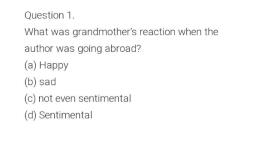
20 What was the last sign of physical contact, , between the author and his grandmother?, Why did the author think so?, , Ans When the author was going abroad for five years for, , higher studies, the grandmother went to leave him off, at the railway station. He could tell that she was still, reciting prayers. The grandmother then kissed his, forehead lovingly. That kiss seemed to the author as, the last sign of physical contact between them. He, perhaps thought that the grandmother, being old,, might not survive for five years., , 21 The grandmother's farewell and reception of, , her grandson were very touching. Comment., , Ans When the author went abroad, the grandmother came, , to the station to see him off. She was not sentimental, and was silently praying and counting her beads. She, kissed the forehead of her grandson as a goodbye, gesture. When he returned after five years, she, expressed her joy by collecting the women of the, neighbourhood and singing for hours about the, homecoming of warriors. For the first time, she missed, her prayers., , 22 How did the grandmother celebrate the, , homecoming of her grandson?, , Ans After five years, the author was coming home. The, , grandmother went to the railway station to receive, him. She hugged him and he could hear her reciting, prayers. After reaching home, she gathered the, women of the neighbourhood. She got an old drum, and started singing songs about the homecoming of, warriors. That was the first time since the author had, known her that she did not pray., , 23 What could have been the cause of, , grandmother’s falling ill?, , Ans When the author came back from abroad after five, , years, grandmother collected the women from the, neighbourhood. She kept singing and thumping a, drum for several hours. This overstrained her body, and this could have been the cause of her falling ill., , 24 Why did the grandmother stop talking before |, , her death?, , Ans The old lady fell ill. She had a mild fever. The doctor, , told her that she would be all right soon. But the, grandmother declared that her end was near. She did, not pray that evening. She was not going to waste any, , more time talking to them. That is why she stopped, talking before her death,, , 25 “We protested but she ignored our protests», , Who protested and why? ,, Ans The day after the author arrived from abroad, his, grandmother was t, , doctor said that it was a mild fever and would go, away. But she said that her last hour had come., , The author and his family protested about her, thinking like this. But she ignored their protests., Thus, she stopped talking to anybody in order to, pray and counting the beads of her rosary., , 26 The grandmother has been portrayed asa, , very religious lady. What details in the story, , create this impression?, , Ans The grandmother was a very religious lady. Her lips, , always moved in inaudible prayer. Her one hand, , was always busy counting the beads of her rosary., She also read scriptures at the village temple. When, , she knew her end was near, she lay peacefully in, bed praying and counting her beads till death., , 27 How did the grandmother die?, , Ans The grandmother realised that she was going to die, , soon. $o she continued praying with her fingers, , busy in counting the beads of her rosary. She did no!, , talk to anyone. After some time, her lips stopped, moving. The rosary fell down from her fingers., , Thus, she died a peaceful death., , 28 what role did the grandmother play in, shaping the grandson's personality?, , Ans The grandmother played a key role in her, grandson’s life from his childhood. She is the one, who took care of him from sunrise to sunset. She, indirectly taught him how a person should live 4, religious life with God, scriptures and values as, , guides. That is why the grandson was more attach, , to his grandmother., , 29 How did the sparrows pay their homage t0, the dead grandmother?, , Ans The grandmother had died. Thousands of sparrows, , came and sat in the courtyard next to the ©, , grandmother’s body. They were totally silent. ES, , when the narrator’s mother threw some crumbs °, bread to them, they did not eat them. When the, , grandmother’s body was carried off to be cremale®, , they flew away silently. Thus the sparrows paid, silent homage to the grandmother., , aken ill. She had celebrated his, homecoming and perhaps overstrained herself, The
Page 4 :
|, i Ans, i, |, , {0, , ins, , il, , Ans, , Ans, , 13, , Ans, , 14, , Was the grandmother educated? How can, , The grandmother was definitely educated. We can, tell this by the fact that when the narrator was, studying in the village school, the grandmother, used to read the scriptures in the temple while the, narrator attended his classes. As she could read, , the scriptures, possibly understanding them also,, we can say that she was educated., , The author and his grandmother were, intimate friends. How?, , The author and his grandmother were very close, to each other. His parents had left him with her in, the village. So, they spent most of their time, together. She used to wake him up early in the, morning. She got him ready for school., , She even accompanied him to the school. While, returning from the school they enjoyed feeding, , the dogs. Hence, they were perhaps very intimate, friends., , “That was the turning point in our, friendship.” What was the turning point?, , The author used to live with his grandmother in, the village, where they were always together. The, turning point in their friendship came when the, author’s parents called them to the city. They, shared the same room in the city but the, grandmother could no longer accompany him to, school or help him in his studies. Gradually they, saw less of each other. |, , What was the grandmother's reaction, towards education in the English school?, , The author’s grandmother was unhappy as she ., could no longer help the narrator in his lessons., She didn’t know English words or about Western, Science, She was hurt to know that there was no, teaching of God and scriptures in the English, school, She didn’t believe in the things that were, , taught at the English school., , Bring out the contrast between the school, education in the village and in the city:, , The education in the village school was vastly, different from the education in the city school. In, the village, the school was next to the temple and, the priest himself was the teacher. He taught them, , the alphabet and the morning prayet: But in the, , city school, there was no teaching of God or the, , scriptures. English and science along with music, , Were taught in the city school., , 15, , Ans, , 16, , Ans, , 17, , Ans, , 18, , Ans, , 19, , Ans, , Why was the grandmother disturbed when she, , came to know that music lessons were being, given in school?, , The grandmother thought that music was associated, with indecent professions like prostitution. She thought, that it should not be taught to decent and gentle persons, like her grandson. That is why she was disturbed when, she came to know that the narrator was being taught, music in the English school in the city., , Which moment of the day used to be the, happiest for the grandmother in the city?, , After the author and the grandmother moved to the city,, she felt lonely. Her grandson became engrossed in his, studies and she could no longer help him. She spent, most of her time spinning the wheel., , She only rested for a while in the afternoon when she, fed the sparrows. This used to be the happiest moment, of the day for her. The birds came and perched on her, legs and shoulders and some even sat on her head. She, smiled but never shooed them away., , Describe how the grandmother spent some time, with the sparrows every day in the city house., How did she feel at that time?, , The grandmother usually fed the sparrows in the, afternoon by sitting in the verandah and breaking the, bread into small pieces before throwing it to them., Hundreds of sparrows gathered there, chirping noisily., Some even perched on her legs, shoulders and head. She, felt very happy at this time. It was the happiest time of, the day for her., , “I was sure my grandmother would be upset.”, What was the author sure about? Was he right?, , When the author decided to go to abroad for further, studies, he was sure that his grandmother would be, upset. But she was not even sentimental. She went to bid, him goodbye at the railway station. However, she didn’t, talk or show any emotion. She was lost in prayer and her, hands kept counting her beads., , How can you say that the grandmother was a, kind-hearted woman?, , When she lived in the village, the grandmother used to, feed the street dogs with stale chapattis. When she, moved to the city, as there were no dogs in the streets,, she started feeding sparrows in the house courtyard. She, used to break the bread into little crumbs and throw the, crumbs to them. The sparrows perched on her legs,, shoulders and even sat on her head but she never shooed, them away. All these actions show that the grandmother, was a kind-hearted woman, particularly for animals.