Page 1 :
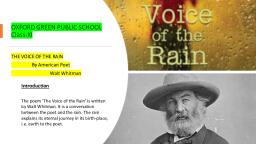
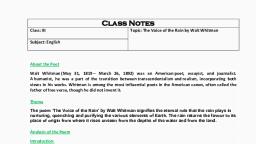
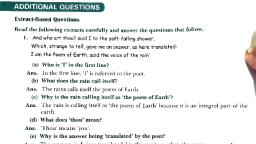
Shama Sherwani:, The Voice of The Rain Poem, Poet : Walt Whitman, Born 31 May 1819, West Hills, New York, United States, Died 26 March 1892, Camden, New Jersey, United States, Poems Leaves of Grass, Song of Myself, O Captain! My Captain!, The Voice of The Rain Central Idea of the Poem, The poem The Voice of the Rain' by Walt Whitman signifies the eternal role that the rain plays in, nurturing, quenching and purifying the various elements of Earth. The rain returns the favour to, its place of origin from where it rises unseen from the depths of the water and from the land., The rain itself is explaining to the reader about its origin, work and its cyclic movement. A, comparison has also been drawn between rain and music as both of them make the world more, lively and return to their place of origin after fulfilling their purpose., The Voice of The Rain Poem, Stanza Wise Explanation of The Poem, Stanza 1, And who art thou? said I to the soft-falling shower,, Which, strange to tell, gave me an answer, as here translated:, I am the Poem of Earth, said the voice of the rain,, Word Meanings:, thou - you, soft-falling - dropping softly, shower - raindrops when they fall continuously on Earth, Explanation: The poem begins with the poet asking for the identity of the soft-falling rain shower., Much to the surprise of the poet, the rain replies to his question which the poet translates for his, readers. The rain in its own voice tells the poet that she is the poem of this Earth. The rain is, trying to say that, as music or poetry gives pleasure to human beings, the rain gives happiness, to mother Earth.
Page 2 :
Stanza 2, Eternal I rise impalpable out of the land and the bottomless sea,, Upward, to heaven, whence, vaguely form'd, altogether changed, and, yet the same,, Word Meanings:, eternal -, - everlasting, impalpable - unable to be felt by touching, bottomless - very deep, upward, - towards a higher level, whence - from where, vaguely – unclearly, form'd – made into a specific shape or form, Explanation: The poet says that the rain is an eternal process, but it takes different forms at, different times. It rises from the land and the deep sea in the form of intangible water vapour, and goes up to the sky. There it takes an indistinct shape in the form of clouds., Although it changes in its form or shape, its core matter remains the same. Since vapour and, clouds contain water they can get transformed into the other. The words 'impalpable' and, 'eternal' indicate that nature is not fully understood and some part of it always remains beyond, our reach., Stanza 3, |- descend to lave the droughts, atomies, dust-layers of the globe,, And all that in them without me were seeds only, latent, unborn;, Word Meanings:, descend - move or fall downwards, lave – wash, droughts - dry spells, atomies - very tiny particles
Page 3 :
globe - Earth, latent - dormant, inactive, Explanation: The raindrops pour down from above to wash away droughts and dust layers, enveloping Earth. It satisfies the thirst of the dry Earth and heals everything that is degrading, and is lying lifeless. The showers remove the dust particles and make Earth clean and green., The rain also helps in the germination of seeds which were lying dormant due to a dry spelI., Stanza 4, "And forever, by day and night, I give back life to my own origin, And make pure and beautify it;, (For song, issuing from its birth-place, after fulfilment, wandering Reck'd or unreck'd, duly with, love returns.), Word Meanings:, origin, - source, beautify – make beautiful, issuing - originating/starting, fulfilment – completing the cycle, wandering - moving from one place to another, reck'd – cared about, unreck'd – uncared for, duly – properly, rightly, Explanation: The rain is involved in a continued process of giving life on Earth by providing water, to dormant seeds and making the Earth more beautiful and full of greenery. Rain helps in, enhancing the beauty of Earth as, in the absence of water, everything turns dull or lifeless and, dust accumulates everywhere., The last two lines are the poet's own words and his reflections upon the answers given by the, rain. The poet observes that the life of rain is similar to that of a song. A song or poem is, creativity at its best. It has the power to calm, heal, rejuvenate, transform and thrill. In the same, way, repeated evaporation and condensation purifies the rain. The entire environment gets, drenched in the rain, dust particles settle down and there is greenery everywhere which makes, the whole Earth beautiful to look at. The poet therefore draws a parallel between rain and music, as both have rhythm and ability to thrill. Both of them rejuvenate and beautify life.
Page 4 :
The Voice of The Rain Poetic Devices Used in the Poem, Personification: The rain has been personified as it has been given a voice in the poem., Metaphor: "I am the Poem of the Earth". The poet uses a metaphor to compare how the rain, leaves the ground to come back to the ground, giving back to it much like a person who leaves, its home, only to come back after fulfilling its journey., Parallelism/Simile: In the last two lines, the poet has drawn a parallel between the rain and the, song of a poet., Hyperbole: 'Bottomless sea' is an example of hyperbole. The poet describes sea as bottomless, which is an exaggerated statement to bring out the desired effect., Imagery: In the first line of the poem, 'Soft-falling shower' gives the reader an image of gentle, rain or drizzle. During the dialogue between the poet and the rain, it creates an image of, showers or drops of water falling down from the heavens to Earth and infusing it with greenery,, purity and beauty.