Page 1 :
Shama Sherwani:, , Question 1., , Why does the poet get surprised when he gets an answer from the rain?, Answer:, , The poet gets surprised when he gets an answer from the rain, as it is inanimate and cannot, speak. In this poem, to the poet's and reader's amazement, the rain gives a reply which has, been translated by the poet for the readers., , Question 2., What answer does the rain give back to the poet?, Answer:, , The rain answers to the poet's question by telling him that it is the Poem of Earth and is involved, in a continuing process of going up and coming down., , Question 3., How does the rain justify its claim ‘lam the Poem of Earth’?, Answer:, , The rain calls itself the Poem of the Earth because the poem rendered by the poet has the task, of bringing joy, happiness, life to its readers. Similarly when the rain falls down over Earth, a, rhythm or music is created. That's why the rain calls itself the Poem of Earth., , Question 4., Describe the never ending cycle of rain., Answer:, , Water rises unperceived in the form of vapour from land and water bodies on the Earth. It goes, up, takes the form of a cloud, changes its shape and falls down on Earth in the form .of water, drops to bathe the small dust particles, land and sea. The water returns through rivers to oceans, and seas after it rains on Earth., , Question 5., Why does the rain call itself ‘impalpable’?, Answer:, , Impalpable means something that cannot be felt by touching or seeing. When water takes the
Page 2 :
form of vapour, it is not visible to the human eye and nor can we feel its touch., , The vapour rises to the sky, condenses and forms clouds which cause rain. Though we are, aware of its presence, the process remains invisible to us. Hence, the rain has rightly called, itself ‘impalpable’., , Question 6., What happens when it rains after a long hot spell?, Answer:, , After a long hot spell, everything is dried up on Earth. When it rains, all the dust that has, accumulated on Earth gets washed away, giving a new fresh look to nature. Moreover the seeds, which were lying latent till now, get germinated with the help of rain and new trees and plants, start growing., , Question 7., Latent seeds get a life by rain. Explain., Answer:, , The seeds lying on Earth require water to germinate and take shape. When it rains, the seeds, start germinating and change into the form of saplings. In this way, the seeds which would have, dried up or get wasted get a new lease of life by rain., , Question 8., Why is rain essential for Earth?, Answer:, , If it doesn’t rain then Earth will remain parched, droughts will follow and the dust-layers will not, be washed away. There will be nothing to quench the thirst of the plants and trees and their, seeds will die., , Question 9., How does the rain become the voice of Earth?, Answer:, , In the poem, ‘The Voice of the Rain’, the poet describes how the rain falls on Earth. He also asks, a question to the rain’about it. He calls the showers of the rain as ‘Poem of Earth’ as the rain, gives a new lease of life to ‘ the scorched and parched Earth and falls on Earth in a rhythmic, manner.
Page 3 :
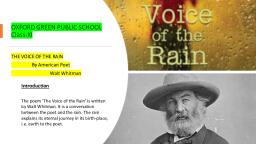
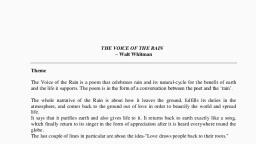
Actually, it is the voice of Earth as the slowly falling showers produce a very soft music and, Earth finds its expression only through the showers falling on it., , Question 10., Why do you think the poet says the phrase ‘reck’d or unreck'd’?, Answer:, , The words have been poetically drafted. Reck’d and unreck’d stand for reckoned and, unreckoned. The words literally mean cared and uncared for respectively. The poet says these, words to emphasise the fact that when it falls on the Earth, we sometimes take notice of it or, sometimes completely ignore it. But even if it is left uncared for, it completes its destiny and, returns to absorbed where it started from., , Question 11., Justify the title ‘The Voice of the Rain’., Answer:, , The whole poem is about the eternal process of rain and its benefits. Through the words of the, rain, the poet has tried to bring out the importance of rain for Earth, for plants and for man. As, the poet is translating what the rain is speaking through its own language (the sounds it makes, when it falls), the whole poem is about the rain talking to the poet. Thus, the title is justified., , Question 12., , The poem has a conversational tone throughout. Who are the two participants? Is there any, advantage of this method?, , Answer:, , The two participants are the poet and the voice of the rain which answers the poet's questions., The advantage of this method is to maintain continuity of thoughts and ideas expressed by the, poet and to bring about clarity in what he wants to express., , The Voice Of The Rain Extract based Questions and Answers, , |. Read the extract given below and answer any two of the questions that follow., And who art thou? said | to the soft-falling shower,, , Which, strange to tell, gave me an answer, as here translated:, , | am the Poem of Earth, said the voice of the rain,
Page 4 :
Question 1., , Who is T in the first line?, (a) The poet, , (b) The land, , (c) The sea, , (d) The raindrops, Answer:, , (a) The poet, , Question 2., , What does the rain call itself? Why?, (a) The poet of the Earth, (b) The poem of the Earth, (c) The poem of the Sea, (d) The poet of the Sea, Answer:, , The poem of the Earth, Question 3., , The word ‘thou’ in the extract is a .......... ., (a) noun, , (b) verb, , (c) preposition, , (d) pronoun, , Answer:, , (d) pronoun, , Il. Read the extract given below and answer any two of the questions that follow.
Page 5 :
Eternal | rise impalpable out of the land and the bottomless sea,, Upward to heaven, whence, vaguely form’d, altogether changed, and yet the same,, Question 1., , What does the use of word ‘eternal’ indicate here?, , (a) It indicates the continual process of rain, , (b) It indicates the continual process of nature, , (c) It indicates the discontinuous process of rain, , (d) It indicates the discontinuous process of nature, , Answer:, , (a) It indicates the continual process of rain, , Question 2., , From where does ‘I’ rise and where does it go?, , (a) It rises in the form of droplets and goes to the sea, , (b) It rises in the form of clouds and goes to the sky, , (c) It rises in the form of water vapour and goes to the land, , (d) It rises in the form of water vapour and goes to the sky, Answer:, , (d) It rises in the form of water vapour and goes to the sky, Question 3., , Which word in the extract means the same as “in a way that is uncertain, indefinite or unclear”?, (a) Eternal, , (b) Impalpable, , (c) Vaguely, , (d) Bottomless