Notes of Class 11, English Mother's Day Q$A.docx - Study Material
Page 1 :
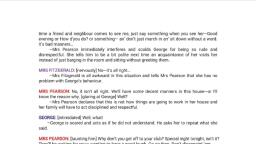
Summary of Mother’s Day, The play begins with two friends having a candid conversation at Mrs Pearson’s house. Mrs Fitzgerald is telling Mrs Pearson’s fortune and advises her on it. Mrs Pearson goes about telling how her family members don’t value her and don’t appreciate whatever she does for them. She is available for them 24*7 and all they do is come in, throw orders around at her and leave without even saying thank you. Mrs Fitzgerald tells her to take her stand as the woman of the house but Mrs Pearson, being the sweet and innocent lady doesn’t want to bring her family any sort of discomfort. She continues to handle their tantrums because she doesn’t know where to begin when it comes to making them disciplined. Mrs Fitzgerald proposes a plan to switch their bodies so that Mrs Fitzgerald takes her place without her family knowing. Mrs Pearson is hesitant at first but then Mrs Fitzgerald convinces her for it. Mrs Fitzgerald performs her magic that she’d learned from the East and their personalities are changed. Now, Mrs Fitzgerald is actually in Mrs Pearson’s body and vice-versa. Now, new Mrs Pearson tells Mrs Fitzgerald to go to her house for the time being. At this moment in the play, Doris Pearson, daughter of Mrs Pearson enters the scene asking for tea and ordering Mrs Pearson to iron her yellow silk. She gets shocked at the sight of her mother smoking and from there, the argument begins where Mrs Pearson insults Charlie Spence, the guy she is about to go out with. Doris leaves crying and Cyril, her brother enters asking for tea and something to eat. He too, is amazed at having come home to see that there is nothing to eat and no tea to drink. Upon asking if anything is wrong, Mrs Pearson tells him that she had never felt better. Cyril gets annoyed and Doris joins him where they are told that Mrs Pearson might even take the weekend off. Next, George Pearson enters the scene, shocked to see his wife day-drinking. He announces that he has some special match at the club and that he won’t be requiring any tea this afternoon.On being told there is no tea, he gets annoyed again. Mrs Pearson mocks him for getting annoyed at not getting something he didn’t actually want. She tells him about the names they call him at the club. She further taunts him that this would not have happened had he stayed at home once in a while. After a while, Mrs Fitzgerald enters. She interferes in their family matters. George gets annoyed when Mrs Fitzgerald calls him by his name. But just like it had been happening all day, Mrs Pearson barges in to bring George on track. Doris enters the scene and she too, is not very pleasant to Mrs Fitzgerald. Mrs Pearson brings her on track too., At this point, Mrs Fitzgerald (actually Mrs Pearson) loses her cool and asks the family members to excuse the two friends for a moment. She promises them that she knows how to make the situation better. Mrs Fitzgerald asks Mrs Pearson to switch their bodies and while Mrs Fitzgerald resists at first, but later she agrees to do it. They repeat the process they did in the first place. The real Mrs Fitzgerald now explains Mrs Pearson how important it is for her to be a bit dominating once in a while to establish her control and respect. The family enters and Mrs Pearson suggests that they play rummy and the kids make supper. Everyone instantly agrees and they are a bit relieved too. Mrs Fitzgerald exits and the play ends., QUESTIONS FROM TEXTBOOK SOLVED, Reading With Insight, Question 1: This play, written in the 1950s, is a humorous and satirical depiction of the status of the mother in the family., 1.What are the issues it raises?, 2.Do you think it caricatures these issues or do you think that the problems it raises are genuine? How does the play resolve the issues? Do you agree with the resolution?, Answer:, 1. The play raises many serious issues. The first and foremost is proper appreciation of a housewife‘s role and responsibilities. Those who work eight hours a day and forty hours a week treat the housewife as an unpaid domestic servant, who must carry out their orders. They neither request her nor thank her for her services. The second issue is the reciprocity of love and gratitude towards the mother or wife. The husband, son and daughter leave the lady of the house alone every night and go out to enjoy themselves in their several ways. They do not take any notice of her and have become thoughtless and selfish. The mother’s excessive love, care and promptness to serve them also spoil them., 2.The problems the play raises are serious. The treatment is of course, comic. The playwright adopts an unusual method to resolve the issues. He takes the help of magic bf the East. Incantation of a magical spell helps in the interchange of the personalities. Now Mrs Pearson, with the strong and sinister personality of Mrs Fitzgeraldgives rough treatment to the daughter, son and husband respectively. Her stern looks and commanding tone suggests to them that she can be really tough. The spoilt member are brought round by the heavy dose of exposure of reality to them. They agree to stay and help in preparing the supper while the housewife has a talk with her husband., The resolution of the issues seems far-fetched and unnatural but extreme means have to be adopted in disaster management., Question 2: If you were to write these issues today, what are some of the incidents, examples and problems that you would think of as relevant?Answer: Various responses are possible One such response is given below:, The incidents of unfair treatment to the fair sex at home, at work, in public transport and elsewhere will prove handy. The examples of exploitation of female workers with lower wages, harassment by seniors, indecent remarks, eve-teasing and molestation can highlight the problems of social inequality that women face in practice. Even in the twenty first century women face the same problems in spite of the talk of women empowerment. The poor housewives have to bear the physical torment and mental anguish at the hands of bullish husbands who boast of their masculinity by inflicting physical violence, barbs and taunts on the defense less women. Examples of rapes and sexual harassment which hug the limelight in daily newspapers can also be included to highlight the problems of insecurity of women in modem society., Question 3: Is drama a good medium for conveying a social message? Discuss., Answer: Yes, drama is certainly a good medium for conveying a social message. Direct moralising is often resented and usually ignored. Drama is a presentation of a slice of life through characters placed in various situations. The attention of the spectators centres round their actions and reactions. Most of them feel fully involved with the protagonists. The working out of the theme generally leaves a message-sometimes obvious and explicit but in most of the cases, indirect and implicit. The social message of these plays seems to come out of the interactions of the characters and their traits of character. The victory of evil over good is usually portrayed indirectly. These day we find many plays centred around themes creating social awareness such as evils of drinking and smoking; dangers of pollution, child labour, the decreasing female ratio and need to empower women., Question 4: Discuss in groups plays or films with a strong message of social reform that you have watched., Answer: For group discussion at class level. There can be varied responses. One such response is given below: The latest film I have watched recently is ‘SWADESH’. It has a strong message of social reform. It tells the story of an Indian scientist at NASA (America) who visits his ancestral home in India. The poor condition of the villagers and lack of basic facilities fills him with deep agony. He resigns his job in America and returns to his native country (Swadesh) to begin his work of rural uplift. He gives the villagers a message that self-help is the best help and we cannot depend for everything on the Government.This remote village is plunged in darkness after sunset as there is no electricity. With the help of a few villagers, the scientist is able to produce hydroelectricity and light the village homes. The water can be used for irrigation purposes also. Thus the economic and social condition of the villagers undergoes a sea change., EXTRA QUESTIONS :-, Short Answer Type Questions, Question 1: How are Mrs Pearson and Mrs Fitzgerald contrasted?, Answer: The two ladies are sharply contrasted. Mrs Pearson is a pleasant but worried looking woman in her forties. She speaks in a light, flurried sort of tone with a touch of suburban cockney. Mrs Fitzgerald is older, heavier and has a strong and sinister personality. She smokes. She has a deep voice, rather Irish tone., Question 2: “I‘m much obliged,” says Mrs. J Pearson. What for does she feel obliged and to whom?, Answer: Mrs. Pearson feels obliged to Mrs Fitzgerald for telling her fortune. She thinks it quite wonderful having a real fortune teller living next door., Question 3: What fortune does Mrs Fitzgerald predict for Mrs Pearson?, Answer: Mrs Fitzgerald is quite equivocal in her predictions. She says it could be a good fortune or a bad one. All depends on Mrs Pearson herself now. She asks her to decide firmly. Her fortune depends on it., Question 4: What problem does Mrs Pearson face? Who do you think is responsible for this state of affairs?, Answer: Mrs Pearson devotes all her time and energy to serve her husband, son and daughter. These thoughtless and selfish persons go out every night to enjoy themselves leaving Mrs Pearson alone at home. She is no better than a servant in her own home. Mrs Pearson herself is responsible for the ill-treatment, neglect and lack of concern shown to her., Question 5: What course of action does Mrs Fitzgerald suggest to Mrs Pearson to tackle the situation?, Answer: Mrs Fitzgerald tells Mrs Pearson to decide firmly and stick to her decision. She must assert her position and become the real mistress of the house. Her own initiative can help her. She must let them wait or look after themselves for once., Question 6: What difficulties does Mrs Pearson face while dealing with the various members of her family?, Answer: Mrs Pearson loves her husband and children too much. She does not find courage enough to discuss the problem with them. She only keeps dropping hints. She hates any unpleasantness. She does not know where to start. She doesn’t know how to begin discussion with the other members of the family., Question 7:“Then let me do it”, suggests Mrs Fitzgerald. How does Mrs Pearson react to it?, Answer: Mrs Fitzgerald offers to deal with the family of Mrs Pearson and teach them to, Treat her properly Mrs Pearson feels flustered. She thanks her saying that it wouldn‘t do at all. They would resent being ill-treated by somebody else and wouldn’t listen., Question 8: How does Mrs Fitzgerald plan to deal with the family of Mrs Pearson?, Answer:, She tells Mrs Pearson that she will deal with her family not as herself but as Mrs Pearson. They will change places or really bodies. Mrs Pearson would then look like Mrs Fitzgerald and the latter would look like the former., Question 9: Why does Doris Pearson feel astounded on returning home?, Answer: Doris finds her mother smoking away—lighting another cigarette and laying out the cards for patience on the table. She shoots her query about ironing her yellow silk, but feel astounded on seeing her mother‘s behaviour., Question 10 : How does the stern treatment reform the spoilt children?, Answer: The children look apprehensively at Mrs Pearson. However, they smile back at her, as she smile. Since they are not going out, she suggests having a nice family game of rummy. She tells the children to get the supper ready while she has a talk with their father. The spoilt children meekly obey her., Question 11: How is Doris taught a lesson in behaviour?, Answer: When Mrs Fitzgerald remarks that Doris was going out with Charlie Spence that, Night, Doris feels annoyed and retorts that she has got nothing to do with it. Mrs Pearson rebukes Doris harshly and tells her to answer Mrs Fitzgerald properly. She adds that she won‘t have her daughter behaving rudely with anyone., Long Answer Type Questions, Question 1: What do you think is the theme of the play? How has it been worked out?, Answer: The theme of the play is the status of women in their own household. The housewife serves the members of her family with complete devotion, sincerity and love. However, she is never given the regard, attention or thanks due to her. Her leniency and eagerness to please everyone reduces her to the rank of an unpaid domestic servant in her own house. Instead of being politely requested for a favour, she is ordered to do it. She gets no thanks in return.The theme is worked out by portrayal of the Pearson family. Mrs Pearson is the harassed mother. Her daughter Doris, son Cyril and husband George take her services for granted and have become thoughtless and selfish. The interchange of personalities and the harsh treatment meted out to them by the personality of Mrs Fitzgerald (in the body of Mrs Pearson) reforms them and they obey the mother willingly., Question 2: What impression do you form of Mrs Annie Pearson?, Answer: Mrs Pearson is the main character in the play ‘Mother’s Day‘. She is a pleasant but worried-looking woman in her forties. She speaks in a light, flurried sort of tone, with a touch of suburban cockney. She loves her husband and children very much and runs after them all the time. Her excessive love and care have spoilt them and they have become thoughtless and selfish. She feels neglected and lonely but lacks courage to discuss things with them. Perhaps she hates any unpleasantness as well. She is not willing to act as a tough mom as she is nervous and fluttering by nature. She is so tender-hearted that she is shocked to see the rough treatment meted out to her children. She decides to change back to her original personality to deal with her family herself. She is indeed a loving and affectionate mother and a devoted wife., Question 3:“The shock treatment makes the thoughtless and selfish persons realise the real position of the lady of the house.” How far do you agree with the statement? Give reasons for your answer., Answer: I fully agree with the aforesaid statement. Drastic situations need drastic remedies. The thoughtless, selfish and spoilt members of the Pearson family do not understand the language of love and affection. Mrs Pearson with Mrs Fitzgerald‘s bold and dominating personality and her toughness makes them realise their own state. Doris is the first to learn her lesson in civility and politeness. The criticism of her boy friend seems quite unexpected to her—perhaps more than the non-compliance of her orders of ironing the yellow silk dress. Doris has tearful eyes. Cyril is also told to help himself. The mother’s declaration that she too will henceforth work forty hours a week, have the weekends off and go somewhere to enjoy herself come as a shock treatment. The balloon of her husband’s ego is punctured by disclosing to him how people at the club make fun of him. In the end all the three members come round and show their willingness to obey the mother’s command., Question 5: The play ‘Mother’s Day‘ is a humorous and satirical depiction of the status of the woman in a family. Bring out briefly the elements of humour and satire., Answer: The play ‘Mother’s Day‘ treats a serious theme in a light-hearted manner. The humour in the play springs from an unusual situation where the personalities of two ladies change bodies. Their subsequent behaviour, which is in total contrast to their previous one, is a very powerful source of laughter. The ignorance of the characters about the personality they are facing also creates humour. Suggestive dialogues also provide a lot of fun. For example, consider the following:“Mrs Pearson if you had to live my life it wouldn‘t be so bad. You’d have more fun as me than you‘ve had as you.”, “It‘s that silly old bag from next door—Mrs Fitzgerald.”, “Ticking her off now, are you, Annie?”, “They call you Pompy-Ompy Pearson because they think you‘re so slow and pompous.”, The actions, gestures and reactions of the characters also provide humour. The housewife being given orders, treated like dirt and forced to stay home every night while other members go out to amuse themselves is sharply contrasted with the position at the end of the play where she is the mistress of the house. Then play also satirises the eight hour work culture and threats to go on strike. Even the housewife adopts this weapon., Question 7: Write a note on the title of the play ‘Mother’s Day‘., Answer: The title of the play is quite appropriate. It sums up the theme of the play. It suggests that the action of the play revolves round a mother. The playwright confronts us at the outset with the problems the mother faces from her grown up children and their father. The novel technique employed to tackle the spoilt children and the grown up man is quite amusing and thought provoking. The bold and dominating mother acts tough with the children and makes them realise the need of proper attention towards their mother. They are made to learn lesson in courtesy, And polite behaviour not only towards the mother but also towards the visiting neighbour. The mother certainly has her day as the children learn to treat her properly. The supper being prepared by the children, their stay at home and the family game of rummy is a rare gift that the mother receives on this important day.



 Learn better on this topic