Notes of Class 11, English Albert Einstein At School - Study Material
Page 1 :
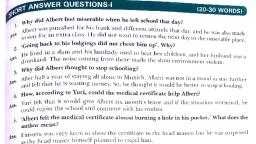
Reading with Insight book, Albert Einstein at School Question and Answers :1.What do you understand of Einstein’s nature from his conversations with his history teacher, his, mathematics teacher and the head teacher?, Ans. The conversation between Einstein and his teachers demonstrates that he was a truthful student., He acknowledges his flaws without hesitation. Though Albert’s History teacher thought he was a, disgrace because he failed to learn the facts and figures, Albert never insulted him. He only said what he, wanted in front of the teacher. The Mathematics teacher, on the other hand, thought highly of him and, stated that he could not even teach him any longer since he already knew everything. The headmaster, wanted Albert to leave the school because it was nearly impossible to teach the other students when he, was present. Albert was a bit of a rebel, but he was a good person., 2. The school system often curbs individual talents. Discuss., Ans. According to the story, the school system is given priority on learning facts and dates over learning, ideas. Rather than highlighting the fact that they had such a brilliant student among them, the head, teacher expelled Albert from school. This demonstrates how the school was only concerned with, imparting bookish knowledge to the students. This type of education continues to exist today when, children’s talents are ignored in favor of grades and marks. The education system is set up in such a way, that brilliant students like Albert are regarded as inept and unfit rebels whose presence makes it more, difficult for the teacher to teach other students., 3. How do you distinguish between information gathering and insight formation?, Ans. There is a significant difference between the concepts of gathering information and forming, insights. The collection of data and facts is referred to as information gathering. It refers to knowledge, of specific events or situations gathered or obtained through communication. It is a passive process with, a low level of comprehension. It is merely a mechanical approach that supports fact memorization., Insight formation, on the other hand, relates to one’s way of seeing things as a result of a thorough, understanding of the topic. The ability to discern the true nature of a situation is referred to as insight., As a result, it may vary from person to person, depending on everyone’s concepts and ideas., Short Answer Type Questions:Q1. Why was Mr Braun speechless for a few moments?, Ans. Mr Braun asked Albert in which year the Prussians defeated the French at Waterloo. Albert told, him that he didn’t know. Mr Braun said that he had told them so many times. Albert told him that he, saw no point in learning dates. These could be seen in books. This made him speechless., Q2.Who asks for the Einstein theory of education? How?
Page 2 :
Ans. Mr Braun, the History teacher asks for Einstein theory of education. He does so highly sarcastically, and in a mocking tone’., Q3.What is Einstein's view about education? How far do you agree with it?, Ans. For Einstein ideas are important and facts do not matter. He considers learning the dates of battles, or the details about victorious armies meaningless. He is more interested in the causes that led the, soldiers to kill each other., Q4. How did the history teacher react to Albert‘s replies? Will a modern student agree with the, teacher? Why /Why not?, Ans. The history teacher felt amazed as well as annoyed at Albert’s stubbornness. It was because Albert, challenged all the established norms of attaining knowledge. Modem students do not agree with the, history teacher’s view. Education is not a mere acquisition of certain facts and their verbatim, reproduction., Q5.Why did Albert see no point in learning dates and facts?, Ans. Dates and facts are parts of knowledge which are content based. Albert thought that there was no, point in learning dates and facts because firstly, these could be, ascertained from the books any time by, just looking them up. Secondly, for him, learning facts was not education., Q6. Do you think Albert is being impolite while answering the history teacher’s questions? Give your, reasons., Ans. No, Albert is not at all impolite. He addresses his teacher respectfully. Secondly, he answers the, questions honestly. He does not think that his free and frank opinion will annoy the teacher and will be, construed as impoliteness., Q7. What was the history teacher’s opinion of Albert?, Ans. The history teacher had a very low opinion of Albert. He called Albert an ungrateful boy who ought, to be ashamed of himself. He suggested that Albert should ask his father to take him away from school., Q8. Yuri calls Albert ‘the world's worst liar’ -do you think this is an insult or a compliment to Albert?, Why?, Ans. It is a compliment, Albert is honest and truthful. He can’t tell a deliberate lie. He can’t deceive, anyone. He is so simple hearted that if he tries to tell a lie, his face betrays him at once., Q9. Who was Ernest Weil? How did he help Albert?, Ans. Ernest Weil was a doctor. He had qualified as a doctor only the previous week. He was a good, friend of Yuri. Albert told Yuri of his plan to leave school. Yuri told him to go to Dr Ernest Weil to get a, medical certificate for the purpose.
Page 3 :
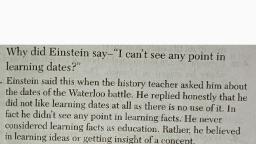
Q10. What did the head teacher tell Albert when he met him?, Ans. The head teacher told him that his work was terrible. He was not prepared to have him in the, school any longer. He wanted him to leave the school then., Long Answer Type Questions:Question 1:Relate in your own words what transpired between the history teacher, Mr Braun and young, Einstein., Answer: Mr Braun, the history teacher laid stress on learning dates and facts. He repeated them often, enough for his students to learn them. Young Albert Einstein was found wanting. He didn’t know in what, year the Prussians defeated the French at Waterloo. Albert frankly admitted that he didn’t know. He, said that he didn't ever try to learn dates. He claimed that he couldn’t see any point in learning dates., One can always look them up in a book. The teacher felt angry as well as amazed at Albert‘s, stubbornness. The boy insisted that learning facts is not education., Mr. Braun then sarcastically asked Albert to tell the class the Einstein theory of education. Albert said, that ideas are more important than facts. Instead of learning the dates of battles or which of the armies, killed more men, he would be more interested in learning why those soldiers were trying to kill each, other., Mr Braun felt exasperated. His eyes were cold and cruel. He punished Albert by making him stay in for, an extra period that day. He had a low opinion of Einstein and called him a disgrace. He wondered why, he continued to come to school. Albert politely replied that it was not his wish. Mr Braun angrily called, him an ungrateful boy who ought to be ashamed of himself. He suggested that the boy, should ask his, father to take him away., Question 2:Where the teacher interested in understanding Albert and bringing out his potential?, Answer: This extract mentions only two of the teachers of young Einstein. They are: Mr. Braun—the, history teacher and Mr Koch—the mathematics teacher. The former was not at all interested in, understanding Albert and bringing out his potential. He followed the traditional methods and, philosophy of education which laid more stress on acquisition of knowledge. Dates and facts were more, important to him than the causes which led to the events. Secondly, he had a sarcastic attitude and, mocking tone towards Einstein. Instead of helping the development of a talented boy, he complained to, the head teacher and got him expelled., Mr Koch appreciated Einstein’s genius, and had a good opinion of him. But he too was confined to his, subject and didn’t take interest in the real person. All this was because of the curriculum centred, approach., Question 3: What factors made Einstein‘s life in Munich miserable? What did he realise after six, months?
Page 4 :
Answer: Two factors made Einstein’s life in Munich miserable. These were his school and residential, environment. The school was a hateful place. He had many bad days when he got punishment. He hated, going back to school, but he had no option. He wishes that his father would take him away. However, he, was forced to stay there and obtain diploma. Einstein found the system of education uninspiring and the, teachers, unsympathetic., He had his lodging in the poorest quarters of Munich. The food was bad. Lack of comfort, dirt and, squalor made his life miserable. The atmosphere of slum violence was oppressive. The landlady would, beat her children. Her husband would come home on Saturdays. He would get drunk and beat his wife., Albert found young students fighting duels and killing others. The scars on the face were badges of, honour for the victors., Question 4: Comment on the role of Yuri as described in the extract., Answer: Yuri performs an important function in young Albert's life. He is the friends, philosopher and, guide for Albert. He is in fact Albert’s confidant. He has won the love and trust of Albert to such an, extent that he confides his miseries, problems and plans with him. Yuri is the only person in Munich that, Albert likes. Yuri lives among poor students who frequently indulge in fighting duels., Yuri helps Albert in his plans to obtain a medical certificate of nervous breakdown advising rest for six, months. He introduces Albert to Dr Ernest Weil and asks Albert to be frank with him. Dr Weil turns out, to be a sympathetic soul and issues him the much needed certificate., Yuri again guides the course of Albert’s ship of life. He advises Albert to obtain a written reference from, the mathematics teacher before seeing the head teacher. Albert follows his advice faithfully. The, certificate, however, proves useless because the head teacher has already decided to expel Albert for, his undesirable activities. This, however, does not diminish Yuri’s role in Albert’s life. He is like a pillar of, strength to the miserable young Albert in a foreign land., Question 5:What stratagem (plan) did Einstein devise to stay away from school for six months? How far, did he succeed?, Answer: Albert had told his father to take him away from the school. However, his father insisted that, he should obtain a diploma first. Hence, he was unwilling to take Albert away from school. For Albert,, staying at that school meant wastage of time and money., One day, he had a bright idea. He asked Yuri if he knew some friendly doctor. He could say that Albert, suffered from nervous breakdown. The doctor would certify that the disease was ‘bad for him to go to, school'. They had to find a specialist in nerves. Albert began to look nervous and lost his high spirits., Yuri fixed appointment with Dr Ernest Weil and asked Albert to tell him the truth. Albert was frank and, truthful. He could enter some Italian college or institution at Milan without diploma. The doctor issued a, certificate advising him rest for six months. The certificate proved useless as the head teacher was bent, on expelling Albert.
Page 5 :
Question 6: I knew you were going to leave before you knew yourself. Who said it and how did he know, it? Substantiate with example from the text., Answer: Mr Koch was Albert’s Maths teacher. He was genuinely interested in Albert. Yuri told Albert to, get a written reference from him. He willingly gave Albert the reference he wanted. He made it clear, that Albert was ready to enter a college or institute for the study of higher mathematics. Mr Koch, regretted that Albert was leaving the school. His logic was correct. A reference is usually asked when, one leaves. Albert is puzzled. There are more surprises in store for Albert. He is summoned by the head, teacher before Albert’s request for interview. The head teacher does not want Albert to stay there any, longer. Perhaps the issue might have figured in the staff council. The Maths teacher was discreet. He did, not reveal the confidential discussion. He gave plausible reasons for his observation., Question 7:Describe how the head teacher made it easy for Albert to leave school., Answer: Albert wanted to remain away from the school. He got a medical certificate from Dr Ernest, Weil. It was certified that he had a nervous breakdown. So he must stay away from school. He wanted to, see the head teacher. Next day the head teacher called Albert to his office. He told Albert that his work, was terrible. So he was not prepared to have him in the school. Albert asked if he should think he was to, be expelled. The head teacher told him that if he left the school of his own accord, the question, wouldn’t arise. Albert asked what crime he had committed. The head teacher told him that the teacher, couldn’t teach the class when he was in it. In his presence, the pupils couldn’t learn. Albert wanted to, tell the head teacher what he thought of him and the school, but he didn’t say anything. The head, teacher asked him to close the door behind him. But Albert didn’t do so. Nor did he have the last look at, his school. He met only Yuri., Question 8:Suppose you were the Principal of young Albert’s School. What changes in education system, would you like to introduce to make it more effective, meaningful and purposeful?, Answer: If I were the Principal of Albert’s school, I would bring in drastic changes. I have a clear concept, of education. For me, education means drawing out the best in the student. I’ll help to develop an, individual’s personality by encouraging the budding talent. I know that all are not cast in the same, mould. Our old system talks of uniformity and average student level. These are abstract principles., Education will focus on individual’s aptitude and talent. There will be no cramming of facts, dates or, multiplication tables. The audio visual devices will be used as aids to learning. Computer will supplement, knowledge. I will provide more facilities for self-expression. The atmosphere of the school will be, relaxed. I’ll act as a father figure- a friend, philosopher and guide rather than a tormentor. I hope to, inculcate values through examples of personal conduct.



 Learn better on this topic