Page 1 :
8, , INFRASTRUCTURE, , After studying this chapter, the learners will, • understand the main challenges India faces in the areas of social and, economic infrastructure, • know the role of infrastructure in economic development, • understand the role of energy as a critical component of infrastructure, • understand the problems and prospects of the energy and health sectors, • understand the health infrastructure of India., , 2021-22
Page 2 :
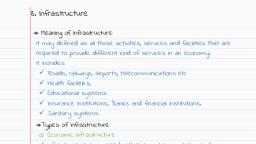
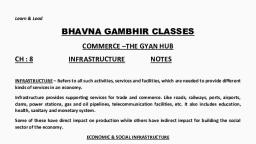
“Many things we need can wait, the child cannot. To him, we cannot say,, ‘tomorrow’. His name is today.”, Gabrriella Mistral— Chilean poet, So is the Infrastructure., , 8.1 INTRODUCTION, Have you ever thought of why some, states in India are performing much, better than others in certain areas? Why, do Punjab, Haryana and Himachal, Pradesh prosper in agriculture and, horticulture? Why are Maharashtra, and Gujarat industrially more, advanced than others? How come, Kerala, popularly known as ‘God’s own, country’, has excelled in literacy, health, care and sanitation and also attracts, tourists in such large numbers? Why, does Karnataka’s information, technology industry attracts world, attention?, It is all because these states have, better infrastructure in the areas they, excel than other states of India. Some, have better irrigation facilities. Others, have better transportation facilities, or, are located near ports which makes raw, materials required for various, , manufacturing industries easily, accessible. Cities like Bengaluru in, Karnataka attract many multinational, companies because they provide, world-class communication facilities., All these support structures, which, facilitate development of a country,, constitute its infrastructure. How, then does infrastructure facilitate, development?, , 8.2 WHAT, , IS, , INFRASTRUCTURE?, , Infrastructure provides supporting, services in the main areas of industrial, and agricultural production, domestic, and foreign trade and commerce. These, services include roads, railways, ports,, airports, dams, power stations, oil and, gas pipelines, telecommunication, facilities, the country’s educational, system including schools and colleges,, health system including hospitals,, sanitary system including clean, drinking water facilities and the monetary, system, including, banks, insurance and, other financial institutions. Some of these, facilities have a direct, impact on production, of goods and services, while others give, indirect support by, building the social, sector of the economy., Fig. 8.1 Roads are the missing link with growth, , 140, , INDIAN ECONOMIC DEVELOPMENT, , 2021-22
Page 3 :
speedy and large-scale, transport of seeds,, pesticides, fertilisers, and the produce using, modern, roadways,, railways and shipping, facilities. In recent times,, agriculture also depends, on insurance and, banking, facilities, because of its need to, operate on a very large, scale., Fig. 8.2 Schools: an important infrastructure for a nation, , Some divide infrastructure into, two categories — economic and social., Infrastructure associated with energy,, transportation and communication, are included in the former category, whereas those related to education,, health and housing are included in, the latter., Work This Out, , In your locality or neighbourhood, you might be using a variety of, infrastructure. List all of those., Your locality may also be, requiring a few more. List those, separately. Classify them using, a few criteria and discuss the, details in the class., , 8.3 RELEVANCE, , OF, , Infrastructure contributes to, economic development of a country, both by increasing the productivity of, the factors of production and improving, the quality of life of its people., Inadequate infrastructure can have, multiple adverse effects on health., Improvements in water supply and, sanitation have a large impact by, reducing morbidity (meaning, proneness to fall ill) from major, waterborne diseases and reducing the, severity of disease when it occurs. In, addition to the obvious linkage between, water and sanitation and health,, the quality of transport and, communication infrastructure can, affect access to health care. Air pollution, and safety hazards connected to, transportation also affect morbidity,, particularly in densely populated areas., , INFRASTRUCTURE, , Infrastructure is the support system on, which depends the efficient working of, a modern industrial economy. Modern, agriculture also largely depends on it for, , 8.4 THE STATE, INDIA, , OF, , INFRASTRUCTURE, , IN, , Traditionally, the government has been, solely responsible for developing the, , INFRASTRUCUTRE, , 141, , 2021-22
Page 4 :
per cent still use, kerosene. About, 85 per cent of the, rural households, use bio-fuels for, cooking. Tap water, availability, is, limited to only 31, per cent rural, households. About, 69 per cent of the, population drinks, Fig. 8.3 Dams: temples of development, water from open, sources such as wells, tanks, ponds,, country’s infrastructure. But it was, lakes, rivers, canals, etc. Access to, found that the government’s investment, improved sanitation in rural areas was, in infrastructure was inadequate., only 30 per cent., Today, the private sector by itself and, Look at Table 8.1 which shows the, also in joint partnership with the public, state of some infrastructure in India in, sector, has started playing a very, comparison to a few other countries., important role in infrastructure, Though it is widely understood that, development., infrastructure is the foundation of, A majority of our people live, development, India is yet to wake up, in rural areas. Despite so much, to the call. India invests only 30 per cent, technical progress in the world,, rural women are, still using bio-fuels, such as crop, residues, dung, and fuel wood to, meet their energy, requirement. They, w a l k l o n g d i stances to fetch, fuel, water and, other basic needs., The census 2011, shows that in rural, India only 56 per, cent households, have an electricity, connection and 43, Fig. 8.4 Safe drinking water with pucca house: still a dream, 142, , INDIAN ECONOMIC DEVELOPMENT, , 2021-22
Page 5 :
TABLE 8.1, Some Infrastructure in India and other Countries, 2018, Country, , Investment* in, Infrastructure, as a % GDP, , Percentage of people using, safely managed, Drinking, Sanitation, Water Sources, Services, 96, 72, 100, 92, , Mobile, Consumption, Subscribers/100 of energy (ml., People, tonnes of, oil equivalent), 115, 3274, 259, 31, , China, Hong Kong, , 44, 22, , India, , 30, , 94, , 40, , 87, , 809, , South Korea, , 31, , 98, , 100, , 130, , 301, , Pakistan, , 16, , 35, , 64, , 73, , 85, , Singapore, , 28, , 100, , 100, , 146, , 88, , Indonesia, , 34, , 87, , 61, , 120, , 186, , Sources: World Development Indicators 2019, World Bank website: www.worldbank.org.;, BP Statistical Review of World Energy 2019, 69th Edition., Note: (*) refers to Gross Capital Formation., , Work These Out, , Ø While, , reading newspapers, you will come across terms, like Bharat Nirman, Special, Purpose Vehicle (SPV),, Special Economic Zones, (SEZ),, Build, Operate, Transfer (BOT), Private, Public Partnership (PPP) etc., Make a scrapbook of news, items containing these, terms. How are these terms, related to infrastructure?, , Ø Using, , the references at, the end of the chapter,, collect the details of, other infrastructure., , of its GDP on infrastructure, which is, far below that of China and Indonesia., Some economists have projected, that India will become the third biggest, economy in the world a few decades, from now. For that to happen, India will, , have to boost its infrastructure, investment. In any country, as the, income rises, the composition of, infrastructure requirements changes, significantly. For low-income countries,, basic infrastructure services, like, irrigation, transport and power, are, more important. As economies mature, and most of their basic consumption, demands are met, the share of, agriculture in the economy shrinks and, more service-related infrastructure is, required. This is why, the share of power, and telecommunication infrastructure, is greater in high-income countries., Thus, development of infrastructure, and economic development go hand in, hand. Agriculture depends, to a, considerable extent, on the adequate, expansion and development of irrigation, facilities. Industrial progress depends, on the development of power and, electricity generation, transport and, communications. Obviously, if proper, attention is not paid to the development, of infrastructure, it is likely to act as a, , INFRASTRUCUTRE, , 143, , 2021-22
Page 6 :
severe constraint on, economic development. In, this chapter the focus, will be on only two kinds of, infrastructure — those, associated with energy, and health., , 8.5 ENERGY, Why do we need energy?, In what forms is it, available? Energy is a, critical aspect of the, development process of a, nation. It is, of course,, Fig. 8.6 Bullock carts still play a crucial role in rural, transportation market, essential for industries., Now it is used on a large, scale in agriculture and related areas, S o u r c e s o f E n e r g y : There are, like production and transportation of, commercial and non-commercial, fertilisers, pesticides and farm, sources of energy. Commercial, equipment. It is required in houses for, sources are coal, petroleum and, cooking, household lighting and, electricity as they are bought and, heating. Can you think of producing a, sold. Non-commercial sources of, commodity or service without using, energy are fuelwood, agricultural, energy?, waste and dried dung. These are noncommercial as they are not, available in the market on a, large scale., While, commercial, sources of energy are, generally exhaustible (with, the exception of hydropower),, non-commercial sources or, traditional are generally, renewable. More than 60 per, cent of Indian households, depend on traditional, sources of energy for, meeting their regular, cooking and heating needs., Fig. 8.5 Fuel wood is the major source of energy, 144, , INDIAN ECONOMIC DEVELOPMENT, , 2021-22
Page 7 :
Non-conventional Sources of, Energy: Both commercial and, non-commercial sources of, energy are known as, conventional sources of energy., There are three other sources, of energy which are commonly, termed as non-conventional, sources — solar energy, wind, energy and tidal power. Being, a tropical country, India has, almost unlimited potential for, Fig. 8.8 Solar energy has great prospects, producing all three types of, energy if some appropriate cost effective, Consumption Pattern of Commercial, technologies are used. Even cheaper, Energy: In India, commercial energy, technologies can be developed., consumption makes up about 74 per, cent of the total energy consumed in, India. This includes coal and lignite, with the largest share of 74 per cent,, followed by oil at 10 per cent, natural, gas at 9 per cent, hydro and other new, and renewable energy at 7 per cent., Non-commercial energy sources, consisting of firewood, cow dung and, agricultural wastes account for over 26, per cent of the total energy, consumption. The critical feature of, India’s energy sector, and its linkages, to the economy, is the import, dependence on crude and petroleum, products, which is likely to grow rapidly, in the near future., The sectoral pattern of consumption, of commercial energy is given in Table, 8.2. The transport sector was the largest, consumer of commercial energy in, 1953-54. However, there has been, continuous fall in the share of the, transport sector while the shares of, the household, agriculture and ‘others’, Fig. 8.7 Wind mill : another source of generating, power, have been increasing. The share, INFRASTRUCUTRE, , 145, , 2021-22
Page 8 :
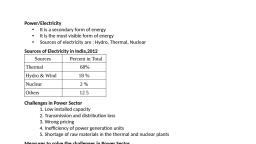
TABLE 8.2, Trends in Sectoral Share of Commercial Energy Consumption (in %), 1953-54, , 1970-71, , 1990-91, , Household, , 10, , 12, , 12, , 24, , Agriculture, , 01, , 03, , 08, , 18, , Industries, , 40, , 50, , 45, , 42, , Transport, , 44, , 28, , 22, , 1, , 5, , 07, , 13, , 15, , 100, , 100, , 100, , 100, , Sector, , Others, Total, , 2017-18, , Source: Ninth Five year Plan, Vol. II, Chapter 6, Planning Commission, Government of India, New Delhi, and Energy Statistics 2019, Central Statistical Office, Ministry of Statistics and Programme, Implementation, Government of India., , of oil and gas is the highest among all, commercial energy consumption. With, the rapid rate of economic growth, there, has been a corresponding increase in, the use of energy., , rate of demand for power is generally, higher than the GDP growth rate., Studies point out that in order to have, 8 per cent GDP growth per annum,, power supply needs to grow around 12, per cent annually., Power/Electricity: The most visible, In India, in 2018, thermal, form of energy, which is often identified, sources accounted for 82 per cent, with progress in modern civilisation, is, of the power generation capacity., power, commonly called electricity. It is, Hydel power accounted for 8.5 per cent,, a critical component of infrastructure, while nuclear power accounted for only, that determines the economic, 2.5 per cent. India’s energy policy, development of a country. The growth, encourages three energy sources — solar,, hydel, and wind — as they, do not rely on fossil fuel and,, Chart 8.1: Different Sources of Electricity Generated, hence, avoid carbon, in India, 2016, emissions. Yet, this has not, 7%, 2.5%, resulted in faster growth of, Thermal, electricity produced from, 8.5%, these sources., Hydro, Atomic energy is an, important source of electric, power, it has economic, Nuclear, advantages. At present,, nuclear energy accounts, New and Renewable, 82%, Energy, for only 2.5 per cent of the, total energy consumption,, 146, , INDIAN ECONOMIC DEVELOPMENT, , 2021-22
Page 9 :
Work These Out, , Ø Among, , other sources of, energy, you would have, noticed that a marginal share, of energy comes from nuclear, power. Why?, , Ø Solar energy, wind power and, power produced from tides, are going to be the future, sources of energy. What are, their comparative merits, and demerits? Discuss in, the class., , against a global average of 13 per cent., This is far too low. Hence, some, scholars suggest to generate more, electricity through atomic (nuclear), sources and yet a few others object, about this, from the viewpoint of, environment and sustainable, development. What do you think?, , Some Challenges in the Power, Sector: Electricity generated by, various power stations is not consumed, entirely by ultimate consumers; a part, is consumed by power station, auxiliaries. Also, while transmitting, power, a portion is lost in transmission., What we get in our houses, offices and, factories is the net availability., Some of the challenges that India’s, power sector faces today are — (i) India’s, installed capacity to generate electricity, is not sufficient to feed the high, economic growth. In order to meet the, growing demand for electricity, India’s, commercial energy supply needs to, grow at about 7 per cent. At present,, India is able to add only 20,000 MW a, year. Even the installed capacity is, under-utilised because plants are not, run properly (ii) State Electricity Boards, (SEBs), which distribute electricity,, incur losses exceed `20,000 crores., This is due to transmission and, distribution losses, wrong pricing of, electricity and other inefficiencies. Some, scholars also say that distribution of, electricity to farmers is the main reason, , Box 8.1: Making a Difference, Thane city is acquiring a brand new image — an environment-friendly, makeover. Large-scale use of solar energy, which was considered a somewhat, far-fetched concept, has brought in real benefits and results in cost and energy, saving. It is being applied to heat water, power traffic lights and advertising, hoardings. And leading this unique experiment is the Thane Municipal, Corporation. It has made compulsory for all new buildings in the city to install, solar water heating system. (Appeared in the column, Making a Difference,, Outlook, 01 August 2005)., ØCan you suggest such other ideas to use non-conventional energy in a better, way?, , INFRASTRUCUTRE, , 147, , 2021-22
Page 10 :
Box 8.2: Power Distribution: The Case of Delhi, Since Independence, power management in the national capital has changed, hands four times. The Delhi State Electricity Board (DSEB) was set up in, 1951. This was succeeded by the Delhi Electric Supply Undertaking (DESU), in 1958. The Delhi Vidyut Board (DVB) came into existence as SEB in, February 1997. Now, the distribution of electricity vests with two leading, Private sector companies — Reliance Energy Limited (BSES Rajdhani Power, Limited and BSES Yamuna Power Limited) and Tata Power Limited (NDPL)., They supply electricity to approximately 46 lakh customers in Delhi. The, tariff structure and other regulatory issues are monitored by the Delhi, Electricity Regulatory Commission (DERC). Though it was expected that, there will be greater improvement in power distribution and the consumers, will benefit in a major way, experience shows unsatisfactory results., , for the losses; electricity is also stolen, in different areas which also adds to the, woes of SEBs (iii) private sector power, generators are yet to play their role in a, major way; same is the case with, foreign investors (iv) there is general, public unrest due to high power tariffs, , and prolonged power cuts in different, parts of the country, and (v) thermal, power plants, which are the mainstay of, India’s power sector are facing shortage, of raw material and coal supplies., Thus, continued economic, development and population growth, , Box 8.3: Saving Energy: Promoting the Case of Compact Fluorescent, Lamps (CFL) and LED Bulbs, According to the Bureau of Energy Efficiency (BEE), CFLs consume 80 per cent, less power as compared to ordinary bulbs. As put by a CFL manufacturer,, Indo-Asian, replacement of one million 100-watt bulbs with 20 watt CFLs can, save 80 megawatt in power generation. This amounts to saving Rs 400 crore., These days LED (Light Emitting Diode) lamps are promoted throughout the, country to save energy. The LED bulb uses one-tenth energy as an, incandescent bulb and half as much as a CFL to produce the same amount of, light. According to the Energy Efficiency Services Ltd, the UJALA scheme that, aims to replace incandescent bulbs with LEDs could save 5,905 MW in power, generation. This translates to an annual savings of Rs. 4,000 for an average, family due to efficiency gains and lower replacement costs., , 148, , INDIAN ECONOMIC DEVELOPMENT, , 2021-22
Page 11 :
Work These Out, , Ø What, , kind of energy do you use in your house? Find out from your parents, the amount they spend in a month on different types of energy., Ø Who supplies power to your area and where is it generated? Can you think, of other cheaper alternative sources which could help in lighting your house, or cooking food or for travelling to far away places?, Ø Look at the following table. Do you think energy consumption is an effective, indicator of development?, Country, , India, , GDP per capita, (in US $) in, 2018 (ppp), , Energy use (kg of, oil equivalent per, capita) 2018, , 6,899, , 637, , Indonesia, , 11,605, , 884, , Egypt, , 11,013, , 828, , U.K., , 40,158, , 2777, , Japan, , 294, , 3471, , U.S.A., , 58,681, , 6961, , Source: World Development Indicators 2019, www.worldbank.org., , Ø Find out how power is distributed in your area/state. Also find out the total, electricity demand of your city, village or town and how it is being met., , Ø You, , might notice people using a variety of methods to save electricity and, other energy. For instance, while using the gas stove, some suggestions are, made by gas agencies for using the gas efficiently and economically. Discuss, them with your parents and the elderly, note down the points and discuss, them in class., , are driving the demand for energy faster, than what India is producing currently., More public investment, better research, and development efforts, exploration,, technological innovation and use of, renewable energy sources can ensure, additional supply of electricity. Instead, of investing in the power sector by, , adding to the installed capacity, the, government has gone for privatisation, of the power sector, and particularly,, distribution (see Box 8.2), and allowed, much higher prices for electricity that, have impacted certain sectors very, badly (see Box 3.3). Do you think it is a, right policy? Why? Discuss in the class., , INFRASTRUCUTRE, , 149, , 2021-22
Page 12 :
8.6 HEALTH, Since 2020, due to Covid 19 Pandemic, you are aware of the need for keeping, our hands washed, wearing masks and, following social distance. Health is not, only absence of disease but also the, ability to realise one’s potential. It is a, yardstick of one’s well being. Health is, the holistic process related to the overall, growth and development of the nation., Though the twentieth century has seen, a global transformation in human, health unmatched in history, it may be, difficult to define the health status of, a nation in terms of a single set of, measures. Generally, scholars assess, people’s health by taking into account, indicators, like infant mortality and, maternal mortality rates, life expectancy, and nutrition levels, along with the, incidence of communicable and noncommunicable diseases., Development of health infrastructure ensures a country of healthy, , manpower for the production of goods, and services. In recent times, scholars, argue that people are entitled to health, care facilities. It is the responsibility of, the government to ensure the right to, healthy living. Health infrastructure, includes hospitals, doctors, nurses and, other para-medical professionals, beds,, equipment required in hospitals and a, well-developed pharmaceutical, industry. It is also true that mere, presence of health infrastructure is not, sufficient to have healthy people. The, same should be accessible to all, people. Since, the initial stages of, planned development, policy-makers, envisaged that no individual should, fail to secure medical care, curative, and preventive, because of the, inability to pay for it. But are we able, to achieve this vision? Before we, discuss various health infrastructure,, let us discuss the status of health, in India., , Fig. 8.9 Health infrastructure is still lacking in large parts of the country, 150, , INDIAN ECONOMIC DEVELOPMENT, , 2021-22
Page 13 :
TABLE 8.3, State of Health InfraPublic Health Infrastructure in India, 1951-2018, structure: The government has, the constitutional obligation to Item, 1951, 1981, 2000, 2018, guide and regulate all health- Hospitals, 2,694, 6,805 15,888, 25,778, related issues, such as medical, (Govt.), education, adulteration of food,, drugs and poisons, medical Beds (Govt.) 1,17,000 5,04,538 7,19,861 7,13,986, 6,600, 16,745 23,065, 27,951, profession, vital statistics, Dispensaries, 725, 9,115 22,842, 25,743, mental deficiency and lunacy. PHCs, The Union Government evolves Sub-centres, 84,736 1,37,311 1,58,417, broad policies and plans, CHCs, 761, 3,043, 5,624, through the Central Council of, Health and Family Welfare. It Sources: National Commission on Macroeconomics and, Health, Ministry of Health and Family Welfare,, collects information and renders, Government of India, New Delhi, 2005 ; National, financial and technical assistance, Health Profile for various years available on, to State governments, Union Territories www.cbhidghs.nic.in., and, other, bodies, for, the, resulted in the eradication of smallpox,, implementation of important health, guinea worms and the near eradication, programmes in the country., of polio and leprosy. What do you think, O ver the years, India has, about the efforts taken by government, built a vast health infrastructure and, to protect people from Covid 19, manpower at different levels. At the, Pandemic. Discuss in the class., village level, a variety of hospitals,, technically known as Primary Health, Private Sector Health Infrastructure:, Centres (PHCs) (see also Box 8.4), have, In recent times, while the public health, been set up by the government. India, sector has not been so successful in, also has a large number of hospitals, delivering the goods about which we, run by voluntary agencies and the, will study more in the next section,, private sector. These hospitals engage, private sector has grown by leaps and, professionals and para-medical, bounds. A study reports that more than, professionals trained in medical,, 70 per cent of the hospitals in India are, pharmacy and nursing colleges., run by the private sector. They control, Since Independence, there has been, nearly two-fifth of the beds available in, a significant expansion in the physical, the hospitals. Nearly 60 per cent of, provision of health services. During, dispensaries are run by the same, 1951–2018, the number of government, private sector. They provide healthcare, hospitals and dispensaries together, for 80 per cent of out-patients and 46, increased from 9,300 to 53,800 and, per cent of in-patients., hospital beds from 1.2 to 7.1 lakhs., In recent times, private sector has, Also, nursing personnel increased from, been playing a dominant role in medical, 18,000 to 30 lakh and allopathic, education and training, medical, doctors from 62,000 to 11.5 lakhs. The, technology and diagnostics, manufacture, expansion of health infrastructure has, and sale of pharmaceuticals, hospital, INFRASTRUCUTRE, , 151, , 2021-22
Page 14 :
Box 8.4: Health System in India, India’s health infrastructure and health care is made up of a three-tier system, — primary, secondary and tertiary. Primary health care includes education, concerning prevailing health problems and methods of identifying, preventing, and controlling them; promotion of food supply and proper nutrition and, adequate supply of water and basic sanitation; maternal and child health, care; immunisation against major infectious diseases and injuries; promotion, of mental health and provision of essential drugs., Auxiliary Nursing Midwife, (ANM) is the first person who, provides primary healthcare in, rural areas. In order to provide, primary health care, hospitals, have been set up in villages and, small towns which are generally, manned by a single doctor, a, nurse and a limited quantity of, medicines. They are known as, Primary Health Centres (PHC),, Community Health Centres, (CHC) and sub-centres. When, A health awareness meeting in progress, the condition of a patient is not, managed by PHCs, they are, referred to secondary or tertiary hospitals. Hospitals which have better facilities, for surgery, X-ray, Electro Cardio Gram (ECG) are called secondary health, care institutions. They function both as primary health, care provider and also provide better healthcare facilities., They are mostly located in district headquarters and in, big towns. All those hospitals which have advanced level, equipment and medicines and undertake all the, complicated health problems, which could not be, managed by primary and secondary hospitals, come, under the tertiary sector., The tertiary sector also includes many premier, institutes which not only impart quality medical, Polio drops being, education and conduct research but also provide, given to an infant, specialised health care. Some of them are — All India, Institute of Medical Science, New Delhi; Post Graduate Institute, Chandigarh;, Jawaharlal Institute of Postgraduate Medical Education and Research,, Pondicherry; National Institute of Mental Health and Neuro Sciences, Bangalore, and All India Institute of Hygiene and Public Health, Kolkata., Source: Report of the National Commission on Macroeconomics and Health, 2005., , 152, , INDIAN ECONOMIC DEVELOPMENT, , 2021-22
Page 15 :
Box 8.5: Medical Tourism — A great opportunity, You might have seen and heard on TV news or read in newspapers about, foreigners flocking to India for surgeries, liver transplants, dental and even, cosmetic care. Why? Because India’s health services combine the latest medical, technologies with qualified professionals and are cheaper for foreigners as, compared to costs of similar healthcare services in their own countries. In, 2016, as many as 2,01,000 foreigners visited India for medical treatment. And, this figure is likely to increase by 15 per cent each year. Experts predict that by, 2020 India could earn more than 500 billion rupees a year through such ‘medical, tourism’., Sources : Ministry of Tourism, Government of India and www.grantthornton.in, , construction and the provision of, medical services. In 2001-02, there, were more than 13 lakh medical, enterprises employing 22 lakh people;, more than 80 per cent of them were, single person owned, and operated by, one person occasionally employing a, hired worker. Scholars point out that, the private sector in India has grown, independently without any major, regulation; some private practitioners, are not even registered doctors and are, known as quacks., , Since the 1990s, owing to, liberalisation measures, many, non-resident Indians and industrial, and pharmaceutical companies have set, up state-of-the-art super-specialty, hospitals to attract India’s rich and, medical tourists (see Box 8.5). Do you, think most people in India can get, access to such super -specialty, hospitals? Why not? What could be, done so that every person in India could, access a decent quality healthcare?, , Box 8.6: Community and Non-profit Organisations in Healthcare, One of the important aspects of a good healthcare system is community, participation. It functions with the idea that the people can be trained and, involved in primary healthcare system. This method is already being used in, some parts of our country. SEWA in Ahmedabad and ACCORD in the Nilgiris, could be the examples of some such NGOs working in India. Trade unions have, built alternative healthcare services for their members and also to give, low-cost healthcare to people from nearby villages. The most well-known and, pioneering initiative in this regard has been Shahid Hospital, built in 1983, and sustained by the workers of CMSS (Chhattisgarh Mines Shramik Sangh), in Durg, Madhya Pradesh. A few attempts have also been made by rural, organisations to build alternative healthcare initiatives. One example is in, Thane, Maharashtra, where in the context of a tribal people’s organisation,, Kashtakari Sangathan, trains women health workers at the village level to, treat simple illnesses at minimal cost., INFRASTRUCUTRE, , 153, , 2021-22
Page 16 :
TABLE 8.4, Indicators of Health in India in comparison with other Countries, 2016-2018, Indicators, , India, , China, , USA, , Sri Lanka, , Infant Mortality Rate/1,000 live births (2018), , 30, , 7.4, , 5.6, , 6.4, , Under-5 mortality /1,000 live-births (2016), , 37, , 8.6, , 6.5, , 7.4, , Birth by skilled attendants (% of total) (2016), , 81, , 81, , 99, , 99, , Infants immunised (DTP) (%) (2016), , 89, , 89, , 94, , 99, , Government health spending, , 3.7, , 5.7, , 17, , 3.9, , 65, , 36, , 11.1, , 50, , as a % of GDP (%) (2016), Out of pocket expenditure as a % of, current health expenditure (2016), , Sources: World Development Indicators 2019, World Bank, Washington., , Indian Systems of Medicine (ISM):, It includes six systems—Ayurveda,, Yoga, Unani, Siddha, Naturopathy, and Homeopathy (AYUSH). At present,, there are 4,095 AYUSH hospitals and, 27,951 dispensaries and as many as, 8 lakh registered practitioners in, India. But little has been done to set, up a framework to standardise, education or to promote research., ISMs have huge potential and can, solve a large part of our healthcare, problems because they are effective,, safe and inexpensive., Indicators of Health and Health, Infrastructure—A Critical Appraisal:, As pointed out earlier, the health status, of a country can be assessed through, indicators, such as infant mortality and, maternal mortality rates, life expectancy, and nutrition levels, along with the, incidence of communicable and, non-communicable diseases. Some of, the health indicators, and India’s, position, are given in Table 8.4., , Scholars argue that there is greater, scope for the role of government in the, health sector. For instance, the table, shows expenditure on health sector as, 3.7 per cent of the total GDP. This is, abysmally low as compared to other, countries, both developed and, developing., One study points out that India, has about one-fifth of the world’s, population but it bears a frightening, 20 per cent of the global burden of, diseases (GBD). GBD is an indicator, used by experts to gauge the number, of people dying prematurely due to a, particular disease, as well as, the, number of years spent by them in a, state of ‘disability’ owing to the, disease., A 2017 study shows nearly twothirds of GBD, now known as Total, Burden of Disease was caused by noncommunicable diseases associated, with heart, respiratory system – lungs,, kidney, obesity and lifestyle. Diarrhoea,, lower respiratory system and other, , 154, , INDIAN ECONOMIC DEVELOPMENT, , 2021-22
Page 17 :
Work These Out, , Find, , out one or two government hospitals of different kinds. Invite nurses and, doctors to discuss the ways and means through which they managed Covid 19, situation., , Visit a primary health centre located in your area or neighbourhood. Also, collect, the details of the number of private hospitals, medical laboratories, scan centres,, medical shops and other such facilities in your locality., Debate in the class on the topic — ‘Should we build an army of tais (midwives) to, take care of the poor, who cannot afford the services of the thousands of medical graduates who pass out of our medical colleges every year?’, A study estimates that medical costs alone push down 2.2 per cent of the population below the poverty line each year. How?, Visit a few hospitals in your locality. Find out the number of children receiving, immunisation from them. Ask the hospital staff about the number of children, immunised 5 years ago. Discuss the details in class., Two students — Leena Talukdar (16) and Sushanta Mahanta (16) of Assam —, have developed a herbal mosquito repellent ‘jag’ using a few locally available, medicinal plants — paddy straw, husk and dried garbage. Their experiment, has been successful [Shodh Yatra (innovation), Yojana, September 2005]. If you, know anyone whose innovative methods improve the health status of people, or, if you know someone who has a knowledge of medicinal plants and heals the, ailments of people, speak to them and bring them to the class or collect, information about why and how they treat ailments. Share this with your class., You can also write to local newspapers or magazines., Do you think Indian cities could be provided with world-class health infrastructure, so that they will become attractive for medical tourists? Or should the government, concentrate on providing health infrastructure to people in rural areas? What, should be the priority of the government? Debate., , common infectious diseases account, for one-sixth of total deaths in India., Out of 4.1 million early deaths occuring, globally due to air pollution, 1.1 million, deaths occur in India alone. The, proportion of deaths occurs due to, cancer (8 per cent) injuries (11 per cent), also has been increasing over the last, two decades., At present, less than 20 per cent of, the population utilises public health, facilities. One study has pointed out, , that only 38 per cent of the PHCs have, the required number of doctors and, only 30 per cent of the PHCs have, sufficient stock of medicines., Urban-Rural and Poor-Rich Divide:, Though 70 per cent of India’s, population lives in rural areas, only, one-fifth of its hospitals (including, private hospitals) are located in rural, areas. Rural India has only about half, the number of dispensaries. Out of, , INFRASTRUCUTRE, , 155, , 2021-22
Page 18 :
Work These Out, , Ø The overall health status of the country has certainly improved through the years., Life expectancy has gone up, infant mortality rate has come down. Smallpox has, been eradicated and the goal to eradicate leprosy and polio looks achievable. But, these statistics seem good only when you look at them in isolation. Compare these, with the rest of the world. You can get these details from the World Health Report, brought out by the World Health Organization What do you find?, Ø Observe your class for a month and find out why some students remain absent. If it, is due to health problems, then find out what kind of medical problems they had., Collect the details of the problem, the nature of treatment they took and the amount, of money their parents spent on their treatment. Discuss the information in class., , about 7.13 lakh beds in government, hospitals, roughly 30 per cent are, available in rural areas. Thus, people, living in rural areas do not have, sufficient medical infrastructure. This, has led to differences in the health status, of people. As far as hospitals are, concerned, there are only 0.36 hospitals, for every one lakh people in rural areas,, while urban areas have 3.6 hospitals for, the same number of people. The PHCs, located in rural areas do not even offer, X-ray or blood testing facilities, which, for a city dweller, constitutes basic, healthcare. States, like Bihar, Madhya, Pradesh, Rajasthan and Uttar Pradesh,, are relatively lagging behind in, healthcare facilities. In rural areas, the, percentage of people who have no access, , to proper healthcare facilities has, increased over the last few years., Villagers have no access to any, specialised medical care, like, paediatrics, gynaecology, anaesthesia, and obstetrics. Even though 530, recognised medical colleges produce, about 50,000 medical graduates every, year, the shortage of doctors in rural, areas persists. While one-fifth of these, doctor graduates leave the country for, better monetary prospects, many others, opt for private hospitals, which are mostly, located in urban areas. What could be, the reason for this trend? Interact with, one or two doctors working in your area, and discuss in the class., One study points out that the, poorest 20 per cent of Indians living in, both urban and rural areas spend 12, , Fig. 8.10 Despite availing various healthcare measures, maternal health is a cause of concern, 156, , INDIAN ECONOMIC DEVELOPMENT, , 2021-22
Page 19 :
per cent of their income on healthcare,, while the rich spend only 2 per cent., What happens when the poor fall sick?, Many have to sell their land or even, pledge their children to afford treatment., Since government-run hospitals do not, provide sufficient facilities, the poor are, driven to private hospitals, which make, them indebted forever, else they opt to, die. Recently, Indian governments have, been taking various initiatives to, improve healthcare. Collect the details, and review in the class., Women’s Health: Women constitute, about half of the total population in, India. They suffer many disadvantages, as compared to men in the areas of, education, participation in economic, activities and healthcare. The, deterioration in the child sex ratio, in the country from 927 in 2001 to, 919 in 2011 points to the growing, incidence of female foeticide. Five per, cent of girls aged between 15-19 years, are not only married but have already, borne children at least once. More than, 50 per cent of married women in the, age group of 15–49 years have anaemia, and nutritional anaemia caused by iron, deficiency, and this has not declined, since 2005. The GBD Study 2017, reports that premature deaths due to, neonatal disorders tops in both the, years 2007 and 2017 and this has not, declined since 2005., Health is a vital public good and a, basic human right. All citizens can get, better health facilities if public health, services are decentralised. Success in, the long-term battle against diseases, depends on education and efficient, health infrastructure. It is, therefore,, critical to create awareness on health, , and hygiene and provide efficient, systems. The role of telecom and IT, sectors cannot be neglected in this, process. The effectiveness of healthcare, programmes also rests on primary, healthcare. The ultimate goal should, be to help people move towards a, better quality of life. There is a sharp, divide between urban and rural, healthcare in India. If we continue to, ignore this deepening divide, we run the, risk of destabilising the socio-economic, fabric of our country. In order to provide, basic healthcare to all, accessibility and, affordability need to be integrated in, our basic health infrastructure., , 8.7 CONCLUSION, Infrastructure, both economic and, social, is essential for the development, of a country. As a support system, it, directly influences all economic, activities by increasing the productivity, of the factors of production and, improving the quality of life. In the last, seven decades of Independence, India, has made considerable progress in, building infrastructure, nevertheless,, its distribution is uneven. Many parts, of rural India are yet to get good roads,, telecommunication facilities, electricity,, schools and hospitals. As India moves, towards modernisation, the increase in, demand for quality infrastrucutre,, keeping in view their environmental, impact, will have to be addressed. The, reform policies by providing various, concessions and incentives, aim at, attracting the private sector, in general,, and foreign investors, in particular., While assessing the two infrastructure, — energy and health, it is clear that, there is scope for equal access to, infrastructure for all., , INFRASTRUCUTRE, , 157, , 2021-22
Page 20 :
Recap, , Ø Infrastructure, , is a network of physical facilities and public services, and with this social infrastructure is equally important to support it., It is an important base for economic development of the country., , Ø Infrastructure, , needs to be upgraded from time to time to maintain, high economic growth rate. Better infrastructural facilities have, attracted more foreign investments and tourists to India recently., , Ø It, , is important to develop rural infrastructural facilities., , Ø Public, , and private partnership is required to bring in huge funds for, infrastructural development., , Ø Energy is very vital for rapid economic growth. There is a big gap between, consumer demand and supply of electricity in India., , Ø Non-conventional, , sources of energy can be of great support to meet, shortage of energy., , Ø The, , power sector is facing a number of problems at generation,, transmission and distribution levels., , Ø Health, , is a yardstick of human well-being, physical as well as mental., , Ø There, , has been significant expansion in physical provision of health, services and improvements in health indicators since independence., , Ø Public health system and facilities are not sufficient for the bulk of the, population., , Ø There, , is a wide gap between rural-urban areas and between poor and, rich in utilising health care facilities., , Ø Women’s, , health across the country has become a matter of great, concern with reports of increasing cases of female foeticide and, mortality., , Ø Regulated private sector health services can improve the situation and,, at the same time, NGOs and community participation are very, important in providing health care facilities and spreading health, awareness., , Ø Natural, , systems of medicine have to be explored and used to support, public health. There is a great scope of advancement of medical tourism, in India., , 158, , INDIAN ECONOMIC DEVELOPMENT, , 2021-22
Page 21 :
EXERCISES, , 1., , Explain the term ‘infrastructure’., , 2., , Explain the two categories into which infrastructure is divided. How, are both interdependent?, , 3., , How do infrastructure facilities boost production?, , 4., , Infrastructure contributes to the economic development of a country., Do you agree? Explain., , 5., , What is the state of rural infrastructure in India?, , 6., , What is the significance of ‘energy’? Differentiate between commercial, and non-commercial sources of energy., , 7., , What are the three basic sources of generating power?, , 8., , What do you mean by transmission and distribution losses? How can, they be reduced?, , 9., , What are the various non-commercial sources of energy?, , 10., , Justify that energy crisis can be overcome with the use of renewable, sources of energy., , 11., , How has the consumption pattern of energy changed over the years?, , 12., , How are the rates of consumption of energy and economic growth, connected?, , 13., , What problems are being faced by the power sector in India?, , 14., , Discuss the reforms which have been initiated recently to meet the, energy crisis in India., , 15., , What are the main characteristics of health of the people of our, country?, , 16., , What is a ‘total burden of disease’?, , 17., , Discuss the main drawbacks of our health care system., , 18., , How has women’s health become a matter of great concern?, , 19., , Describe the meaning of public health. Discuss the major public health, measures undertaken by the state in recent years to control diseases., , 20., , Differentiate the six systems of Indian medicine., , 21., , How can we increase the effectiveness of health care programmes?, , INFRASTRUCUTRE, , 159, , 2021-22
Page 22 :
SUGGESTED ADDITIONAL ACTIVITIES, 1., , Did you know that to bring a megawatt of electricity to your homes, 30-40, million rupees are spent? Building a new power plant would cost millions., Isn’t this reason enough for you to begin conserving energy in your house?, Electricity saved is money saved; in fact, it is worth much more than, electricity generated. Every time your electricity bill reaches home, you, realise there is no need for so many lights and fans around you. All you, have to do is be slightly more alert and careful. And the best thing is, you, can start right away. Involve the rest of your family in this effort and see, the difference. Note down the monthly consumption of electricity in your, house. See the difference in the bill amount after you apply energy saving, tactics., , 2., , Find out what infrastructure projects are in progress in your area. Then,, find out, (i), (ii), (iii), (iv), (v), (vi), , The budget allotted for the project., The sources of its financing., How much employment will it generate?, What will be the overall benefits after its completion?, How long will it take to be completed?, Company/companies engaged in the project., , 3., , Visit any nearby thermal power station/hydro-power station/nuclear, power plant. Observe how these plants work., , 4., , The class can be divided into groups to make a survey of energy use in, their neighbourhood. The aim of the survey should be to find out which, particular fuel is most used in the neighbourhood and the quantity in, which it is used. Graphs can be made by the different groups and compared, to find out possible reason for preference of one particular fuel., , 5., , Study the life and work of Dr Homi Bhaba, the architect of modern India’s, energy establishments., , 6., , Hold a classroom discussion or debate on — ‘warring nations make for an, unhealthy world, so do warped attitudes and closed minds make for mental ill-health’., REFERENCES, , Books, JALAN, BIMAL (Ed.). The Indian Economy — Problems and Prospects. Penguin Books,, Delhi, 1993., KALAM, A.P.J. ABDUL WITH Y.S. RAJAN. 2002. India 2020: A Vision for the New, Millennium. Penguin Books, Delhi., 160, , INDIAN ECONOMIC DEVELOPMENT, , 2021-22
Page 23 :
P ARIKH , K IRIT S. AND R ADHAKRISHNA (Eds.). 2005. India Development Report, 2004-05. Oxford University Press, Delhi., Government Reports, Energy Statistics 2016, Ministry of Statistics and Programme Implementation,, Government of India., The World Health Report 2002. Reducing Risks, Promoting Healthy Life, World, Health Organisation, Geneva., Report of the National Commission on Macroeconomics and Health, Ministry, of Health and Family Welfare, Government of India, New Delhi, 2005., Tenth Five Year Plan, Vol.2, Planning Commission, Government of India,, New Delhi., The India Infrastructure Report: Policy Imperatives for Growth and Welfare, 1996. Expert Group on the Commercialisaton of Infrastructure Projects., Vols.1, 2 and 3 Ministry of Finance. Government of India, New Delhi., World Development Report 2004. The World Bank, Washington DC., India Infrastructure Report 2004. Oxford University Press, New Delhi., Economic Survey 2004-2005. Ministry of Finance, Government of India., World Development Indicators, 2013, The World Bank, Washington., World Health Statistics 2014, World Health Organisation, Geneva., National Health Profile (NHP) of India for various years, Central Bureau of, Health Intelligence, Goverment of India, New Delhi., National Family Health Survey (NFHS-4) 2015-16, Ministry of Health and, Family Welfare, Govt. of India., ICMR et al. 2017. India: Health of the Nation States: The India State Level, Disease Burden Initiative, Indian Coucil of Medical Research, Public Health, Foundation of India and, Institute for Health Metrics and Evaluation,, New Delhi., , Websites, On energy related issues:, www.pcra.org, www.bee-india.com, www.edugreen.teri.res.in, http://powermin.nic.in, On health related issues:, http://www.aiims.edu, http://www.whoindia.org, http://mohfw.nic.in, www.apollohospitalsgroup.com, www.worldbank.org, www.cbhidghs.nic.in, INFRASTRUCUTRE, , 161, , 2021-22