Page 1 :
Economic Reforms 1991, (New Economic Policy –NEP ) or, LIBERALISATION, PRIVATISATION AND GLOBALISATION, BACKGROUND of Reforms, The following are the background of NEP 1991, a), b), c), d), , Political instability in the country, Inefficient management of the Indian Economy in the 1980s., Foreign exchange was spent on meeting consumption needs, foreign exchange reserves declined to a level that was not adequate to finance imports for, more than two weeks, , So India approached the International Bank for Reconstruction and Development (IBRD),, popularly known as World Bank and the International Monetary Fund (IMF) and received $7, billion as loan to manage the crisis. For availing the loan, these international agencies expected, India to liberalise and open up the economy by removing restrictions on the private sector,, reduce the role of the overnment in many areas and remove trade restrictions between India, and other countries., India agreed to the conditionality’s of World Bank and IMF .This set of policies can broadly be, classified into two groups: the stabilization measures and the structural reform measures., Stabilization measures are short-term measures, intended to correct some of the weaknesses, that have developed in the balance of payments and to bring inflation under control. In simple, words, this means that there was a need to maintain sufficient foreign exchange reserves and, keep the rising prices under control. On the other hand, structural reform policies are long-term, measures, aimed at improving the efficiency of the economy and increasing its international, competitiveness). The NEP consisted of wide ranging economic reforms The government, initiated a variety of policies which fall under three heads viz., liberalisation, privatisation and, globalisation., , LIBERALISATION, The slackened policy towards economic restrictions is known as liberalization Liberalization, was introduced to put an end to restrictions and open various sectors of the economy., 1.Deregulation of Industrial Sector, The reform policies introduced in and after 1991 removed many of the restrictions. Industrial, licensing was abolished for almost all but product categories — alcohol, cigarettes, hazardous, chemicals, industrial explosives, electronics, aerospace and drugs and pharmaceuticals. The only, industries which are now reserved for the public sector are defence equipment, atomic energy, generation and railway transport. Many goods produced by small-scale industries have now been, dereserved. In many industries, the market has been allowed to determine the prices.
Page 2 :
2.Financial Sector Reforms:, Financial sector includes financial institutions, such as commercial banks, investment banks,, stock exchange operations and foreign exchange market. The financial sector in India is, regulated by the Reserve Bank of India (RBI). One of the major aims of financial sector reforms, is to reduce the role of RBI from regulator to facilitator of financial sector. This means that the, financial sector may be allowed to take decisions on many matters without consulting the RBI., The reform policies led to the establishment of private sector banks, Indian as well as foreign, Foreign Institutional Investors (FII), such as merchant bankers, mutual funds and pension, funds, are now allowed to invest in Indian financial markets., 3.Tax Reforms:, Tax reforms are concerned with the reforms in the government’s taxation and public, expenditure policies, which are collectively known as its fiscal policy. There are two types of, taxes: direct and indirect. Direct taxes consist of taxes on incomes of individuals, as well as, profits of business enterprises. Since 1991, The rate of corporation tax, which was very high, earlier, has been gradually reduced., , GST:(Goods, , and Services Tax) In 2016, the Indian Parliament passed a law,, Goods and Services Tax Act 2016, to simplify and introduce a unified indirect tax system in, India. This law came into effect from July 2017. This is expected to generate additional revenue, for the government, reduce tax evasion and create ‘one nation, one tax and one market’., Another component of reform in this area is simplification. In order to encourage better, compliance on the part of taxpayers, many procedures have been simplified and the rates also, substantially lowered., 4.Foreign Exchange Reforms:, The first important reform in the external sector was made in the foreign exchange market. In, 1991, as an immediate measure to resolve the balance of payments crisis, the rupee was, devalued against foreign currencies. (Devaluation means purposive reduction in the value of a, currency by the government). This led to an increase in the inflow of foreign exchange ., 5.Trade and Investment Policy Reforms:, Liberalisation of trade and investment regime was initiated to increase international, competitiveness of industrial production and also foreign investments and technology into the, economy. The trade policy reforms aimed at (i) dismantling of quantitative restrictions on, imports and exports (ii) reduction of tariff rates and (iii) removal of licensing procedures for, imports. Import licensing was abolished except in case of hazardous and Environmentally, sensitive industries.
Page 3 :
ii PRIVATISATION (NEP- Economic Reforms ), It implies shedding of the ownership or management of a government owned enterprise., Government companies are converted into private companies in two ways (i) by withdrawal of, the government from ownership and management of companies and or (ii) by outright sale of, public sector companies. Privatisation of the public sector enterprises by selling off part of, the equity of PSEs to the public is known as disinvestment. The purpose of the sale,, according to the government, was mainly to improve financial discipline and facilitate, modernisation. It was also envisaged that private capital and managerial capabilities could be, effectively utilised to improve the performance of the PSUs. The government envisaged that, privatisation will increase the inflow of FDI. The government has also made attempts to, improve the efficiency of PSUs by giving them autonomy in taking managerial decisions. For, instance, some PSUs have been granted special status as maharatnas, navratnas and, miniratnas., iii.GLOBALISATION :Globalisation means integration of economies . Globalisation of indian, economy means integration of indian economy with the world economy.It is an outcome of the set, of various policies that are aimed at transforming the world towards greater interdependence, and integration. It involves creation of networks and activities transcending economic, social and, geographical boundaries links in such a way that the happenings in India can be influenced by, events happening miles away. It is turning the world into one whole or creating a borderless, world.(Global Village), The important features of globalization are outsourcing&WTO, Outsourcing: This is one of the important outcomes of the lobalisation process. In outsourcing,, a company hires regular service from external sources, mostly from other countries, which was, previously provided internally or from within the country (like legal advice, computer service,, advertisement, security — each provided by respective departments of the company). As a form, of economic activity, outsourcing has intensified, in recent times, because of the growth of fast, modes of communication, particularly the growth of Information Technology (IT). Many of the, services such as voice-based business processes (popularly known as BPO or call centres), record, keeping accountancy, banking services, music recording, film editing, book transcription, clinical, advice or even teaching are being outsourced by companies in developed countries to India. With, the help of modern telecommunication links including the Internet, the text, voice and visual, data in respect of these services is digitized and transmitted in real time over continents and, national boundaries. Most multinational corporations, and even small companies, are utsourcing, their services to India where they can be availed at a cheaper cost with reasonable degree of skill, and accuracy. The low wage rates and availability of skilled manpower in India have made it a, destination for global outsourcing in the post-reform period., World Trade Organisation (WTO): The WTO was founded in 1995 as the successor, organisation to the General Agreement on Trade and Tariff (GATT). GATT was established, GATT was established in 1948 with 23 countries as the global trade organization to administer, all multilateral trade agreements by providing equal opportunities to all countries in the, international market for trading purposes. WTO is expected to establish a rule-based trading, regime in which nations cannot place arbitrary restrictions on trade. In addition, production and, trade of services, to ensure optimum utilisation of world resources and to protect the, environment. The WTO agreements cover trade in goods as well as services to facilitate, international trade (bilateral and multilateral) through removal of tariff as well as non-tariff, barriers and providing greater market access to all member countries., As an important member of WTO,India has been in the forefront of framing fair global rules,, and advocating the interests of the developing world. India has kept its commitments towards
Page 4 :
liberalisation of trade, made in the WTO, by removing quantitative restrictions on imports and, reducing tariff rates., Some scholars question the usefulness of India being a member of the WTO as a major volume, of international trade occurs among the developed nations. They say that developing countries, feel cheated as they are forced to open their markets for developed countries but are not allowed, access to the markets of developed countries., INDIAN ECONOMY DURING REFORMS: AN ASSESSMENT (NEP Merits&Demerits), Merits:-The post– 1991 India witnessed a rapid growth in GDP on a continual basis for two, decades. The growth of GDP increased from 5.6 per cent during 1980–91 to 8.2 per cent during, 2007–12. During the reform period,. the growth of the service sector has gone up. in 2014–15,, this sector witnessed the high growth rate of 9.8 per cent The opening of the economy has led to a, rapid increase in foreign direct investment and foreign exchange reserves. The foreign, investment,which includes foreign direct investment (FDI) and foreign institutional investment, (FII), has increased from about US $100 million in 1990-91 to US $ 30 billion in 2017-18. There, has been an increase in the foreign exchange reserves from about US $ 6 billion in 1990-91 to, about US $ 413 billion in 2018-19. India is one of the largest foreign exchange reserve holders in, the world India is seen as a successful exporter of auto parts, engineering goods, IT software and, textiles in the reform period., On the other hand, the reform process has been widely criticized(Demerits) in the following, grounds –(criticisms on reforms 1991), 1 .Growth and Employment: Though the GDP growth rate has increased in the reform period,, scholars point out that the reform-led growth has not generated sufficient employment, opportunities in the country.(Jobless growth), 2.Reforms in Agriculture: Reforms have not been able to benefit agriculture, where the, growth rate has been decelerating Public investment in agriculture sector especially in, infrastructure, which includes irrigation, power, roads, market linkages and research and, extension (which played a crucial role in the Green Revolution), has fallen in the reform period., Further, the partial removal of fertiliser subsidy has led to increase in the cost of production,, which has severely affected the small and marginal farmers., 3 Reforms in Industry: Industrial growth has also recorded a slowdown. This is because of, decreasing demand of industrial products due to various reasons such as cheaper imports,, inadequate investment in infrastructure etc Moreover, a developing country like India still does, not have the access to developed countries’ markets because of high non-tariff barriers. For, example, although all quota restrictions on exports of textiles and clothing have been removed in, India,USA has not removed their quota restriction on import of textiles from India and China, 4.Disinvestment: Every year, the government fixes a target for disinvestment of PSEs. For, instance, in 1991-92, it was targeted to mobilise Rs 2500 crore through disinvestment The, government was able to mobilise ` 3,040 crore more than the target. In 2017–18, the target was, about `1,00,000 crore, whereas, the achievement was about ` 1,00,057 crore. Critics point out that, the assets of PSEs have been undervalued and sold to the private sector. This means that there, has been a substantial loss to the government. Moreover, the proceeds from disinvestment are, used to offset the shortage of government revenues rather than using it for the development of, PSEs and building social infrastructure in the country ., 5.Reforms and Fiscal Policies: Economic reforms have placed limits on the growth of public, expenditure, especially in social sectors. The tax reductions in the reform period, aimed at, yielding larger revenue and curb tax evasion, have not resulted in increase in tax revenue for the, government In order to attract foreign investment, tax incentives are provided to foreign, investors which further reduced the scope for raising tax revenues. This has a negative impact, on developmental and welfare expenditures.
Page 5 :
)Poverty, “Poverty may be defined as the inability to secure minimum consumption requirements for, life health and efficiency”, Categorising Poverty: There are many ways to categorise poverty. In one such way, people who are always poor and those who are usually poor are grouped together as the, chronic poor (example: casual workers). Another group are the churning poor who regularly, move in and out of poverty and the occasionally poor who are rich most of the time but may, sometimes have a patch of bad luck. They are called the transient poor. And then, there are, those who are never poor and they are the non-poor ., The Poverty Line: It is an imaginary line dividing poor and non poor There are many ways, of measuring poverty. One way is to determine it by the monetary value (per capita, expenditure) of the minimum calorie intake that was estimated at 2,400 calories for a rural, person and 2,100 calories for a person in the urban area. Based on this, in 2011-12, the, poverty line was defined for rural areas as consumption worth Rs 816 per person a month, and for urban areas it was Rs 1,000. Though the government uses Monthly Per Capita, Expenditure (MPCE) as proxy for income of households to identify the poor., Estimating Poverty, In pre-independent India,Dadabhai Naoroji was the first to, discuss the concept of a Poverty Line He used the menu for a prisoner and used appropriate, prevailing prices to arrive at what may be called ‘jail cost of living’. In post-independent India,, there have been several attempts to work out a mechanism to identify the number of poor in, the country. For instance, in 1962, the Planning Commission now called as NITI Aayog, (National Institution for Transforming India) formed a Study Group. In 1979, another body, called the ‘Task Force on Projections of Minimum Needs and Effective Consumption, Demand’ was formed. In 1989 and 2005, ‘Expert Groups’ were constituted for the same, purpose Due to various limitations in the official estimation of poverty, scholars have, attempted to find alternative methods. For instance, Amartya Sen,, noted Nobel Laureate, has developed an index known as Sen Index. There are other tools, such as Poverty Gap Index and Squared Poverty Gap When the number of poor is, estimated as the proportion of people below the poverty line, it is known as ‘Head Count, Ratio, The official data on poverty is now made available to the public by the NITI, Aayog. It is estimated on the basis of consumption expenditure data collected by the, National Sample Survey Organisation (NSSO) now called as National Statistical Office, (NSO) shows the number of poor and their proportion to the population in India for the years, 1973-2012. In 1973-74, more than 320 million people were below the poverty line. In, 2011-12, this number has come down to about 270 million in 1973-74, about 55 per cent of, the total population was below the poverty line. In 2011-12, it has fallen to 22 per cent the, poverty levels in four states - Odisha, Madhya Pradesh, Bihar and Uttar Pradesh are still far, above the national poverty level., CAUSES OF POVERTY (i) social, economic and political inequality (ii) social exclusion (iii), unemployment (iv) indebtedness (v) unequal distribution of wealth( vi)Lack of quality, education and skills (vii)Indebtedness. The general reasons are, economy-wide problems,, such as (i) low capital formation (ii) lack of infrastructure (iii) lack of demand (iv) pressure of, population (v) lack of social/ welfare nets, (CURRENT CHALLENGES FACING THE INDIAN ECONOMY, , POVERTY ALLEVIATION PROGRAMMES AND POLICIES 1.Growthoriented approach:, It is based on the expectation that the effects of economic growth — rapid increase in gross
Page 6 :
domestic product and per capita income — would spread to all sections of society and will, trickle down to the poor sections also., 2.self-employment programmes and wage employment programmes, Examples of self-employment programmes implemented until 2008 were Rural, Employment Generation Programme (REGP), Prime Minister’s Rozgar Yojana (PMRY) and, Swarna Jayanti Shahari Rozgar Yojana (SJSRY). The first programme aimed at creating, self-employment opportunities in urban areas. The Khadi and Village Industries Commission, was implementing it. Under this programme, one could get financial assistance in the form of, bank loans to set up small industries. The educated unemployed from low-income families, in rural and urban areas could get financial help to set up any kind of enterprise that, generates employment under PMRY. SJSRY mainly aimed at creating employment, opportunities— both self-employment and wage employment—in urban areas. These, programmes now become Prime Minister’s Empolyment Generation Programme (PMEGP)., Now those who wish to benefit from these programmes are encouraged to form self-help, groups. through banks, the government provides partial financial assistance to SHGs which, then decide whom the loan is to be given to for self employment activities. Swarnajayanti, Gram Swarozgar Yojana (SGSY) is one such programme. This has now been restructured, as National Rural Livelihoods Mission (NRLM) and renamed as Deendayal Upadhyay, Antyodaya Yojana., In August 2005, the Parliament passed a new Act to provide guaranteed wage employment, to every rural household whose adult volunteer is to do unskilled manual work for a minimum, of 100 days in a year. This Act is known as Mahatma Gandhi National Rural Employment, Guarantee Act (MNREGA). This scheme is now known as Deen Dayal Upadhyaya, Antyodaya., 3 Provide minimum basic amenities to the people, It includes provision of food grains at subsidised rates, education, health, water supply and, sanitation,essential food grains, nutrition, drinking water, housing, communications and, electricity Three major programmes that aim at improving the food and nutritional status of, the poor are Public Distribution System, Integrated Child Development Scheme and Midday, Meal Scheme. Pradhan Mantri Gram Sadak Yojana and Valmiki Ambedkar Awas Yojana are, also attempts in developing infrastructure and housing conditions From 2014, a scheme, called Pradhan Mantri Jan-Dhan Yojana is available in which people in India are encouraged, to open bank accounts., POVERTY ALLEVIATION PROGRAMMES — A CRITICAL ASSESSMENT, 1 Due to unequal distribution of land and other assets, the benefits from direct poverty alleviation, programmes have been appropriated by the non-poor, 2.The amount of resources allocated for these programmes is not sufficient., 3.these programmes depend mainly on government and bank officials for their implementation, Since such officials are ill motivated,inadequately trained, corruption prone and vulnerable to pressure, from a variety of local elites, the resources are inefficiently used and wasted., 4 Without the active participation of the poor, successful implementation of any programme is not, possible., Poverty can effectively be eradicated only when the poor start contributing to growth by their, active involvement in the growth process. This is possible through a process of social mobilisation,, encouraging poor people to participate and get them empowered. This will also help create, employment opportunities which may lead to increase in levels of income, skill development, health, and literacy. Moreover, it is necessary to identify poverty stricken areas and provide infrastructure, such as schools, roads, power, telecom, IT services, training institutions etc.
Page 7 :
Chapter, -8, C, , HSE I Year, , INFRASTRUCTURE, Infrastructure provides supporting services in the main areas of industrial and agricultural, production, domestic and foreign trade and commerce. These services include roads,, railways, ports,airports, dams, power stations, oil and gas pipelines, telecommunication, facilities, the country’s educational system including schools and colleges, health system, including hospitals,sanitary system including clean drinking water facilities and the, monetary system including banks, insurance and other financial institutions . Some divide, infrastructure into two categories — economic and social. Infrastructure associated with, energy, transportation and communication are included in the economic category whereas, those related to education, health and housing are included in the social category., RELEVANCE OF INFRASTRUCTURE, Infrastructure is the support system on which depends the efficient working of a modern, industrial economy. Modern agriculture also largely depends on it . Inadequate, infrastructure can have multiple adverse effects on health. Improvements in water supply, and sanitation have a large impact by reducing morbidity (meaning proneness to fall ill) from, major waterborne diseases and reducing the severity of disease when it occurs. In addition to, the obvious linkage between water and sanitation and health, the quality of transport and, communication infrastructure can affect access to health care., THE STATE OF INFRASTRUCTURE IN INDIA, It was found that the government’s investment in infrastructure was inadequate. Today, the, private sector by itself and also in joint partnership with the public sector, has started playing, a very important role in infrastructure development. The census 2011 shows that in rural, India only 56 per cent households have an electricity connection and 43 per cent still use, kerosene. About 85 per cent of the rural households use bio-fuels for cooking. Tap water, availability is limited to only 31 per cent rural households. About 69 per cent of the opulation, drinks water from open sources such as wells, tanks, ponds, lakes, rivers, canals, etc. Access, to improved sanitation in rural areas was only 30 per cent. India invests only 30 per cent of its, GDP on infrastructure, which is far below that of China and Indonesia., Some economists have projected that India will become the third biggest economy in the, world a few decades from now. For that to happen, India will have to boost its infrastructure, investment . Thus, development of infrastructure and economic development go hand in, hand. Agriculture depends, to a considerable extent, on the adequate expansion and, development of irrigation facilities. Industrial progress depends on the development of, power and electricity generation, transport and communications. If proper attention is not, paid to the development of infrastructure, it is likely to act as a severe constraint on economic, development., , ENERGY, Energy is a critical aspect of the development process of a nation., Sources of Energy: There are commercial and non-commercial sources of energy., Commercial sources are coal, petroleum and electricity as they are bought and sold. Noncommercial sources of energy are fuelwood, agricultural waste and dried dung. These are, noncommercial as they are found in nature/forests. While commercial sources of energy are
Page 8 :
Chapter, -8, C, , HSE I Year, , generally exhaustible (with the exception of hydropower), noncommercial sources are, generally renewable. More than 60 per cent of Indian households depend on traditional, sources of energy for meeting their regular cooking and heating needs ., Non-conventional Sources of Energy: Both commercial and non-commercial sources of, energy are known as conventional sources of energy. There are three other sources of energy, which are commonly termed as non-conventional sources — solar energy, wind energy and, tidal power. Being a tropical country, India has almost unlimited potential for producing all, three types of energy if some appropriate cost effective technologies are used., Consumption Pattern of Commercial Energy: In India, commercial energy consumption, makes up about 74 per cent of the total energy consumed in India. This includes coal and, lignite with the largest share of 74 per cent, followed by oil at 10 per cent, natural gas at 9 per, cent, hydro and other new and renewable energy at 7 per cent. Non-commercial energy, sources consisting of firewood, cow dung and agricultural wastes account for over 26 per, cent of the total energy consumption., Power/Electricity: The most visible form of energy, which is often identified with progress in, modern civilisation, is power, commonly called electricity. It is a critical component of, infrastructure that determines the economic development of a country. The growth rate of, demand for power is generally higher than the GDP growth rate. Studies point out that in, order to have 8 per cent GDP growth per annum, power supply needs to grow around 12 per, cent annually In India, in 2018, thermal sources accounted for 82 per cent of the power, generation capacity. Hydel power accounted for 8.5 per cent, while nuclear power accounted, for only 2.5 per cent. India’s energy policy encourages three energy sources — solar, hydel,, and wind — as they do not rely on fossil fuel and, hence, avoid carbon emissions. Atomic, energy is an important source of electric power, it has economic advantages. At present,, nuclear energy accounts for only 2.5 per cent of the total energy consumption., Some Challenges in the Power Sector: Electricity generated by various power stations is not, consumed entirely by ultimate consumers; a part is consumed by power station auxiliaries., Also, while transmitting power, a portion is lost in transmission. What we get in our houses,, offices and factories is the net availability . Some of the challenges that India’s power sector, faces today are — (i) India’s installed capacity to generate electricity is not sufficient At, present, India is able to add only 20,000 MW a year. (ii) State Electricity Boards (SEBs,, Incur losses exceed `20,000 crores. This is due to transmission and distribution losses, wrong, pricing of electricity and other inefficiencies Some scholars also say that distribution of, electricity to farmers is the main reason for the losses; electricity is also stolen in different, areas which also adds to the woes of SEBs (iii) private sector power generators are yet to play, their role in a major way; same is the case with foreign investors (iv) there is general public, unrest due to high power tariffs and prolonged power cuts in different parts of the country,, and (v) thermal power plants, which are the mainstay of India’s power sector are facing, shortage of raw material and coal supplies.
Page 9 :
INFRASTRUCTURE, , Economic, Energy, , Transportation, , ,, , conventional, sources of energy, , non-conventional, sources of energy, , solar , wind &, tidal power, , Social, Communication, , Health, , Education, , NCERT,UGC,AICTE, , ICMR, , Housing, , Modern&Indian Systems of, Medicine (ISM):((AYUSH), , Commercial, (exhaustible), Non commercial, (Renewable), Fuelwood,, agricultural waste and, dried dung, coal, petroleum, and electricity, , Govt, hospital, , Private hospitals
Page 10 :
Chapter8, Infrastructure, NEW, , HEALTH, Health is not only absence of disease but also the ability to realize one’s potential. It is a, yardstick of one’s well being. Health is the holistic process related to the overall growth and, development of the nation . Generally scholars assess people’s health by taking into account, indicators like infant mortality and maternal mortality rates, life expectancy and nutrition, levels, along with the incidence of communicable and non communicable diseases. Health, infrastructureincludes hospitals, doctors, nurses and other para-medical professionals, beds,, equipment required in hospitals and a well-developed pharmaceutical industry., State of Health Infrastructure: The government has the constitutional obligation to guide, and regulate all health related issues, such as medical education, adulteration of food, drugs, and poisons, medical profession, vital statistics, mental deficiency and lunacy. Over the years,, India has built a vast health infrastructure and manpower at different levels. At the village, level, a variety of hospitals, technically known as Primary Health Centres (PHCs) India also, has a large number of hospitals run by voluntary agencies and the private sector. The, expansion of health infrastructure has resulted in the eradication of smallpox, guinea worms, and the near eradication of polio and leprosy A study reports that more than 70 per cent of, the hospitals in India are run by the private sector. They control nearly two-fifth of the beds, available in the hospitals, Since the 1990s, owing to liberalisation measures, many non-resident Indians and industrial, and pharmaceutical companies have set up state-of-the-art super-specialty hospitals to attract, India’s rich and medical tourists . Do you think most people in India can get access to such, super-specialty hospitals? Why not? What could be done so that every person in India could, access a decent quality healthcare ?, Indian Systems of Medicine (ISM):It includes six systems—Ayurveda, Yoga, Unani,, Siddha, Naturopathy and Homeopathy (AYUSH). At present, there are 4,095 AYUSH, hospitals and 27,951 dispensaries and as many as 8 lakh registered practitioners in India. But, little has been done to set up a framework to standardize education or to promote research., ISMs have huge potential and can solve a large part of our healthcare problems because they, are effective, safe and inexpensive., Indicators of Health and Health Infrastructure—A Critical Appraisal, Indicators of Health in India in comparison with other Countries, 2016-2018, Indicators, Infant Mortality Rate/1,000 live births (2018), Under-5 mortality /1,000 live-births (2016), Birth by skilled attendants (% of total) (2016), Infants immunised (DTP) (%) (2016), Government health spending, as a % of GDP (%) (2016), , India, 30, 37, 81, 89, 3.7, , China, 7.4, 8.6, 81, 89, 5.7, , USA, 5.6, 6.5, 99, 94, 17, , Sri Lanka, 6.4, 7.4, 99, 99, 3.9
Page 11 :
Chapter8, Infrastructure, NEW, , Some of the health indicators, and India’s position, are given in Table. Scholars argue that, there is greater scope for the role of government in the health sector One study points out that, India has about one-fifth of the world’s population but it bears a frightening 20 per cent of the, global burden of diseases (GBD). GBD is an indicator used by experts to gauge the number, of people dying prematurely due to a particular disease At present, less than 20 per cent of, the population utilises public health facilities. One study has pointed out that only 38 per cent, of the PHCs have the required number of doctors and only 30 per cent of the PHCs have, sufficient stock of medicines., , Urban-Rural and Poor-Rich Divide: Though 70 per cent of India’s population lives in, rural areas, only one-fifth of its hospitals (including private hospitals) are located in rural, areas. Rural India has only about half the number of dispensaries. Out of about 7.13 lakh beds, in government hospitals, roughly 30 per cent are available in rural areas. Thus, people living, in rural areas do not have sufficient medical infrastructure. The PHCs located in rural areas, do not even offer X-ray or blood testing facilities States, like Bihar, Madhya Pradesh,, Rajasthan and Uttar Pradesh , are relatively lagging behind in healthcare facilities. Villagers, have no access to any specialized medical care, like pediatrics, gynecology, anesthesia and, obstetrics, , Women’s Health: Women constitute about half of the total population in India. They suffer, many disadvantages as compared to men in the areas of education, participation in economic, activities and healthcare. The deterioration in the child sex ratio in the country from 927 in, 2001 to 919 in 2011 More than 50 per cent of married women in the age group of 15–49 years, have anemia., Health is a vital public good and a basic human right. All citizens can get better health, facilities if public health services are decentralized. Success in the long-term battle against, diseases depends on education and efficient health infrastructure It is, therefore, critical to, create awareness on health and hygiene and provide efficient systems In order to provide, basic healthcare to all, accessibility and affordability need to be integrated in our basic health, infrastructure.
Page 12 :
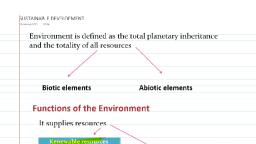
HSEI 1, Chapter -9, , ENVIRONMENT AND SUSTAINABLE DEVELOPMENT, ENVIRONMENT — DEFINITION AND FUNCTIONS, Environment is defined as the total planetary inheritance and the totality of all resources., It includes all the biotic and abiotic factors that influence each other. While all living, elements—the birds, animals and plants, forests, fisheries etc.—are biotic elements, abiotic, elements include air, water, land etc. Rocks and sunlight are examples of abiotic elements of, the environment. A study of the environment then calls for a study of the inter-relationship, between these biotic and abiotic components of the environment, Functions of the Environment: The environment performs four vital functions, (i) it supplies resources: resources here include both renewable and non-renewable, resources. Examples of renewable resources are the trees in the forests and the fishes in the, ocean. Non-renewable resources, on the other hand, are those which get exhausted with, extraction and use, for example, fossil fuel, (ii) it assimilates waste, (iii) it sustains life by providing genetic and bio diversity and, (iv) it also provides aesthetic services like scenery etc., The environment is able to perform these functions without any interruption as long as, the demand on these functions is within its carrying capacity. This implies that the resource, extraction is not above the rate of regeneration of the resource and the wastes generated are, within the assimilating capacity of the environment. When this is not so, the environment, fails to perform its third and vital function of life sustenance and this results in an, environmental crisis. This is the situation today all over the world. The rising population of, the developing countries and the affluent consumption and production standards of the, developed world have placed a huge stress on the environment in terms of its first two, functions. Many resources have become extinct and the wastes generated are beyond the, absorptive capacity of the environment Absorptive capacity means the ability of the, environment to absorb degradation. The result — we are today at the threshold of, environmental crisis Added to these are the health costs of degraded environmental quality —, decline in air and water quality (seventy per cent of water in India is polluted) have resulted, in increased incidence of respiratory and water-borne diseases. Hence the expenditure on, health is also rising. To make matters worse, global environmental issues such as global, warming and ozone depletion also contribute to increased financial commitments for the, government Thus, it is clear that the opportunity costs of negative environmental impacts are, high., STATE OF INDIA’S ENVIRONMENT, India has abundant natural resources in terms of rich quality of soil, hundreds of rivers and, tributaries, lush green forests, plenty of mineral deposits beneath the land surface, vast stretch, of the Indian Ocean, ranges of mountains, etc. The black soil of the Deccan Plateau is, particularly suitable for cultivation of cotton, leading to concentration of textile industries in, this region. The Indo-Gangetic plains — spread from the Arabian Sea to the Bay of Bengal —, are one of the most fertile, intensively cultivated and densely populated regions in the world., India’s forests, though unevenly distributed, provide green cover for a majority of its, population and natural cover for its wildlife. Large deposits of iron-ore, coal and natural gas
Page 13 :
HSEI 2, Chapter -9, , are found in the country. India accounts for nearly 8 per cent of the world’s total iron-ore, reserves. Bauxite, copper, chromate, diamonds, gold, lead, lignite, manganese, zinc, uranium,, etc. are also available in different parts of the country., The threat to India’s environment poses a dichotomy—threat of poverty-induced, environmental degradation and, at the same time, threat of pollution from affluence and a, rapidly growing industrial sector. Air pollution, water contamination, soil erosion,, deforestation and wildlife extinction are some of the most pressing environmental concerns of, India. The priority issues identified are (i) land degradation (ii) biodiversity loss (iii) air, pollution with special reference to vehicular pollution in urban cities (iv) management of, fresh water and (v) solid waste management., Some of the factors responsible for land degradation are (i) loss of vegetation occuring due, to deforestation (ii) unsustainable fuel wood and fodder extraction (iii) shifting cultivation, (iv) encroachment into forest lands (v) forest fires and over grazing (vi) non-adoption of, adequate soilconservation measures (vii) improper crop rotation (viii) indiscriminate use of, agro-chemicals such as fertilisers and pesticides (ix) improper planning and management of, irrigation systems (x) extraction of ground water in excess of the recharge capacity (xi) open, access resource and (xii) poverty of the agriculture-dependent people, India supports approximately 17 per cent of the world’s human and 20 per cent of, livestock population on a mere 2.5 per cent of the world’s geographical area The high density, of population and livestock and the competing uses of land for forestry, agriculture, pastures,, human settlements and industries exert an enormous pressure on the country’s finite land, resources, In India, air pollution is widespread in urban areas where vehicles are the major, contributors and in a few other areas which have a high concentration of industries and, thermal power plants The number of motor vehicles has increased from about 3 lakh in 1951, to 23 crores in 2016. In 2016, personal transport vehicles (two-wheeled vehicles and cars, only) constituted about 85 per cent of the total number of registered vehicles thus, contributing significantly to total air pollution load. India is one of the ten most industrialised, nations of the world. But this status has brought with it unwanted and unanticipated, consequences such as unplanned urbanisation, pollution and the risk of accidents. The CPCB, (Central Pollution Control Board) has identified seventeen categories of industries as, significantly polluting The various measures adopted by the Ministry of Environment and the, central and state pollution control boards may not yield reward unless we consciously adopt a, path of sustainable development.
Page 14 :
Chapter -9, , 1, , SUSTAINABLE DEVELOPMENT, The concept of sustainable development was emphasized by the United Nations Conference, on Environment and Development (UNCED), which defined it as: ‘Development that meets, the need of the present generation without compromising the ability of the future generation, to meet their own needs .Environment and economy are interdependent and need each other., Sustainable development is, in this sense, a development that meets the basic needs of all,, particularly the poor majority, for employment, food, energy, water,housing, and ensures, growth of agriculture, manufacturing, power and services to meet these needs.’So sustainable, development is a path of development in which the options of future generations are not, compromised by the path taken by the present generation”, The Brundtland Commission emphasizes on protecting the future generation we have a, moral obligation to hand over the planet earth in good order to the future generation. The, present generation can promote development that enhances the natural and built, environment in ways that are compatible with (i) conservation of natural assets (ii), preservation of the regenerative capacity of the world’s natural ecological system (iii), avoiding the imposition of added costs or risks on future generations., , STRATEGIES FOR SUSTAINABLE DEVELOPMENT, 1 Use of Non-conventional Sources of Energy : India is hugely dependent on thermal and, hydro power plants to meet its power needs. Both of these have adverse environmental, impacts. Wind power and solar rays are good examples of conventional but cleaner and, greener energy sources but are not yet been explored on a large scale due to lack of, technological devices., 2 LPG, Gobar Gas in Rural Areas: Households in rural areas generally use wood, dung cake or, other biomass as fuel. This practice has several adverse implications like, deforestation,reduction in green cover, wastage of cattle dung and air pollution. To rectify the, situation, subsidised LPG is being provided. In addition, gobar gas plants are being provided, through easy loans and subsidy., 3 CNG in Urban Areas: In Delhi, the use of Compressed Natural Gas (CNG) as fuel in public, transport system has significantly lowered air pollution and the air has become cleaner. In the, last few years many other Indian cities also began to use CNG., 4 Wind Power: In areas where speed of wind is usually high, wind mills can provide, electricity without any adverse impact on the environment. Wind turbines move with the, wind and electricity is generated., 5 Solar Power through Photovoltaic Cells: India is naturally endowed with a large quantity of, solar energy in the form of sunlight . Now, with the help of photovoltaic cells, solar energy, can be converted into electricity. This technology is extremely useful for remote areas and for, places where supply of power through grid or power lines is either not possible or proves, very costly.This technique is also totally free from pollution . India is also leading an, International body called International Solar Alliance (ISA).
Page 15 : Chapter -9, , 2, , 6 Mini-hydel Plants: In mountainous regions, streams can be found almost everywhere. A, large percentage of such streams are perennial. Mini-hydel plants use the energy of such, streams to move small turbines. The turbines generate electricity which can be used locally., Such power plants are more or less environment-friendly as they do not change the land use, pattern in areas where they are located; This means that they can also do away with the need, for large scale transmission towers and cables and avoid transmission loss., 7 Traditional Knowledge and Practices: Traditionally, Indian people have been close to their, environment. They have been more a component of the environment and not its controller.If, we look back at our agriculture system, healthcare system, housing, transport etc., we find, that all practices have been environment friendly Only recently have we drifted away from, the traditional systems and caused large s large scale damage to the environment and also our, rural heritage Now, it is time to go back.. India is very much privileged to have about 15,000, species of plants which have medicinal properties . Now a days every cosmetic produce —, hair oil,toothpaste, body lotion, face cream and what not — is herbal in composition. Not only, are these products environment friendly, they are relatively free from side effects and do not, involve large-scale industrial and chemical processing. damage to the environment and also, our rural heritage., 8 Biocomposting : Farmers, in large numbers all over the country, have again started using, compost made from organic wastes of different types. In certain parts of the country, cattle, are maintained only because they produce dung which is an important fertiliser and soil, conditioner. Earthworms can convert organic matter into compost faster than the normal, composting process. This process is now being widely used, 9 Biopest Control: With the advent of green revolution, the entire country entered into a, frenzy to use more and more chemical pesticides for higher yield. Soon, the adverse impacts, began to show; food products were contaminated, soil, water bodies andeven ground water, were polluted with pesticides. Even milk, meat and fishes were found to be contaminated. To, meet this challenge, efforts are on to bring in better methods of pest control. One such step is, the use of pesticides based on plant products. Neem trees are proving to be quite useful., Several types of pest controlling chemicals have been isolated from neem and these are being, used. In addition, awareness is spreading about various animals and birds which help in, controlling pests, for example, owls and peacocks, prey upon vermin and pests. If these are, allowed to dwell around the agricultural areas, they can clear large varieties of pests, including insects., Sustainable development has become a catch phrase today. It is ‘indeed’ a paradigm shift in, development thinking. Though it has been interpreted in a number of ways, this ensures, lasting development and non-declining welfare for all.,
[email protected]