Notes of 11 EM, Chemistry Thermodynamics.pdf - Study Material
Page 1 :
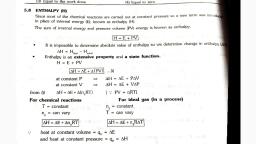
5.8, , I a, , ENTHALPY (H), Since most of the chemical reactions are, in place of internal energy (E); known as enthalpy (H)., , The sum of internal energy and pressure volume (PV) energy is known as enthalpy., , e, 4H = Fiat ~ an, Enthalpy is an extensive property and a state function., , H=E+PV, , a), , at constant P => AH=AE+ PAV, at constant V => AH =AE + VAP, , 4H = AE + A(n,RT) [ « PV = nRT], , from (i), For ideal gas (in a process), , For chemical reactions, T = constant n, = constant, n, = can vary T = can vary, , SASaE saa, , heat at constant volume = q, = AE, and heat at constant pressure = g, = AH, , q, =q, +An,RT qp =q+ n,RAT|, , carried out at constant pressure so a new term was introduce, , It is impossible to determine absolute value of enthalpy so we determine change in enthalpy (AH)
Page 2 :
(4) +1 \é) ~ont, , 5.9 HEAT CAPACITY / MOLAR HEAT CAPACITY 7 SPECIFIC HEAT CAPACITY, , , , , , , (i) Heat capacity (C) : Amount of heat required to raise the temperature of given amount ofa Substang, by 1°C or 1K is called heat capacity., (i) Molar heat capacity (C,):, , Amount of heat required to raise the temperature of 1 mole of substance by 1°C or 1 K ig cal, as molar heat capacity., , (iii) Specific heat capacity (c) : Amount of heat required to raise the temperature of 1 g of substan, by 1°C or 1K is called as specific heat capacity., , , , Constant Pressure | Constant Volume, , , , Heat capacity (C) AH = C,AT AE = CAT, , , , Molar heat capacity (C,) | AH = nc, ,AT AE = nC,,,AT, , , , , , , , Specific heat capacity (c) | AH = mc,AT AE = mc,AT, , , , , , , , Relation between C, and C, for 1 mole of an ideal gas :H=E+ PV, for ideal gas,, PV = nRT, PV=RT for 1 mole, , H = E + RT differentiate w.rt. temperature, , ar)-(a)**, , C,=C,+R, , , , , , () C,-Cy =R} Mayer's formula, , , , , , ap, pa, , (ii), , » Y = Poisson's ratio
Page 4 :
PRE Pre Medical : Chemistry A, , S 3, (b) Work done in reversible adiabatic proces:, , In adiabatic process 4 = 0, FLOT : AE=q+W, , , , => We=nCAT, we (1), C.-C, =R, Ga., CG Cy, R c), ie ths sya, a Cy ( v, R, Ss ray aceaasons (2), nR P,V, —P,V,, From equation (1) and (2) We ie) = |W= “G-i} :, , , , , , , , , , , , (©) Work done in isochoric process., , in isochoric process AV = 0, , W=-P,AV=0 = [W=0], , (@ ~~ Work done in isobaric process, , , , in isobaric process AP = 0 > P., = constant, , , , , , W =-P__AV, , , , , , (e) Work done during free expansion, , during free expension P= 0, , W=-PAV=0 = W=0
Page 5 :
wom tavew nave, , 5.11 SPONTANEOUS PROCESS AND NON-SPONTANEOUS PROCESS., @ Spontaneous process :, ° The process which has a natural tendency to occur in a particular direction either Of its o, proper initiation under the given set of conditions. WD OF attr, , . All natural processes are ir-reversible and spontaneous processes. The natural Processes t ake, of their own in one direction only. Dlace, (i) |Non-spontaneous process :, , The process which does not occur of its own in a particular direction i.e. a process whicl, , ~— h di, have a natural tendency to occur in a particular direction is called as non-spontaneous oro, , Process, Non-spontaneous process may be made to occur when energy from some external source is suppliog, pl, , continuously throughout the process., , Examples of spontaneous process that need no initiation :, Eg.1 Flow of water from high level to low level., Flow of heat from hot body to cold body., Flow of charge from high potential to low potential., Flow of gas from high pressure to low pressure., Eg.2 Melting of ice at 25° C, Evapouration of water at 25° C, Dissolution of common salt in water., Eg.3 Mixing of different non reacting gases, , Examples of spontaneous process that need initiation :, Eg.1 Buming of fuel (coal, petrol), , Cis) + O, —— CO,, , CH, + 20, —~CO, + 2H,O, Eg.2 Lighting of candle, , CRITERIA FOR A PROCESS TO BE SPONTANEOUS :, a Tendency to attain minimum energy, (I) Tendency to attain maximum randomness.



 Learn better on this topic