Notes of CHEMISTRY-XI, Chemistry STRUCTURE OF ATOM - Study Material
Page 1 :
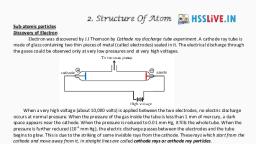
UNIT 2:, STRUCTURE OF ATOM, DISCOVERY OF ELECTRONS:, Cathode ray discharge tube experiment:, The Electron was discovered by J.J Thomson by conducting a Cathode ray tube, experiment., , , , , , , Discovery of Cathode Rays, When a high-voltage electric current is passed through the discharge tube, containing a gas at a very low pressure, a green fluorescence is seen coming, out of the other end of the discharge tube., This fluorescence is the result of rays emitted from the cathode (negative, plate) towards the anode (positive plate) in the discharge tube. Hence, these, rays are called cathode rays., Later, J. J. Thomson studied the characteristics and the constituents of cathode, rays.
Page 2 :
Conclusion: From his experiment, Thomson arrived at the conclusion that, 1. Cathode rays are nothing but a stream of negatively charged particles, called electrons., 2. These negatively charged particles are an integral part of all atoms., 3. Electrons have both definite mass and definite electric charge, both of, which are independent of the nature of the gas in the discharge tube., 4. They travel in straight line and produces heating effect., Properties of Electrons, 1. Electrons from al the sources are alike, having identical mass., 2. They are constituent part of all atoms., 3. An electron carries negative charge of magnitude -1.602×10⁻¹⁹ Coulombs., 4. Its mass is 1/1837 the mass of hydrogen atom, which is 9.108×10⁻³¹ kg., 5. An electron is extremely small, its radius is less than 1×10-15 m., DISCOVERY OF PROTON:, Discovered by E.Goldstein, , In 1836 the same experiment was carried out where the same conditions were, provided. The gas at low pressure was taken and current was passed., o, , The high voltage between the electrodes was passed. It was found that, when cathode rays passed through the gas, they ionized the gas by, taking electrons along, leaving behind positively ionized gas particles.
Page 3 :
o, , These particles were travelling towards cathode.These particles were, found to form the beam of rays of positively charged particles and were, called as canal rays., , o, , These rays consist of positively charged particles called a proton., , Properties of anode rays, 1. They also travel in straight line., 2. They are also made up of particles., 3. They carry positive charge., 4. Their ratio of charge to mass was different for different gas that was, taken in tube., 5. The mass of particles were found to be different for different gases. It, was nearly equal to the mass of atom., When hydrogen gas was taken in the tube its mass was found to be minimum., As we know, Hydrogen atom is the lightest one and its charge to be same as, Electron. It is 1.6x10⁻¹⁹C and its e/m ratio taken as standard that is 1.67x 10⁻²⁴g., Proton is defined as a, “Fundamental particle which carries one-unit positive charge and mass, nearly same as hydrogen atom”., RUTHERFORD’S SCATTERING EXPERIMENT:
Page 4 :
Rutherford passed beams of alpha particles through a thin gold foil to observe, the atom and noted how the alpha particles scattered from the foil., Conclusion of Rutherford's scattering experiment:, 1. Most of the space inside the atom is empty because most of the α-particles, passed through the gold foil without getting deflected., 2. Very few particles were deflected from their path, indicating that the, positive charge of the atom occupies very little space., 3. A very small fraction of α-particles were deflected by very large angles,, indicating that all the positive charge and mass of the gold atom were, concentrated in a very small volume within the atom., Thus Rutherford conclude that most of the space in an atom is empty in which, the nucleus resides in a very small region at the centre where the negatively, charge electrons revolve around the nucleus in circular orbits. The protons, reside at the nucleus and it is the region where most of the mass of an atom, concentrates., Failure of Rutherford’s Model of Atom:, According to Rutherford’s model, electrons revolve around the nucleus in a, circular path. But charged particles that are in motion on a circular path would, undergo acceleration, and acceleration causes the charged particles to radiate, energy in the form of electromagnetic radiation and eventually,the electrons, should lose energy and fall into the nucleus which would lead to instability of, the atom. But this is not possible because atoms are stable. Hence, Rutherford, failed to give an explanation on account of this., DISCOVERY OF NEUTRON:, It was discovered by Chadwick. In which he bombarded some light elements, with fast moving alpha particles. He found, that some new particles were, emitted which carried no charge and had mass equal to that of proton. These, neutral particles were named as neutron., So, neutron is defined as:, “the fundamental particle which carries no charge and mass equal to that of, hydrogen atom.”, Measured masses and charges of the three elementary particles are given in, the following table.
Page 5 :
Particle, , Symbol, , Charge, , Mass, , Electron, , e–, , -1.60×10⁻¹⁹ C, , 9.1×10⁻³¹ kg, , Proton, , p+ (H+), , 1.60×10⁻¹⁹ C, , 1.672×10⁻²⁷ kg, , Neutron, , n0, , 0.00 C, , 1.674×10⁻²⁷ kg, , Atomic no. = No.of Electrons = No. of Protons, Mass no. = No. of Protons + No. of Neutrons, ISOTOPES: Atoms of same elements having same atomic no. but different mass, no. due to difference in no. of neutrons., EX: 12C, 13C, 14C., ISOBARS: Atoms of different elements having different atomic no. but same, mass no., EX: 40Ar, 40Ca., ISOTONES: Atoms of different elements having same no. of neutrons., EX: 14C, 16O., WAVE NATURE OF ELECTROMAGNETIC RADIATION: (JAMES CLARK, MAXWELL), Whenever a charge is placed in an electric or a magnetic field, it experiences a, certain force acting on it or if multiple charges are placed, they experience an, interaction due to one another., When electrically charged particles perform an accelerating motion,, alternating electrical and magnetic fields are produced and transmitted. These, fields traverse in the forms of waves known as electromagnetic radiation. A, light wave is an example of electromagnetic radiation., Properties of Electromagnetic Radiation:, 1. The oscillating charged particles produce oscillating electric and magnetic, fields which are perpendicular to each other and both are perpendicular to the, direction of propagation of the wave., 2. Electromagnetic waves do not require a medium i.e., they can travel in a, vacuum too.
Page 6 :
3. There are many kinds of electromagnetic radiation, differing from one, another in terms of wavelength or frequency. This electromagnetic radiation as, a whole constitutes the electromagnetic spectrum. For example radio, frequency region, microwave region, infrared region, ultraviolet region, visible, region etc., 4. The electromagnetic radiation is characterized based on various properties, like frequency, wavelength, time period etc., , Fig: Electromagnetic spectrum, Properties of Waves, The prime properties of waves are as follows:, Amplitude (a) – Wave is an energy transport phenomenon. Amplitude is the, height of the wave, usually measured in meters. It is directly related to the, amount of energy carried by a wave., Wavelength (λ) – The distance between identical points in the adjacent cycles, of crests of a wave is called a wavelength. It is also measured in meters.
Page 7 :
Period – The period of a wave is the time for a particle on a medium to make, one complete vibrational cycle. As the period is time, hence is measured in, units of time such as seconds or minutes., Frequency (ʋ) – Frequency of a wave is the number of waves passing a point in, a certain time. The unit of frequency is hertz (Hz) which is equal to one wave, per second., The period is the reciprocal of the frequency and vice versa., Period=1/Frequency, OR, Frequency=1/Period, Speed – The speed of an object means how fast an object moves and is usually, expressed as the distance travelled per time of travel. The speed of a wave, refers to the distance travelled by a given point on the wave (crest) in a given, interval of time. That is –, Speed=Distance/Time, Speed of a wave is thus measured in meter/second i.e. m/s., DIFFRACTION AND INTERFERENCE:, Interference refers to the phenomenon where two waves of the same kind, overlap to produce a resultant wave of greater, lower, or the same amplitude., , FIG: Constructive and Destructive Interference
Page 8 :
Constructive interference occurs when light waves align crest to crest and, trough to trough to grow in intensity, while destructive interference is when, light waves collide and the crests and troughs align cancelling out the light all, together., , Diffraction is defined as the bending of a wave around the corners of an, obstacle or aperture., , FIG: Diffraction, A good example of this is the diffraction of sunlight by clouds that we often, refer to as a silver lining, illustrated in Figure 1 with a beautiful sunset over the, ocean. When sunlight (or moonlight) encounters a cloud droplet, light waves, are altered and interact with one another in a similar manner as the water, waves described above. If there is constructive interference, (the crests of two, light waves combining), the light will appear brighter. If there is destructive, interference, (the trough of one light wave meeting the crest of another), the, light will either appear darker or disappear entirely., ., , PARTICLE NATURE OF ELECTROMAGNETIC RADIATION:, Planck’s Quantum Theory Of Radiation
Page 9 :
The main points of quantum theory are, Substances radiate or absorb energy discontinuously in the form of small, packets or bundles of energy., The smallest packet of energy is called quantum. In case of light the, quantum is known as photon., The energy of a quantum is directly proportional to the frequency of the, radiation. E α ʋ (or) E = hʋ where ʋ is the frequency of radiation and h is, Planck’s constant having the value 6.626 X 10⁻²⁷ erg sec or, 6.626 X 10⁻³⁴ J sec., A body can radiate or absorb energy in whole number multiples of a, quantum hn, 2hʋ,3hʋ ………..Nhʋ. Where ‘N' is the positive integer., Energy associated with Avogadro’s no. of quanta is known as EINSTEIN, OF ENERGY (E), E = Nohʋ, Where No is Avogadro’s No., BLACKBODY RADIATION:, In thermal equilibrium, a black body emit radiation at the same rate as it, absorbs and so it is a perfect emitter of radiation, emitting electromagnetic, waves of as many frequencies as it can absorb i.e. all the frequencies. The, radiation emitted by the blackbody is known as blackbody radiation., , FIG: Graph between wavelength and intensity of radiations.
Page 10 :
In the image above, we notice that:, , , As the temperature of the blackbody increases, the peak of emitted, radiation moves towards shorter wavelength. The intensity of all, wavelengths increases as the temperature of the blackbody increases., , , , The total energy being radiated (the area under the curve) increases, rapidly as the temperature increases., , , , Although the intensity may be very low for very short as well as very, long wavelengths, at any temperature above absolute zero, radiation of, all wavelengths is emitted. (the blackbody radiation curves never reach, zero)., , Thus when a piece of metal is heated, it first becomes ‘red hot’ as it emits red, light the longest wavelength of electromagnetic radiation of the visible, spectrum . On further heating, the emitted radiation moves from red to orange, and then yellow i.e towards shorter wavelength i.e more energetic radiations., At its hottest, the metal will be seen to be glowing white as it emits shorter, wavelengths of radiation i.e bluish white with greater intensity., , Photoelectric Effect:, When a light of certain frequency strikes the surface of a metal of low, ionisation energy, electrons are ejected from the metal. This phenomenon is, known as photoelectric effect and the ejected electrons are called, photoelectrons., , FIG: Photoelectric effect.
Page 11 :
Observations of photo electric effect:, (i) The electrons are ejected from the metal surface as soon as the beam of, light that possesses a certain minimum frequency known as threshold, frequency (ʋo) strikes the surface of the metal and it is different for different, metals., (iii) The kinetic energy of the ejected photoelectrons is, directly proportional to the frequency of the incident radiation and it is, independent of its intensity., (iv) The number of electrons ejected per second from the metal surface, depends upon the intensity or brightness of incident radiation but does not, depend upon its frequency., EXPLANATION OF PHOTOELECTRIC EFFECT:, Einstein explained the photoelectric effect with the help of particle nature of, light in 1905. Electrons are held by the nuclei of the metal atoms by a certain, known as binding force. When radiations of a certain frequency i.e threshold, frequency (ʋo) pocessesing a certain minimum amount of energy known as, threshold energy or work function (WO) strikes the metal surface the energy, of the photons are transferred to the loosely held valence electrons of the, metal atom which results in stricking out of the electrons as photoelectrons., When the incident radiation possesses energy greater than threshold energy, then the photoelectrons take up the extra energy as kinetic energy., Energy of incident photon (hʋ) = Work function (ʋo) + kinetic energy of, emitted electron ( ½ mv2), If the energy of the photon of the incident radiation is less than the threshold, energy then no electrons will be emitted. Greater is the intensity of the, incident radiation greater is the no. of photons released hence greater is the, no. of photoelectrons emitted., Dual Behaviour of Electromagnetic Radiation:, The photoelectric effect could be explained considering that radiations consist, of small packets of energy called quanta. These packets of energy can be, treated as particles. On the other hand, radiations exhibit phenomenon of, interference and diffraction which indicated that they possess wave nature
Page 12 :
also. So it may be concluded that electromagnetic radiations possess dual, nature., 1. Particle nature, 2. Wave nature, ATOMIS SPECTRA OF ELEMENTS:, Atomic spectra is the study of atoms (and atomic ions) through their, interaction with electromagnetic radiation., It is of types EMISSION SPECTRA and ABSORBTION SPECTRA., Emission Spectrum, Whenever electromagnetic radiation interacts with atoms and molecules of, matter, the electrons in these atoms absorbs energy and jump to a higher, energy level, losing their stability and they regain their stability, when these, electron return from their higher energy level to their lower energy level, by emiting radiation in various regions of the electromagnetic spectrum. This, spectrum of radiation emitted by electrons in the excited atoms or molecules, is known as an emission spectrum., It is of two types continuous spectra and line spectra., Continuous spectra : A spectrum (as of light emitted by a white-hot lamp, filament) having no apparent breaks or gaps throughout its wavelength, range. Eg rainbow., , Line spectra: A spectrum that consists of narrow, brightly colored, parallel lines, on a dark background, emitted by a low-pressurized glowing gas.
Page 13 :
FIG: Hydrogen absorption and emission lines spectra in the visible spectrum, ABSORPTION SPECTRA: When sunlight or white light is passed through, vapours of a substance and the transmitted light is allowed to strike a prism,, dark lines appear in the otherwise continuous spectrum. The dark lines, indicate the radiations corresponding to the absorbed radiations by the, substance from the white light. This spectrum is known as Absorption Spectra., BOHR’S MODEL OF AN ATOM:, 1. An atom has a number of stable orbits in which an electron can reside, without the emission of radiant energy. Each orbit corresponds, to a certain, energy level. The energy of the stationary orbit of an electron is given by, En = -RH (1/n2), , ; n =1,2,3,……………., , RH = Rydberg’s constant = 2.18 x 10- 18 J, 2. Only those orbits are permitted for electrons whose angular momentum is, an integral multiple of h/2π, Thus, mvr = nh/2π, where m = mass of the electron, v = velocity of the electron, r = radius of the orbit and, n = 1,2,3,4,………..
Page 14 :
3. As long as an electron is revolving in an orbit it neither loses nor gains, energy. Hence these orbits are called stationary states. Each stationary state is, associated with a definite amount of energy and it is also known as energy, levels. The greater the distance of the energy level from the nucleus, the more, is the energy associated with it. The different energy levels are numbered as, 1,2,3,4, (from nucleus onwards) or K, L, M, N etc., 4. An electron, may jump (excite) instantaneously from lower energy/normal, or ground state (say 1) to higher energy level/ excited state (say 2, 3, 4, etc.) by, absorbing one or more quanta of energy., Energy absorbed when an electron jump from E1 to E2, (∆E) is given by, ∆E =E2 – E1 = hʋ, Where E1 and E2 are the energies of the electron in the initial and final energy, levels, and ʋ is the frequency of radiation absorbed by the electron and the, amount of energy is emitted when the electron jumps back to the initial, ground energy level., ACHIEVEMENTS OF BOHR’S MODEL OF ATOM:, 1. It explains the stability of an atom as electron neither losses nor gains, energy as long as it revolves around the nucleus in its fixed circular orbit., 2. It can explain atomic spectrum of hydrogen atom., 3. It helps in calculating the energy of an electron in hydrogen and H like 1, electron species., En = (-2∏2 k2 me e4 z2) / n2 h2, K = absolute permittivity of the medium ( vacuum) = 9 x 10⁹ Nm2C—2, Me = mass of the electron = 9.1 x 10 –31 Kg, e = charge on the electron = 1.6 x 10 –19 C, Z =Nuclear charge of the element, h = Planck’s constant = 6.626 x10 –34 Kg m2 s –1, Significance of negative for electronic energy:
Page 15 :
When an electon is at infinite distance from the nucleus it doesn’t experience, any force of attraction from the nucleus and its energy is regarded to be zero., If the electron jumps from infinite distance towards the nucleus, energy is, released as a result of the attraction. Therefore the energy of the electron will, become less than zero and it has negative sign., BOHR’S EXPLAINATION OF HYDROGEN SPECTRA:, Hydrogen atom has atomic number ‘Z’ as one. It contains one electron, revolving round the nucleus. When electric discharge is passed through, hydrogen gas enclosed in a discharge tube under low pressure and the emitted, light is analyse by a spectroscope the spectrum consist of a large no. of lines, which are group into different series. The series of spectrum are namely, Lyman, Balmer, Paschen, Brackett and Pfund. The spectrum of H-atom can, now be explained on the basis of Bohr's Model of an atom. When an electron, absorbs energy it jumps from lower energy level to higher energy level and, when it returns to its lower energy level, energy is emitted in form of, electromagnetic radiation. The radiation emitted in such a transition, corresponds to the spectral line in the atomic spectra of H-atom., The wavelength of the radiation depends upon the initial and final energy, levels within which the transition takes place.
Page 16 :
The wavelengths and frequencies of different spectral lines are given in the, below table., Series of lines, , nf, , ni, , Spectral region, , Wavelength, , Lyman Series, , 1, , >1, , UV, , < 4000, , Balmer Series, , 2, , >2, , Visible, , 4000 to 7000, , Paschen Series, , 3, , >3, , Near IR, , > 7000, , Brackett Series, , 4, , >4, , Far IR, , > 7000, , Pfund Series, , 5, , >5, , Far IR, , > 7000, , When an electron jumps to lowest energy level (nf = 1) from any higher energy, level (ni = 2,3,4,5……) the spectral series of the emitted radiations belong to, Lyman series. Similarly when an electron jumps to energy level (nf = 2) from, any higher energy level (ni = 3,4,5,6,7……) the spectral series of the emitted, radiations belong to Balmer series and so on., The energy associated with the photon emitted by an electron when it jumps, from initial energy level ni to final energy level nf is given by,, ∆E = {- RH (1/ nf2)} - {- RH (1/ ni2)}, ∆E = RH { (1/ ni2) - (1/ nf2)}, ∆E = 2.18 x 10⁻¹⁸ J { (1/ ni2) - (1/ nf2)}, , RH = 2.18 x 10⁻¹⁸ J, , The frequency and wavelength associated with the photon of the radiation, emitted by an electron when it jumps from initial energy level ni to final, energy level nf is given by,, ʋ = ∆E/h = RH/h { (1/ ni2) - (1/ nf2)}, , RH = 2.18 x 10⁻¹⁸ J, , λ = C/ʋ = {3.0 x 10⁻⁸ m/s}/[{RH/h { (1/ ni2) - (1/ nf2)], respectively.
Page 17 :
Limitations of Bohr’s theory:, , , It can’t explain the spectra of atoms having more than one electron., , , , Neils Bohr’s atomic model failed to account for Zeeman effect and Stark, effect on the spectra of atoms or ions. Splitting of each spectral line into, a number of lines when the source of a spectrum is placed in a strong, magnetic and electric field are known as Zeeman Effect and Stark Effect, respectively., , , , De Broglie suggested that electrons like light have dual character. It has, both particle and wave nature. Bohr treated the electron only as, particle., , , , Another objection to Bohr’s theory came from Heisenberg’s Uncertainty, Principle. According to this principle “It is impossible to determine, simultaneously the exact position and momentum of a small moving, microscopic particle like an electron”. The postulate of Bohr, that, electrons revolve in well define orbits around the nucleus with well, define velocities is thus in contradiction with Heisenberg’s Uncertainty, Principle., , DUAL NATURE OF MATTER (de-Broglie Equation):, From Planck’s Quantum Theory we have,, E = hʋ…………………….. (1), From Einstein’s mass energy relation we have,, E = mc2……………………. (2), From equations 1 and 2 we have,, mc2 = hʋ, mc2 = hc/λ, mc = h/λ, λ = h/mc ………………... (3)
Page 18 :
Here c is the velocity of light. If v is the velocity of a moving material object, then equation (3) may be represented as, λ = h/mv = h/p, , where p = momentum =mv, , i.e λ α 1/p, i.e wave nature α (1/ particle nature), Thus greater is the mass or particle nature lesser is the wave nature., Derivation of Bohr’s Quantisation of Angular Momentum from de-Broglie, relationship:, , Figure 1. The circumference of the orbit in (A) allows the electron wave to fit, perfectly into the orbit. This is an allowed orbit. In (B), the electron wave does, not fit properly into the orbit, so this orbit is not allowed., For sn electron moving in nth orbit of radius r around the nucleus if the wave, motion is to remain continuously in phase, the circumference of the electron, orbit must be an integral multiple of the wavelength λ., 2∏r = nλ, λ = 2∏r/n …………………. (1), But λ = h/mv from de- Broglie relationship equation (1) becomes
Page 19 :
h/mv = 2∏r/n, i.e mvr = nh/2∏ ………………………. (2), Equation 2 represents Bohr’s quantisation of angular momentum., HEISENBERG’S UNCERTAINTY PRINCIPLE:, It states that “It is impossible to measure simultaneously the position and, momentum of a small microscopic moving particle with absolute accuracy or, certainty” i.e., if an attempt is made to measure any one of these two, quantities with higher accuracy, the other becomes less accurate., The product of the uncertainty in position (∆x) and the uncertainty in the, momentum (∆p = m x ∆v where m is the mass of the particle and v is the, uncertainty in velocity) is equal to or greater than h/4π where h is the Planck’s, constant., Thus, the mathematical expression for the Heisenberg’s uncertainty principle is, simply written as, ∆x ∆p ≥ h/4π, Explanation of Heisenberg’s uncertainty principle, Suppose we attempt to measure both the position and momentum of an, electron, to pinpoint the position of the electron we have to use light so that, the photon of light strikes the electron and the reflected photon is seen in the, microscope. As a result of the hitting, the position as well as the velocity of the, electron are disturbed. The accuracy with which the position of the particle can, be measured depends upon the wavelength of the light used. The uncertainty, in position is ±λ. The shorter the wavelength, the greater is the accuracy. But, shorter wavelength means higher frequency and hence higher energy. This, high energy photon on striking the electron changes its speed as well as, direction. But this is not true for macroscopic moving particle. Hence, Heisenberg’s uncertainty principle is not applicable to macroscopic particles., Question: An electron cannot exist in the nucleus. Explain.
Page 20 :
Ans: Let us assume that electrons exist in the nucleus. The radius of the, nucleus is approximately 10-15 m. If electron is to exist inside the nucleus, then, uncertainty in the position of the electron is given by, ∆x= 10-15 m, According to Heisenberg’s uncertainty principle,, ∆x. m∆v =h/4∏ ………………….. (1), Putting all the values of h = 6.626 x10⁻³⁴ J s, m = 9.1 x10⁻³¹Kg, ∏ = 3.14 in equation (1) we have,, ∆v = 5.79 x 10¹⁰ m/s, Since this value comes out to be greater than the velocity of light i.e 3.0 x 10⁸, m/s, this means that an electron can’t exist in the nucleus., QUANTUM MECHANICAL MODEL OF AN ATOM:, Features of quantum mechanical model:, 1. The energy of an electron is quantized i.e. an electron can only have, certain specific values of energy., 2. The quantized energy of an electron is the allowed solution of the, Schrödinger wave equation and it is the result of wave like properties of, electron., 3. As per Heisenberg’s Uncertainty principle, the exact position and, momentum of an electron cannot be determined. So the only probability, of finding an electron at a position can be determined and it is |ψ|2 at, that point where ψ represents the wave-function of that electron., 4. An atomic orbital is the wave-function (ψ) of an electron in an atom. It is, the region in the space around the nucleus where the probability of, finding an electron is maximum. Whenever an electron is described by a, wave-function, it occupies atomic orbital. As an electron can have many, wave-functions, there are many atomic orbitals for the electron. Every
Page 21 :
wave-function or atomic orbital have some shape and energy associated, with it., 5. The probability of finding an electron at a point within an atom is, proportional to the square of the orbital wave function i.e., | ψ |2 at that, point. | ψ |2 is known as probability density and is always positive., Differences between an orbit and an orbital:, Orbits, Orbit is a well-defined circular path, around the nucleus in which, electrons revolve around the, nucleus., It represents the motion of an, electron in one plane., All the orbits are either circular or, elliptical., , In an orbit one, two or more than, two electrons can be present. In an, orbit number of electrons can be 2n2, where ‘n’ is number of orbit or, principle quantum number., Orbits are non-directional in nature., , In an Orbit both the position and, momentum of an electron can be, measured simultaneously with, certainty which is against, Heisenberg’s uncertainty principle., , Orbitals, 3-dimensional space, around the nucleus where, is probability of finding an, electron is maximum is, called an orbital., It represents motion of an, electron in threedimensional space., Orbitals are of different, shapes such as spherical,, dumbbell and double, dumbbell., In one orbital maximum, two electrons can be filled., , Orbitals are directional in, nature except s-orbitals, which are spherical in, shape., Orbitals concept, completely complies with, Heisenberg’s uncertainty, principle., , QUANTUM NUMBERS: Quantum numbers may be defined as a set of four, numbers with the help of which we can get complete information about all the
Page 22 :
electrons in an atom. It tells us the address of the electron i.e., location,, energy, the type of orbital occupied, orientation of that orbital and spin of the, electron., Principal Quantum No (n): It gives us information about the main shell in, which the electron resides, the approximate distance of the electron from the, nucleus and energy of that particular electron. It also tells the maximum, number of electrons that a shell can accommodate is 2n2, where n is the, principal quantum number., Shell, , K, , L, , M, , N, , Principal quantum number (n), , 1, , 2, , 3, , 4, , Maximum number of electrons, , 2, , 8, , 18, , 32, , Azimuthal or angular momentum quantum number (l): This represents the, number of subshells present in the main shell. These subshells within a shell, will be denoted as 0, 1, 2, 3, …… or s, p, d, f… This tells the shape of the, subshells. The orbital angular momentum of the electron is given as √l(l +1), h/2π . For a given value of n values of possible l vary from 0 ………….. n – 1., Magnetic quantum number (ml): An electron due to its angular motion around, the nucleus generates an electric field. This electric field is expected to, produce a magnetic field. Under the influence of external magnetic field, the, electrons of a subshell can orient themselves in certain preferred regions of, space around the nucleus called orbitals. The magnetic quantum number, determines the number of preferred orientations of the electron present in a, subshell. The values allowed depends on the value of l, the angular momentum, quantum number, ml can assume all integral values between –l ..……..0……… +l., Thus m can be –1, 0, +1 for l = 1.Total values of m associated with a particular, value of l is given by 2l+ 1., Spin quantum number (mS): An electron in an atom not only revolves around, the nucleus but also spins about its own axis. Since an electron can spin either, in clockwise direction or in anticlockwise direction, therefore, for any particular, value of magnetic quantum number, spin quantum number can have two
Page 23 :
values, i.e., +1/2 and –1/2 or these are represented by two arrows pointing in, the opposite directions, i.e., ↑ and ↓.
Page 24 :
Quantum Number, , Symbol, , Values, , Principal quantum No., , n, , 1,2,3..., , Azimuthal quantum No., , l, , 0,1,2,.......,n-1, , Magnetic quantum No., , ml, , -l …….0…….. +l, , Spin quantum No., , ms, , +1/2,-1/2, , Filling up of electrons in an atom:, There are some important rules for filling up of electrons which can be discuss, as follows:, AUFBAU PRINCIPLE:, It states that, “In the ground state of an atom the electrons are added progressively to the, various orbitals in increasing order of their energies starting from the lowest, energy level.”, 1. The orbital having lower (n + l) value have lower energy., 2. For orbitals whose (n + l) values are equal, the orbital having lower value of, 'n' has lower energy. It is important to remember that because of this rule, this, sequence of energy levels pertains to energy level up to '3p' and thereafter,, '4s' orbitals comes first instead of '3d'. Thus, the orbitals should be filled in the, order:, 1s, 2s, 2p, 3s, 3p, 4s, 3d, 4p, 5s, 4d, 5p, 6s, 4f, 5d, 6p, 7s
Page 25 :
FIG: Sequence of filling up of electrons in orbitals belonging to different, energy levels., PAULI’S EXCLUSION PRINCIPLE:, No two electrons in an atom can have the same set of four quantum numbers., OR, An orbital can accommodate a total of two electrons of opposite spins., HUND’S RULE OF MAXIMUM SPIN MULTIPLICITY:, “Electron pairing in p, d and f degenerate orbitals occurs only when each, degenerate orbital of a given sub shell is first singly filled.”, Representation of electronic configuration of an atom of an element:
Page 26 :
Electronic configuration of Na, , STABILITY OF HALF FILLED AND FULLY FILLED ELECTRONIC CONFIGURATIONS:, This is because of two reasons:, 1. Symmetrical distribution: As everyone knows that symmetry leads to, stability. The orbitals in which the sub-shell is exactly half-filled or, completely filled are more stable because of the symmetrical, distribution of electrons., 2. Exchange energy: The electrons which are there in degenerate orbitals, have a parallel spin and tend to exchange their position. Exchange, energy is nothing but the energy released during this process. When the, orbitals are half-filled or completely filled then the number of exchange, is maximum. Therefore, its stability is maximum., , Electronic Configuration of First 30 Elements with Atomic Numbers:, Given below is a table describing the electronic configuration of first 30, elements with atomic numbers., Atomic Number, , Name of the Element, , Electronic Configuration, , 1, , Hydrogen (H), , 1s1, , 2, , Helium (He), , 1s2
Page 29 :
SHAPES OF ATOMIC ORBITALS:, s-orbitals are spherically symmetric having the probability of finding, the electron at a given distance equal in all the directions. The size of the s, orbital is also found to increase with the increase in the value of the principal, quantum number (n), thus, 4s > 3s> 2s > 1s., , An important feature of the 2s-orbital is that there is a spherical shell within, this orbital where the probability of finding the electron is zero (nearly). This is, called a radial node. In 2s orbital there is one spherical node. The number of, nodal surfaces or nodes in s-orbital of any energy level is equal to (n-1),, where n is the principal quantum number., p orbitals are dumbell in shape. For p-subshell l = 1, and there are three values, of ml namely -1, 0, +1. It means that p orbitals can have three possible, orientations. These three p-orbitals are equal in energy (degenerate state) but, differ in their orientations. Each p-orbital consists of two lobes symmetrical, about a particular axis. Depending upon the orientation of the lobes, these are, denoted as 2px, 2py and 2pz accordingly as they are symmetrical about X,Y and, Z - axis respectively. Similar to s orbitals, size, and energy of p orbitals, increases with an increase in the principal quantum number (4p > 3p > 2p)., Two lobes of each p-orbital are separated by a nodal plane (a plane having zero, electron density). For example, for 2px orbital, YZ plane is the nodal plane.
Page 30 :
d-orbitals are double dumbbell in shape. There are 5 d-orbitals. These orbitals, are designated as dxy, dyz, dxz, dx2–y 2 and dz2. Out of these five d orbitals, shapes, of the first four d-orbitals are similar to each other, which is different from the, dz2 orbital whereas the energy of all five d-orbitals is the same. The dxy, dyz and, dzx orbitals have same shape i.e., clover leaf shape (double dumbbell) but they, lie in XY, YZ and ZX-planes respectively. The dz2 orbital is symmetrical about Zaxis and has a dumb - bell shape with a doughnut shaped electron cloud in the, centre., The dx2–y 2 orbital is also clover leaf shaped (double dumbbell) but its leaves are, directed along the X and Y- axis., Each d orbital has two nodal planes or angular nodes. For the dZ2 orbital, the, nodal planes are represented by a single conical surface. For dxy orbital the, nodal planes are ZX and ZY planes. For dyz orbital the nodal planes are XY and, XZ planes. Similarly for dxz orbital the nodal planes are XY and YZ planes., A node is a point where the electron probability is zero., For a given orbital there are two types of nodes., 1) Radial node, Radial node is also called as nodal region. Radial node is a spherical surface, where the probability of finding an electron is zero., The number of radial nodes increase with principle quantum number (n)., 2) Angular node, Angular node is also called nodal plane., Angular node is a plane that passing through the nucleus., Angular node is equal to the azimuthal quantum number (l).
Page 31 :
The number of angular nodes = l, The number of radial nodes = (n - l - 1), Total number of nodes = n - 1, , FIG: Nodal planes of d-orbitals, f-orbitals have a diffused shape.



 Learn better on this topic