Page 1 :
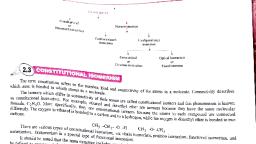
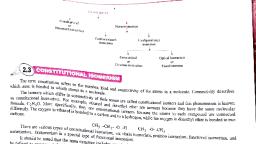
2.8 STEREOIsoMERISM, but different spatial arrangement, s me, s naving, stereoisomers and the isomerism exhibited by them is called stereoisomerism., uhe, , constitution, , of their, , atoms, , or, , groupS, , are, , known, , as, , isomerism. The different, conformational, isomerism and, configurational, stereoisomerism:, of, about single bonds 1s called, interconvertible by rotation, spatial arTangement of atoms in a molecule which is readily, without breaking of, which is not interconvertible, conformation. The different spatial arrangement of atoms in a molecule, also called, different configurations are, bond(s) and formation of bonds is called configurations. Stereoisomers having, different, molecule,, a, different configuration in, isomers. A molecule can have only one configuration, i.e., a, , There, , are two, , types, , contigurational, , whereas a molecule could have an infinite number of conformations., , 2.9 cONFIGURATIONAL 1SOMERISM, There, , are, , two kinds of configurational, , (cis-trans isomerism)., , isomerism:, , () optical isomerism (enantiomerism) and (i) geometrical isomerism
Page 2 :
I50NILNIOM, , 2.9-1., , Enantiomerismn, , Isomers which, , enantiomorphs, , compounds, , or, , exhibit, , nonsuperimposable mirror images of each other are called enantiomers (optical antipodes or, mirror-image isomers) and the isomerism exhibited by them is known as enantiomerism. Al, optically ace, enantiomerism. Thus, in older literature the term, optical activity has been used for enantiomerism, but this 1, are, , it has also been used, not appropriatebecause sometimes, The, stereoisomers which, stereoisomers., diastereomers, are, not mirror, which, of each, images, , are, , Optical Activity, , 2.9-2., , other, , and, , are, , diastereomers having chiral centres. All the enantiomers and, images of each other are called enantiomers. and those, called diastereomers., , Optically, , for, , are, , mirror, , Active, , Compounds, , Compound which rotates the plane of plane polarised light is known as optically active compound and the phenomenon is, as optical activity., Whether compound is optically active or not can be known by the configuration of the compound as well as by, , known, , polarimeter., , Ifa, , plane polarised light in clockwise direction then it is dextrorotatory, (+) form or (d) torm. If a, substance rotates the plane polarised light in, ( form or ( form. Whether the, direction, thenitisand, laevorotatory,, compound is (d) form or () form can be knownanticlockwise, only by the use, of polarimeter, not bythe configuration, of thecompound., substance rotates the
Page 5 :
2.11 ELEMENTS OF SYMMETRY, whether it, is chiral or achiral, i.e.,, a simple device to decide whether a molecule, offer, symmetry, and, EementsS, no centre of symmetry, Superimposable on its mirror image or not. When a molecule has no plane of symmetry,, alternating axis of symmetry, it is nonsuperimposable on its mirror image and is chiral (optically active)., , of, , 2.11-1., , Plane of, , 1s, no, , Symmetry, , The plane which divides a molecule into two equal halves which are related as object and miror image is known as plane, of symmetry. For example :, , COOH, I, , a-, , H-C-OH, , I, , H-C-OH, , II, , Plane, , II, , Plane, , -b, , ad, , PROBLEM 8., , are, , mirror, , images hence, , there is, , plane, , of symmetry, , COOH, , Plane of symmetry, , The molecules, , I and II, , Plane of symmetry, , having plane of symmetry, , are, , achiral, , (optically inactive)., , The given molecule is optically active or inactive and why?, , COOH, , H-C-OH, HO-C-H, COOT, Colution, , :, , The given molecule, , is, , chiral, , it has no, , because, COOH, , H-COH, HO C-H, COOH, , plane of symmetry. Thus, the, no, , I, , plane, , of, , symmetry, because portion, I is, mirror image of ll not, , given molecule, , is, , optically active.