Page 1 :
UNIT : 1, SOME BASIC CONCEPTS OF CHEMISTRY, Matter : Anything that occupies spaces and have mass is known as matter., Physical Classification Of Matter :, Solid , Liquid , Gas and Plasma., Chemical Classification Of Matter :
Page 2 :
SEVEN BASIC PHYSICAL QUANTITIES AND THEIR MEASUREMENTS :, Quantity, , Unit, , Symbol, , Mass, , Kilogram, , kg, , Time, , Second, , s, , Temperature, , Kelvin, , K, , Electric Current, , Ampere, , A, , Luminous Intensity, , Candela, , cd, , Length, , Meter, , m, , Amount of Substance, , Mole, , mol, , Units of density, area, volume etc are known as derived unit because they are, derived from two or more basic physical units., Density = Mass/Volume ( gm/L), Area = Length X Breadth ( m2), Volume =Length x Breadth x Height ( m3), PREFIXES USED IN SI SYSTEM :, Prefix, , Power of 10, , Symbol, , Exa, , 18, , E, , peta, , 15, , P, , tera, , 12, , T, , giga, , 9, , G
Page 3 :
mega, , 6, , M, , Kilo, , 3, , k, , hecto, , 2, , h, , deca, , 1, , da, , deci, , -1, , d, , centi, , -2, , c, , milli, , -3, , m, , micro, , -6, , μ, , nano, , -9, , n, , pico, , -12, , p, , femto, , -15, , f, , SCIENTIFIC NOTATION OF NUMBERS :, Scientific notation is a form of presenting very large numbers or very small, numbers in a simpler form., The examples of scientific notation are:, 490000000 = 4.9×10⁸, 1230000000 = 1.23×10⁹, 50500000 = 5.05 x 10⁷, 0.000000097 = 9.7 x 10⁻⁸, 0.0000212 = 2.12 x 10⁻⁵, SIGNIFICANT FIGURES, Significant figures are total number of digits in any number including the last, digit whose value is uncertain.
Page 4 :
Precision and Accuracy : Precision refers to the closeness of various, measurements for the same quantity while accuracy refers to the agreement, of a particular value to the true value of the result., Rules for Determination of Number of the Significant Figures, , , All non-zero digits are significant. For example, 866 has three significant, figures and 0.866 also has three significant figures.., , , , Zeros to the left of the first non-zero digit in the number are not, significant. For example, 0.008 has only one significant figure and 0.0085, has two significant figures., , , , Zeros between non-zero digits are significant. For example, 3.05 has, three significant figures., , , , Zeros to the right of the decimal point are significant. For example, 6.00,, 0.60 and 0.6000 have 3, 2 and 4 significant figures., , , , If a number ends with zeros that does not have decimal, the zeros are, not significant. For example: 3800 has two significant figures., , Identify the number of significant digits/figures in the following given numbers., 45, 0.046, 7.4220, 5002, 3800., Solution:, , Number, , Number of Significant digits/figures, , 45, , Two, , 0.046, , Two, , 7.4220, , Five
Page 5 :
5002, , Four, , 3800, , Four, , LAWS OF CHEMICAL COMBINATIONS :, Law Of Conservation Of Mass:, Proposed by Antoine Lavoisier in 1744. According to this law, “Matter can, neither be created nor destroyed in a chemical reaction”., For any chemical change total mass of active reactants are always equal to the, mass of the product formed., Total masses of reactants = Total masses of products + Masses of unreacted, reactants., Law of Constant Composition/Definite Proportion :, This law was proposed by Joseph Proust in 1799., According to this law a chemical compound always contains same elements in, definite proportion by mass and it does not depend on the source of, compound., This law can also be stated as “All pure samples of the same chemical, compounds contain the same elements combined in the same proportion by, mass”. For example, a sample of pure water from various sources or any, country always contains hydrogen and oxygen in the same fixed ratio of 1:8 by, mass., Law of Multiple Proportion, This law was proposed by John Dalton in 1804., This law states that “When two elements combine to form two or more than, two different compounds then the different masses of one element which, combine with fixed mass of the other element bear a simple whole no ratio to, one another.”
Page 6 :
For example, let us assume 2 molecules CO (carbon monoxide) and CO2, (carbon dioxide)., CO= 12gm of carbon + 16 grams of Oxygen., CO2 = 12gm carbon+ 32 grams of Oxygen., The ratio of the mass of oxygen in the given two compounds is 16:32=1:2., Thus law of multiple proportions is proved., Law of Reciprocal Proportion, This law was proposed by “Richer” in 1794, This law states that "If two different elements combine separately with the, same weight of a third element, the ratio of the masses in which they do so are, either the same or a simple multiple of the mass ratio in which they combine., For example: Oxygen and sulfur react with copper to give copper oxide and, copper sulfide, respectively.Sulfur and oxygen also react with each other to, form SO2. Therefore,in CuS:Cu:S = 63.5:32 in CuO:Cu:O = 63.5:16 S:O = 32:1, S:O = 2:1 Now in SO2 :S:O = 32:32 S:O = 1:1Thus the ratio between the two, ratios is the following:2:1, Gay Lussac’s law of Combining Volumes, In 1808, Gay Lussac gave this law based on his observations., At given temperature and pressure the volumes of all gaseous reactants and, products bear a simple whole number ratio to each other., For example : 1 volume of hydrogen and 1 volume of chlorine always combine, to form two volumes of hydrochloric acid gas. The ratio between the volumes, of the reactants and the product in this reaction is simple, i.e., 1:1:2., Avogadro’s Law, Avogadro proposed this law in the year 1811., It stated that under the same conditions of temperature and pressure, an, equal volume of all the gases contains an equal number of molecules
Page 7 :
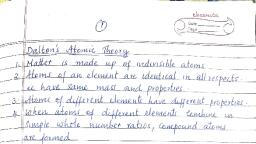
For example : Under normal conditions of temperature and pressure 22.4 Lof, any gas will contain 6.022 x 10²³ no. of gas molecules., Dalton’s Atomic Theory :, Dalton, in 1808, proposed that matter was made up of extremely small,, indivisible particles called atoms., The main postulates of Dalton’s atomic theory are, , , Matter is made up of small indivisible particles, called atoms., , , , Atoms can neither be created nor destroyed. This means that a, chemical reaction is just a simple rearrangement of atoms and the same, number of atoms must be present before and after the reaction., , , , Atom is the smallest particle of an element which takes part in a, chemical reaction., , , , Atoms of the same element are identical in all respects especially, size,, shape and mass., , , , Atoms of different elements have different mass, shape, , and size., , , Atoms of different elements combine in a fixed ratio of small whole, numbers to form compound atoms, called molecules., , Limitations of Dalton’s Atomic Theory, , , , , , , It does not account for subatomic particles: Dalton’s atomic theory, stated that atoms were indivisible. However, the discovery of subatomic, particles (such as protons, electrons, and neutrons) disproved this, postulate., It does not account for isotopes: As per Dalton’s atomic theory, all, atoms of an element have identical masses and densities. However,, different isotopes of elements have different atomic masses (Example:, hydrogen, deuterium, and tritium)., It does not account for isobars: This theory states that the masses of the, atoms of two different elements must differ. However, it is possible for
Page 8 :
two different elements to share the same mass number. Such atoms are, called isobars (Example: 40Ar and 40Ca)., Elements need not combine in simple, whole-number ratios to form, compounds: Certain complex organic compounds do not feature simple, ratios of constituent atoms. Example: sugar/sucrose (C11H22O11)., The theory does not account for allotropes: The differences in the, properties of diamond and graphite, both of which contain only carbon,, cannot be explained by Dalton’s atomic theory., ATOMIC MASS AND MOLECULAR MASS :, Atomic Mass : The atomic mass of an element may be defined as the number, which indicates how many times the mass of one atom of the element is as, compare to the mass of 1/12 th parts the mass of 12C atom., Atomic Mass Unit: The quantity 1/12th the mass of an atom of carbon-12 is, known as the atomic mass unit and is abbreviated as amu or Unified mass(U)., The actual mass of one atom of carbon-12 is, or, Thus 1 amu = 1.66 x 10 -24gm, Molecular mass : Molecular mass of an element is defined as the sum of the, masses of the elements present in the molecule., CALCULATION OF AVERAGE ATOMIC MASS OF ELEMENTS:, What is the average atomic mass of chlorine if it has isotopes of masses, 36.96590 and 34.96885, which are 24.47% and 75.53% abundant, respectively?, Ans: Relative abundance of isotopes of chlorine atoms of at. masses 36.96590, and 34.96885, are 24.47% and 75.53% , respectively, First let us convert the percentages to their decimal forms:, 24.47 %=24.47/ 100 = 0.2447, 75.53% =75.53 / 100=0.7553, Now multiply the mass of each isotope by its per cent abundance and add., The symbol u is used for atomic mass units., 0.2447(36.9590 u)+0.7553(34.96885 u) =35.46 u, The average atomic mass of chlorine of given isotopes of chlorine with their, respective percentage value is 35.36u, MOLE CONCEPT:, The various relationships of mole can be summarized as follows:
Page 9 :
FIG: Mole concept chart., Question 1: Calculate the number of molecules present in 34.20 grams of cane, sugar (C12H22O11), Solution:, 1 mole of C12H22O11 = 342 g, = 12 x 12 + 22 x 1 + 11 x 16 = 342 amu, = 6.022 x 10²³ molecules, Now 342 g of cane sugar contain 6.022 x 10²³ molecules., 1 g of cane sugar will contain 6.022 x 10²³÷342 molecules., Therefore 34.20 gram of cane sugar will contain (6.022 x 1023 x 34.20) ÷ 342, molecules i.e 6.022 x 10²²., Question 2: Calculate the number of moles in 392 grams of sulphuric acid., Solution:, 1 mole of H2SO4 = 98 g, Thus 98 g of H2SO4 = 1 mole of H2SO4, 392 g of H2SO4, , = 4 moles of H2SO4, , Question 2: Find the per cent composition of each element in water., Solution:
Page 10 :
The chemical formula for water is H2O., Molar mass of water = 2x1 + 16 x1 = 18, Mass of Oxygen in 18 gm of water = 16 g, Mass of Hydrogen 18 gm of water = 2 g, Now,, % composition of an element = (mass of the element in one molecule of the, compound x 100%) ÷ Molar mass of the compound., Percentage composition of Hydrogen = (2 x 100%) ÷ 18 = 11.21%, Percentage composition of Oxygen = (100 – 11.21) % = 88.79%, EMPERICAL FORMULA AND MOLECULAR FORMULA:, The empirical formula of a compound gives the simplest ratio of the number of, different atoms present, whereas the molecular formula gives the actual, number of each different atom present in a molecule., Molecular Formula = n × Empirical Formula, Where n = Molecular formula mass ÷ Emperical formula mass, Question 1:, A compound contains C = 71.23%, H = 12.95% and O = 15.81%. What is the, empirical formula of the compound?, Solution, Element’s Atomic, name with mass, their, symbol, , Weight % in, compound, , Carbon (C) 12, , 71.93, , Hydrogen, (H), , 12.95, , 1, , Oxygen (O) 16, , 15.81, , Relative number Simplest, of atom, atomic ratio, , Empirical, formula
Page 11 :
Question 3:, A compound of carbon, hydrogen and nitrogen contains these elements in the, ratio 9:1:3.5. Calculate the empirical formula. If its molecular mass is 108, what, is the molecular formula?, Solution:, Element Element, ratio, , Atomic mass, , Carbon, , 12, , 9, , Hydrogen 1, , 1, , Nitrogen 3.5, , 14, , Relative number of, atoms, , Simplest ratio, , Empirical formula = C3H4N, Empirical formula mass = (3 x 12) + (4 x 1) + 14 = 54, , Thus, molecular formula of the compound = 2 x empirical formula = 2 x C3H4N, = C6H8N2, LIMITING REAGENT:, The reactant which is present in lesser amount and which limits the amount of, products formed in the reaction is known as limiting reagent., Let us consider the following reaction of formation of ammonia:, 3H2 + N2 → 2NH3, In the reaction given above, 3 moles of Hydrogen gas are required to react, with 1 mole of nitrogen gas to form 2 moles of ammonia. But what if, during, the reaction, only 2 moles of hydrogen gas are available along with 1 mole of, nitrogen., In that case, the entire quantity of nitrogen cannot be used (because the, entirety of nitrogen requires 3 moles of hydrogen gas to react). Hence, the
Page 13 :
= 56.1 kg NH3, CONCENTRATION OF A SOLUTION:, It may be defined as the amount of solute present in a solution, Ways of expressing concentration of a solution:, 1.STRENGTH: It is the amount of solute in grams present per litre of the, solution., Strength = Mass of solute in gm/ Volume of solution in litres, Unit of strength is gm/L, 2.MOLARITY (M): It is defined as the no. of moles of a solute dissolve per, liters of a solution. Molarity is also known as the molar., Molarity(M) = No. of moles of solute (nB) / Volume of solution in litres (V), M = (nB) / (V), M =( WB /(MB x V), If volume of solution is given in grams then it is first converted into Kg as, , M =( WB x 1000)/(MB x V), Since nB = WB/MB, Where WB = Mass of solute, MB = Molar mass of solute, Unit of Molarity is mol/L Or Molar, M0larity of a solution upon mixing two solution containing same solute, M1V1 + M2V2 = ( V1 + V2) M3, Where;, V1 and V2 are the volumes of the two solutions having molarity M1 and M2, respectively., 3. MOLALITY(m): It is defined as the no. of moles of solute dissolve per Kg of, the solvent. Molality is also known as the molal., Molality(m) = No. of moles of solute (nB) / Mass of solvent in kg (WA), m = (nB) / (WA), m = ( WB)/(MB x WA)
Page 14 :
If mass of solvent is given in mL then it is first converted into litres as, m = ( WB x 1000)/(MB x WA), Since nB = WB/MB, Where WB = Mass of solute, MB = Molar mass of solute, WA = Mass of solvent, Unit of Molality is mol/Kg Or Molal, 4.NORMALITY(N): It is define as the number of gram equivalent of solute that, is present per litre of the solution., Normality (N) = No. of gm equivalent of solute/Volume of solution in litres, It’s unit is gm Eqv/L, Equivalent masses of substances:, (i) Acids: Molar mass the acid /No. of replaceable H+ions or Basicity of the acid, EX: Eqv. Mass of H2SO4 = 98/2 =49 gm, (ii) Base: Molar mass of the base/ No. of replaceable OH- ions or Acidity of the, base, EX: Eqv mass of Ca(OH)2 = 74/2 =37 gm, (iii) Element: Atomic mass of the element / Valency of the element, EX: Eqv mass of Al = 27/3 = 9gm, (iv) Salt: Molar mass of the salt / Total charge on the cation, EX: Eqv mass of Na2CO3 = 106/(1x 2) =53 gm, (v) Oxidising Agent: Atomic mass or Molar mass of the oxidising agent/No. of, electrons gain by the oxidising agent., (v) Reducing Agent: Atomic mass or Molar mass of the reducing agent/No. of, electrons loss by the reducing agent., EX: In the redox reaction;, Fe(s) + Cu2+(aq) ------------- Fe2+(aq) + Cu (s), Eqv mass of Oxidising agent Cu2+ = 63.5/2= 26.75gm, Eqv mass of reducing agent Fe = 55.6/2=27.8gm, Then,
Page 15 :
No. of gm Eqv of a substance = Molar Mass of the substance/ Eqv. Mass of, the substance., Normality of a solution upon mixing two solution containing same solute, N1V1 + N2V2 = ( V1 + V2) N3, Where;, V1 and V2 are the volumes of the two solutions having normality N1 and N2, respectively., Calculation of Normality in Titration, Titration is the process of gradual addition of a solution of a known, concentration and volume with another solution of unknown concentration, until the reaction approaches its neutralization. To find the normality of, the acid and base titration:, N1 V1 = N2 V2, Where,, , , N1 = Normality of the Acidic solution, , , , V1 = Volume of the Acidic solution, , , , N2 = Normality of the basic solution, , , , V3 = Volume of the basic solution, , Normality Equations, The equation of normality that helps to estimate the volume of a solution, required to prepare a solution of different normality is given by,, Initial Normality (N1) × Initial Volume (V1) = Normality of the Final Solution, (N2) × Final Volume (V2), PARTS PER MILLION (ppm) : It is the no. of parts by mass or by volume of one, component present per one million parts by mass or by volume of the solution., ppm =( Mass of one component/Mass of the solution)x 106, or, ppm =( Volume of one component/Volume of the solution)x 106, It’s unit is ppm, MOLE FRACTION (χ): The mole fraction of any component in a solution is the, ratio of the number of moles of that component to the total number of moles, of all components ., For a binary solution of A and B
Page 16 :
Mole Fraction of A (XA) =, , Mole Fraction of B (XB) =, , Where nA and nB are No. of moles of components A and B respectively., And, XA+XB = 1, It is unitless., Question 1: 8.0575 × 10⁻² kg of glauber’s salt (Na2SO4.10H2O) is dissolved in, water to obtain 1 dm3 of a solution of density 1077.2 kgm–3. Calculate the, molality, molarity and mole fraction of Na2SO4 in the solution., Solution:, Wt. of Glauber’s satt = w1 = 8.0575 × 10⁻² kg, = 80.575 gm, density of solution = d = 1077.2 kg m–3
Page 17 :
Question 2 :– How much water should be added to 1 liter of 1 M KOH solution, to make it 0.2 M KOH solution?, Solution:1M solution of KOH contains 1 mole of KOH in 1 liter of solution,, So, moles of KOH present in solution = 1 mole, Now we know,, Molarity = No. of moles of solute/Volume of solution (in Litres), ⇒ 0.2 = 1x, ⇒ X = 10.2, ⇒X=5, Hence, if 1 mole of a solution is present in 5 litres of solution, then the molarity, of solution will be 0.2 M., So, extra 4 litres of water should be added to the 1 liter of 1 M KOH solution to, make it 0.2 M KOH solution.