Page 2 :
aa How is the structural formula of a molecule represented? Give an example., Ans: Structural formula:, , i, Structural formula of a molecule shows all the constituent atoms denoted with their Tespective chemical, , symbols and all the covalent bonds therein represented by a dash joining mutually bonded atoms,, ii, Structural formula of methane is:, , H, \, H—C—H, \, H, , -S. Write a note on Lewis Structures with the help of an example., Ans: Lewis structures:, , The electron dot structures are called as Lewis structures,, -g- The Lewis structure of methane is shown below., , H, H--CeeH ., H, ii. All the valence electrons of carbon and hydrogen are shown as dot:, es ee, , joining mutually bonded atoms., iii. The dash formula Tepresents simp, , e.g. Dash formula of methane:, , H, , |, , H—C—H, |, H, , lified Lewis formula of the molecule.
Page 3 :
wae - toe eae memuntisamra sey Senin ence ee:, , /§.13. Write a short note on: Wedge formula,, , Ans: Wedge formula:, , i. The three-dimensional (3-D) structure of organic molecules can be represented on plane paper by using, solid {_— and dashed | --++« |wedges and normal line (—) for single bonds., , ii. In this formula, the solid wedge is used to indicate a bond projecting up from the plane of paper, towards the, reader (observer), whereas the dashed wedge is used to depict a bond going backward, below the paper away, from the reader. _, , iti. The bonds lying in plane of the paper are depicted by using a normal line (-)., , , , , , :
Page 4 :
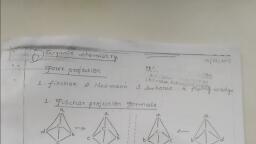
= enn n below:, V. Wedge formula of methane molecule is show!, , ‘ ‘ he paper), Bonds in H Bond going below t, , onan Dashed wedge (, the plane |, , of paper ecu Ma wedge (Bond projecting above the paper), H, , b ‘iving an example., Q.14, How fs Fischer projection formula of a molecule drawn? Explian by g, ns: Fischer projection (cross) formula: ; une Gf paper, a In this representation, a three dimensional molecule is projected _ wil ion cabon chien, Fischer projection formula can be drawn by visualizing the molecule, , i horizontal lines of the, Each carbon on the vertical chain is represented by a cross. By convention, the Cross, , eggs onds going bel, Tepresent bonds projecting up from the carbon and the vertical lines represent the b going below the, carbon., , ii., iii., , oe i elow:, iv. Fischer projection formula of a molecule along with its wedge formula is represented b, COOH COOH, , 1, , H OH = H ™C ~—S0H, CH; CH3, Fischer projection/ Wedge formula, cross formula, , (Note: Fischer projection formula is more commonly used in carbohydrate chemistry.], , Q.15. Write the Fischer projection and wedge formula for 2-chloro-propan-2-ol., Ans: 2-Chloropropan-2-ol has formula CHsC(Cl)(OH)CHs., Fischer projection and wedge formula for 2, , -chloropropan-2-ol can be given as:, CH;, , CH3, Ch OH = Cla C a OH, CH; CH;, Fischer projection/ Wedge formula, cross formula, , Q.16. Convert the following wedge formula to Fischer projection formula:, COOH, , |, , H @C —S0OH, H @C —10H, , CH;, , Ans: COOH, H—+—- OH, H—+—- 0H, , CH; . |, Fischer projection/, cross formula
Page 5 :
1.2 CHARACTERISTICS OF C-ATOMS ° ‘, , (a), , {b), , ©, , {d), , Tetra valency : Atomic number.of carbon atom is 6 and it has four valence electrons so C-Atom is, tetravalent. ‘, , ‘ 28 , 2p, In ground state (here covalency of carbon is 2) [11] UiftT J, , First excited state (here covalency of carbon is 4): (t] 4 t[t], , Available for bond formation °, , , , , , Tendency to-form multiple bonds : Carbon atom forms following type of bonds, such as, | | 1 4 | |, prac —Cc=C-, —C=Cc=c—, | ;, Tetrahedral shape : The four covalent bond are directed, towards the four corners of a regular tetrahedron LS 109°28", oe, , Bond angle 109°28', , Caitenation : Self linking property of C-atom is known as catenation “Itis responsible for the variety, and large number of organic compounds. It may also give rise to open chain: and ‘closed chain nature, of compounds., , , , , , , , , , , , , , Structure | o & x bonds Hybridisation | Bond angle Shape, | ;, Fe 40 sp* 109°28' Tetrahedral, _3 < = 3,1 sp? 120° Planar (Trigonal), =e= 2,2 sp 180° Linear, =C— 2,2 sp 180° Linear, , , , , , , , , , , , , , ! 1.3 CLASSIFICATION OF ORGANIC COMPOUNDS, (a) Classification based on functional group :, , Homologous series : A group or class of organic compounds each containing same functional group, with increased molecular weight, constitute a homologous series., , (a) The various members are called homologue, (b) Two successive homologues differ by >cH, group or 14 molecular weight., (c) All the homologues can be prepared by similar methods., , (d) Homologues have same chemical properties but there is a regular change in physical properties., {e) All the members represented by same general formula., , (@eswememnsnsuec mmm) 1