Page 1 :
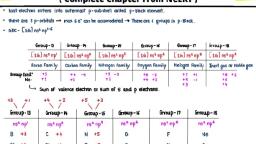
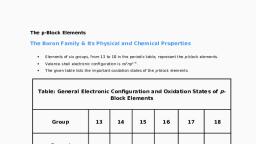
The p-Block Elements, (Group 13 and 14), The elements in which the last electron, enters into any of the outermost p-orbitals, are called p-block elements., X The general outer electronic configuration, of the p-block elements is ns2np1 – 6., X The elements belonging to the group 13, to 18 of the long form of periodic table are, p-block elements. The p-block elements, include metals, non-metals and metalloids., X The p-block elements enter into chemical, combination by losing, gaining or sharing, the valence electrons., X Nature of compounds : The p-block, elements mostly form covalent compounds., The halogens, however, form ionic, compounds with alkali and alkaline earth, metals., X Oxidation states : The highest oxidation, state shown by a p-block element is equal, to the total number of valence electrons., X The first element of a group differs from the, heavier elements in their ability to form, pp-pp bonds., GROUP 13 ELEMENTS (BORON FAMILY), Group 13 of periodic table consists of following, elements : 5B, 13Al, 31Ga, 49In, 81Tl and 113Nh., Physical properties :, X Physical state : All are solids, B is, non‑metallic, Al, Ga, In and Tl are silvery, white metals., X Atomic and ionic radii : Increases from, B to Al then decreases from Al to Ga and, then again increases., X Ionisation enthalpy : Less than the, corresponding members of alkaline earth, metals and shows no regular trend down, the group : B > Tl > Ga > Al > In, , X, X, , X, X, , X, , Electronegativity : First decreases from, B to Al and then increases., Metallic or electropositive character :, First increases from B to Al and then, decreases., Density : Increases down the group., Melting and boiling points : Melting, points decreases sharply on moving down, the group from B to Ga and then increases, from Ga to Tl while boiling points decreases, from B to Tl., Reducing character : Al > Ga > In > Tl., , Chemical properties :, MH3 +, , Hydrides, (MH3), , Oxides, (M2O3), and, Hydroxides, M(OH)3, , Halides, (MX3), , Electron, acceptor , , H–, , [MH4]–, , Electron Anionic, donor complex, , (where M = B, Al and Ga), Thermal stability :, BH3 > AlH3 > GaH3 > InH3 > TlH3, , Basic strength :, B2O3 < Al2O3 < Ga2O3 < In2O3 < Tl2O3, B(OH)3 < Al(OH)3 < Ga(OH)3, Acidic, Amphoteric, , < In(OH)3 < Tl(OH)3, , , Basic Basic, , 2MX3, 2M + 3X2, (where, M = B, Al, Ga, In and, X = F, Cl, Br, I), Lewis acid strength of boron, trihalides :, BF3 < BCl3 < BBr3 < BI3, Lewis acid strength of trihalides of, group 13 elements :, BX3 > AlX3 > GaX3 > InX3, Tl does not form trihalides.
Page 3 :
Anomalous behaviour of boron :, Property, Boron, Other, elements of, group 13, Metallic, Non-metal, Metals, behaviour, Maximum, 4, 6, covalency, Allotropy, Exhibits, Do not exhibit, Oxidation states Only +3, +1, +3, Compounds, Only covalent Both ionic and, covalent, Halides, Monomeric, Polymeric, Aqueous, No ionisation Form cations, solution, Oxides and, Acidic, Mainly basic, hydroxides, Action of non‑, No action, React, oxidising acids, Combination, Forms boride Do not combine, with metals, (form alloy), GROUP 14 ELEMENTS (CARBON FAMILY), Group 14 of periodic table consists of following, elements : 6C, 14Si, 32Ge, 50Sn, 82Pb and 114Fl., Property, Atomic, number(Z), Covalent, radius (pm), Electronegativity, Oxidation, states, , C, , Si, , Ge Sn Pb, 32, , 50, , 82, , Fl, , 6, , 14, , 77, , 118 122 140 144 180, , +4, , General characteristics and properties :, X The variable oxidation states are seen due, to inert pair effect., X C and Si → non-metals, Ge → metalloid,, Sn and Pb → metals. Metallic character, increases down the group., X The covalent nature in the compounds of, Sn4+ and Pb4+ ions is due to high polarisation, produced by them., X As we move down the group, stability of, lower oxidation state increases due to inert, pair effect., X, , X, , Semiconductor grade Si is prepared by, the reduction of highly pure SiCl4/SiHCl3, with H2 or by the pyrolysis of SiH4 mainly., , X, , Nature of oxides :, Oxides, , Except C, all other elements form complexes, due to presence of vacant d-orbitals in them, i.e., these behave as Lewis acids e.g.,, , Nature, , CO, CO2, SiO2, , acidic, , GeO, GeO2, SnO, SnO2,, Pb3O4, , amphoteric, , PbO, PbO2, , basic, , X Thermal stability of tetrahalides :, CX4 > SiX4 > GeX4 > SnX4 > PbX4, X Elements in this group are relatively, unreactive but reactivity increases down, the group. Pb often appears more noble, than expected due to a surface coating, of oxide and partly due to high over, potential for the reduction of H+ to H2 at, a lead surface., X, , Reactivity of the elements of group 14 :, , Reagent, , 114, , +2, +2, +2, 0, +1,, +4 +4 +4 +2, +4, +6, , [SiF6]2–, , octahedral; sp3d2, , hybridisation, , H 2O, , 2.5 1.8 1.8 1.8 1.8 –, +4, , –, , 2F ions, , SiF4, , Dilute, acids, , Concentrated, acids, , Reactivity, C, Si, Ge, Pb are unaffected by, H2O., SnO2 + 2H2, Sn + 2H2O, (steam) , C, Si, Ge are unaffected by dilute, acids., Pb does not dissolve in dilute, H2SO4 due to formation of PbSO4, coating., Diamond is unaffected by, concentrated acids, but graphite, is oxidised by concentrated HNO3, to give graphitic acid (C11H4O5), which is an insoluble yellowish, green substance and to graphite, oxide with hot concentrated HF/, HNO3., Si is oxidised and changes to SiF4, by hot concentrated HNO3/HF., Pb does not dissolve in, concentrated HCl due to, formation of PbCl2 coating.
Page 4 :
Alkalies, , Complex, formation, , Halogens, , Carbon is unaffected by alkalies., Sn and Pb are slowly attacked, by cold alkali, and rapidly by, hot alkali, giving stannates, Na 2 [Sn(OH) 6 ] and plumbates, Na2[Pb(OH)6]., Si, Ge, Sn and Pb can show, coordination number more than, 4., e.g., : Si, Ge (6), Sn, Pb (8), Diamond is unreactive, but, graphite reacts forming (CF)n., Si and Ge form volatile SiX4 and, GeX4 respectively., Sn and Pb are less reactive. Sn, reacts with Cl2 and Br2 in cold,, and with F2 and I2 on warming., Lead reacts with F2 in cold and, with Cl2 on heating forming PbX2., , Anomalous behaviour of carbon :, Property, , Carbon, , Other, elements, , Hardness, , hardest, , less hard, , M.pt. and B.pt., , high, , low, , Maximum, covalency, , 4, , 6, , Multiple bonds, , pp-pp, (high extent), , pp-dp, (low extent), , Catenation, , very high, tendency, , very low, , Tetrahalides, , does not, undergo, hydrolysis, , undergo, hydrolysis, , X, , X, , Multiple bonding : C has strong tendency, to form pp-pp multiple bonds either with, itself (C, C, C, C) or with atoms like, N, O (C, N, C, O). Carbon does not, have d-orbitals and never forms dp-pp or, dp-dp bonds. Silicon on the other hand, forms dp-dp bonds., In case of N(CH3)3, geometry is pyramidal, but in case of N(SiH3)3 it is planar because, the lone pair on N-atom is transferred, to the empty d-orbitals of silicon. (pp-dp, overlapping)., , Allotropes of carbon :, X Crystalline form : It includes diamond,, graphite and fullerene., X Amorphous form : It includes coal,, charcoal, lampblack, etc., Diamond, X It is a transparent, crystalline substance, with very high refractive index., X It is the purest form of carbon found, naturally and can also be made artificially., X Diamond is the hardest natural substance, known and is a bad conductor of heat and, electricity., X Structure :, – All important properties of diamond, are attributed to its structure., – Each carbon atom of diamond is bonded, to four other carbon atoms, through, sp3 hybridised orbitals, situated at the, corners of a regular tetrahedron, with, C–C bond length 1.54 Å and bond angle, of 109.5°., – This gives diamond a three-dimensional, network structure which explains its, hardness and poor conductivity due to, absence of any free electron., , 1.54 Å, , Structure of diamond, , Graphite, X It is a dark grey, crystalline solid which, is soft and greasy to touch. It possesses a, metallic lustre., X It is also known as ‘plaumbago’ (black, lead) as it leaves a black mark on paper., X It is a good conductor of electricity and, its conductivity increases with rise in, temperature., X Structure :, – It has a two dimensional sheet like, structure with each carbon atom being, covalently bonded to three carbon, atoms through sp2 hybridised orbitals,, forming a planar hexagonal structure.
Page 5 :
– The fourth electron of each carbon, forms a pi(p) bond with partial overlap, with that of the neighbouring carbon., – The C – C bond length is 1.42 Å, shorter, than that in diamond. The p-electrons, are free to move (mobile electrons) and, account for the electrical conductivity., – The adjacent hexagonal layers (sheets), are held by weak van der Waals’ forces, thus, making it easy for the layers to, slide over one another, accounting for, its soft and greasy texture., , Fullerenes, X Fullerenes are made by heating graphite, in an electric arc in the presence of inert, gases such as helium or argon. The sooty, material formed by condensation of, vapourised Cn small molecules consists, of mainly C60 with smaller quantity of, C70 and traces of fullerenes consisting of, even number of carbon atoms up to 350, or above. Fullerenes are the only pure, form of carbon because they have smooth, structure without having ‘dangling’, bonds. Fullerenes are cage like molecules., C60 molecule has a shape like soccer ball, and called Buckminsterfullerene., X It contains twenty, six-membered rings, and twelve, five-membered rings. A six, membered ring is fused with six or five, membered ring but a five membered ring, can only be fused with six membered, ring. All the carbon atoms are equal and, they undergo sp2 hybridisation. This ball, shaped molecule has 60 vertices and each, one is occupied by one carbon atom and it, also contains both single and double bonds, with C–C distances of 143.5 pm and 138.3, pm, respectively. Spherical fullerenes are, also called bucky balls in short., , X, , Uses of carbon :, – Diamond is used as previous decorative, stones in jewellery because of its, unusual brilliant shine., – Graphite is used as a lubricant at higher, temperature and as a refractory material, in making crucibles and electrodes for, high temperature work., – Coal and charcoal are used as fuel., – Coal is used for manufacturing producer, gas and water gas., – Coke is used as a reducing agent in, metallurgical operations., , Some important compounds of carbon, and silicon :, Carbon dioxide (CO2), X Structure :, X, , Preparation :, , C(s) + O2(g), , �, , CH4(g) + 2O2(g), , CO2(g), �, , CaCO3(s) + 2HCl(aq), , CO2(g) + 2H2O(g), CaCl2(aq) + CO2(g) + H2O(l), , Properties :, – It is an acidic oxide, and reacts with, bases, forming salts., CaCO3 + H2O, CO2 + Ca(OH)2, KHCO3, CO2 + K2CO3 + H2O, – Solid CO2 is called ‘dry ice’ and is used to, freeze foods and ice-cream., – It is consumed during photosynthesis., X, , C6H12O6 + 6O2 + 6H2O, 6CO2 + 12H2O, X Uses :, – In aerated water, e.g., in soda water, etc., – In extinguishing fire., – Solid carbon dioxide (dry ice) is used as, refrigerant., – As carbogen [mixture of O2 + CO2, (5-10%)] in artificial respiration, especially for pneumonia patients and, victims of CO poisoning.
Page 6 :
Carbon monoxide (CO), X Structure, X Preparation : 2C(s) + O2(g), HCOOH, , �, , 2CO(g), , H2O + CO, , , , , (g), , 2(g), , 2CO(g) + 4N2(g), Producer gas, , X, , Properties :, – Highly poisonous due to the ability to, form a complex with haemoglobin (Hb), , X, , which is 300 times more stable than, O2–Hb complex thus, prevents Hb in the, RBCs from carrying O2 around the body., – It is a powerful reducing agent and, reduces many metal oxides to the metal., – CO molecule acts as a donor and reacts, with metals to form metal carbonyls., Uses :, – As an important constituent of two, industrial fuels, i.e., water gas and, producer gas., – In Mond’s process for the purification of, nickel.
Page 7 :
OBJECTIVE TYPE QUESTIONS, , 1. The stability of +1 oxidation state among Al,, Ga, In and Tl increases in the sequence, (a) Al < Ga < In < Tl, (b) Tl < In < Ga < Al, (c) In < Tl < Ga < Al, (d) Ga < In < Al < Tl, 2. In group 13, electronegativity first decreases, from B to Al and then increases marginally down, the group. This is because of, (a) non-metallic nature of B, (b) discrepancies in atomic size of elements, (c) ability of B and Al to form pp - pp multiple, bonds, (d) irregular trend in electronegativity throughout, the periodic table., 3. Choose the correct statement., (a) N o n - m e t a l s h a v e h i g h e r i o n i s a t i o n, enthalpies and higher electronegativities, than the metals., (b) Non-metals and metalloids exist only in the, p-block of the periodic table., (c) Change of non-metallic to metallic character, can be illustrated by the nature of oxides, they form., (d) All are correct., 4. What is the hybridisation of B in BCl3?, (a) sp3, (b) sp2, (c) sp, (d) dsp2, 5., (a), (b), (c), (d), , Elements of group 14, exhibit oxidation state of +4 only, exhibit oxidation state of +2 and +4 only, form M 2 – and M 4 + ions, form M 2 + and M 4 – ions., , 6., (a), (b), (c), (d), , Carbon-60 contains, 20 pentagons and 12, 12 pentagons and 20, 30 pentagons and 30, 24 pentagons and 36, , hexagons, hexagons, hexagons, hexagons., , 7. Al and Ga have nearly the same covalent, radii because of, (a) greater shielding effect of s-electrons of Ga, atom, (b) poor shielding effect of s-electrons of Ga, atom, (c) poor shielding effect of d-electrons of Ga, atom, (d) greater shielding effect of d-electrons of Ga, atom., 8. Which of the following structures correctly, represents the boron trifluoride molecule?, F, (a), F, , B, , F, F, , F, , F, , B, , F, , F, , F, (c), F, (d), F, 9., (a), (b), (c), (d), , B+, , B, , F, , F, , F, , F, , F, (b), , B, , F, , B, , F, , F, F–, , F, , B+, , F, , F–, , B, , B+, , F, , F, , F, F–, , –, , F, , B+, , F, , F, F, , F, , B, , F, , Boron is unable to form BF63– because of, high electronegativity of boron, high electronegativity of fluorine, lack of d-orbitals in boron, less difference in electronegativity between B, and F., , 10. Which of the following bonds has the most, polar character?, (a) C – O, (c) C – S, , (b) C – Br, (d) C – F
Page 8 :
11., (a), (b), (c), (d), , In graphite, electrons are, localised on every third C-atom, present in anti-bonding orbital, localised in each C-atom, spread out between the structure., , 12. Amongst the halides, (1) BCl3, , (2) AlCl3, , (3) GaCl3, , (4) InCl3, , the order of decreasing Lewis acid character is, (a) 1, 2, 3, 4, (b) 4, 3, 2, 1, (c) 3, 4, 2, 1, (d) 2, 3, 4, 1, 13. The +1 oxidation state of thallium is more, stable than its +3 oxidation state because of, (a), (b), (c), (d), , its atomic size, its ionisation potential, inert pair effect, diagonal relationship., , 14. Ionisation enthalpy (ΔiH1 kJ mol–1) for the, elements of Group 13 follows the order, (a), (b), (c), (d), , B, B, B, B, , > Al, < Al, < Al, > Al, , >, <, >, <, , Ga, Ga, Ga, Ga, , >, <, <, >, , In, In, In, In, , >, <, >, <, , Tl, Tl, Tl, Tl, , 15. Which of the following conceivable structures, for CCl4 will have a zero dipole moment?, (a) Square planar, (b) Square pyramid (carbon at apex), (c) Irregular tetrahedron, (d) Regular tetrahedron, 16. The wrong statement about fullerene is, (a), (b), (c), (d), , it has 5-membered carbon ring, it has 6-membered carbon ring, it has sp2 hybridization, it has 5-membered rings more than, 6-membered rings., , 17. Fluorine is more electronegative than either, boron or phosphorus. What conclusion can be, drawn from the fact that BF 3 has no dipole, moment but PF3 does?, (a) BF3 is not spherically symmetrical, but PF3, is., (b) BF3 molecule must be linear., (c) The atomic radius of P is larger than the, atomic radius of B., (d) The BF3 molecule must be planar triangular., , 18. Which of the following statements is correct?, (a) Graphite is thermodynamically more stable, than diamond., (b) Diamond is thermodynamically more stable, than graphite., (c) Graphite has such a high thermodynamical, stability that diamond spontaneously, changes into graphite in ordinary conditions., (d) G r a p h i t e a n d d i a m o n d h a v e e q u a l, thermodynamic stability., 19. In the carbon family, the elements other, than carbon do not form pp-pp bonds because, the atomic orbitals are too, (a) small and diffused to undergo effective, lateral overlap, (b) large and diffused to undergo effective, lateral overlap, (c) large and far, too less diffused to overlap, linearly, (d) small to overlap both laterally and linearly., 20. Which among CH4, SiH4, GeH4 and SnH4 is, most volatile?, (a) CH4, (b) SiH4, (c) GeH4, , (d) SnH4, , 21. Which of the following does not have a, tetrahedral structure?, (a) BH3, (b) NH4+, (c) BH4–, , (d) CH4, , 22. Which is least stable compound?, (b) GaCl3, (a) BCl3, (c) InCl3, , (d) TlCl3, , 23. Which of the following acts as an oxidising, agent?, (a) B3+, , (b) Al3+, , (c) Tl3+, , (d) None of these, , 24. Match the species given in Column I with, the properties mentioned in Column II., Column I , Column II, –, , (A) Oxidation state of, (i) BF4, central atom is +4, (B) �Strong oxidising, (ii) AlCl3, agent, (iii) SnO, (C) Lewis acid, (D) �Can be further, (iv) PbO2, oxidised, , (E) Tetrahedral shape
Page 9 :
(a), (b), (c), (d), , (i) → (E), (ii) → (B), (iii) → (D), (iv) → (A, C), (i) → (E), (ii) → (C), (iii) → (D), (iv) → (A, B), (i) → (B), (ii) → (E), (iii) → (D), (iv) → (A, C), (i) → (D), (ii) → (E), (iii) → (B), (iv) → (A, C), , 25. Which element does not exhibit allotropy?, (a) C, (b) Sn, (c) Si, (d) Pb, 26. The exhibition of highest co-ordination, number depends on the availability of vacant, orbitals in the central atom. Which of the, following elements is not likely to act as central, atom in MF63– ?, (a) B, (c) Ga, , (b) Al, (d) In, , 27. Aluminium vessels should not be washed, with materials containing washing soda since, (a) washing soda is expensive, (b) washing soda is easily decomposed, (c) washing soda reacts with Al to form insoluble, aluminium oxide, (d) washing soda reacts with Al to form insoluble, aluminate., 28. Carbon forms a large number of compounds, because it has, , Case I : Read the passage given below and, answer the following questions from 33 to 38., The heavier members of 13 and 14 groups besides, the group oxidation state also show another, oxidation state which is two units less than the, group oxidation state. Down the group (↓), the, stability of higher oxidation state decreases and, that of lower oxidation state increases. This, concept which is commonly called inert pair, effect has been used to explain many physical, and chemical properties of the element of these, groups., 33. Heavier members of groups 13 exhibit, oxidation state, (a) +3 only, (b) +1 only, (c) +1 and +3 both, (d) +1, +2, +3, 34. Which among the following is the strongest, oxidising agent?, (a) SiO2, (b) GeO2, (c) SnO2, (d) PbO2, , (a), (b), (c), (d), , fixed valency, non-metallic nature, high ionization potential, property of catenation., , 29. Thallium shows different oxidation states, because, (a) of its high reactivity, (b) of inert pair of electrons, (c) of its amphoteric nature, (d) it is a transition metal., 30. Aluminium is more reactive than iron but, aluminium is less easily corroded than iron, because, (a) aluminium is a noble metal, (b) iron undergoes reaction easily with water, (c) aluminium with oxygen forms a protective, oxide layer, (d) iron forms mono and divalent ions., 31. The shape and hybridisation of Si(CH3)4 is, (a) bent, sp, (b) trigonal, sp2, 3, (c) tetrahedral, sp, (d) octahedral, sp3d2, 32. The element with smallest atomic radius, and lowest melting point out of the following is, (a) Al, (b) Ga, (c) In, (d) Tl, , 35. Which among the following is the strongest, reducing agent?, (a) GaCl, , (b) InCl, , (c) BCl3, , (d) TlCl, , 36. The strongest reductant among the following, is, (a) SnCl2, , (b) SnCl4, , (c) PbCl2, , (d) GeCl2, , 37., (a), (b), (c), , Which of the following statement is wrong?, Tl(III) salt undergo disproportionation., CO is used as a reducing agent., CO2 is a greenhouse gas., , (d) SiO2 is a covalent solid., 38. Which of the following act as the strongest, acid?, (a) Tl2O3, , (b) SnO2, , (c) PbO2, , (d) CO2
Page 10 :
Case II : Read the passage given below and, answer the following questions from 39 to 43., , (c) high lattice enthalpy of its compounds in the, solid state., , Allotropy : The phenomenon of existence of the, same substance (element or compound) in two or, more forms, in the same physical state, having, different properties. Different forms are called, allotropes or allotropic modifications., Except lead, all other elements of group 14 show, allotropy., Element Allotropic form, C, Crystalline : graphite and diamond, Amorphous : coal, coke and charcoal, Si, Crystalline and amorphous, Ge, Two crystalline forms, Sn, Three forms : grey tin, white tin,, rhombic tin, , Hence, aluminium can form both covalent and, ionic bond. Like halides of boron, halides of, aluminium do not show backbonding because, of increase in size of aluminium. In fact,, aluminium atoms complete their octets by, forming dimers. Thus, chloride and bromide of, aluminium exist as dimers. Thus, chloride and, bromide of aluminium exist as dimers, both, in the vapor state and in polar solvents like, benzene, while the corresponding boron halides, exist as monomer. In boron trihalides, the extent, of back bonding decreases with increase in size, of halogens and thus Lewis acid character, increases. All BX3 are hydrolysed by water but, BF3 shows as different behavior., , 39., it, (a), (b), (c), (d), , Wood charcoal is used in gas masks because, is poisonous, liquefies gases, is porous, adsorbs poisonous gases., , 40. Which of the following is not sp2 hybridised?, (a) Graphite, (b) Graphene, (c) Fullerene, (d) Dry ice, 41. Fullerene with formula C60 has a structure, where every carbon atom is, (a) sp-hybridized, (b) sp2-hybridized, 3, (c) sp -hybridized, (d) not hybridized., 42. Thermodynamically the most stable form of, carbon is, (a) diamond, (b) graphite, (c) fullerene, (d) coal., 43. The element that does not show catenation, among the following p-block elements is, (a) carbon, (b) silicon, (c) germanium, (d) lead., Case III : Read the passage given below and, answer the following questions from 44 to 47., The high charge and small size of Al3+ ion gives, it a high charge density which is responsible for, its tendency to show, (a) covalency in its compounds in the gaseous, state, (b) high hydration enthalpy which stabilizes its, compounds in solution, and, , 44. Which of the following statements about, anhydrous aluminium chloride is correct?, (a) It exists as Al2Cl6 dimer in vapour form., (b) It is not easily hydrolysed., (c) It sublimes at 100°C under vacuum., (d) It is a strong Lewis base., 45. Which one of the following statements is, correct?, (a) All boron trihalides form back bonding., (b) Anhydrous aluminium chloride is an ionic, compound., (c) Aluminium bromide make up the electron, deficiency by bridging with other aluminium, bromide., (d) None of these., 46. The dimeric structure of aluminium chloride, disappear when, (a) it dissolves in water, (b) it reacts with donor molecules like R3N, (c) it dissolves in benzene, (d) both (a) and (b)., 47. Which of the following reaction is incorrect?, (a) BF3(g) + F –(aq), (b) BF3(g) + 2H2O, (c) BCl3(g) + 3C2H5OH(l), , BF4–, [BF3OH]– + H3O+, B(OC2H5)3(l), + 3HCl, , (d) BCl3(g) + 2C5H5N(l), , Cl3B(C5H5N)2(s)
Page 11 :
For question numbers 48-55, a statement of assertion followed by a statement of reason is given. Choose, the correct answer out of the following choices., (a) Assertion and reason both are correct statements and reason is correct explanation for assertion., (b) Assertion and reason both are correct statements but reason is not correct explanation for assertion., (c) Assertion is correct statement but reason is wrong statement., (d) Assertion is wrong statement but reason is correct statement., 48. Assertion : Compounds formed by nonmetals with metals are covalent in nature., Reason : Compounds formed between nonmetals themselves are largely covalent., 49. Assertion : Anhydrous AlCl3 is covalent but, hydrated AlCl3 is ionic., Reason : In water, Al 2 Cl 6 dissociates into, hydrated Al3+ and Cl– ions due to high heat of, hydration of these ions., 50. Assertion : The tetrahalides of carbon, are not hydrolysed by water under normal, conditions., Reason : Carbon cannot expand its coordination, number beyond 4 because of the absence of, d-orbitals., 51. Assertion : All the trihalides of boron act as, Lewis acids., , Reason : The relative strength of boron, trihalides is of the order, BI3 > BBr3 > BCl3 > BF3, 52. Assertion : Al forms [AlF6]3– but B does not, form [BF6]3–., Reason : B does not react with F2., 53. Assertion : The tendency for catenation, decreases in the order C > Si > Ge > Sn., Reason : The catenation depends on the, strength of the element-element bond., 54. Assertion : Boron differs from aluminium, and other members of group 13 in a number of, properties., Reason : Boron shows anomalous behaviour., 55. Assertion : In carbon dioxide, the carbon is, sp3 hybridized., Reason : CO is a linear monomeric covalent, compound., , SUBJECTIVE TYPE QUESTIONS, , Very Short Answer Type Questions (VSA), 1., , Why does graphite act as a good lubricant?, , 7., , 2., , What is inert pair effect?, , in BF3 (130 pm) and BF 4 (143 pm) differ., , Suggest reasons why the B—F bond lengths, –, , 3. Write reactions to justify amphoteric nature, of aluminium., , 8., , 4. Describe the shapes of BF3 and BH4–. Assign, the hybridisation of boron in these species., , Explain., , 5. How would you explain the lower atomic, radius of Ga as compared to Al?, 6. Explain why is there a phenomenal, decrease in ionization enthalpy from carbon to, silicon?, , What are electron deficient compounds?, , Are BCl3 and SiCl4 electron deficient species?, , 9., , W hat are ful le re ne s? Ho w a re t h ey, , prepared?, 10. If B–Cl bond has a dipole moment, explain, why BCl3 molecule has zero dipole moment.
Page 12 :
Short Answer Type Questions (SA-I), 11. What are allotropes? Sketch the structure, of two allotropes of carbon namely diamond and, graphite. What is the impact of structure on, physical properties of two allotropes?, 12. Draw the structures of BCl3.NH3 and AlCl3, (dimer)., 13. Explain why the following compounds, behave as Lewis acids?, (ii) AlCl3, (i) BCl3, 14. Describe the general trends in the metallic, character of the elements in groups 13 and 14., 15. The +1 oxidation state in group 13 and +2, oxidation state in group 14 becomes more and, more stable with increasing atomic number., Explain., , 16. What do you understand by (a) inert pair, effect (b) allotropy and (c) catenation?, 17. Carbon and silicon both belong to the group, 14, but inspite of the stoichiometric similarity,, the dioxides, (i.e., carbon dioxide and silicon, dioxide), differ in their structures. Comment., 18. Though fluorine is more electronegative, than chlorine yet BF 3 is a weaker Lewis acid, than BCl3. Comment., 19. Explain, why CO2 is a gas whereas SiO2 is a, solid?, 20. Give reason why CCl4 is immiscible in water,, whereas SiCl4 is easily hydrolysed., , Short Answer Type Questions (SA-II), 21. (a) Classify following oxides as neutral,, acidic, basic or amphoteric:, CO, B2O3, SiO2, CO2, Al2O3, PbO2, Tl2O3, (b) Write suitable chemical equations to show, their nature., 22. S i l i c o n f o r m s S i F 62 – i o n w h e r e a s, corresponding fluoro compound of carbon is not, known. Explain., 23. Arrange the following in increasing order of, the property indicated :, (a) �SiCl2, GeCl2, SnCl2 and PbCl2�(stability), (b) CO, SiO, SnO, GeO, PbO�, (basicity), (c) SiF4, SiCl4, SiI4, SiBr4�(stability), 24. Explain the difference in properties of, diamond and graphite on the basis of their, structures., 25. Describe the general trends in the following, properties of the elements in Groups 13 and 14., (i) Oxidation states, (ii) Atomic size, (iii) Nature of halide, , 26. Explain the following :, (i) Boron does not exist as B3+ ion., (ii) Discuss the Lewis acid nature of boron, halides., 27. How does AlCl3 act as a Lewis acid?, 28. Explain the following :, (a) Electron gain enthalpy of chlorine is more, negative as compared to fluorine., (b) Pb4+ acts as an oxidising agent but Sn2+ acts, as a reducing agent., 29. BCl 3 exists as monomer whereas AlCl3 is, dimerised through halogen bridging. Give reason., Explain the structure of the dimer of AlCl3 also., 30. Complete the following chemical equations, and identify X, Y and Z., Z + 3 LiAlH4, X + 6H2O, X + 3O2, , X + 3LiF + 3AlF3, Y + 6H2, , ∆, , B2O3 + 3H2O, , Long Answer Type Questions (LA), 31. (a) Boron fluoride exists as BF3 but boron, hydride doesn’t exist as BH3. Give reason. In, which form does it exist? Explain its structure., , (b) A tetravalent element forms monoxide, and dioxide with oxygen. When air is passed, over heated element (1273 K), producer gas is
Page 13 :
obtained. Monoxide of the element is a powerful, reducing agent and reduces ferric oxide to, iron. Identify the element and write formulas, of its monoxide and dioxide. Write chemical, equations for the formation of producer gas and, reduction of ferric oxide with the monoxide., 32. Explain the following :, (a) Carbon shows catenation property but lead, does not., (b) Lead does not form PbI4., (c) Pb4+ acts as an oxidising agent but Sn2+ acts, as a reducing agent., 33. Explain the following:, (i) Why PbO2 is a stronger oxidising agent than, SnO2?, (ii) Why ionisation enthalpy of Ga is higher, than that of Al?, , OBJECTIVE TYPE QUESTIONS, 1. (a) : In group 13 elements, stability of +3 oxidation, state decreases down the group while that of +1 oxidation, state increases due to inert pair effect., Hence, stability of +1 oxidation state increases in the, sequence : Al < Ga < In < Tl., 2., , (b) : There is a large size difference between B and Al., , 3., , (d), , 4., , (b) : In BCl3, B is sp2 hybridised., , 5. (b) : General electronic configuration of Group-14, elements is ns2np2. Thus, they can exhibit +2 oxidation, state by losing 2p-electron or +4 oxidation state by losing, all 4 valence electrons., 6. (b) : C-60 contains 12 pentagons and 20-hexagons, folded into a sphere., 7. (c) : Due to poor shielding effect of d-electrons of, Ga, the outer electrons experience more attraction by the, nucleus., 8. (a) : BF 3 molecule involves extensive back bonding, from fluorine to boron., 9., , (c), , 10. (d) : C – F bond has maximum electronegativity, difference, hence most polar., 11. (d) : In graphite, electrons are spread out between the, structure., , (iii) Thallous compounds (Tl+) are more stable, than thallic (Tl3+) compounds. Why?, 34. Three pairs of compounds are given below., Identify that compound in each of the pairs, which has group 13 element in more stable, oxidation state. Give reason for your choice., State the nature of bonding also., (ii) AlCl3 , AlCl, (i) TlCl3 , TlCl, (iii) InCl3 , InCl, 35. Describe the general trends in the following, properties of the elements of groups 13., (i) Atomic size, (ii) Ionisation enthalpy, (iii) Metallic character, (iv) Oxidation states, (v) Nature of halides., , 12. (a) : Lewis acid strength of group 13 halides follows, the order :, BCl3 > AlCl3 > GaCl3 > InCl3, 13. (c), 14. (d) : I.E. has the order B > Al < Ga > In < Tl, Decrease from B to Al is associated with increase in size., Discontinuity between Al and Ga and between In and Tl are, due to poor shielding of d and f electrons., 15. (d) : CCl4 has regular tetrahedral structure where dipole, moment of all four C–Cl bonds are cancelled out by each, other and CCl4 as a molecule remains non-polar., 16. (d) : Fullerene consists of 12 five-membered rings and, 20 six-membered rings. So, it has five-membered rings less, than six-membered rings., 17. (d) : In BF3, B is sp2 hybridised and compound is planar, triangular so that BF3 is non-polar., 18. (a) : Graphite is thermodynamically more stable than, diamond., 19. (b) : In carbon family, elements other than carbon do, not form pp-pp bonds because the atomic orbitals are too, large and diffused to undergo effective lateral overlap., 20. (a) : CH4 is most volatile due to lower molecular mass., 21. (a) : BH3 is trigonal planar where B is sp2 hybridised.
Page 14 :
22. (d) : All the given compounds belong to group 13 of, the periodic table. In this group, the +3 oxidation state, becomes less stable on moving down the group due to, inert pair effect. Hence, BCl3 is most stable and TlCl3 is least, stable., 23. (c) : Due to inert pair effect Tl3+ is unstable and is, reduced to more stable Tl+ thus behaving as an oxidising, agent., 24. (b) : (i) → (E), (ii) → (C), (iii) → (D), (iv) → (A, B), 25. (d) : Lead (Pb) does not show allotropy., 26. (a) : Boron can not expand its coordination number, from 4 due to absence of d-orbitals., 27. (d) : Aluminium vessel has an upper layer of aluminium, oxide. When this vessel is washed with material containing, washing soda then insoluble sodium metaaluminate is, formed., 2NaAlO2 + CO2, Al2O3 + Na2CO3 →, , , , , Sodium, metaaluminate, , 28. (d) : Carbon has high tendency to catenate thus forms, large number of compounds., 29. (b) : Tl+ ions are more stable than Tl3+ due to inert pair, effect which results in reluctance of s-electrons to unpair to, show higher oxidation state., 30. (c) : Al forms a protective oxide layer, on reaction with, oxygen which is hard and impervious., 31. (c), 32. (b) : Element with smallest atomic radius (135 pm) and, lowest melting point (303 K) is Ga., 33. (c) : In heavier members due to inert pair effect both, +1, +3 oxidation state are possible., 34. (d), 35. (c) : +1, +3 oxidation state are possible in Ga., Ga3+ is more stable than Ga1+ hence. GaCl act as reducing, agent., 36. (d) : GeCl2 is the strongest reductant because Ge in, +4 oxidation state is more stable than Ge in +2 oxidation, state., 37. (a) : Tl(III) salt doesn’t undergo disproportionation, reaction because +3 oxidation state of Tl is more stable due, to inert pair effect., , 40. (d) : Solid CO 2 is dry ice in which carbon atom, undergoes sp-hybridisation., 41. (b) : In fullerene with formula C60, all the carbon atoms, are equal and they undergo sp2 hybridisation., 42. (b), 43. (d), 44. (a) : Anhydrous AlCl3 dimerise to form Al2Cl6 in vapour, form., 45. (c) : AlX3 (X = Cl, Br, I) make up the electron deficiency, by forming the dimer Al2X6, Br, , Br, Al, , Br, , Br, Al, , Br, , Br, , 46. (a) : AlCl3 + H2O → Al(OH)3, 47. (b) : BF3 + H2O → BF4–, 48. (d) : Compounds formed by non-metals with metals, are generally ionic in view of larger differences in their, electronegativities. Compounds formed between non-metals, themselves are largely covalent in character because of small, differences in their electronegativities., 49. (a), 50. (a), 51. (b) : BF3 is weakest Lewis acid., 52. (c) : B does not have vacant d-orbitals as for B, second, shell is the outermost shell., 53. (a) : As we move down the group 14, the elementelement bond energies decrease rapidly, viz. C–C, (355 kJ mol–1), Si–Si (222 kJ mol–1), Ge–Ge (167 kJ mol–1), and Sn–Sn (155 kJ mol–1), so the tendency for catenation, decreases in the order C > Si > Ge > Sn., 54. (b) : This is due to small atomic size, high electronegativity, high ionization energy and absence of d-orbital, of B., 55. (d) : In CO2, C is sp hybridized. It forms two s bonds, with two oxygen atoms and two pp-pp multiple bonds. So, CO2 is a linear, monomeric and covalent compound., , SUBJECTIVE TYPE QUESTIONS, , 38. (d) : CO2 is most acidic as acidic character of oxide, decrease down the group., , 1. �, Graphite has sheet like structure and it is slippery so, it, can act as lubricant., , 39. (d) : Wood charcoal adsorbs large volume of poisonous, gases from atmosphere., , 2. �, The tendency of s-electrons of the valence shell to, participate in bond formation decreases down the group. This
Page 15 :
reluctance of the s-electrons to participate in bond formation, is called inert pair effect., , 6. Large decrease in ionisation potential from C to Si is due, to increase in size of the atom and shielding effect., , 3. Amphoteric substances are those that can react with, both acids and bases. Aluminium reacts with HCl to liberate, H2 gas as :, , 7. The bond length in any compound is dependent on, the hybridisation of the central atom. Boron in BF3 is sp2, hybridised which means that the s-character is 33% and, therefore, the bond length is shorter. Also due to similar, size of both atoms and vacant p-orbital of B, a pp-pp back, bonding from F to B occurs causes partial double bond, character. This further decreases the bond length of B — F., In BF4–, the hybridisation of B is sp3 which means that the, s-character is 25% and therefore, a longer bond length., , 2Al(s) + 6HCl(aq), , –, 2Al3+, (aq)+ 6Cl(aq) + 3H2(g), , Aluminium can react with aqueous alkali and liberate, hydrogen gas., , �, 4. BF3 has a planar triangular structure which arises from, the sp2 hybrid orbitals., , 8. Electron deficient compounds are those where the, central atom has less than 8 electrons in its outermost shell., Out of BCl3 and SiCl4, the former is an electron deficient, compound since it has only 6 electrons in the outermost shell., SiCl4 is not an electron deficient compound., However, it can accept electrons by expanding its octet due, to presence of empty d-orbitals. Thus, it may form species, , These three sp 2 hybrid orbitals are directed towards the, corners of triangle and BF3 has a trigonal structure., , like SiCl62–., 9. �, Fullerenes are the purest form of carbon, consisting, of mainly C60 units. C60 unit has a shape of football, called, Buckminsterfullerene. Fullerenes are prepared by heating, graphite in an electric arc in the presence of inert gas such, as helium or argon., , BH4– may be assumed to be made of a central B atom, 3H, atoms and one hydride ion H–., , 10. �, The dipole moment of any molecule is the vector sum, total of each of the dipole moments. In BCl3 molecule,, although the B–Cl bonds individually are polar, the resultant, dipole moment becomes zero., , In order to accommodate the 3H atoms and one H– ion, B, undergoes sp3 hybridisation yielding four orbitals, 3 of which, contain one e– each and one is empty. The fourth, empty, orbital accomodates the H– ion. Thus, the structure of BH4– is, tetrahedral., , We can see that the dipole moments of B– 1Cl and B–2Cl, produce a resultant which is equal in magnitude but opposite, in direction to B–3Cl and hence cancels it out. That is why the, net dipole moment of BCl3 is zero., , 5. This can be understood from the variation in the, inner core of the electronic configuration. The presence of, additional 10 d-electrons offer only poor screening effect, for the outer electron from the increased nuclear charge in, gallium. Consequently, the atomic radius of gallium (135 pm), is less than that of aluminium (143 pm)., , 11. The property due to which an element exists in two or, more forms which differ in their physical and some of the, chemical properties is known as allotropy and the various, forms are called allotropes or allotropic modifications. Carbon, exists in two allotropic forms crystalline and amorphous. The, crystalline forms are diamond and graphite.
Page 16 :
13 elements. Due to smaller size group 14 elements are less, metallic. Metallic character increases gradually down the, group. C (non-metal), Si,Ge (metalloid) Sn, Pb (metals)., , Structure of diamond, , 15. In group 13 and 14, as we move down the group, the, tendency of s-electrons of the valence shell to participate in, bond formation decreases. This is due to ineffective shielding, of ns1 and ns2 electrons of the valence shell by intervening, d- and f-electrons. This is called inert pair effect., Due to this, ns1 and ns2 electrons of valence shell of group, 13 and 14 are unable to participate in bonding. Hence, +1, and +2 oxidation states become more stable with increasing, atomic number., 16. (a) Inert pair effect : The reluctance of ns 2 pair in, p-block elements having higher atomic number to take part, in bond formation is called inert pair effect., (b) Allotropy : The existence of an element in more than one, form having different physical properties but same or slightly, different chemical properties is called allotropy., , Diamond due to extended covalent bonding is the hardest, natural substance on the earth. Graphite has layer of, sheets which are held by weak van der Waals’ forces thus,, it can be cleaved easily between layers which makes it soft, and slippery., 12., , 13. (i) BCl3 – Boron has 6 electrons in its outermost orbital, and has a vacant p-orbital. Thus, it is an electron deficient, compound hence acts as Lewis acid and accepts a lone pair, of electrons., �, , �, �, , (ii) AlCl 3 is also an electron deficient compound and, acts as Lewis acid. It generally forms a dimer to achieve, stability., , 14. Metallic character : Metallic character increases from, boron to aluminium then decreases down the group for group, , (c) Catenation : The property by virtue of which a large, number of atoms of the same element get linked together, through covalent bonds resulting in the formation of long, chains, branched chains and rings of different sizes is called, catenation., 17. Due to absence of d-orbitals multiple pp-pp bonding is, C, O), present in carbon dioxide hence CO2 is linear (O, with sp hybridisation. SiO 2 has discrete single bonded, structure in a tetrahedral manner., , 18. Due to back bonding in B — F, electron deficiency is, compensated which makes it a weaker Lewis acid than BCl3., However, in B-Cl, back bonding is not significant due to much, bigger size of 3p-orbital of Cl than vacant 2p-orbital of B., 19. Silicon dioxide is a covalent three dimensional network, solid due to absence of pp-pp bonding in SiO2 and very high, Si — O bond enthalpy but in CO2 due to pp-pp bonding, gives discrete molecules unlike SiO2. Thus, CO2 is a gas., 20. CCl4 cannot be hydrolysed by water because carbon atom, can not accommodate lone pair of electrons from oxygen, atom of water due to absence of d-orbital. SiCl4 can be, hydrolysed to give Si(OH)4 due to presence of d-orbitals.
Page 17 :
21. (a) Neutral oxides, , :, , CO, , Acidic oxides, , :, , B2O3, SiO2, CO2, , Basic oxides, , :, , Tl2O3, , Amphoteric oxides :, , Al2O3, PbO2, , (b) (i) CO Neutral to litmus, [Neutral], (ii) �B2O3 reacts with basic (metallic) oxides forming, meta-borates., B2O3 + CuO, , Cu(BO2)2, , [Acidic], , (iii) SiO2 + 2NaOH, , Na2SiO3 + H2O [Acidic], , (iv) CO2 + 2NaOH, , Na2CO3 + H2O [Acidic], , (v), , Tl2O3 + 3H2SO4, , Tl2(SO4)3 + 3H2O [Basic], , Hardness, , Due, to, 3-D, structure, diamond, is the hardest, natural element on, the earth., , Electrical, Conductivity, , Diamond, insulator., , is, , It is made up of 2-D, sheets of carbon which, slip over each other. This, gives graphite a slippery, surface., , an Graphite is a good, conductor of electricity, due to presence of, delocalised p-electrons., , 25. �(i) Oxidation states : For group 13 both +1 and +3, oxidation state are observed. +1 oxidation state becomes, more stable as we move down the group due to inert pair, effect. Boron does not show +3 oxidation state., For group 14 common oxidation state are +4 and +2., Tendency to show +2 oxidation state increases down the, group., (ii) Atomic size : Atomic radii of group13 elements, increases down the group with exception Ga < Al, , (vi), , due to presence of 10 d-electrons which offer poor, (vii), , screening effect. In group 14, there is a considerable, , 22. SiF 62– ion exists because of presence of d-orbitals., Silicon expands its octet to give sp 3d 2 hybridisation and, forms complexes or ions by accepting electron pairs from, donor species like SiF62–. Carbon cannot exceed its covalency, more than 4. Thus, CF 2–, 6 is not known., , increase in radius from C to Si, thereafter from Si → Pb, a small increase is seen due to presence of completely filled, d and f-orbitals., (iii) Nature of halides : Group 13 elements form trihalides, (except TlI3). Due to electron deficient nature BCl3 accepts, electrons and forms adducts. AlCl 3 achieves stability, , 23. �, (a) The stability of dihalides increases down the group, because divalent state becomes more and more stable as we, move down the group., , by forming a dimer. Group 14 elements form halides, , SiCl2 < GeCl2 < SnCl2 < PbCl2, , easily hydrolysed. Stability of dihalides increases down the, , (b) Basicity of oxides increases down the group as metallic, character increases., , group., 26. (i) Due to small size of boron, the sum of its first three, , CO < SiO < GeO < SnO < PbO, , ionisation enthalpies is very high, hence, it does not exist in, , (c) Si—X bond strength decreases as the size of the halogen, increases. The correct order is, , +3 form., , SiI4 < SiBr4 < SiCl4 < SiF4, Diamond, , Graphite, , Hybridisation sp3, , sp2, , Structure, , Tetrahedral carbon, which gives rise to, a 3-dimensional, structure., , Planar trigonal which gives, rise to a 2-dimensional, sheet like structure of, carbon., , 154 pm, , 141.5 pm, , C—C, , (ii) The Lewis acid character of boron trihalides follows the, order :, , 24. �, Criterion, , with formula MX2 and MX4. Except CCl4 other halides are, , BI3 > BBr3 > BCl3 > BF3., The above order is just the reverse of the expected order, on the basis of relative electronegativities of the halogens., This can be explained on the basis of the tendency of the, halogen atom to back-donate its electrons to the boron atoms, resulting in the formation of an additional pp–pp bond. This, type of bond formation is known as dative or back bonding.
Page 18 :
atoms and two boron atoms are in one plane. Above, and below this plane, there are two bridging hydrogen, atoms. The four terminal B — H bonds are regular, two centre two electron bonds while the two bridge, B — H — B bonds are different and are three centre – two, electron bonds., Formation of back bonding between boron and fluorine in BF3 molecule., , As a result of back donation of electrons from fluorine to boron,, the electron deficiency of boron atom gets compensated and, therefore, the Lewis acid character of BF3 decreases., The tendency to form pp–pp bond is maximum in the case of, BF3 and falls rapidly as we move to BCl3 and BBr3, 27. AlCl3 is a Lewis acid since it is an electron deficient, halide. It has only six electrons in its outermost shell therefore,, to complete its octet it accepts a lone pair of electrons and, acts as a Lewis acid., 28. (a) Due to small size of fluorine there is inter-electronic, repulsion which reduces its tendency to accepts electron., (b) Pb4+ acts as oxidising agent because it has a tendency, to exist in Pb2+ form which is more stable. Sn2+ is a reducing, agent due to tendency to form Sn4+ compounds., 29. Due to absence of d-orbitals in boron, it exists as an, electron deficient monomer and achieves stability through, accepting electrons from a base like NH3. It cannot exists as, dimer due to small size of B which cannot accomodate bigger, size 4 Cl atoms around it. AlCl3 achieves stability by forming, a dimer., , Tetrahedral dimer, , 30. �, , (b) The tetravalent element is carbon which forms CO and, CO2. When heated in air it forms producer gas., , CO is a powerful reducing agent and reduces ferric oxide to, iron., D, 2Fe + 3CO2, Fe2O3 + 3CO →, , 32. (a) Property of catenation is maximum in carbon because, C — C bonds are very strong due to smaller size. The tendency, of catenation decreases down the group due to increase in, size and decrease in electronegativity., (b) Pb + 2I2, –, , PbI4, , I is a good reducing agent and therefore, reduces Pb (IV) to, Pb (II) easily. That is why, PbI4 does not exist., (c) Pb4+ acts as an oxidising agent because it has a tendency, to exist in Pb2+ form which is more stable. Sn2+ is a reducing, agent due to tendency to form Sn4+ compounds., 33. (i) Lead compounds in +2 oxidation state are more, stable than +4 oxidation state hence are stronger oxidising, agents. Due to stronger inert pair effect Pb2+ is more stable, than Sn2+., (ii) As we move from Al to Ga, due to poor shielding of the, nucleus by 3d-electrons, the effective nuclear charge acting, on Ga is slightly higher than that on Al. As a result, ionisation, enthalpy of Ga is higher than that of Al., (ii) TlCl is more stable than TlCl3 due to inert pair effect., , 31. �, (a) Due to non-availability of d-orbitals, boron is unable, to expand its octet hence, it exists as BF3 and is electron, deficient compound. Due to back bonding, electron deficiency, of BF3 is compensated. But in boron hydride, hydrogen atoms, does not have lone pairs for back bonding thus, to compensate, electron deficiency it exists in the form of diborane., In the structure of diborane, four terminal hydrogen, , 34. (i) TlCl3, TlCl – TlCl is in more stable oxidation state, (+1 O.S. more stable). It is ionic in nature., (ii) AlCl3,AlCl – AlCl3 is more stable (+3 oxidation state). It, is covalent in nature., (iii) InCl3, InCl – InCl3 is relatively more stable than InCl, due to higher stability of +3 oxidation state. It is covalent in, nature.
Page 19 :
35. �, ( i) Atomic size : Atomic radii of group 13 elements, increase down the group with the exception that atomic, radius of Ga is less than that of Al due to the presence of 10, d-electrons which offer poor screening effect for the outer, electrons from the increased nuclear charge in Ga., (ii) Ionisation enthalpy : For group 13 elements, the trend, of ionisation enthalpy is, B > Al < Ga > In < Tl. This is due to increase in size and low, screening effect of d- and f- electrons., , (iii) Metallic character : Metallic character increases from, boron to aluminium then decreases down the group., (iv) Oxidation states : For group 13 elements, both +1 and +3, oxidation states are observed. The +1 oxidation state becomes, more stable as we move down the group due to inert pair, effect. Boron does not show +3 oxidation state., (v) Nature of halides : Group 13 elements form trihalides, (except TlI3). Due to electron deficient nature, BCl3 accepts, electrons and forms adducts. AlCl3 achieves stability by forming, a dimer., ,