Page 1 :
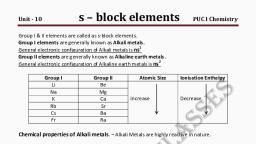
The s-Block Elements, , [29], , The s-Block Elements, Syllabus, Introduction, General Characteristic, Group-1 (Alkali Metals), Physical Properties, Chemical Reactivity,, Group-2 (Alkaline Earth Metals), Reducing Nature, , INTRODUCTION, (a), , Elements of IA and IIA group of the periodic table are called s-block elements., , (b) For these elements outer s-orbital is in the process of filling., (c), , IA [ns1] group elements are called alkali metals and IIA [ns2] group elements are called alkaline, earth metals., , GENERAL CHARACTERISTIC, (a), , They are good conductors of heat and electricity., , (b) They are malleable and ductile., (c), , Exhibit group valency of 1 and 2 for IA and IIA groups respectively., , (d) They are prepared by the electrolysis of their fused salts., (e) They are very reactive as their last shell contains 1 or 2 electrons which can be given off easily, (low ionization potential)., (f), , They form colourless compounds except chromates, dichromates etc., , (g) Their cations are diamagnetic., (h) They form ionic compounds (except Li and Be)., (i), , Their solutions in liquid ammonia are good conductor of electricity and are good reductant., , (j), , Oxides are basic in nature., , GROUP-1 (ALKALI METALS), Elements Symbol, , Atomic number, , Lithium, Sodium, , Li, Na, , 3, 11, , Potassium, Rubidium, , K, Rb, , 19, 37, , Caesium, , Cs, , 55, , Francium, , Fr, , 87, , Knowledge Horizon Classes - UGF, South Wing, NBCC Place, Bhishma Pitamah Marg, Lodhi Road, New Delhi– 110003, , ANAND ACADEMY BHILAI 9827464311, 8109132711, Phone: 011-43612404/32531042. Website: www.khclasses.co.in
Page 2 :
[30], , The s-Block Elements, , PHYSICAL PROPERTIES, Important physical properties of Alkali metals are given below :, 1., , 2., , Physical State, (a), , Soft, silvery white metal having a high and bright lusture when freshly cut., , (b), , They all form body centred lattices., , (c), , Softness increases with increase of atomic number because there is a continuous decrease, of metallic bond strength on account of an increase in atomic size., , Atomic Size :, These elements are largest in size in the period and the atomic size increase in going downwards in, the group., , Order of size :, Be < Li < Mg < Na < Ca < Sr < Ba < K < Rb < Cs, 3., , Oxidation State :, These metals exhibit + 1 oxidation state, difference of their second and third ionisation potentials is, more than 16 eV. Therefore, their + 1 oxidation state is more stable., , 4., , Density :, Density =, , Atomic weight, M, =, V, Volume, , Atomic weight increase from Li to Cs in the group and volume also increase, but increase in atomic, weight is more as compared to volume. Therefore, density, increases from Li to Cs., Exception :, Density of Na is more than that of K., Density :, Li < K < Na < Rb < Cs, 5., , Tendency of forming ionic Bond :, One electron is present in the outermost shell of these metals. They form cation by the loss of this, electron, i.e., they form ionic bond in their compounds., , Knowledge Horizon, Classes ACADEMY, - UGF, South Wing,, NBCC Place,, Bhishma Pitamah, Marg, Lodhi Road, New Delhi– 110003, ANAND, BHILAI, 9827464311,, 8109132711, Phone: 011-43612404/32531042. Website: www.khclasses.co.in
Page 3 :
The s-Block Elements, , 6., , [31], , Standard Electrode Potential or Standard Oxidation Potential :, The measure of the tendency of donating electrons of a metal in water is called its electrode potential., If concentration of metal ions is unity, then it is called standard electrode potential., Standard electrode potential ∝, , 7., , ∝ Atomic size, , Colourless and Diamagnetic Ions :, The property of an ion as being colourless or coloured, depends on the number of unpaired electrons, present in the ion. If unpaired electrons are more in an ion, then these electrons get excited by the, atmospheric energy and show colour on coming back to the ground state., Intensity of the colour ∝ Number of unpaired electrons, The ions which have unpaired electrons, show magnetic properties. Whereas, the ions having paired, electrons nullify the magnetic fields of each other. Such ions are called diamagnetic ions., , 8., , Flame Test :, Alkali metals have large size. When they are heated in the flame of Bunsen burner, the electrons, present in the valence shell move from lower energy level to higher energy level by absorption of, heat from the flame (ns1 or ns2 nºp). When they come back to the ground state, they emit the extra, energy in the form of visible light to provide colour to the flame. Elements and their respective colours, imparted to the flame are given below., , Element, 1 1, , Li, , 9., , Colour, Red, Conductivity, Ionisation, potential, , Na, K, Rb :, Cs, Photoelectric, effect, Golden, Violet, Blue, yellow, Size of Cs is, large Red, andviolet, one electron, is present in its outermost shell. Due to this, electron of outermost, , shell gets excited by absorption of visible light. Therefore, Cs shows photoelectric effect. This is the, reason that it is used in the cells., 10., , Solubility in Liquefied Ammonia :, Ionisation potential is low due to large size of these metals, i.e., they readily dissolve in liquefied, ammonia to form blue coloured solution, which is a good conductor of electricity and a strong reducing, agent., M + nNH3 → M+1 + Ammoniated electron, Ammoniated metal ion, , 11., , Hydration Energy :, Hydration energy decreases on going downwards in the group, due to increase in the size of metal, ion., Li > Na > K > Rb > Cs, Lithium gets more hydrated due to high hydration energy of Li+ and the charge present on it gets, protected., Thus,, 1, , Hydration energy ∝ Ionic size ∝, Knowledge Horizon Classes - UGF, South Wing, NBCC Place, Bhishma Pitamah Marg, Lodhi Road, New Delhi– 110003, , ANAND ACADEMY BHILAI 9827464311, 8109132711, Phone: 011-43612404/32531042. Website: www.khclasses.co.in
Page 4 :
[32], , The s-Block Elements, , 12., , Reactivity :, Due to large size of these metals, the electron of the outermost shell is weakly attracted towards the, nucleus., (1) Na is very reactive, and is kept in kerosene, so that air does not come directly in contact with, sodium., (2) Li is stable in air due to small size, Na and K become neutral and Rb and Cs burn spontaneously, in air., (3) Li hardly reacts with steam, whereas, Cs reacts even with cold water., (4) Li forms only one of oxide (Li2O), because ionisation potential of Li is high., Superoxide are paramagnetic and coloured due to the presence of unpaired electron. Order, of their stability is as follows :, Normal oxide > Peroxide > Superoxide, , 13. Lustrous Surface :, Lustre is due to mobile electrons in the metallic lattice. Valence electrons generated vibration in the, electrical field of the light waves. The vibrating electrons emit electromagnetic energy in the form, of light, and thus the surface of these metals starts shining., 14. Tendency of Forming Complex compounds :, A complex compound is a compounds which gives a complex ion on ionisation. For example –, K4Fe(CN)6 gives K+1 and a complex ion. [Fe(CN)6]–4, on ionisation. Complex compounds are, formed by the metal which has :, , 15., , (1), , Very small size of the cation., , (2), , Maximum charge on the cation, , (3), , Vacant d orbitals in the cation., , Strength of metallic Bonds (Softness), Metallic bond is weak due to presence of one electron in the valence shell and the BCC structure., The packing efficiency is 68%. Thus, packing of atoms is loose and these elements are soft., Strength of metallic bond ∝, These metals are soft because one electron is present in their valence shell, which participates in bond, formation. Thus, metallic bond is weak., Atomic size increases in the group from Li to Cs, due to which strength of metallic bond decreases., This is the reason why Li is hard, but Na and K are soft, whereas, Rb and Cs are liquid due to weak, metallic bonds. Sheets and wires can be prepared from Li because of its hardness., , 16. Melting point and Boiling Point :, Their melting and boiling points are low due to weak metallic bonds. Strength of metallic bond, decreases in the group from Li to Cs, due to which hardness from Li to Cs., Li > Na > K > Rb > Cs, , Knowledge Horizon Classes - UGF, South Wing, NBCC Place, Bhishma Pitamah Marg, Lodhi Road, New Delhi– 110003, , ANAND ACADEMY BHILAI 9827464311, 8109132711, Phone: 011-43612404/32531042. Website: www.khclasses.co.in, , A
Page 5 :
The s-Block Elements, , [33], , Thus, melting and boiling points ∝ Strength of metallic bond., , 17., , Reducing Power, , The reducing power of a metal is related to its oxidation potential which represents the tendency of element, to lose electron and get oxidised., All alkali metals have low I.E. leading to a high oxidation potential., (a), , Reducing nature (in solution is) :–, Li > Cs > Rb > K > Na, , (b), , In gaseous state, Li < Na < K < Rb < Cs, , Metal, Melting Point, ºC, Boiling Point, ºC, , Elements, , Electronic, , IP (eV), , At. Vol., , At. Radii, 'Å', , Ionic radii, 'Å', , m.pt. ºC, , b.pt. ºC, , Standard electrode, potential (volt), , Electronegativity, , Li (3), , [He]2s 1, , 5.4, , 13.1, , 1.23, , 0.60, , 181, , 1336, , –3.04, , 1.0, , Na (11), , [Ne] 3s, , 1, , 5.1, , 23.7, , 1.54, , 0.95, , 98, , 883, , –2.71, , 0.9, , K (19), , [Ar] 4s 1, , 4.3, , 45.3, , 2.03, , 1.33, , 64, , 760, , –2.92, , 0.8, , Rb (37), , [Kr] 5s 1, , 4.2, , 55.9, , 2.16, , 1.48, , 39, , 688, , –2.92, , 0.8, , Cs (55), , [Xe] 6s 1, , 3.9, , 70.0, , 2.35, , 1.69, , 29, , 690, , –2.92, , 0.7, , CHEMICAL PROPERTIES, Rb, Cs, , Li, Na, K, 180, 98, 63, are, 1320 Alkali, 880metals, 760, , 1., , 38, , 29, , highly, due to low ionisation energy., 700 reactive, 670, , Reaction with Oxygen, (a), , Alkali metal ignites in oxygen and form oxides., O, , O, , O, , 2, 2, 2, M , , → M2O , , → M2O2 , , → MO 2, , Oxide, , Peroxide, , Superoxide, , (b), , Li forms stable oxide (Li2O), Na forms peroxide(Na2O2) and rest of the metal forms superoxides., , (c), , Oxides of alkali metals are basic in nature and basic character increases from Li to Cs as ionic, character increases., , (d), , Peroxides and superoxides behave as strong oxidising agents. Superoxides on treatment with, dil. acids form H2O2 , O2 and hydroxide., KO2 + 2H2O → 2KOH + H2O2 + 3O2, , 2., , Reaction with Water, (a), , Hydrogen is liberated., 2M + 2H2O → 2MOH + H2., , (b), , Basicity of hydroxides increases down the group, due to increase in electropositive character., , Knowledge Horizon Classes - UGF, South Wing, NBCC Place, Bhishma Pitamah Marg, Lodhi Road, New Delhi– 110003, , ANAND ACADEMY BHILAI 9827464311, 8109132711, Phone: 011-43612404/32531042. Website: www.khclasses.co.in
Page 6 :
[34], , 3., , The s-Block Elements, , Reaction with Hydrogen, (a), , Alkali metal hydrides are formed when metals are heated with H2., 2Na + H2 → 2NaH., , (b), 4., , Metal hydrides are ionic. They are good reducing agents. Reducing power increases down the, group., , Reactivity with Halogen, (a), , Halides are ionic compounds having negative enthalpies of formation., , (b), , The most negative enthalpy of formation occur with fluorides. The negative value decreases, as, Fluorides > Chlorides > Bromides > Iodides., Thus fluorides are most stable., , (c), , LiF is insoluble in water due to very high lattice energy., CsI is insoluble in water due to very low hydration energy., Rest of halides are soluble in H2O., , 5., , Metal Hydroxides, (a), , Basic strength of hydroxide increases with the increasing electropositivity of metal., CsOH > RbOH > KOH > NaOH > LiOH., , (b), , Solubility of hydroxides increases with increasing ionic character., CsOH > RbOH > KOH > NaOH > LiOH., , 6., , Reaction with dilute acids :, , Due to alkaline nature, these metals react rapidly with dilute acids and the rate of reaction increases from, Li to Cs, because of increase in basic character., , METAL CARBONATES, (1), , All these metals from M2CO3 type carbonates., (Li2CO3, Na2CO3, K2CO3, Rb2CO3, Cs2CO3), , (2), , Basic character, ionic character, melting point, boiling point these carbonates increase from carbonates, of Li to Cs., , (3), , Li2CO3 is least stable out of all these carbonates, because it is covalent and decomposes to Li2O and, CO2 at low temperature. Order of their stability is as follows :, Li2CO3 < Na2CO3 < K2CO3 < Rb2CO3 < Cs2CO3, , (4), , Stability of carbonates of IA group metals > stability of carbonates of IIA group metals., , NITRIDES, Among all alkali metals, only lithium directly combines with nitrogen to form nitride. Other alkali metals, combine indirectly with nitrogen, because Li3N is covalent and as the metallic character increases, the, tendency of donating electron and forming ionic bond increases. Due to which strength of metal nitrogen, bond decreases., Knowledge Horizon Classes - UGF, South Wing, NBCC Place, Bhishma Pitamah Marg, Lodhi Road, New Delhi– 110003, , ANAND, ACADEMY BHILAI 9827464311, 8109132711, Phone: 011-43612404/32531042. Website: www.khclasses.co.in
Page 7 :
The s-Block Elements, , [35], , SULPHATES, Basic character, ionic character, melting point, boiling point, solubility, thermal stability and reactivity, increases from Li to Cs., Li2SO4, Na2SO4 < K2SO4 < RbSO3 < Cs2SO4, , NITRATES, Their basic character, ionic character, solubility, melting point boiling point and thermal stability increase, from Li to Cs., LiNO3 decomposes to Li2O at low temperature, whereas NaNO3 gets decomposed to NaNO2., , HYDRIDES, (1), , Lithium reacts with hydrogen due to its low electropositive character., , (2), , Li is less electropositive and therefore, thermal stability on LiH is high., , LiH > NaH > KH > RbH > CsH, They are ionic hydrides and their stability depends of lattice energy., , BICARBONATES, These metals from MHCO3 type bicarbonates. Basic character, ionic character, melting point, boiling point, reactivity and thermal stability of these bicarbonates increase from Li to Cs., , FORMATION OF AMALGAMS, Alkali metals form amalgams with mercury and alloys with other metals., , ANAMALOUS BEHAVIOUR OF LITHIUM, Due to small size of Li, it has high tendency of polarization and due to high density of electrical charge. It, shows difference with other alkali metals., (1), , Li is hard, due to which its melting and boiling points are higher as compared to other metals., , (2), , LiOH is weak base compared to other hydroxides., , (3), , Li forms single type of oxide (Li2O), whereas, Na(M2O and M2O2), K, Rb and Cs (M2O, M2O2 and, MO2) form more types of oxides., , (4), , LiCl is insoluble in water, whereas, other chlorides are soluble, LiCl gets dissolved in benzene, petrol, and ether., , (5), , Due to small size of Li+1, its hydration energy is high., , (6), , Li does not get affected easily by moist air. Therefore, it can be kept open in the air, whereas, other, metals form oxides., , (7), , Due to high hydration energy of Li, its conductivity is low., , (8), , Li directly combines with N2 to form Li3N whereas, other metal do not form nitrides., , (9), , Phosphate, oxalate, chloride, fluoride, sulphate and carbonate of Li are insoluble in water, whereas, the above compounds of other alkali metals are soluble., , Knowledge Horizon Classes - UGF, South Wing, NBCC Place, Bhishma Pitamah Marg, Lodhi Road, New Delhi– 110003, , ANAND Phone:, ACADEMY, BHILAI 9827464311, 8109132711, 011-43612404/32531042. Website: www.khclasses.co.in
Page 8 :
[36], , The s-Block Elements, , (10) Due to small size of Li, its ionisation potential electronegativity and electron affinity are higher than, those of the other alkali metals., (11) Due to covalent nature of LiCl, their melting and boiling points are lower than those of the other alkli, metal halides., , DIAGONAL RELATIONSHIP : SIMILARITIES WITH MAGNESIUM, Lithium shows resemblance with magnesium, an element of group 2. This resemblance is termed as, diagonal relationship, Group 1, , Group 2, , Li, , Be, , Na, , Mg, , Reasons for the diagonal relationship are the following :, 1., , Electronegativities of Li and Mg are quite comparable (Li = 1.00, Mg = 1.20)., , 2., , Atomic radii and ionic radii of Li and Mg are not very much different., Atomic radii (Å), , Li, , 1.52, , Mg, , Ionic radii (Å)Li+, , 0.76, , Mg2+, , 0.72, , (i), , Atomic volumes of Li and Mg are quite similar., Li 12.97 mL/mole, , 3., , 1.60, , Mg, , 13.97 mL/mole, , Both have high polarising power (ionic potential), Polarising power (Φ) =, , Ionic charge, (Ionic radius) 2, , Cations with large ionic potentials have a tendency to polarise the anions and to give partial covalent, character to compounds., 4., , Nitrates of lithium like magnesium decompose to give oxide, whereas all other alkali metal nitrates, give nitrite., , GROUP-2. ALKALINE EARTH METALS, , Elements, , Symbol, , Atomic number, , Beryllium, Magnesium, , Be, Mg, , 4, 12, , Calcium, Strontium, , Ca, Sr, , 20, 38, , Barium, Radium, , Ba, Ra, , 56, 88, , Knowledge Horizon Classes - UGF, South Wing, NBCC Place, Bhishma Pitamah Marg, Lodhi Road, New Delhi– 110003, , ANANDPhone:, ACADEMY, BHILAI 9827464311,, 8109132711, 011-43612404/32531042., Website: www.khclasses.co.in
Page 9 :
The s-Block Elements, , [37], , PHYSICAL PROPERTIES, 1., , Atomic Size :, Size of these elements are small as compared to alkali metals and it increases on going downwards, in the group., Order of size :, Be < Mg < Ca < Sr < Ba, , 2., , Oxidation State :, These metals exhibt + 2 oxidation state, difference of their second and first ionisation potentials is, 11 eV. Therefore, their + 2 oxidation state of these metals is more stable., , 3., , Density :, Atomic weight increase from Be to Ba in a group and volume also increases, but increase in atomic, weight is more as compared to volume. Therefore, density increases from Be to Ba., Exception :, Density of Mg is more as compared to Ca., Density :, Ca < Mg < Be < Sr < Ba, , 4., , Tendency of forming ionic Bond :, There are two electrons in the outermost shell of these metal, which are donated to form ionic, compounds. For example, BaCl2, CaCl2, MgCl2, etc. Due to small size of cations of Be and Mg, their, compounds have covalent character., , 5., , Standard Electrode Potential or Standard Oxidation Potential :, Size of these metals is smaller than that of alkali metals. Therefore, their ionisation potential will be, higher than those of alkali metals, i.e. they have low tendency of donating electron as compared to, alkali metals. Their standard electrode potentials (oxidation potentials) are lower than those of alkali, metals and increases in the group with the increases in atomic size from Be to Ba., , Be < Mg < Ca < Sr < Ba, 6., , Colourless and Diamagnetic ions :, These metals form diapositive ions (M+2). These diapositive ions have noble gas configuration and, their compounds are colourless, because all the electrons are paired. Their ions are diamagnetic due, to the presence of paired electrons. For example, BeCl2, CaCl2, CaCO3, BaSO4, etc., are colourless, compounds., , 7., , Flame Test :, Size of Be and Mg is very small and their electrons are strongly bonded to the nucleus. These, electrons cannot be excited to higher energy level by the flame of the burner. Thus, Be and Mg do, not impart any colour to the flame. Elements and their respective colour imparted to the flame are, given below :, Element, , Be, , Mg, , Flame, , ––, , ––, , Ca, , Sr, , Ba, Apple, Brick red Blood red, green, , Knowledge Horizon Classes - UGF, South Wing, NBCC Place, Bhishma Pitamah Marg, Lodhi Road, New Delhi– 110003, , ANAND, ACADEMY BHILAI 9827464311, 8109132711, Phone: 011-43612404/32531042. Website: www.khclasses.co.in
Page 10 :
[38], , The s-Block Elements, , 8., , Photoelectric effect :, Due to small size of these metals as compared to alkali metals, their ionisation potential is high. Thus,, electrons can be released only by high energy radiations., , 9., , Solubility in Liquefied Ammonia :, Due to small size of Be and Mg. Their ionisation potential is high. Therefore, they do not dissolve, in liquefied ammonia. Ca, Sr and Ba give ammoniated electron by getting dissolved in liquefied, ammonia due to large size, due to which the solution turns blue., Ca + nNH3 → Ca+2 + 2e– (NH3)n, The solution is a good conductor of electricity and a strong reducing agent., , 10. Hydration Energy :, Hydration energy of the metal ions (M+2) is higher than that of the elements of IA group, because, the size of these cations is small and charge is high. Hydration energy decreases on going downwards, in the group, due to increase in the size of cations., Be > Mg > Ca > Sr > Ba, 11., , Reactivity :, Due to small size of these metals as compared to alkali metals, the alkaline earth metals are less, reactive than the alkali metals. Their reactivity increases from Be to Ba with increase in the size of, the metal., (i), , Beryllium does not react with hot water, Mg reacts with hot water, whereas Ca, Sr and Ba, react even with cold water., , (ii) All these metals react with oxygen to form MO type oxides (M = Be, Mg, Ca, Sr and Ba), but, due to low ionisation potential and high reactivity, Ca, Sr and Ba form peroxides also at low, temperature., (iii) Be and Mg are less reactive due to their high ionisation potential and they form normal oxides, because of breaking of O = O bond., 12., , Lustrous Surface :, Lustre is due to mobile electron in the metallic lattice. Valence electrons generated vibration in the, electrical field of the light waves. The vibrating electrons emit electromagnetic energy in the form, of light, and thus the surface of these metals starts shining., , 13., , Tendency of Forming Complex compounds :, These metals have weak tendency of forming complex compounds due to large size, low charge, density and absence of vacant orbitals. But these metals have higher tendency of forming complex, compounds as compared to alkali metals, due to their relatively smaller size. This tendency decreases, from Be to Ba., , 14., , Strength of metallic Bonds (Softness), There are two electrons in the outermost shell of these metals, which participate in bond formation., Therefore, metallic bond is weak, but a little bit stronger than the elements of IA group. Their atomic, size is smaller as compared to elements of IA group. Therefore, these metals from strong metallic, bonds as compared to metals of IA group. Thus, these metals are harder than the metals of IA group., Order of their hardness is Be > Mg > Ca > Sr > Ba, They have BCC, HCP and FCC structures, i.e., packing efficiency is more than that of the elements, of IA group., , Knowledge Horizon Classes - UGF, South Wing, NBCC Place, Bhishma Pitamah Marg, Lodhi Road, New Delhi– 110003, , ANAND ACADEMY, BHILAI 9827464311, 8109132711, Phone: 011-43612404/32531042. Website: www.khclasses.co.in
Page 11 :
The s-Block Elements, , 15., , [39], , Melting point and Boiling Point :, Melting and boiling points of these metals are low, but these metals are harder as compared to metals, of IA group. Thus, their melting and boiling points are higher as compared to metals of IA group., Hardness decreases from Be to Ba, due to which melting and boiling points decrease., Be > Ca > Sr > Ba > Mg, Higher melting and boiling points of Ca than Mg are due to the presence of d-orbitals in its outermost, shell, which starts from Ca. The d-orbital forms strong metallic point., , 16., , Metal, , Be, , Mg, , Ca, , Sr, , Ba, , Melting Point, ºC, , 1280, , 647, , 850, , 770, , 710, , Boiling Point, ºC, , 1500, , 1135, , 1490, , 1360, , 1535, , Reducing Nature, (a), , The alkaline earth metals have the tendency to loose electrons and change into bivalent cation., M → M2+ + 2e–, Hence they act as strong reducing agents., , (b), , The reducing nature increases as the atomic number increases., , Electronic, At. Radii Ionic radii, IP (eV) At. Vol., m.pt. ºC, Configuration, 'Å', 'Å', 2, 9.3, 5.0, 0.9, 0.31, 1277, [He]2s, 2, 7.6, 14.0, 1.36, 0.65, 650, [Ne] 3s, 2, 6.1, 29.9, 1.74, 0.99, 838, [Ar] 4s, 2, 5.7, 33.7, 1.91, 1.13, 768, [Kr] 5s, 2, 5.2, 39.0, 1.98, 1.35, 714, [Xe] 6s, , b.pt. ºC, 2970, 1100, 1440, 1380, 1640, , Standard electrode, Electronegativity, potential (volt), –1.80, 1.5, –2.37, 1.2, –2.87, 1.0, –2.89, 1.0, –2.90, 0.9, , CHEMICAL PROPERTIES, The important chemical properties of alkaline earth metals are discussed below, 1., , Reaction with Oxygen, (a), , Except Ba and Ra, all other metals when burnt in oxygen form oxide of type MO., 2M + O2 → 2MO, O2, O2, Ba , → BaO , → BaO 2, high temp., , (b), , BeO is amphoteric in nature while other oxides are basic in nature., MO + H2O → M(OH)2 + heat., , (c), 2., , Basic nature of oxide increases from Be to Ba., , Action of Water, (a), , Mg decomposes boiling water., , (b), , Be is not attacked by water at any temperature., , Knowledge Horizon Classes - UGF, South Wing, NBCC Place, Bhishma Pitamah Marg, Lodhi Road, New Delhi– 110003, , ANANDPhone:, ACADEMY, BHILAI 9827464311,, 8109132711, 011-43612404/32531042., Website: www.khclasses.co.in
Page 13 :
The s-Block Elements, , [41], , BEHAVIOUR OF BERYLLIUM DIFFERENT FROM OTHER ALKALINE EARTH, METALS, Beryllium exhibits different behaviour due to small size as compared to other elements of its group., (1), , Ionisation potential and electronegativity of Be are higher than those of other metals., , (2), , BeCl2 is insoluble in water, due to its covalent nature, but soluble in organic solvents. Other chlorides, (CaCl2, SrCl2 and BaCl2) get dissolved in water., , (3), , BeCl2 gets hydrolysed due to its covalent nature. Chlorides of Ca, Sr and Ba get dissociated., , (4), , BeO and Be (OH)2 are amphoteric in nature. Therefore they react with acids as well as bases. Other, oxides react only with acids due to their alkaline nature, BeO + 2NaOH + H2O → Na2[Be(OH)4], Sodium berylate, BeO + 2HCl → BeCl2 + H2O, , (5), , Beryllium forms single type of oxide (MO), Ca Sr and Ba form peroxides also., , (6), , Hydration energy of Be is higher than that of other metals., , (7), , Beryllium does not give flame test, Ca, Sr and Ba impart characteristic colours to the flame., , (8), , Due to small size, Be forms complex compounds, Ca, Sr and Ba are insoluble in water., , (9), , Hydrides and halides of Be get polymerizes., , Cl, Be, , Cl, Be, , Cl, , Be, Cl, , H, , Cl, Be, Cl, , Be, , H, Be, , H, , H, Be, , H, , Be, H, , Polymerized BeH2 in which tricentric forces are present., , Polymerized BeCl2, (10) Beryllium does not react with water even at high temperatures. Others (Ca, Sr and Ba) react even, with cold water., , DIAGONAL RELATIONSHIP SIMILARITIES BETWEEN BERYLLIUM AND, ALUMINIUM, Beryllium shows some similarities in properties with aluminium, the second typical element of group 13 of, the next higher period., Group 2, , Group 13, , Second period, , Be, , B, , Third period, , Mg, , Al, , Knowledge Horizon Classes - UGF, South Wing, NBCC Place, Bhishma Pitamah Marg, Lodhi Road, New Delhi– 110003, , ANAND, ACADEMY BHILAI 9827464311, 8109132711, Phone: 011-43612404/32531042. Website: www.khclasses.co.in
Page 15 :
The s-Block Elements, , (v), , [43], , Action of NH3, 2Na + 2NH3, , (vi), , 2NaNH2 + H2, , Reducing agent :, 3 CO2 + 4Na → C + 2Na2CO3, Al2O3 + 6Na → 2Al + 3Na2O, BeCl2 + 2Na → Be + 2NaCl, , USES, (i), , Sodium is used in the manufacture of Na2O2, NaNH2, NaCN etc., , (ii), , For making sodium amalgam (used as reducing agent)., , (iii), , For making TEL ( used as antiknock in petrol)., 4C2H5Cl + 2Na –Pb → (C2H5)4Pb + 3Pb + 4NaCl., , (iv), , For making sodium vapour lamps which emits yellow light., , (v), , For making high temperature thermometer, use is made in the form of Na – K alloy., , (vi), , For the extraction of Be, Mg, Si, C., , SODIUM CHLORIDE (NaCL) :, , solar, heat, high, temp, (evaporation), , , →, , →, , Occurrence: Sodium chloride or common salt is found in sea water, in salt wells, lakes and in deposits of, rock salt., MANUFACTURE, Hot countries : sea water or lake water, , Crude salt, , Crude salt contains : [Na2SO4, MgCl2, CaCl2 as impurities], Filtered solution Precipitation of NaCl, [Common ion effect, NaCl → Na+ + Cl–, HCl → H+ + Cl–, [Na+] [Cl–] > solubility product], PHYSICAL PROPERTIES, (i), , NaCl is white crystalline solid., , (ii), , Hygroscopic (due to the presence of MgCl2 and CaCl2), , (iii), , M.P. 800ºC, density 2.17 g/ml., , (iv), , Dissolves with the absorption of heat. Solubility does not change appreciably with rise of temperature., , (v), , FCC structure., , Knowledge Horizon Classes - UGF, South Wing, NBCC Place, Bhishma Pitamah Marg, Lodhi Road, New Delhi– 110003, , ANAND, ACADEMY, BHILAI Website:, 9827464311,, 8109132711, Phone:, 011-43612404/32531042., www.khclasses.co.in
Page 21 :
The s-Block Elements, , [49], , Cement : Composition-CaO-50-60%; MgO-2-3%, SiO2-20-25%; Fe2O3-1-2%; Al2O3-5-10%; SO3 12%., In general silica and alumina should be present in the ratio of 2.5 to 4.0. Similarly the ratio of lime to the, total mixture of SiO2, Al2O3 and Fe2O3 should be 2 : 1., , MAGNESIUM CHLORIDE, MgCL2.6H2O, PREPARATION, 1., , By heating and cooling the carnallite when whole of KCl is deposited while MgCl2.6H2O remains, in the fused state., , 2., , By dissolving Mg, MgO, Mg(OH)2 or MgCO3 in dil. HCl acid., , PROPERTIES, 1., , Highly deliquescent solid, , 2., , The molecule of hexahydrate can be removed by heating, HCl(g), → MgCl2, MgCl2.6H2O , , MAGNESIUM SULPHATE, EPSOM SALT, MgSO4.7H2O, PREPARATION, 1., , By heating dolomite with dil. H2SO4, , → MgSO4 + H2O + CO2, MgCO3 + H2SO4 , 2., , By boiling Kieserite in water and cooling the resulting solution, , → MgSO4·7H2O, MgSO4·H2O + 6H2O , PROPERTIES, 1., , Upon heating to 150°C, it changes to monohydrate which on further heating changes to anhydrous, state at 200°C., , 2., , It is reduced by lamp black., , → 2MgO + 2SO2 + CO2, 2MgSO4 + C , 3., , Forms double salts with alkalimetal sulphates, , BIOLOGICAL ROLE OF SODIUM, POTASSIUM, MAGNESIUM AND CALCIUM, 1., , Sodium and potassium are the most common cations in biological fluids., , 2., , Na+ is an extracellular ion and K+ an intracellular ion., , 3., , Na+ takes parts in maintenance of electric potential across the cell membrane, also help in retaining, water in blood., , 4., , The main pigment for absorption of light in plants is chlorophyll which contains magnesium., , 5., , Calcium ions are also involved in enzymatic system and play roles in regulating muscle contraction,, transmitting nervous pulses and acts as an agent of blood coagulation., , Knowledge Horizon Classes - UGF, South Wing, NBCC Place, Bhishma Pitamah Marg, Lodhi Road, New Delhi– 110003, , ANAND, ACADEMY BHILAI 9827464311, 8109132711, Phone: 011-43612404/32531042. Website: www.khclasses.co.in
Page 23 :
The s-Block Elements, , [51], , SOME IMPORTANT COMPOUNDS, Na2CO3 – Soda ash, Na2CO3. 10H2O – Washing soda, Na2CO3. NaHCO3.Na2SO4 – Sazzi clay, [Na2O2 + dil HCl] – Soda bleach, Na2SO4 – Salt cake.NT, , SOME IMPORTANT POINTS (s - BLOCK ELEMENTS), , 1, Atomic size, , 1., , KNO3 is used in gun powder., , 2., , KO2 is used to obtain oxygen on high monutains., , 3., , BaCO3 is a medicine for killing rats., , 4., , CaOCl2 is a germicide and a bleacing agent., , 5., , BaSO4 is used in X-ray examination of intestines., , 6., , MgCO3.Mg(OH)2.3H2O is called magnesium alba, which is used for the filling up to cavities in the, teeth., , 7., , CaCN2 is a fertilizer., , 8., , Na2B4O7.10H2O is called borax, which is a mineral of Na., , 9., , Complex compounds of Mg and Fe are chlorophyll and haemoglobin, respctively., , 10., , Na and K is kept in kerosene because thye are reactive., , 11., , Li is hard and cannot be cut by knife. Na, K and Rb are soft solids and Cs is a liquid., , 12., , Order of stability of alkali metals is M2O > M2O2 > MO2., , 13., , Hydration energy of Li+1 is maximum. Therefore, its conductivity is low., , 14., , Strength of metallic bond ∝, , 15., , Ionic character ∝ Size of cation ∝ Boiling and melting points of compounds., , 16., , Superoxides are paramagnetic and coloured due to the presence of unpaired electrons., , 17., , Formulae and constituents of portland cement are : Ca3SiO5 + CaSiO4 + Ca3Al2O6, , 18., , Formula of superphosphate of lime is : Ca(H2PO4)2.H2O + CaSO4.2H2O, , 19., , Stability of hydrides is : LiH > NaH > KH > RbH > CsH, , 20., , H2SO4, Na2CO3 and NaHCO3 are used as fire extinguisher., , 21., , LiCO3 is used in mental disorders., , 22., , LiNO3 and NaNO3 melt on absorbing moisture of air, KNO3 does not have this character. Therfore,, it is used in gun powder., , 23., , CaH2 is called Hydrolith. It is used in the transportation of H2, because it is light and reacts with ice, to release hydrogen., , ∝ Melting and boiling points ∝ Hardness, , Knowledge Horizon Classes - UGF, South Wing, NBCC Place, Bhishma Pitamah Marg, Lodhi Road, New Delhi– 110003, , ANAND Phone:, ACADEMY, BHILAI 9827464311, 8109132711, 011-43612404/32531042. Website: www.khclasses.co.in
Page 24 :
[52], , The s-Block Elements, , 24., , Mixture of water + sand + slaked lime is called mortar., , 25., , Mg(ClO4)2 (Magnessium perchlorate) is called anhydrone., , 26., , A mixture of MgO and MgCl2, (Mg2OCl2) is called sorrel cement., , 27., , Calcium nitrate is called Norwegian salt petre., , 28., , 15% K2CO3 is found in wood ash., , 29., , KClO3 (Potassium chlorate) is used in an explosive substance, in ammunitions and fireworks., , ♦, , Cs is the most electropositive element in the periodic table., , ♦, , Rb and Cs because of low ionisation energies show photoelectric effect., , ♦, , The ease of formation of ionic hydrides increases from lithium to caesium., , ♦, , The alkali metals are soluble in ammonia., The solution is (i) paramagnetic, in colour, , (ii) highly conducting, , (iii) good reductant, , (iv) blue, , ♦, , All alkali metals possess body centrad cubic lattice in the solid state., , ♦, , The most abundant alkali metal in earth’s crust is sodium., , ♦, , The alkali metal hydrides are strong reducing agents and reducing property increases with decrease, in stability., [Li –H bond is only 25% ionic]. The stability decreases from LiH to CsH., , ♦, , Under the trade name oxone, Na2O2 is used as a bleaching agent., Calcium is the most abundant element of the IIA group., , ♦, , The solubility of some halides in water follows the order, (i) BeF2 > MgF2 > CaF2 > SrF2 > BaF2, (ii) BeCl2 < MgCl2 < CaCl2 < SrCl2 < BaCl2, (iii) CaF2 < CaCl2 < CaBr2 < CaI2, , ♦, , Hydroxides of alkaline earth metals are only slightly soluble and the solubility increases from, Mg(OH)2 to Ba (OH)2., , ♦, , Both BeO and Be(OH)2 are amphoteric. Be(OH)2 is a feeble base and its aqueous suspension is, known as milk of magnesia., , ♦, , Setting of plaster of Paris is due to hydration as well as transition., , ♦, , Quick lime reacts vigorously with water of form strong base Ca(OH)2 which is much less soluble, than Ba(OH)2., CaCO3 → CaO + CO2, CaO + H2O → Ca(OH)2, Ca(OH)2 is known as slaked lime., , Knowledge Horizon Classes - UGF, South Wing, NBCC Place, Bhishma Pitamah Marg, Lodhi Road, New Delhi– 110003, , ANANDPhone:, ACADEMY, BHILAI 9827464311, 8109132711, 011-43612404/32531042. Website: www.khclasses.co.in
Page 26 :
[54], , The s-Block Elements, , CBSE SECTION, SECTION - 1, A., , VERY - SHORT - ANSWER QUESTION, 1., , Name the elements belonging to the Group 1 of the periodic table., , 2., , Write the general electronic configuration of alkali metals., , 3., , Which of the group 1 elements has the highest and the lowest value of ionisation enthalpy?, , 4., , Why do the group 1 elements show +1 oxidation state in their compounds?, , 6., , Why does lithium behave differently than the other elements in this group?, , 7., , What happens when sodium is burnt in excess of oxygen., , 8., , Which alkali metal gives golden yellow colour to the flame?, , 9., , How can you obtain sodium from fused sodium chloride., , 10. Why are alkali metals normally kept under kerosene?, 11. Write two physical properties of sodium., 12. Write one major difference in the chemical behaviour of sodium and potassum., 13. What is Nafion membrane? Where is it used?, 14. Why is the solution of an alkali metal in ammonia blue?, 15. Which of the sodium carbonate and sodium bicarbonate is more soluble in water?, 16. Mention one typical use of each: (a) sodium carbonate, (b) sodium bicarbonate., 17. How is crude sodium chloride purified?, 18. Why is sodium carbonate solution basic in nature?, 19. How is potassium chloride obtained from carnallite?, 20. To which group of the periodic table the metals calcium and magnesium belong?, 21. Write the electronic configurations of Mg and Ca., 22. Why do Ca and Mg act as good reducing agents?, 23. Salts of which metal give brick-red colour to the flame?, 24. Why are the oxides of alkali metals more basic than those of alkaline earth metals?, 25. Name the minerals of magnesium which are commonly used for the manufacture of magnesium., 26. Write the chemical equations to describe the extraction of magnesium from sea water., 27. Why is magnesium not isolated by chemical reduction method?, 28. Why is anhydrous calcium chloride used as a dehydrating agent?, 29. Which of the bases, NaOH, and Mg(OH)2 is more basic?, 30. Ionic hydrides of only alkali and alkaline earth metals are known? Give reason., 31. How is anhydrous magnesium chloride obtained from MgCl2.6H2O?, 32. What is Grignard’s reagent?, 33. What is the composition of magnesia cement?, 34. Write down the formula of epsom salt., Knowledge Horizon Classes - UGF, South Wing, NBCC Place, Bhishma Pitamah Marg, Lodhi Road, New Delhi– 110003, , ANANDPhone:, ACADEMY, BHILAI 9827464311,, 8109132711, 011-43612404/32531042., Website: www.khclasses.co.in
Page 27 :
The s-Block Elements, , [55], , 35. How does limewater differ from milk of lime?, 36. What are the various forms in which CaCO3 occur in nature?, 37. Write the chemical equation describing the effect of heat on gypsum., 38. What is the formula of plaster of paris. Mention one of its use., 39. Name the raw material required for the manufacture of cement., 40. Describe the average composition of cement., 41. What changes occur during the setting of cement?, 42. Why is small amount of gypsum added before cement clinker is finely ground?, , B., , SHORT - ANSWER - QUESTIONS, 1., , Which of the alkali metals has, (a) highest reducing power, , (b) smallest ionic size, , (c) highest melting point, , (d) least electropositive character?, , 2., , Why does lithium resemble magnesium?, , 3., , Sodium amalgam is used as a reducing agent. Give reason, , 4., , Sodium metal cannot be obtained by the electrolysis of aqueous solution of sodium chloride. Give, reason., , 5., , Can we store sodium metal under water? Give reason., , 6., , The solutions of alkali metals in ammonia are blue coloured and conducting. Explain, , 7., , State what happens when, (i) Sodium burns in air, , 8., , (iii) Sodium reacts with water, , What happens when sodium peroxide is reacted with, (a) Water at 0ºC, , 9., , (ii) Sodium is exposed to air, (b) water at 40ºC, , (c) chromium (III) hydroxide, , Name the raw materials used in the manufacture of sodium carbonate by Solvay process. Name, the by-product of this process. Why is potassium carbonate not prepared by this method?, , 10. What are the products formed when a concentrated aqueous solution of sodium chloride is electrolysed, using, (a) platinum cathode, (b) mercury cathode?, 11. Why are the hydration enthalpies of alkaline earth metal ions much larger than those for the alkali, metal ions?, 12. BeO is amphoteric, MgO is weakly basic, CaO is more basic, while SrO and BaO are extremely, basic. What do you conclude from this?, 13. How do the following properties vary in the group?, (a) Solubility of hydroxides of alkaline earth metals., (b) Solubility of sulphates of alkaline earth metals., 14. Draw the structures of, (a) Solid beryllium chloride, , (b) Solid aluminium chloride, , 15. The complex-forming tendency of magnesium is reflected in the formation of chlorophylls. Give, reason., 16. Arrange the following in the increasing order of the ionic character : KCl, MgCl2, CaCl2, BeCl2., 17. What happens when, (i) Mgnesium is burnt in air., Knowledge Horizon Classes - UGF, South Wing, NBCC Place, Bhishma Pitamah Marg, Lodhi Road, New Delhi– 110003, , ANAND, ACADEMY BHILAI 9827464311, 8109132711, Phone: 011-43612404/32531042. Website: www.khclasses.co.in
Page 28 :
[56], , The s-Block Elements, , (ii) Magnesium is heated in steam,, (iii) A piece of burning magnesium continues to burn in sulphur dioxide?, 18. How will you detect the presence of Mg2+ ions in any solution?, 19. Explain the following phenomenon by means of balanced equations., (i), , When exhaling is made through a tube passing into a solution of limewater, solution becomes, turbid., , (ii), , The turbidity of solution in (i) eventually disappears when continued exhaling is made, through it., , (iii) When the solution obtained in (ii) is heated, turbidity reappears., 20. Write the balanced chemical equations showing the preparation of the following compounds starting, from calcium carbonate., (i) CaO, , C., , (ii) Ca(OH)2, , (iii) CaSO4, , (iv) Ca(HCO3)2, , LONG - ANSWER - QUESTIONS, 1., , Alkali metals have low ionisation enthalpies. Why is it so?, , 2., , How can sodium be extracted from (i) fused sodium hydroxide, (ii) fused sodium chloride. Give the, theory of the process employed., , 3., , Why cannot sodium and potassium be prepared by the electrolysis of aqueous solutions of its salts?, , 4., , Describe the chemistry of Solvay process for the manufacture of sodium carbonate., , 5., , Draw a flow-sheet diagram of Solvay process for the manufacture of sodium carbonate., , 6., , How is sodium hydroxide manufactured by Castner-Kellner process?, , 7., , Mention some important uses of the following compounds:, (a) Sodium bicarbonate, , (b) Sodium hydroxide, , (c) Sodium peroxide., , 8., , Why are calcium and magnesium metals not isolated by chemical reduction methods?, , 9., , Name the important ores of magnesium. How is magnesium extracted from fused magnesium, chloride?, , 10. How is anhydrous magnesium chloride obtained from the sea water?, 11. Name two important ores of calcium. How is calcium obtained from calcium chloride?, 12. How is lime (quicklime) obtained from limestone? What precautions shold one take while converting, limestone into lime (quicklime)?, 13. How does slaked lime react with,, (a) chloride, , (b) carbon dioxide, , (c) hydrochloric acid?, , 14. How is epsom salt obtained? Mention two of its uses., 15. Explain why during the preparation of plaster of paris, the temperature is maintained around, 120ºC?, 16. Write the sequence of changes that take place during setting of the plaster of paris., 17. What is the effect of heat on the following compounds? Write equations for the reactions., (1) Calcium carbonate, , (2) Magnesium chloride hexahydrate,, , (3) Gypsum,, , (4) Magnesium sulphate heptahydrate., , 18. Name the raw materials used for manufacturing cement. How is cement manufactured?, , Knowledge Horizon Classes - UGF, South Wing, NBCC Place, Bhishma Pitamah Marg, Lodhi Road, New Delhi– 110003, , ANANDPhone:, ACADEMY, BHILAI 9827464311, 8109132711, 011-43612404/32531042. Website: www.khclasses.co.in