Page 1 :
( 14.6 Theoretical basis of organic reactions J, , a3., , Ans:, 1;, ii., , iii., iv., , Vv., , Explain the terms substrate, reagent and byproduct in an organic reaction., , rgani i i i ;, , a z " mie primarily contain various types of covalent bonds between the constituent atoms. During, , edie a Teaction, molecules of the reactant undergo change in their structure. A covalent bond at a carbon, € reactant is broken and a new covalent bond is formed at it, giving rise to the product., , The Teactant that Provides carbon to the new bond is called substrate. In other words, substrate is a chemical, species which reacts with reagent to give corresponding products., , The other reactant which brings about this change is called reagent., , Apart from the product of interest, some other products are also formed in an organic reaction. These are, called byproducts., , eg. In following reaction, methane is the substrate-and chlorine is the reagent. The product of interest is, methyl chloride and the byproduct is HCl., , CH, + Ch —ee, cucl 6+ HC, Methane Chlorine Methyl chloride (Byproduct), (Substrate) (Reagent) (Product), , Q.74. Explain: Organic reactions are often a multi-step process... ~—, , Ans:, i., ii., , iti., , iv., , Organic molecules contain covalent bonds, which are made of valence electrons of the constituent atoms., During an organic reaction, molecules of the reactant undergo change in their structure due to redistribution, of valence electrons of constituent atoms. :, , This results in the bond breaking or bond forming processes as organic reaction proceeds. However, these, processes are usually not instantaneous. :, , As a result of this, the overall organic reaction occurs by the formation of one or more unstable species, called intermediates. ., , Thus, organic reactions are often a multi-step process., , SN
Page 2 :
45, What are the different ways in which a covalent bond fission can takes place?, Ans: The covalent bond fission/cleavage takes place in two ways:, , , Homolytic fission il. Heterolytic fission, (oi. Explain homolytic cleavage of a bond with suitable example., Ans: Homolytic cleavage:, , i,, ii,, , , , A covalent bond consists of two electrons (i.e., a bond pair of electrons) shared between the two bonded atoms., In homolytic cleavage of a covalent bond, one of the two electrons go to one of the bonded atoms and the, other is bound to the other atom., , iii, This type of cleavage gives rise to two neutral species carrying one unpaired electron each. Such a species, with single unpaired electron is called as free radical.
Page 3 :
iv. The free radicals are short lived (transitory) and unstable. Therefore, they are very reactive, having tenden SS, to seek an electron for pairing. 2, , v. Homolytic cleavage can be represented as follows:, , Nom wv . °, Ae. BWV , An + iB, homolysis, Free radicals, where movement of a single electron is represented by a half-headed curved arrow or fish hook., vi. Thus, the symmetrical breaking of a covalent bond between two atoms such that each atom retains one, , electron of the shared pair forming free radicals is known as homolytic cleavage (homolysis)., , wale What conditions favour homolytic cleavage?, Al, , ns: Homolytic cleavage is favoured in the presence of UV radiation or in presence of catalyst such as peroxides, (H202) or at high temperatures., , Enrich Your Knowledge | \ se eh mem kt tk i a, , i. Homolytic cleavage generally takes place in covalent bond between two atoms of the same element or, between two different atoms having nearly same electronegativities., , |, , 1, , |, , }, , fe AA of . ws |, a Clee] 4 Cl +Cl b. mete wiht EBC + Cl ', 1, , 1, , 1, , 1, , j, , , , , , homolysis homolysis, Free radicals, , Free radicals, li. Organic reactions proceeding by homolytic cleavage are called free radical or nonpolar reactions, as, these reactions takes place in a nonpolar solvent., , Qa. Write a short note on free radical., 4 Ans: Free radical:, i A species with unpaired electron is called free radical., OR, An uncharged species which is electrically neutral and which contains a single electron is called free radical., ii. A free radical is highly reactive, unstable and therefore has a transitory existence (short-lived)., iii. Free radicals are formed as reaction intermediate which subsequently react with another radical/molecule to, restore stable bonding pair., iv. In acarbon free radical, the carbon atom having unpaired electron is sp* hybridized and has planar trigonal geomet., , Pz orbital, Odd electron, , : {, \, |, i |, : \, ‘, C—H, : 1, : ', : |, 1 1, \, \, , 1 Shape of the methyl free radical, , Dn he ae et — a |, , v. The alkyl free radicals are classified as primary, secondary or tertiary depending upon the number of carbo, atoms attached 10 the C-atom carrying the unpaired electron., , , H ce CHs, H-C> CHs ~ C+ CHs - i CHy “es, | |, H H H CHy, Methyl! Ethyl free radical Isopropyl free tert- Buty! tree, free radical ae) radical radical, (2°) @°), , vi. Stability of alkyl free radicals decreases in the order 3° > 2° > 1° > methyl free radical. _
Page 4 :
+Q.79. Observe the following and answer the questions given below., , CH3-CH; 2%, CH, + CH,, i. Name the reactive intermediates produced., ji, Indicate the movement of electrons by suitable arrow to produce ¢, iii, Comment on stability of this intermediate produced., , his intermediate., , oe ivei Oy, vv, CH + CHs, i The reactive intermediates produced are methyl free radicals: H3C - CH3, ii, Stability order of alkyl free radicals is: Gy, < 1°<2°<3°,, = 5,, Hence, CH; produced in the above reaction is least stable and highly reactive., 80. Explain heterolytic cleavage with suitable example., Ans: Heterolytic cleavage:, i. In heterolytic cleavage of a covalent bond, both shared electrons go to one of the two bonded atoms. h “ih, ii, This type of cleavage gives rise to two charged species, one with negative charge (anion) and the other wi, positive charge (cation). tof, iii, |The negatively charged species has the more electronegative atom which has taken away the shared pair 0, electrons with it., iv. Heterolytic cleavage can be represented as follows:, C Polar solvent +4ep- gn Polar solvent *RA-B Heterolysis A’ +:B OR A*B Heterolysis ee ee, , Cation Anion, Where B is more electronegative than A and the movement of an electron pair is represented by a curved arrow., , v. Thus, the unsymmetrical breaking of a covalent bond between two atoms in such a way that the more, electronegative atom acquires both the electrons of the shared pair, thereby forming charged ions is known, as heterolytic fission or heterolysis., , Enrich Your Knowledge !, , Heterolysis is favoured in polar solvents. ;, Organic reactions proceeding by heterolysis are called ionic or heteropolar or polar reactions., In methyl bromide, bromine is more electronegative than carbon. Thus, heterolysis of methyl bromide, , , , , , results in formation of methyl carbocation and bromide anion., , ([™, , H3C —Br —+H3Ct + Br, Methyl Bromide, carbocation anion, , Nit ere, , , , , , _Q81. Distinguish: Homolysis and heterolysis., , Ans:, , Homolysis (Homolytic fission, The symmetrical breaking of a covalent bond in which, each departing atom takes one electron from the, bonding pair is called as homolytic fission., , Heterolys:, The unsymmetrical breaking of a covalent bond in, which one of the departing atoms retains the bonding, pair is called as heterolytic fission., , , , In this type of fission, formation’ of free radicals, (uncharged species) bearing unpaired electrons take place., , In this type of fission, formation of charged species, called ions, like carbocation or carbonium ion take place., , , , iii., , The covalent bond between two atoms of the same, , The covalent bond between two atoms of the different, , element or two atoms having nearly the same | element or two atoms having different, electronegativity breaks in this manner. electronegativity values breaks in this manner., eg. A , a CH, Ky . ., ue UV light, Cl + Cl z, cic i, CHy-c CG rome, CH, ct + Be, | heterolysis| |, CH; CH3, , , , , , This takes place favourably in a nonpolar solvent., , This takes place favourably in a polar solvent., , , , , , Generally, reaction takes place at high temperature or in, , , , presence of UV light or peroxides., , Heterolysis takes place in solutions (polar condition).
Page 5 :
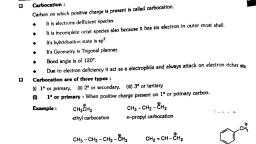
*Q.82. Write true or false. Correct the false statement. ;, Homolytic fission involves unsymmetrical breaking of a covalent bond., , Heterolytic fission results in the formation of free radicals., iii. Free radicals are negatively charged species., , , , Ans:, i. False, Homolytic fission involves symmetrical breaking of a covalent bond., ii. False ., Heterolytic fission results in the formation of charged ions like cation and anion., iii. False, , Free radicals are electrically neutral/uncharged species., , fo What is carbocation? Explain with the help of an example and comment on the Stability ,, , carbocation., Ans: Carbocation:, i, A carbon atom having sextet of electrons and a positive charge is called a carbocation., , ii, They are unstable and highly reactive species formed as intermediates in many organic reactions., iii. In a carbocation, the central carbon atom is sp” hybridized and has trigonal planar geometry., , , , e.g. Ina methyl carbocation CH, , the positively charged | [~~ ~~~~~-~~~-~--~----., carbon atom is covalently bonded to three hydrogen, atoms. It is planar with H-C-H bond angle of 120°., The unhybridized p, orbital is vacant and lies H..,, Ot, perpendicular to the plane containing the three sigma %, , |, 1, I, 1, |, C-H bonds. I, I i, |, |, 1, , +, C——H, , iv. -Carbocation are classified as primary (1°), secondary (2°), and tertiary (3°)., v. The stability of carbocations decreases in the order: I, , Shape of methyl carbocation, , CH3 ili H H, CH3-C* > CH3- Ct > ae > risa, CHs3 H H i, , tert- Butyl carbocation Isopropyl carbocation Ethyl carbocation Methyl carbocation, 9) @) ay, *Q.84. A covalent bond in tert-butyl bromide breaks in a suitable polar solvent to give ions., i. Name the anion produced by this breaking of a covalent bond. ,, ii. Indicate the type of bond breaking in this case., iii. | Comment on geometry of the cation formed by such bond cleavage,, , Ans:, 1. The anion produced by breaking of the covalent C — Br bond is bromide ion., CH3 CH3, CH3-—C i —focsove! 5 CH) -— Ct + gBr, heterolysis, CH; CH; Bromide ion, tert-Butyl bromide tert-Butyl, , carbocation, , ii. Heterolytic cleavage/fission takes place as charged ions are produced., iii, __tert-Butyl carbocation formed in the given cleavage has trigonal planar geometry., test rgrearepreeg —