Page 1 :
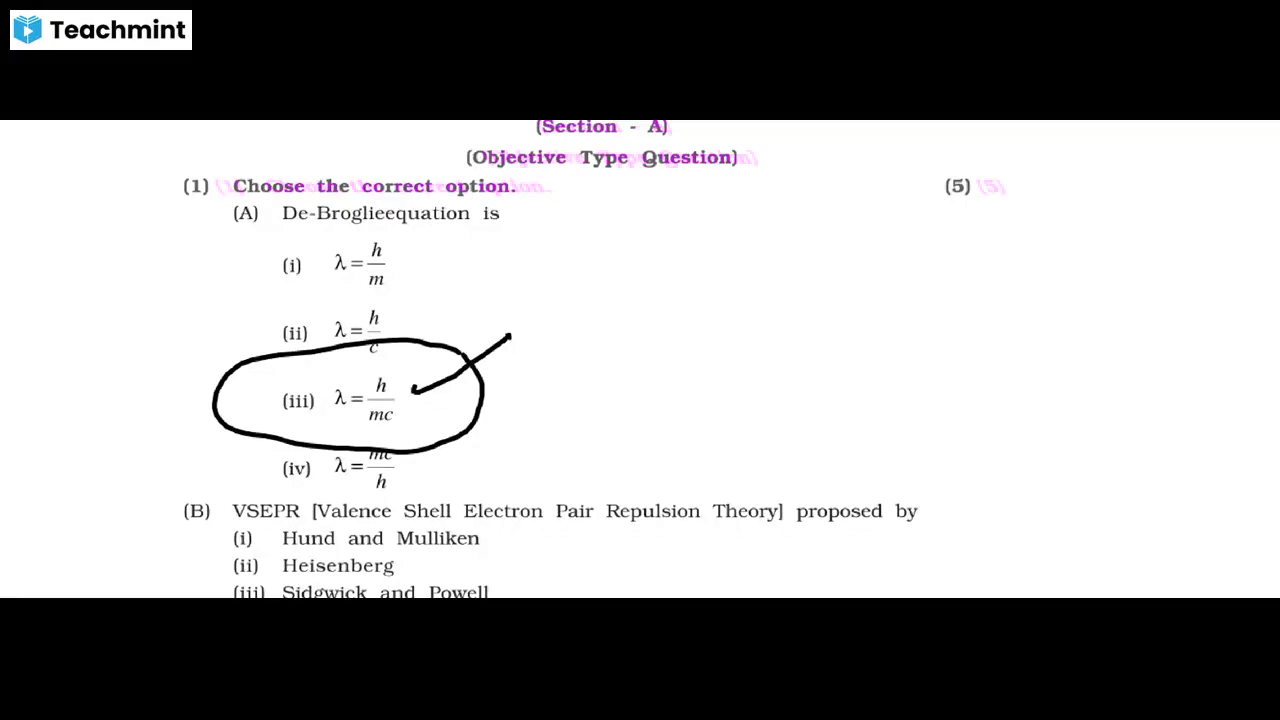
] 414 % Chemistry-11 [ ||, , QUESTION PAPER, , Time: 3 Hours Maximum Marks: 75, Instruction, (1) Attempt all the questions., (2) In ‘Sec. A’ question No. 1 to 4 are objective types, each question carry, 5 marks., (3) In ‘Sec. B’ questions No. 5 to 14, each question carry 4 marks., (4) In ‘Sec. B’ question No. 15 to 17, each question carry 5 makrs., (5) Internal choice are given in question No. 5 to 17., , (1), , (B), , (C), , (D), , (E), , (Section - A), (Objective Type Question), , Choose the correct option. (5), , (A), , De-Broglieequation is, , h, (i) Az=—, , m, , h, (ii) A=—, , c, gay ee, , mec, (iv) A= , VSEPR [Valence Shell Electron Pair Repulsion Theory] proposed by, , @, (ii), (iii), (iv), , Hund and Mulliken, Heisenberg, , Sidgwick and Powell, Heitler and London, , Oxidation Number of C in CCl, is, , (i), (ii), (iii), (iv), , +4, -4, +6, -6, , Oxidation Number of S in [SO,]-~ is, , (i), (ii), (iii), (iv), , +6, -6, +5, -5, , Oxidation Agent (Substance)
Page 2 :
(2), , (3), , (4), , (5), , (6), , (7), , | Test Paper + 415 |, , (i) Accept electron, (ii) Electron Donor, (iii) Accept proton, , (iv) Accept neutron., , Match the column (5), A. B., , (i) H,O, (A) Rocket Fuel, , (ii) D,O (B) Smoke Screen, , (iii) Liquid H, (C) Modedator, , (iv) CaCO, (D) Lime-stone, , (vy) SiCl, (E) Antiseptic, , Fill in the blanks (5), , (A) Sulphide ores are mostly concentrated by _____—_—«—s method., , (B) Iron metal is extracted by __ ss Furnace., , (C) Formula of Bauxite ore is, , , , H,SO,, (D) C,Hs0H pe? +H 0, (E) Ozone Layer is depleted by __ also, Write answer in one word. (5), , (ij) Name the medicinal plant, which helps to prevent environmental, pollution as well as beneficiary in skin diseases also., , (ii) Which gas is caused of Green House effect., , (iii) Which polymer had been used generally to non sticky coating in, cooking utensils., , (iv) Which polymer is used to manufacture tyrecords., (v) Write the formula of Monomer of PVC?, Section-B, , (Very short Answer Question), Calulate the following in 1lgm CO, (4), (A) Mole Number of CO,, (B) No. of Molecules of CO,, OR, , An organic compound contain C = 40% H = 6.66% and O= 53.34% than, find out the Emperical formula of compound., , Describe Heisenberg uncertainty principle? Write its Mathematical, Derivation?, OR, , Explain Pauli’s exclusion principle with an example. Write its utility. [any, two], , Explain Ionigation Enthalpy and Electron Affinity, briefly. (4)
Page 3 :
| 416 * Chemistry-11 |, , (8), , (9), , (10), , (12), , , , , , OR, Explain Atomic radii and Ionic radii, briefly., , Write the name of Geometrical shape and Bond angle of the following, molecules., , (A) C,H,, (B) BCI,, (C) NH,, (D) PCI,, OR, Draw the resonance structure of the following:, (A) NO,”, (B) CO,, , Derive Methematical expression of Ideal gas equation? Write values of R, in different two units? (4), , OR, Volume of a gas at 27°C temperature and 760mm pressure is 1000 ml., What will be the volume at 327°C and 380mm pressure., What is the relationship in between Kp and Ke. Derive mathematically., OR, Write the formula of equilibrium constant (K) for the following Reactions:, (3) H, + 1, = 2HI, (3) N, + 3H, = 2NH,, (4) 2NO, = N,O,, , (@) PCI, = PCI, + Cl,, , Write definition only (4), (A) Salt Hydrolysis, , (B) Solubility product, , (C) Common ion effect, , (D) Buffer solution, , OR, Write one example (with name and formula) each of the following compound., (A) Salt formed by strong acid and strong base., (B) Salt formed by weak acid and strong base., (C) Salt formed by strong acid and weak base., (D) Salt formed by weak acid and weak base., , What is Baking Soda? Write equation of Method of its preparation, any one, chemical property and any two uses of it. (4), , OR
Page 4 :
(13), , (15), , (16), , (2), , (17), , | Test Paper + 417 |, , What do you mean by plaster of Paris? How it is prepared. Give chemical, , equation of it with water and write any two uses., , Write symbole and electronic configuration of Group 14 elements? (4), OR, , What is Zeolite? Write any four uses of it., , Explain the Laboratory method of preparation of Acetylene on the basis of, following points., , (A) Process and Chemical Equation. (B) Labelled Diagram. (4), OR, , How will you obtained following compound from Benzene? Explain, with Equation., (i) Nitrobenzene, (ii) Chlorobenzene, (iii) Toluene, (iv) B.H.C., , (Long answer type questions), , What is Hess’s Law of constant Heat Summation., , Enthalpy of combustion of diamond is -593.5 KJ where as enthalpy of, combustion of graphite is -595.5KJ. Calculate the enthalpy of transition, of diamond to graphite? [2+3=5], , OR, , What is the first Law of Thermodynamics? Derive its mathematical, expression., , (i) Write the formula and any two uses of the following compound:(3), (A) Borax, (B) Boric Acid., , (ii) Draw the structure of Diborane., , OR, , (i) What is alum? Write its general formula and give any one example., , (ii) Write any four uses of alum., , (i) What is substitution reaction? Explain with example. (2), (ii) Write TUPAC. Name of the following compounds. (3), oO, Il, (A) CH3—CH,-CH -CH,; (B) CH,-C-CH;, , |, (C) CH,CH,OH cy, OR
Page 5 :
] 418 & Chemistry-11 [ ||, , (i) What do you understand by Electrophilic and Nucleophilic reagent?, , Explain briefly with two example of each. (3), (ii) Explain the Halogenic process in benzene. (2), CHEMISTRY, Time: 3 Hours Maximum Marks: 75, Instructions:, , (1) Attempt all the questions., (2) Question Nos. 1 to 4 are objective types, carries total 20 marks., (3) Question Nos. 5 to 14, each question carries 4 marks., (4) Question Nos. 15 to 17, each question carries 5 marks., (5) Marks have been shown against each question., (5) Internal choice are given in question No. 5 to 17., 1. Multiple Choice-write correct answer. (5), (i) Oxidation number of Cl in Hocl is :, (a) -1, (b) +6, (c) +1, (d) +2, (ii) Formula of Haematite is:, (a) Fe,0,, (b) Fe,0,, (c) FeCO,, (d) FeS,, (iii) Which oxide with dilute acid to give H,O,, (a) PbO,, (b) Ne,O,, (c) MnO,, (d) Tio,, (iv) Which of the following is a natural polymer:, (a) Starch, (b) Nylon, (c) Teflon, (d) Buna-s-rubber, (v) The number of molecules present in 16 gram Oxygen gas are, (a) 6.023 x 10²³ (b) 3.011 x 1029, (c) 12.044 x 1029 (d) 1.55 x 1028