Page 1 :
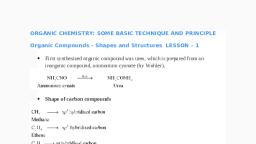
GENERAL ORGANIC CHEMISTRY, , GENERAL ORGANIC CHEMISTRY, 1. GENERAL ORGANIC CHEMISTRY, 1.1 Introduction, In 1807, Berzelius proposed the term ‘Organic Chemistry’, for the study of compounds derived from natural sources., This was based on the theory of vitalism which said that, all living systems possessed a ‘vital force’ which was, absent in non-living systems. Compounds derived from, living natural sources (organic) were thought to be, fundamentally different from inorganic compounds., , The making and breaking of bonds usually occurs, in several discrete steps before transforming, transforming into products. The detailed sequential description, of all the steps is called the mechanism of the reaction., , 2.1 Sigma and Pi Bonds - Comparison, , The vital force could be philosophically thought as the, mysterious force God instilled in the living systems., In 1823, Friedrich Wohler joined Berzelius as his student., In 1828, Wohler made a discovery which changed the, definition of organic chemistry. Wohler conducted the, following experiment., 2.2 Structural Formulas, Several kinds of formulas are used by organic chemists to, represent organic compounds., , Wohler successfully synthesized an organic compound, starting from an inorganic compound. Following this, many, others synthesized organic compounds starting from, inorganic compounds. Thus, the theory of vitalism and, the definition of organic chemistry lost its meaning., But what was common in all the above compounds, synthesized was the presence of carbon. Carbon shows a, special property catenation. Carbon can connect with other, carbon atoms to form long chains and rings (selfcatenation) and can connect with atoms of many other, elements in the periodic table (cross-catenation). Because, of this reason, carbon can form a wide variety of, compounds. Therefore, the modern definition of organic, chemistry is the study of carbon compounds., Probably, the vital force can be explained by the fact that, most of the life-giving and life-sustaining functions are, performed by carbon compounds, for example, the human, tissues and skin are formed by proteins, respiration is, possible due to haemoglobin, the information in our genes, is carried out in the form of DNA/RNA etc., General Organic Chemistry is the detailed study of the, basic concepts and factors that govern the progress and, outcome of reactions., , 2.2.1 Complete Formulas, Complete formulas are lewis structures which shows all, bond pair of electrons as a dash (–). Lone pair of electrons, are shown as a pair of dots., 2.2.2 Condensed Formulas, Condensed formulas are written without showing all the, individual bonds. Each central atom is shown together, with the atoms that are bonded to it., 2.2.3 Line-Angle Formulas, These are also called skeletal structures or a stick figure., Line-angle formulas are often used for cyclic compounds, and occasionally for non-cyclic ones. Bonds are represented, by lines, and carbon atoms are assumed to be present where, two lines meet or a line begins or ends. Hydrogens are, generally implicit in these drawings., 2.2.4 Tetrahedral Representation, This is generally the three-dimensional (3-D) representation, ), ) or solid wedge (, of molecules. Dashed Wedge (, are used to indicate bonds projecting behind the plane
Page 2 :
GENERAL ORGANIC CHEMISTRY, , (away from the observer) and out of the plane (towards the, observer) respectively. Bonds lying in the plane of paper, are depicted by using a normal line (—)., , 2.4 Hybridization, Hybridisation is a process in which two or more atomic, orbitals of comparable energy of the valence-shell of an, atom (central atom of the molecule or ion) either in its, ground state or in its excited state mix together and give, rise to the formation of new degenerate orbitals which are, called hybrid orbitals., 2.5 Applications of Hybridization, , 2.3 Degrees of Carbon, It is defined as the number of carbons attached to carbon, under observation., Methyl, , 1° (Primary), , 2.5.1 Size of Hybrid Orbitals, As % s-character increases, size of hybrid orbital, decreases. Therefore, 3, , 2° (Secondary), , 2, , Size of Hybrid Orbital : sp > sp > sp, 2.5.2 Electronegativity of Hybrid Orbitals, As % s-character increases, electronegativity of hybrid, orbital increases. Therefore, 2, , EN of Hybrid Orbital : sp > sp > sp, 3° (Tertiary), , 3, , 2.6 Dienes, Dienes are organic compounds containing two double, bonds. There are three types of dienes :, (a) Isolated, , 4° (Quaternary), , (b) Conjugated, , (c) Cumulated, , 2.6.1 Isolated Diene, In this case, double bonds are separated by atleast one sp, carbon., , Table : Hybridization of Common Molecules., , 3
Page 3 :
GENERAL ORGANIC CHEMISTRY, , 3.2 Heterolytic Fission or Heterolytic Cleavage, , 2.6.2 Conjugated Diene, Double bonds are separated by only one single bond (or, 2, 4 sp carbons in a row)., , In this type of covalent bond breaking, the shared pair of, electrons are transferred to the more electronegative part., Therefore, this fission leads to the formation of a cation, and an anion (ion-pair)., , 2.6.3 Cumulated Diene, Both sets of double bonds are at the same carbon., , A substituted allene, An allene is, , The bond breaking is shown by a full-headed arrow. A full, headed arrow shows the movement of a pair of electrons., In organic chemistry, the movement of electrons is always, shown by curved arrows - half-headed or full-headed arrows., , 4. INDUCTIVE EFFECT, , 2.6.4 Stability of Dienes, The relative stabilities of dienes follows the order, Conjugated > Isolated > Cumulated, Important : Stability v, , When two unlike atoms form covalent bond, the electronpair forming the sigma bond is never shared equally, between the two atoms but is shifted slightly towards the, more electronegative species., , 1, Energy Content of the molecule, , 2.7 Commonly Occuring Forms of Carbon, The commonly occuring forms of carbon are, (a) Diamond, , (b) Graphite, , (d) Fullerenes, , (e) Charcoal, , (c) Carbides, 3, , Diamond - Each C is sp . Tetrahedral solid., 2, Graphite - Each C is sp . Layered solid with weak, van der Waal’s forces between layers., Calcium Carbide - Each C is sp., 2, , Fullerene - Each C is sp ., , 3. BREAKING OF BONDS, In organic chemistry, the bond that is important for the study, of reactions is covalent bond. We, therefore, study ways in, which a covalent bond can be broken., (a) Homolytic Fission, , (b) Heterolytic Fission, , 3.1 Homolytic Fission or Homolytic Cleavage, , There are broadly three types of groups/atoms that may, be attached to carbon as illustrated. Although C is more, electronegative than H, the electronegativity difference is, small and the bond is generally consider non-polar., 4.1 Nature of Inductive Effect, Inductive effect is a permanent effect and can be directly, correlated to its dipole moment., It is a weak effect as the shifting of electrons takes place, only through sigma bonds., 4.2 Effect of branched carbon chain, An illustration has been marked for operation of inductive, effect which is self-explanatory., , In this kind of bond breaking, each atom separates with, one electron, leading to the formation of highly reactive, species known as radicals (or free radicals)., , The bond breaking is shown by two half-headed or fishhook arrows. A half-headed arrow shows the movement, of one electron., Radicals are neutral and are odd electron species., , More the number of G, lesser the effect
Page 4 :
GENERAL ORGANIC CHEMISTRY, , Order of Acidic Strength : III > II > I, , 4.3 Electron Donating and Electron withdrawing Groups, Inductive effect may be due to single atom or a group of, atoms. Relative inductive effects are measured with, reference to hydrogen. Those which donate electrons to, carbon chain are called electron-donating groups (EDG), or electron-releasing groups (ERG) and are said to exert, +I effect. Those which withdraw electrons from carbon, chain are called electron-withdrawing groups (EWG), and are said to exert –I effect., Important :, 1., , I.E. of alkyl groups : 3° > 2° > 1° > CH3–, , 2., , In general, greater is the number of carbons in an alkyl group,, greater is its +I effect., , 3., , For problem-solving, we take electronegativity of sp3, hybridized carbon to be more than sp hybridized nitrogen., , 4.4.2 Effect of Distance, If the ERG/EWG moves away, the inductive effect, diminishes., Example - 2, (a), , Compare the acidic strength of :, (I), (II), , (III), , (IV), , 4.4 Applications of Inductive Effect, 4.4.1 Effect on Acidic/Basic Strength, EWG increases acidic strength and decreases basic, strength. ERG decreases acidic strength and increases basic, strength., Example - 1, Compare the acidic strength :, (I), , Solution :, (a), , (I), , (II), , (II), (III), , (III), , Solution :, , (IV), , An alkyl group is donating only if no other EWG is present, on it. Therefore, groups like –CH2Cl and –CH2F become, electron withdrawing groups., Order of acidic strength : II > III > IV > I, Series of +I and –I groups in order of their strength, –I Series (EWG), , +I Series (ERG)
Page 5 :
GENERAL ORGANIC CHEMISTRY, , 4.4.3 Basicity of Amines, , 5.1.2 Pi alternate Positive Charge, , The order in gaseous or liquid phase is :, , Example - 4, , 3° > 2° > 1° > NH3, To determine the basic strength of amines in aqueous, phase. We have to consider inductive effect, solvation, effect and steric hinderance. The order of basic strength, is therefore experimental in aqueous state as we can’t give, priority to stability provided by any one factor. Two results, are important for aqueous phase :, (a) (CH3)2NH > CH3NH2 > (CH3)3N > NH3, i.e. 2° > 1° > 3° > NH3, , (R = CH3), , 5.1.3 Pi alternate Negative Charge, Example - 5, , (b) (C2H5)2NH > (C2H5)3N > C2H5NH2 > NH3, i.e. 2° > 3° > 1° > NH3, , (R = C2H5), , 5. RESONANCE, Molecules are generally represented by simple lewis, structures but some molecules can not be represented by, just one Lewis structure. This led to the discovery of, resonance. Resonance refers to the delocalization of, electrons (generally S-electrons)., 5.1 Conjugated Systems, 5.1.1 Pi alternate Pi, Example - 3, , 5.1.4 Pi alternate Odd Electron, Example - 6, , 5.1.5 Pi alternate Lone Pair, This case is similar to ‘pi alternate negative charge’ as, lone pair and negative charge are treated similarly., Example - 7, , 5.1.6 Lone Pair and Positive Charge on Adjacent Atoms, Example - 8, , 5.2 Rules for Validity of Lewis Structures, Rule-1 :, All the lewis structures must conform to lewis octet rule., Rule-2 :, Position of atoms in all resonating structures must be the, same. Only the electrons move.
Page 6 :
GENERAL ORGANIC CHEMISTRY, , Rule-3 :, All the resonating structures must have the same number, of paired and unpaired electrons, i.e. sum of bond pairs, and lone pairs must be constant., Rule-4 :, All the atoms participating in resonance in a molecule must, be coplanar. This is required for the effective overlap of, p orbitals and the delocalization of electrons, for eg,, buta-1,3-diene., , (b) I and II are tied on octets and number of S bonds but, negative charge is more stable on more electronegative, atom. Hence, II is more stable., Example - 11, Give the order of stability of following resonating, structures, (I), , (II), , 5.3 Criteria for Major/Minor Contributors, Resonance forms can be compared using the following, criteria in the following order :, , (III), , 1., , As many octets as possible (a neutral molecule is always, more stable in which its octet is complete)., , (IV), , 2., , As many S bonds as possible., , 3., , Negative charge on more electronegative atom is stable., , 4., , Charge separation., (a) Similar charges - Keep them as FAR as possible to, minimize repulsion and instability., (b) Opposite charges - Keep them as NEAR as possible to, maximize attraction and stability., , Example - 9, Which of the following structures is more stable ?, , (V), Solution :, In (I), there are maximum number of pi bonds. Therefore,, it is most stable. In (II) and (V), the number of pi bonds is, equal but charge separation is greater in (V). Therefore,, (II) is more stable than (V). In (III) and (IV), there is, maximum charge separation but (III) is highly unstable, due to electrostatic repulsion. Hence, the order of stability, is :, I > II > V > IV > III, , 6. MESOMERIC EFFECT, Solution :, II is more stable as all the octets are complete., Example - 10, Which of the following is more stable in the following, pairs ?, (a), , The permanent polarization, due to a group conjugated, with a S bond or a set of alternate S�bonds, is transmitted, through the S electrons of the system-resulting in a different, distribution of electrons in the unsaturated chain., This kind of electron redistribution in unsaturated, compounds conjugated with electron-releasing or electronwithdrawing groups (or atoms) is called Mesomeric Effect, or Resonance Effect., This effect is permanent and is indicated by the dipole, moment., 6.1 Electron-Releasing and Electron-Withdrawing Groups, Groups which release or withdraw electrons by resonance, are said to exert M or R effect., , (b), , Solution :, (a) In II, all octets are complete. Therefore, II is more stable., , 6.1.1 Electron-Releasing Groups (+R or +M effect), , The common thing about all the groups listed is that the, atom connected with the conjugated system has a lone pair, to donate. Therefore, a generic representation can be
Page 7 :
GENERAL ORGANIC CHEMISTRY, 6.1.2 Electron-Withdrawing Groups (–R or –M effect), , Similarly, in phenol, resonance leads to charge separation, which increases the rate of ionization and forms phenoxide, ion which is stabilized by charge delocalization., , The common thing about all the groups listed is that the atom, connected with the conjugated system has a S bond with, another more electronegative atom which withdraws the, electrons or directly has a positive charge on them. Therefore,, a generic representation can be, (ENZ > ENY), 6.1.3 Dual Behaviour, are both electron-releasing and, Groups such as, electron-withdrawing as illustrated., Example - 12, As electron releasing group, , As electron withdrawing group, , Which behaviour dominates and which is used in a, particular context will be discussed later in Electrophilic, Aromatic Substitution later., Resonance Effect does NOT depend upon distance, unlike inductive effect., 6.2 Applications of Mesomeric Effect, , Order of acidic strength, RSO3H > RCOOH > H2CO3 > PhOH > CH3OH >, H2O > ROH > HC{CH > NH3 > CH4, , 6.2.1 Effect on Acidic Strength of Carboxylic Acids and Phenols, The resonating structure of carboxylic acid leads to chargeseparated structure which is less stable than the carboxylate, ion in which charge is delocalized. Therefore, carboxylic, , acid readily loses proton (H ) to form a carboxylate ion., , 6.2.2 Effect on Reactivity of Carboxylic Acid Derivatives, A typical nucleophilic reaction is represented as :, , The stronger is the bond between C and Z, the difficult it, is for a nucleophile to break a bond and therefore, lower, reactivity., , Reactivity order of carboxylic acid derivatives towards, nucleophilic acyl substitution is :, Acyl Chloride > Acid Anhydride > Ester > Amide
Page 8 :
GENERAL ORGANIC CHEMISTRY, , 6.2.3 Effect of ERG/EWG on Acidic/Basic Strength, EWG increases the acidic strength and decreases the basic, strength., ERG decreases the acidic strength and increases the acidic, strength., Example - 13, Arrange the following in the order of decreasing acidic, strength :, , Example - 14, Arrange the following in decreasing order of basic strength, Solution :, , Solution :, , The order of acidic strength is : II > V > I > III > IV, In the previous example, let’s also discuss the stability of, phenoxide ions corresponding to (II) and (IV)., , Therefore, order of basic strength is : IV > III > I > V > II, Let’s also discuss the stability of anilinium ions corresponding, to (II) and (IV).
Page 9 :
GENERAL ORGANIC CHEMISTRY, Example - 15, Mark the number of D-C and D-H in the given compounds, (a), , (b), , (c), , (d), , Solution :, (a), , (b), , D C = 4, D H = 0, (c), 2, , 7. HYPERCONJUGATION, Hyperconjugation is the ability of the V bond electrons of, bond to undergo conjugation with the adjacent, an D, S electrons. It is also known as Baker-Nathan Effect,, No-Bond Resonance and V-S, S Effect., , D C = 1, D H = 1 but since D�C is sp hybridized, therefore,, it won’t participate in hyperconjugation. Therefore, D�H, = 0 that will participate in hyperconjugation., (d), , 7.1 D-Carbon and D-Hydrogen, We have already discussed the D, E, J nomenclature. Let’s, take an example :, , D C = 2, D H = 3, 7.2 Mechanism of Electron Donation in Hyperconjugation, , D-Carbon is the carbon attached to a functional group such, as, . The hydrogen attached to D-carbon is called, bond to be eligible for, D-hydrogen. For an D, 3, hyperconjugation, D C must be sp hybridized., , The hybrid formed by these resonating structures better, known as hyperconjugating structures is :
Page 10 :
GENERAL ORGANIC CHEMISTRY, , 7.3.3 Stability of Carbocations, , Now, greater the number of D-H, greater the number of, hyperconjugating structures and more is the electron, donation of alkyl group to S bond., The order of electron-donation of alkyl groups based on, hyperconjugation is :, , The positive charge on C is delocalized over DH to give, stability to the carbocation. More is the number of DH,, more is the stability of carbocations., Stability of Carbocations, , Methyl > 1° > 2° > 3°, , More is the number of D-H, more is the S�bond, delocalized. This implies that more will be the, , stability of alkene and less will be the heat of hydrogenation, and more is the no-bond resonance energy., 7.3 Applications of Hyperconjugation, 7.3.1 Stability of Alkenes, More is the number of D-hydrogen, more is the number of, hyperconjugating structure and therefore more stability, and greater no bond resonance., , 8. ELECTROMERIC EFFECT, Electromeric effect is observed only in the presence of a, reagent and is therefore, a temporary effect. When a reagent, approaches a molecule, the multiple bond such as, or, is polarized by the complete transfer of S, electrons., , Example - 16, Which alkene is more stable ?, , When the multiple bond is between two unlike atoms, the, shift of electrons takes place towards more electronegative, atom., Solution :, , 9. COMPARISON OF INDUCTIVE, HYPERCONJUGATION, AND RESONANCE EFFECTS, I is more stable than II., 7.3.2 Acidic Character of Alkenes, Hyperconjugation weakens the DC-H bond in, hyperconjugation hybrid (partial single bond) and, therefore DH can be lost easily., , Inductive Effect is a V-V, V interaction and acts through, strong sigma bonds., Resonance/Mesomeric Effect is a S-S, S interaction and, acts through weak pi bonds., Hyperconjugation is a V-S, S interaction and acts through a, strong sigma and a weak pi bond., Therefore, the order of importance is :, Resonance > Hyperconjugation > Inductive
Page 11 :
GENERAL ORGANIC CHEMISTRY, , 10. STERIC INHIBITION OF RESONANCE (SIR), When both the ortho positions of a bulky functional, group are occupied by bulky substituents, all the three, groups are out of plane of the benzene ring., , 11. CARBOCATION, 11.1 Definition, Carbocation is the intermediate of carbon containing, positive charge. It has six electrons in the valence shell., 11.2 Geometry and Hybridization, , , Hybridization of C = sp, , 2, , , , Geometry of C = Trigonal Planar, , Example - 17, Mark the order of basic strength :, , 11.3 Classification of Carbocations, This classification will also be used for carbanions and, carbon free radical and will be studied only in this section., Solution :, In (II) and (III), the lone pair of N is in conjugation with the, benzene ring and is not available for donation. (II) is less, basic than (III) due to –I and –M of –NO2 group. It may, seem that (I) is least basic due to presence of 2 –NO2 groups, but –NO2 and –N(CH3)2 are all bulky groups. This is a case, of steric inhibition of resonance due to which the lone pair, of N is not in conjugation and is readily available for electron, donation. Hence, the order of basic strength is :, (I) > (III) > (II), Example - 18, Mark the order of bond lengths in the given molecule., , Solution :, –I, –NO2 are bulky groups and is case of steric inhibition, of resonance. Therefore, the –NO2 groups ortho to –I are, out of conjugation while the –NO2 group para to –I will, be in conjugation with the benzene ring. Therefore, bonds, ‘a’ and ‘b’ will always have single bond character while, ‘c’ has double bond character. Therefore :, c<a=b, , Methyl Carbocation, 1° Primary Carbocation, 2° Secondary Carbocation, , 3° Tertiary Carbocation
Page 12 :
GENERAL ORGANIC CHEMISTRY, , 11.4 Stability of Carbocations, There are three factors contributing to the stability of, carbocations :, (a) Inductive Effect, (b) Hyperconjugation, (c) Resonance, Order of stability :, , Order of stability : III > I > II, 11.5 Formation of Carbocations, 11.5.1 Ionization of Carbon-Leaving Group Bond, In this method :, (a), , Bond between carbon and leaving group ionizes., , (b), , Leaving group accepts the pair of electrons that were, shared in the covalent bond., Rate of formation of carbocation depends on :, , Example - 19, Rank the stability of carbocations in each case :, , (a), , (a), , The stability of carbocation formed., , (b), , The nature of the leaving group. Weaker the base better, the leaving group. This is because weaker leaving group, implies a stable compound and its formation will therefore, be favoured., , 11.5.2 Addition of Proton to a S bond, , Solution :, , Rate of carbocation formation depends on :, (a), , Stability of carbocation formed., , (b), , Strength of the electrophile., , 11.6 Reactions of Carbocations, There are three important reactions of carbocations :, , (a), , (a), , Capture a Nucleophile, , (b), , Lose a proton to form a S bond., , (c), , Rearrangement, , 11.6.1 Capture a Nucleophile
Page 13 :
GENERAL ORGANIC CHEMISTRY, 11.6.2 Loose a proton to form a S bond, Example - 20, , (a) Hydride Shift, , (b) Alkyl Shift, , Example - 21, , Form the products from the following reaction :, , Solution :, Step-1 : Protonation, , In the above example, both hydride and methyl shifts are, possible leading to more stable carbocation but only that, shift is preferred which leads to more stable, carbocation. In this example, hydride shift will take place., , Step-2 : Formation of Carbocation, , Important : The shift takes place in the form of, ., , 12. CARBANIONS, 12.1 Definition, , Step-3 : Deprotonation, , Carbanion is the intermediate of carbon containing negative, charge. It has eight electrons in the valence shell., , 12.2 Geometry and Hybridization, Hybridization of, , 3, , : sp, , Geometry : Trigonal Pyramidal, Carbanion and ammonia are isoelectronic species having, same structure, , When carbocation deprotonation can lead to more than one, product, all products are formed and the most stable product, is the major product., 11.6.3 Carbocation Rearrangement, A carbocation can become more stable by rearrangement., Bonding electrons of carbocation may shift between, adjacent atoms to form more stable carbocation. There, are two kinds of shifts that take place in order to gain, stability., , 12.3 Stability, ERG will increase the electron density at carbon and will, make it unstable. EWG will decrease the electro density, at carbon and will make it stable.
Page 14 :
GENERAL ORGANIC CHEMISTRY, , Order of Stability :, , 1., , Carbanion is never formed as an intermediate that can be, isolated in the case of Grignard Reagent. It directly, participates in the reaction., , 2., , Dry ether is used in this formation as it is inert to Grignard, reagent. For the formation of Grignard reagent from aryl, halides, we use tetrahedrofuran (THF) as solvent., , 12.4.2 Formation from Carbonyl Compounds, Example - 22, Give the order of stability of :, , Solution :, As s-character increases, electronegativity of C increases, and therefore negative charge will become more stable., Therefore, order of stability is :, , There are three reasons for the easy formation of carbanion, from carbonyl compounds, , III > II > I, , (a), , Resonance - stabilization of carbanion which is the, conjugate base of carbonyl compound., , (b), , Hyperconjugation makes the DC-H bond acidic., , (c), , –I of increases the acidic strength of C–H bond., , 12.5 Reactions of Carbanion, 12.4 Formation of Carbanion, There are two methods for the formation of carbanion :, (A) Partial formation via Grignard Reagent, , The reactions of carbanion are very fast as electropositive, carbon carries negative charge., 12.5.1 Grignard Reagent as a Base, , (B) Formation from Carbonyl Compounds, We will discuss these methods in the subsequent section, 12.4.1 Formation via Grignard Reagent, , In this reaction it captures acidic hydrogen.
Page 15 :
GENERAL ORGANIC CHEMISTRY, , 12.5.3 Aldol Condensation, This reaction is shown by carbonyl compounds containing, atleast one DH in presence of dilute base such as dilute, NaOH., , Mechanism :, , In (d), the reaction with terminal alkyne also takes place, as sp-hydridized carbon is highly electronegative and, therefore H attached to it is fairly acidic., 12.5.2 Grignard Reagent as a Nucleophile, Grignard Reagent reacts with carbonyl compounds to form, alcohols. This is a very important method for the synthesis, of alcohols., , 13. CARBON FREE RADICALS, , Mechanism :, , 13.1 Definition, Carbon Free Radical is the intermediate of carbon having, an odd electron. It is neutral and has seven electrons in the, valence shell. It is highly reactive as it requires only one, electron to complete its octet and therefore, is short-lived., , 13.2 Geometry and Hybridization, , is never added along with the first step as Grignard, Reagent will react with, reaction., , to give, , as in previous, , The hybridization of carbon free radical was proposed after, experimental verification of structure of different radicals.
Page 16 :
GENERAL ORGANIC CHEMISTRY, •, , Mechanism, , 2, , It was proposed that when ERG are placed on C , it has sp, 3, hybridization and when EWG are placed on C•, it has sp, hybridization., , (I) Chain Initiation, There are two choices :, (a), , (b), , (I) (b) will take place as it is energetically feasible., , 13.3 Stability, , (II) Chain Propagation, , ERG increase stability while EWG decrease stability., , (a), , (b), 13.4 Formation of Carbon Free Radical, Carbon Free Radicals are formed by homolytic cleavage of, bonds. They are formed :, (a) at high temperature in the gas phase, (b) in non-polar solvents, (c) by ultraviolet light, , (III) Chain Termination, The various free radicals in the progress of reaction are :, , Cl•, CH3•. There are ways in which free radicals from, different chains may combine to terminate the reaction., , (d) by addition of other radicals, 13.5 Reactions of Carbon Free Radical, The most common reactions in which free radical is, involved are :, (a) Halogenation of alkanes., (b) Addition of HBr in the presence of peroxides to alkenes., (Anti-Markonikov Rule), (c) D-Halogenation of alkenes., (d) Wurtz Reaction, (e) Decarboxylation reaction, 13.5.1 Free Radical Halogenation of Alkanes, The typical reactions of free radical are chain reaction, mechanisms. There are three steps in a chain reaction, mechanism : initiation, propagation and termination., , that is formed in this, There is a side-product, reaction. Besides these, a number of other side-products such, as CH2Cl2, CHCl3 and CCl4 have also been observed. These, get formed since carbon free radical is highly reactive. It, randomly reacts with other species that make it stabler.
Page 17 :
GENERAL ORGANIC CHEMISTRY, 14. NOMENCLACTURE-I, 14.1 INTRODUCTION, In 1949, an organization was set up to formulate the rules for naming organic compounds. This, organization is IUPAC - International Union for Pure and Applied Chemistry. Prior to this, the, organic compounds were known by their trivial/common names which generally indicated their source., For example, formic acid gets its name from formica (Latin, red ants) and acetic acid gets its name from, acetum (Latin, vinegar)., Important : Systematic nomenclature is required in order to have unambigous names for all, compounds., 14.2 CLASSIFICATION OF HYDROCARBONS, , Important :, 1., , Aliphatic Compounds do not have rings and exist as a chain of carbon atoms., , 2., , Alicyclic Compounds have similar properties as aliphatic compounds except that the carbon, chain exists in the form of ring., , 3., , Aromatic Compounds are based on the structure of benzene. These compounds are also, called arenes., , 14.3 HOMOLOGOUS SERIES, A homologous series (Greek homos = “the same as”) is a family of compounds in which each member, differs from the next by one methylene (CH2) group. The members of the homologous series are called, homologues. Example :, (a) Alkanes CnH2n + 2, , (b) Alkenes CnH2n, , (c) Alkynes CnH2n – 2
Page 18 :
GENERAL ORGANIC CHEMISTRY, , 14.4 NOMENCLATURE OF UNBRANCHED ALKANES, , Meth, Eth, Prop, But, etc. are called compound roots. Compound roots represent the number of carbon, atoms., 14.5 IUPAC NAME TEMPLATE, , This template will be used to give the name for any organic compound., 14.6 RULES FOR NOMENCLATURE OF SIMPLE HYDROCARBONS, Rule-1 :, Determine the longest carbon chain in the molecule (parent chain). Where a double/triple bond is, present, choose the chain which includes these bonds. If there is a cyclic structure present, the longest, chain starts and stops within the cyclic structure.
Page 19 :
GENERAL ORGANIC CHEMISTRY, EXAMPLE, (I), , Longest chain = 8, , (II), , Longest chain = 9, , (II) is the correct chain selection., Rule-2 :, Assign numbers to each carbon of the parent chain. Numbering is done to identify the parent alkane, (compound root) and to locate the positions of the carbon atoms at which branching takes place. The, numbering is done in such a way that the branched atoms get the lowest possible number., EXAMPLE, (I), , 4, 8-INCORRECT, , (II), , 2, 6-CORRECT, , If there is a tie for the first branch, then go to the second and so on until a difference is observed., , EXAMPLE, (I), , 2, 4, 5-INCORRECT, , (II), , 2, 3, 5-CORRECT, , Rule-3 :, Determine the compound root and the unsaturation index. Compound root corresponds to the number of, carbon atoms in parent chain. Add prefix cyclo if the parent chain is cyclic.
Page 20 :
GENERAL ORGANIC CHEMISTRY, , EXAMPLE, , [but] [ene], ? Butene, Rule-4 :, Determine the correct name for each branch for example, alkyl groups such as methyl, ethyl, etc., Attach the name of the branches alphabetically along with their positions to the parent chain as prefix., Separate numbers from letters with hyphens., EXAMPLE, , 6-Ethyl-2-methylnonane, If two substituents are in equivalent positions, the lower number is given to the one coming first in, the alphabetical listing., EXAMPLE, , (I), , (II), , CORRECT, , INCORRECT, , Rule-5 :, When two or more branches are identical, use prefixes di-, tri-, tetra-, etc. Numbers are separated with, commas and prefixes are ignored while determining alphabetical order., EXAMPLE, , (I)
Page 21 :
GENERAL ORGANIC CHEMISTRY, 3, 3-Dimethyl-7-ethylnonane INCORRECT, 7-Ethyl-3, 3-dimethylnonane CORRECT, , (II), , This is an incorrect selection as lowest number rule is violated., EXERCISE, Give the IUPAC names of :, , 1., , 2., , 3., , 4., , Solution :
Page 22 :
GENERAL ORGANIC CHEMISTRY, , 14.7 ALKYL SUBSTITUENTS - COMMON AND SYSTEMATIC NAMES, CH3, , –, , Methyl, , CH3CH2, , –, , Ethyl, , From three carbon onwards, alkyl substituents can be complicated for which common as well as, systematic names are possible., Rules for Systematic and Common Names, Rule-1 : For systematic names, the carbon atom of the branch that attaches to the parent chain is, numbered one., Rule-2 : Substituents which have branching at the first carbon can be classified as secondary (sec-), or tertiary (tert-) depending upon the number of carbons attached to it. ‘sec-’ and ‘tert– are, italicized and can also be abbreviated as ‘s-’ or ‘t-’ respectively., Rule-3 : Substituents which have a CH3– group on second last carbon are called iso and which have, two methyl groups on second last carbon are called neo., Rule-4 : Iso and neo are considered while determining alphabetical order of substituents. ‘sec-’ and, ‘tert-’ are not considered., , Alkyl Substituent, , Systematic Name, , Common Name, , 1., , propyl, , propyl, , 2., , 1-methyl ethyl, , isopropyl (not s-propyl), , 3., , 4., , 5.
Page 23 :
GENERAL ORGANIC CHEMISTRY, , 6., , 7., 8., , 9., , 10., , 11., , 12., , 13., , 14.
Page 24 :
GENERAL ORGANIC CHEMISTRY, , 15. NOMENCLATURE–II, 15.1 ALKYL SUBSTITUENTS – COMMON AND SYSTEMATIC NAMES, EXERCISE, Give IUPAC names for :, , (b), , (a), , Solution :, , 15.1.1 Corollory to Longest Chain Rule, If there happen to be two chains of equal length, then that chain is selected which contains more, number of side chains, EXAMPLE, , (I), , (II), , IUPAC Name : 2,3,5-Trimethyl-4-propyloctane, , CORRECT (4 side chains), , INCORRECT (3 side chains)
Page 25 :
GENERAL ORGANIC CHEMISTRY, , 15.2 FUNCTIONAL GROUPS, A functional group is an atom or a group of atoms which characterizes the chemical reactivity of, a molecule. The longest chain of atoms containing the functional group is numbered in such a way, that the carbon to which functional group is attached is assigned the lowest number. In case of, polyfunctional compounds, one of the functional groups is chosen as the principal functional group, and the compound is named treating other functional groups as substituents.
Page 27 :
GENERAL ORGANIC CHEMISTRY, EXERCISE, Write IUPAC names of :, , (a) CH3CH2CH2CH2COOH, , (c), , (b), , Solution :, , EXERCISE, Give IUPAC names for :, , (a), , (b), , (c), , (d)
Page 28 :
GENERAL ORGANIC CHEMISTRY, , (e), , (g), , Solution :, , (f)
Page 29 :
GENERAL ORGANIC CHEMISTRY, EXERCISE, Give IUPAC names for :, , (a), , (b), , (c), , (d), , Solution :, , Important : Pentane-1, 5-dioic acid is incorrect name. There is no need to give positions of COOH, because if we include their carbons in the parent chain, they will always be present at the end of the, chain., EXERCISE, Give IUPAC names of :, , (a), , Solution :, , (b)
Page 30 :
GENERAL ORGANIC CHEMISTRY, , 15.3 PRIORITY BETWEEN ALKENE AND ALKYNE, When there is a choice between alkene and alkyne, alkene is given lower number., EXERCISE, Give IUPAC names of :, (a), , (b), , (c), , Solution :, , Important : ‘e’ of ‘ene’ is dropped as ‘yne’ sounds like starting from ‘i’ (vowel)., 15.3.1 Common Alkenyl/Alkynyl Substituents, Structure, , Common Name, , Systematic Name, , Vinyl, , Ethenyl, , Allyl, , Prop-2-enyl, , –, , Ethynyl, , 15.3.2 Chain selection Rules for Alkene and Alkyne Priority, Rule-1 :, Select that chain which contains maximum number of double and triple bonds., Rule-2 :, If two chains are competing for selection as the chain with maximum number of unsaturated bonds,, then the choice goes to, (a), , The one with the greatest number of carbon atoms., , (b), , The number of carbon atoms being equal, the one containing maximum number of double bonds., , EXERCISE, Give IUPAC names for :, , (a), , (b)
Page 31 :
GENERAL ORGANIC CHEMISTRY, , (c), , (d), , Solution :, , 15.4 CYCLIC COMPOUNDS, Corollory to Longest Chain Rule, A ring is treated as a substituent only when the number of carbon atoms are less in the ring than in the, chain.
Page 32 :
GENERAL ORGANIC CHEMISTRY, , EXAMPLE, (a), , Cyclopropane, , (b), , Cyclohexane, , (d) (i), , (ii), , (iii), EXERCISE, Give IUPAC names for :, , (a), , (d), Solution :, , (b), , (c), , (e), , (c), , Methylcyclohexane
Page 34 :
GENERAL ORGANIC CHEMISTRY, , 15.2 CARBOXYLIC ACID DERIVATIVES, Nomenclature of acid halides and amides is very straight forward., EXAMPLE, , (I), , (II), , (III), , (IV), , Esters nomenclature is done in the following manner :, , (I), , (II), , (III)
Page 36 :
GENERAL ORGANIC CHEMISTRY, , Cyanides/Nitriles, Alkane nitrile (C is counted as part of parent chain), Alkane carbonitrile (C is not counted as part of parent chain), EXAMPLE :, (I), , Propanenitrile, , (II), , Cyclohexane Carbonitrile, , EXERCISE :, (I), , (II), , (III), , 15.3 N-SUBSTITUTED AMINES/AMIDES, The substituents on nitrogen atom is written as N-<substituent name>. Here, ‘N’(italic) indicates the, position of substituent., EXAMPLE, (I), , (II), , (III)
Page 37 :
GENERAL ORGANIC CHEMISTRY, , 15.4 NOMENCLATURE OF BENZENE DERIVATIVES, 15.4.1 Common Names and IUPAC names of Important Compounds, , 15.4.2 Ortho, Meta and Para Positions, , With respect to substituent X, we define three positions on the benzene ring as shown in the figure., Ortho, meta, para positions are used for writing common names of disubstituted benzenes. The positions, are also abbreviated as o-, m-, p-., EXAMPLE, , (I), , (II), , (III)
Page 38 :
GENERAL ORGANIC CHEMISTRY, , EXERCISE, Give the IUPAC and common name (o/m/p wherever possible)., , (a), , (b), , (c), , (d), , (e), , (f), , Solution :, , 15.4.3 Benzene as substituent-Phenyl Group, When C6H5– group is treated as substituent, it’s called phenyl group., Important :, (a) A saturated chain containing benzene ring is named as derivative of the larger structural unit., (Use corollory for longest chain selection for cyclic compounds)., (b) If the chain is unsaturated, the compound is always named as a derivative of that chain., EXAMPLE, , (I), , (II), , (III), , There is another special group in which C6H5– is present.
Page 39 :
GENERAL ORGANIC CHEMISTRY, , 15.5 Alpha (D, D), Beta (E, E ), Gamma (G, G) Nomenclature, Prior to IUPAC, greek symbols were used to indicate positions of the substituents or functional groups., The carbons attached to the principal functional group are numbered as illustrated., , EXAMPLE, , (I), , (II), , (III), , (IV), , (V), EXERCISE, Draw the structure of, (a) D-chloroacetic acid, , (b) D, D‘-Dibromoacetone, , Solution :, , (a), , (b)
Page 41 :
GENERAL ORGANIC CHEMISTRY, , E. ALCOHOL, , F. ALDEHYDE, , G. KETONE, , H. CARBOXYLIC ACID
Page 42 :
GENERAL ORGANIC CHEMISTRY, , I., , ACID DERIVATIVES, , J. N–DERIVATIVES, , K. AROMATIC COMPOUNDS
Page 43 :
GENERAL ORGANIC CHEMISTRY
Page 44 :
GENERAL ORGANIC CHEMISTRY, , K. HETEROCYCLIC COMPOUNDS