Page 1 :
HYDROCARBONS, , 373, , UNIT 13, , HYDROCARBONS, Hydrocarbons are the important sources of energy., , After studying this unit, you will be, able to, •, •, , •, •, , •, •, , •, , •, , •, , •, , name hydrocarbons according to, IUPAC system of nomenclature;, recognise and write structures, of isomers of alkanes, alkenes,, alkynes, and, aromatic, hydrocarbons;, learn about various methods of, preparation of hydrocarbons;, distinguish between alkanes,, alkenes, alkynes and aromatic, hydrocarbons on the basis of, physical and chemical properties;, draw and differentiate between, various conformations of ethane;, appreciate, the, role, of, hydrocarbons as sources of, energy and for other industrial, applications;, predict the formation of the, addition, products, of, unsymmetrical alkenes and, alkynes on the basis of electronic, mechanism;, comprehend the structure of, benzene, explain aromaticity, and understand mechanism, of electrophilic substitution, reactions of benzene;, predict the directive influence of, substituents in monosubstituted, benzene ring;, learn about carcinogenicity and, toxicity., , The term ‘hydrocarbon’ is self-explanatory which means, compounds of carbon and hydrogen only. Hydrocarbons, play a key role in our daily life. You must be familiar with, the terms ‘LPG’ and ‘CNG’ used as fuels. LPG is the, abbreviated form of liquified petroleum gas whereas CNG, stands for compressed natural gas. Another term ‘LNG’, (liquified natural gas) is also in news these days. This is, also a fuel and is obtained by liquifaction of natural gas., Petrol, diesel and kerosene oil are obtained by the fractional, distillation of petroleum found under the earth’s crust., Coal gas is obtained by the destructive distillation of coal., Natural gas is found in upper strata during drilling of oil, wells. The gas after compression is known as compressed, natural gas. LPG is used as a domestic fuel with the least, pollution. Kerosene oil is also used as a domestic fuel but, it causes some pollution. Automobiles need fuels like petrol,, diesel and CNG. Petrol and CNG operated automobiles, cause less pollution. All these fuels contain mixture of, hydrocarbons, which are sources of energy. Hydrocarbons, are also used for the manufacture of polymers like, polythene, polypropene, polystyrene etc. Higher, hydrocarbons are used as solvents for paints. They are also, used as the starting materials for manufacture of many, dyes and drugs. Thus, you can well understand the, importance of hydrocarbons in your daily life. In this unit,, you will learn more about hydrocarbons., 13.1 CLASSIFICATION, Hydrocarbons are of different types. Depending upon the, types of carbon-carbon bonds present, they can be, classified into three main categories – (i) saturated, , 2019-20
Page 2 :
374, , CHEMISTRY, , (ii) unsaturated and (iii) aromatic, hydrocarbons. Saturated hydrocarbons, contain carbon-carbon and carbon-hydrogen, single bonds. If different carbon atoms are, joined together to form open chain of carbon, atoms with single bonds, they are termed as, alkanes as you have already studied in, Unit 12. On the other hand, if carbon atoms, form a closed chain or a ring, they are termed, as cycloalkanes. Unsaturated hydrocarbons, contain carbon-carbon multiple bonds –, double bonds, triple bonds or both. Aromatic, hydrocarbons are a special type of cyclic, compounds. You can construct a large number, of models of such molecules of both types, (open chain and close chain) keeping in mind, that carbon is tetravalent and hydrogen is, monovalent. For making models of alkanes,, you can use toothpicks for bonds and, plasticine balls for atoms. For alkenes, alkynes, and aromatic hydrocarbons, spring models can, be constructed., 13.2 ALKANES, As already mentioned, alkanes are saturated, open chain hydrocarbons containing, carbon - carbon single bonds. Methane (CH4), is the first member of this family. Methane is a, gas found in coal mines and marshy places. If, you replace one hydrogen atom of methane by, carbon and join the required number of, hydrogens to satisfy the tetravalence of the, other carbon atom, what do you get? You get, C 2 H 6 . This hydrocarbon with molecular, formula C2H6 is known as ethane. Thus you, can consider C2H6 as derived from CH4 by, replacing one hydrogen atom by -CH3 group., Go on constructing alkanes by doing this, theoretical exercise i.e., replacing hydrogen, atom by –CH3 group. The next molecules will, be C3H8, C4H10 …, , general formula for alkane family or, homologous series? If we examine the, formula of different alkanes we find that the, general formula for alkanes is C nH 2n+2. It, represents any particular homologue when n, is given appropriate value. Can you recall the, structure of methane? According to VSEPR, theory (Unit 4), methane has a tetrahedral, structure (Fig. 13.1), in which carbon atom lies, at the centre and the four hydrogen atoms lie, at the four corners of a regular tetrahedron., All H-C-H bond angles are of 109.5°., , Fig. 13.1 Structure of methane, , In alkanes, tetrahedra are joined together, in which C-C and C-H bond lengths are, 154 pm and 112 pm respectively (Unit 12). You, have already read that C–C and C–H σ bonds, 3, are formed by head-on overlapping of sp, hybrid orbitals of carbon and 1s orbitals of, hydrogen atoms., 13.2.1 Nomenclature and Isomerism, You have already read about nomenclature, of different classes of organic compounds in, Unit 12. Nomenclature and isomerism in, alkanes can further be understood with the, help of a few more examples. Common names, are given in parenthesis. First three alkanes, – methane, ethane and propane have only, one structure but higher alkanes can have, more than one structure. Let us write, structures for C4H10. Four carbon atoms of, C4H10 can be joined either in a continuous, chain or with a branched chain in the, following two ways :, , These hydrocarbons are inert under, normal conditions as they do not react with, acids, bases and other reagents. Hence, they, were earlier known as paraffins (latin : parum,, little; affinis, affinity). Can you think of the, , 2019-20, , I, , Butane (n- butane), (b.p. 273 K)
Page 3 :
HYDROCARBONS, , 375, , structures, they are known as structural, isomers. It is also clear that structures I and, III have continuous chain of carbon atoms but, structures II, IV and V have a branched chain., Such structural isomers which differ in chain, of carbon atoms are known as chain isomers., Thus, you have seen that C4H10 and C5H12, have two and three chain isomers respectively., , II, , 2-Methylpropane (isobutane), (b.p.261 K), In how many ways, you can join five, carbon atoms and twelve hydrogen atoms of, C5H12? They can be arranged in three ways as, shown in structures III–V, , Problem 13.1, Write structures of different chain isomers, of alkanes corresponding to the molecular, formula C6H14. Also write their IUPAC, names., , III, , Solution, (i) CH3 – CH2 – CH2 – CH2– CH2– CH3, n-Hexane, Pentane (n-pentane), (b.p. 309 K), IV, , 2-Methylpentane, , 3-Methylpentane, 2-Methylbutane (isopentane), (b.p. 301 K), 2,3-Dimethylbutane, V, , 2,2 - Dimethylbutane, , 2,2-Dimethylpropane (neopentane), (b.p. 282.5 K), Structures I and II possess same, molecular formula but differ in their boiling, points and other properties. Similarly, structures III, IV and V possess the same, molecular formula but have different, properties. Structures I and II are isomers of, butane, whereas structures III, IV and V are, isomers of pentane. Since difference in, properties is due to difference in their, , Based upon the number of carbon atoms, attached to a carbon atom, the carbon atom is, termed as primary (1°), secondary (2°), tertiary, (3°) or quaternary (4°). Carbon atom attached, to no other carbon atom as in methane or to, only one carbon atom as in ethane is called, primary carbon atom. Terminal carbon atoms, are always primary. Carbon atom attached to, two carbon atoms is known as secondary., Tertiary carbon is attached to three carbon, atoms and neo or quaternary carbon is, attached to four carbon atoms. Can you identify, 1°, 2°, 3° and 4° carbon atoms in structures I, , 2019-20
Page 6 :
378, , CHEMISTRY, , iii) Attach ethyl group at carbon 3 and two, methyl groups at carbon 2, CH3, |, 1, 2, 3, 4, 5, C – C– C– C– C, |, |, CH 3 C2 H5, iv) Satisfy the valence of each carbon atom by, putting requisite number of hydrogen, atoms :, , Longest chain is of six carbon atoms and, not that of five. Hence, correct name is, 3-Methylhexane., 7, , |, |, CH3 C2H5, , Thus we arrive at the correct structure. If, you have understood writing of structure from, the given name, attempt the following, problems., Problem 13.4, Write structural formulas of the following, compounds :, (i) 3, 4, 4, 5–Tetramethylheptane, (ii) 2,5-Dimethyhexane, Solution, , (i) CH3 – CH2 – CH – C – CH– CH – CH3, , 5, , 4, , 3, , 2, , 1, , (ii) CH3 – CH2 – CH – CH2 – CH – CH2 – CH3, , Numbering is to be started from the end, which gives lower number to ethyl group., Hence, correct name is 3-ethyl-5methylheptane., , CH3, |, , CH3 – C – CH – CH2 – CH3, , 6, , 13.2.2 Preparation, Petroleum and natural gas are the main, sources of alkanes. However, alkanes can be, prepared by following methods :, 1. From unsaturated hydrocarbons, Dihydrogen gas adds to alkenes and alkynes, in the presence of finely divided catalysts like, platinum, palladium or nickel to form alkanes., This process is called hydrogenation. These, metals adsorb dihydrogen gas on their surfaces, and activate the hydrogen – hydrogen bond., Platinum and palladium catalyse the reaction, at room temperature but relatively higher, temperature and pressure are required with, nickel catalysts., Pt /Pd/Ni, CH2 = CH2 + H2 →, CH3 − CH3, , Ethene, , Ethane, , (13.1), , Pt/Pd/Ni, CH3 − CH = CH2 + H2 , →CH3 − CH2 − CH3, , (ii) CH3 – CH – CH2 – CH2 – CH – CH3, , Propene, , Propane, (13.2), , Problem 13.5, Write structures for each of the following, compounds. Why are the given names, incorrect? Write correct IUPAC, names., (i) 2-Ethylpentane, (ii) 5-Ethyl – 3-methylheptane, Solution, (i) CH3 – CH – CH2– CH2 – CH3, , Pt/Pd/Ni, → CH3 − CH2 − CH3, CH3 − C ≡ C − H + 2H2 , , Propyne, , Propane, (13.3), , 2. From alkyl halides, i) Alkyl halides (except fluorides) on, reduction with zinc and dilute hydrochloric, acid give alkanes., +, , Zn, H, CH 3 − Cl + H 2 , , → CH 4 + HCl, , Chloromethane, , 2019-20, , Methane, , (13.4)
Page 8 :
380, , CHEMISTRY, , alkanes) is non-polar and, hence, hydrophobic, in nature. It is generally observed that in, relation to solubility of substances in solvents,, polar substances are soluble in polar solvents,, whereas the non-polar ones in non-polar, solvents i.e., like dissolves like., Boiling point (b.p.) of different alkanes are, given in Table 13.2 from which it is clear that, there is a steady increase in boiling point with, increase in molecular mass. This is due to the, fact that the intermolecular van der Waals, forces increase with increase of the molecular, size or the surface area of the molecule., You can make an interesting observation, by having a look on the boiling points of, three isomeric pentanes viz., (pentane,, 2-methylbutane and 2,2-dimethylpropane). It, is observed (Table 13.2) that pentane having a, continuous chain of five carbon atoms has the, highest boiling point (309.1K) whereas, 2,2 – dimethylpropane boils at 282.5K. With, increase in number of branched chains, the, molecule attains the shape of a sphere. This, results in smaller area of contact and therefore, weak intermolecular forces between spherical, molecules, which are overcome at relatively, lower temperatures., , reducing agents. However, they undergo the, following reactions under certain, conditions., , Chemical properties, As already mentioned, alkanes are generally, inert towards acids, bases, oxidising and, , CHCl3 + Cl2 , → CCl4, + HCl, Tetrachloromethane (13.13), , 1. Substitution reactions, One or more hydrogen atoms of alkanes can, be replaced by halogens, nitro group and, sulphonic acid group. Halogenation takes, place either at higher temperature, (573-773 K) or in the presence of diffused, sunlight or ultraviolet light. Lower alkanes do, not undergo nitration and sulphonation, reactions. These reactions in which hydrogen, atoms of alkanes are substituted are known, as substitution reactions. As an example,, chlorination of methane is given below:, Halogenation, hν, CH4 + Cl2 , →, , CH3 Cl, +, Chloromethane, , HCl, (13.10), , hν, , CH 3 Cl + Cl2 , → CH 2 Cl2, + HCl, Dichloromethane, (13.11), hν, , CH2 Cl2 + Cl2 , → CHCl3, + HCl, Trichloromethane (13.12), hν, , Table 13.2 Variation of Melting Point and Boiling Point in Alkanes, Molecular, formula, CH4, C2H6, C3H8, C4H10, C4H10, C5H12, C5H12, C5H12, C6H14, C7H16, C8H18, C9H20, C10H22, C20H42, , Name, Methane, Ethane, Propane, Butane, 2-Methylpropane, Pentane, 2-Methylbutane, 2,2-Dimethylpropane, Hexane, Heptane, Octane, Nonane, Decane, Eicosane, , Molecular, mass/u, 16, 30, 44, 58, 58, 72, 72, 72, 86, 100, 114, 128, 142, 282, , 2019-20, , b.p./(K), , m.p./(K), , 111.0, 184.4, 230.9, 272.4, 261.0, 309.1, 300.9, 282.5, 341.9, 371.4, 398.7, 423.8, 447.1, 615.0, , 90.5, 101.0, 85.3, 134.6, 114.7, 143.3, 113.1, 256.4, 178.5, 182.4, 216.2, 222.0, 243.3, 236.2
Page 9 :
HYDROCARBONS, , 381, hν, , CH3 -CH3 + Cl2 , → CH3 − CH2 Cl, , + HCl, , Chloroethane (13.14), It is found that the rate of reaction of alkanes, with halogens is F2 > Cl2 > Br2 > I2. Rate of, replacement of hydrogens of alkanes is :, 3° > 2° > 1°. Fluorination is too violent to be, controlled. Iodination is very slow and a, reversible reaction. It can be carried out in the, presence of oxidizing agents like HIO3 or HNO3., , CH4 + I2 CH3 I + HI, , (13.15), , HIO3 + 5HI → 3I2 + 3H2 O, , (13.16), , Halogenation is supposed to proceed via, free radical chain mechanism involving three, steps namely initiation, propagation and, termination as given below:, Mechanism, (i) Initiation : The reaction is initiated by, homolysis of chlorine molecule in the presence, of light or heat. The Cl–Cl bond is weaker than, the C–C and C–H bond and hence, is easiest to, break., hν, Cl − Cl , →, homolysis, , •, , •, , Cl, +, Cl, Chlorine free radicals, , (ii) Propagation : Chlorine free radical attacks, the methane molecule and takes the reaction, in the forward direction by breaking the C-H, bond to generate methyl free radical with the, formation of H-Cl., •, , •, , hν, →CH + H − Cl, ( a) CH4 + Cl , 3, , The methyl radical thus obtained attacks, the second molecule of chlorine to form, CH3 – Cl with the liberation of another chlorine, free radical by homolysis of chlorine molecule., •, , •, , hν, (b) C H 3 + Cl − Cl , → CH3 − Cl + C l, , Chlorine, free radical, , The chlorine and methyl free radicals, generated above repeat steps (a) and (b), respectively and thereby setup a chain of, reactions. The propagation steps (a) and (b) are, those which directly give principal products,, but many other propagation steps are possible, , and may occur. Two such steps given below, explain how more highly haloginated products, are formed., •, , •, , CH3 Cl + Cl → CH2Cl + HCl, •, , •, , CH2 Cl + Cl − Cl → CH 2Cl 2 + Cl, , (iii) Termination: The reaction stops after, some time due to consumption of reactants, and / or due to the following side reactions :, The possible chain terminating steps are :, •, , •, , (a) Cl + Cl → Cl − Cl, •, , •, , (b) H3 C + CH3 → H3 C − CH3, •, , (c) H3 C, , •, , + Cl → H3 C − Cl, , Though in (c), CH3 – Cl, the one of the, products is formed but free radicals are, consumed and the chain is terminated. The, above mechanism helps us to understand the, reason for the formation of ethane as a, byproduct during chlorination of methane., 2. Combustion, Alkanes on heating in the presence of air or, dioxygen are completely oxidized to carbon, dioxide and water with the evolution of large, amount of heat., , CH4 (g) + 2O2 (g) → CO2 (g) + 2H2O(l);, ∆c H = − 890 kJ mol−1, (13.17), C4 H10 (g)+13/2 O2 (g) → 4CO2 (g) +5H2O(l);, ∆c H =−2875.84 kJ mol−1, (13.18), The general combustion equation for any, alkane is :, 3n +1, Cn H2n+2 + , O2 → nCO2 + (n +1) H2 O, 2 , (13.19), Due to the evolution of large amount of, heat during combustion, alkanes are used, as fuels., , During incomplete combustion of, alkanes with insufficient amount of air or, dioxygen, carbon black is formed which is, used in the manufacture of ink, printer ink,, black pigments and as filters., , 2019-20
Page 11 :
HYDROCARBONS, , 383, , 13.2.4 Conformations, Alkanes contain carbon-carbon sigma (σ), bonds. Electron distribution of the sigma, molecular orbital is symmetrical around the, internuclear axis of the C–C bond which is, not disturbed due to rotation about its axis., This permits free rotation about C–C single, bond. This rotation results into different, spatial arrangements of atoms in space which, can change into one another. Such spatial, arrangements of atoms which can be, converted into one another by rotation around, a C-C single bond are called conformations, or conformers or rotamers. Alkanes can thus, have infinite number of conformations by, rotation around C-C single bonds. However,, it may be remembered that rotation around, a C-C single bond is not completely free. It is, hindered by a small energy barrier of, –1, due to weak repulsive, 1-20 kJ mol, interaction between the adjacent bonds. Such, a type of repulsive interaction is called, torsional strain., Conformations of ethane : Ethane, molecule (C2H6) contains a carbon – carbon, single bond with each carbon atom attached, to three hydrogen atoms. Considering the, ball and stick model of ethane, keep one, carbon atom stationary and rotate the other, carbon atom around the C-C axis. This, rotation results into infinite number of spatial, arrangements of hydrogen atoms attached to, one carbon atom with respect to the hydrogen, atoms attached to the other carbon atom., These are called conformational isomers, (conformers). Thus there are infinite number, of conformations of ethane. However, there are, two extreme cases. One such conformation in, which hydrogen atoms attached to two, carbons are as closed together as possible is, called eclipsed conformation and the other, in which hydrogens are as far apart as, possible is known as the staggered, conformation. Any other intermediate, conformation is called a skew conformation.It, may be remembered that in all the, conformations, the bond angles and the bond, lengths remain the same. Eclipsed and the, staggered conformations can be represented, by Sawhorse and Newman projections., , 1. Sawhorse projections, In this projection, the molecule is viewed along, the molecular axis. It is then projected on paper, by drawing the central C–C bond as a, somewhat longer straight line. Upper end of, the line is slightly tilted towards right or left, hand side. The front carbon is shown at the, lower end of the line, whereas the rear carbon, is shown at the upper end. Each carbon has, three lines attached to it corresponding to three, hydrogen atoms. The lines are inclined at an, angle of 120° to each other. Sawhorse projections, of eclipsed and staggered conformations of, ethane are depicted in Fig. 13.2., , Fig. 13.2 Sawhorse projections of ethane, , 2. Newman projections, In this projection, the molecule is viewed at the, C–C bond head on. The carbon atom nearer to, the eye is represented by a point. Three, hydrogen atoms attached to the front carbon, atom are shown by three lines drawn at an, angle of 120° to each other. The rear carbon, atom (the carbon atom away from the eye) is, represented by a circle and the three hydrogen, atoms are shown attached to it by the shorter, lines drawn at an angle of 120° to each other., The Newman’s projections are depicted in, Fig. 13.3., , 2019-20, , Fig. 13.3 Newman’s projections of ethane
Page 12 :
384, , CHEMISTRY, , Relative stability of conformations: As, mentioned earlier, in staggered form of ethane,, the electron clouds of carbon-hydrogen bonds, are as far apart as possible. Thus, there are, minimum repulsive forces, minimum energy, and maximum stability of the molecule. On the, other hand, when the staggered form changes, into the eclipsed form, the electron clouds of, the carbon – hydrogen bonds come closer to, each other resulting in increase in electron, cloud repulsions. To check the increased, repulsive forces, molecule will have to possess, more energy and thus has lesser stability. As, already mentioned, the repulsive interaction, between the electron clouds, which affects, stability of a conformation, is called torsional, strain. Magnitude of torsional strain depends, upon the angle of rotation about C–C bond., This angle is also called dihedral angle or, torsional angle. Of all the conformations of, ethane, the staggered form has the least, torsional strain and the eclipsed form, the, maximum torsional strain. Therefore,, staggered conformation is more stable than the, eclipsed conformation. Hence, molecule largely, remains in staggered conformation or we can, say that it is preferred conformation. Thus it, may be inferred that rotation around C–C bond, in ethane is not completely free. The energy, difference between the two extreme forms is of, –1, the order of 12.5 kJ mol , which is very small., Even at ordinary temperatures, the ethane, molecule gains thermal or kinetic energy, sufficient enough to overcome this energy, –1, barrier of 12.5 kJ mol through intermolecular, collisions. Thus, it can be said that rotation, about carbon-carbon single bond in ethane is, almost free for all practical purposes. It has, not been possible to separate and isolate, different conformational isomers of ethane., 13.3 ALKENES, Alkenes are unsaturated hydrocarbons, containing at least one double bond. What, should be the general formula of alkenes? If there, is one double bond between two carbon atoms, in alkenes, they must possess two hydrogen, atoms less than alkanes. Hence, general formula, for alkenes is CnH2n. Alkenes are also known as, olefins (oil forming) since the first member,, , ethylene or ethene (C2H4) was found to form an, oily liquid on reaction with chlorine., 13.3.1 Structure of Double Bond, Carbon-carbon double bond in alkenes, consists of one strong sigma (σ) bond (bond, –1, enthalpy about 397 kJ mol ) due to head-on, 2, overlapping of sp hybridised orbitals and one, weak pi (π) bond (bond enthalpy about 284 kJ, –1, mol ) obtained by lateral or sideways, overlapping of the two 2p orbitals of the two, carbon atoms. The double bond is shorter in, bond length (134 pm) than the C–C single bond, (154 pm). You have already read that the pi (π), bond is a weaker bond due to poor sideways, overlapping between the two 2p orbitals. Thus,, the presence of the pi (π) bond makes alkenes, behave as sources of loosely held mobile, electrons. Therefore, alkenes are easily attacked, by reagents or compounds which are in search, of electrons. Such reagents are called, electrophilic reagents. The presence of, weaker π-bond makes alkenes unstable, molecules in comparison to alkanes and thus,, alkenes can be changed into single bond, compounds by combining with the, electrophilic reagents. Strength of the double, –1, bond (bond enthalpy, 681 kJ mol ) is greater, than that of a carbon-carbon single bond in, –1, ethane (bond enthalpy, 348 kJ mol ). Orbital, diagrams of ethene molecule are shown in, Figs. 13.4 and 13.5., , Fig. 13.4, , Orbital picture of ethene depicting, σ bonds only, , 13.3.2 Nomenclature, For nomenclature of alkenes in IUPAC system,, the longest chain of carbon atoms containing, the double bond is selected. Numbering of the, chain is done from the end which is nearer to, , 2019-20
Page 14 :
386, , III., , CHEMISTRY, 1, , 2, , 3, , CH2 = C – CH3, |, CH3, 2-Methyprop-1-ene, (C4H8), Structures I and III, and II and III are the, examples of chain isomerism whereas, structures I and II are position isomers., Problem 13.9, Write structures and IUPAC names of, different structural isomers of alkenes, corresponding to C5H10., Solution, (a) CH2 = CH – CH2 – CH2 – CH3, Pent-1-ene, (b) CH3 – CH=CH – CH2 – CH3, Pent-2-ene, (c) CH3 – C = CH – CH3, |, CH3, 2-Methylbut-2-ene, (d) CH3 – CH – CH = CH2, |, CH3, 3-Methylbut-1-ene, (e) CH2 = C – CH2 – CH3, |, CH3, 2-Methylbut-1-ene, Geometrical isomerism: Doubly bonded, carbon atoms have to satisfy the remaining two, valences by joining with two atoms or groups., If the two atoms or groups attached to each, carbon atom are different, they can be, represented by YX C = C XY like structure., YX C = C XY can be represented in space in the, following two ways :, , In (a), the two identical atoms i.e., both the, X or both the Y lie on the same side of the, double bond but in (b) the two X or two Y lie, across the double bond or on the opposite, sides of the double bond. This results in, different geometry of (a) and (b) i.e. disposition, of atoms or groups in space in the two, arrangements is different. Therefore, they are, stereoisomers. They would have the same, geometry if atoms or groups around C=C bond, can be rotated but rotation around C=C bond, is not free. It is restricted. For understanding, this concept, take two pieces of strong, cardboards and join them with the help of two, nails. Hold one cardboard in your one hand, and try to rotate the other. Can you really rotate, the other cardboard ? The answer is no. The, rotation is restricted. This illustrates that the, restricted rotation of atoms or groups around, the doubly bonded carbon atoms gives rise to, different geometries of such compounds. The, stereoisomers of this type are called, geometrical isomers. The isomer of the type, (a), in which two identical atoms or groups lie, on the same side of the double bond is called, cis isomer and the other isomer of the type, (b), in which identical atoms or groups lie on, the opposite sides of the double bond is called, trans isomer . Thus cis and trans isomers, have the same structure but have different, configuration (arrangement of atoms or groups, in space). Due to different arrangement of, atoms or groups in space, these isomers differ, in their properties like melting point, boiling, point, dipole moment, solubility etc., Geometrical or cis-trans isomers of but-2-ene, are represented below :, , Cis form of alkene is found to be more polar, than the trans form. For example, dipole, moment of cis-but-2-ene is 0.33 Debye,, whereas, dipole moment of the trans form, is almost zero or it can be said that, , 2019-20
Page 16 :
388, , CHEMISTRY, , takes out one hydrogen atom from the, β-carbon atom., , say, ethanol) eliminate one molecule of, halogen acid to form alkenes. This reaction, is known as dehydrohalogenation i.e.,, removal of halogen acid. This is example of, β-elimination reaction, since hydrogen, atom is eliminated from the β carbon atom, (carbon atom next to the carbon to which, halogen is attached)., , (13.37), 13.3.5 Properties, , (13.34), Nature of halogen atom and the alkyl, group determine rate of the reaction. It is, observed that for halogens, the rate is:, iodine > bromine > chlorine, while for alkyl, groups it is : tert > secondary > primary., 3. From vicinal dihalides: Dihalides in, which two halogen atoms are attached to, two adjacent carbon atoms are known as, vicinal dihalides. Vicinal dihalides on, treatment with zinc metal lose a molecule, of ZnX2 to form an alkene. This reaction is, known as dehalogenation., , CH2 Br − CH2 Br + Zn , →CH2 = CH2 + ZnBr2, (13.35), , CH3 CHBr − CH2 Br + Zn , → CH3CH = CH2, + ZnBr2, (13.36), 4. From alcohols by acidic dehydration:, You have read during nomenclature of, different homologous series in Unit 12 that, alcohols are the hydroxy derivatives of, alkanes. They are represented by R–OH, where, R is CnH2n+1. Alcohols on heating, with concentrated sulphuric acid form, alkenes with the elimination of one water, molecule. Since a water molecule is, eliminated from the alcohol molecule in the, presence of an acid, this reaction is known, as acidic dehydration of alcohols. This, reaction is also the example of, β-elimination reaction since –OH group, , Physical properties, Alkenes as a class resemble alkanes in physical, properties, except in types of isomerism and, difference in polar nature. The first three, members are gases, the next fourteen are, liquids and the higher ones are solids. Ethene, is a colourless gas with a faint sweet smell. All, other alkenes are colourless and odourless,, insoluble in water but fairly soluble in nonpolar solvents like benzene, petroleum ether., They show a regular increase in boiling point, with increase in size i.e., every – CH2 group, added increases boiling point by 20–30 K. Like, alkanes, straight chain alkenes have higher, boiling point than isomeric branched chain, compounds., Chemical properties, Alkenes are the rich source of loosely held, pi (π) electrons, due to which they show, addition reactions in which the electrophiles, add on to the carbon-carbon double bond to, form the addition products. Some reagents, also add by free radical mechanism. There are, cases when under special conditions, alkenes, also undergo free radical substitution, reactions. Oxidation and ozonolysis reactions, are also quite prominent in alkenes. A brief, description of different reactions of alkenes is, given below:, 1. Addition of dihydrogen: Alkenes add up, one molecule of dihydrogen gas in the, presence of finely divided nickel, palladium, or platinum to form alkanes (Section 13.2.2), 2. Addition of halogens : Halogens like, bromine or chlorine add up to alkene to, form vicinal dihalides. However, iodine, does not show addition reaction under, , 2019-20
Page 17 :
HYDROCARBONS, , 389, , normal conditions. The reddish orange, colour of bromine solution in carbon, tetrachloride is discharged when bromine, adds up to an unsaturation site. This, reaction is used as a test for unsaturation., Addition of halogens to alkenes is an, example of electrophilic addition reaction, involving cyclic halonium ion formation, which you will study in higher classes., , (13.38), (ii) CH3 − CH = CH2 + Cl − Cl →CH3 − CH − CH2, |, |, Cl Cl, Propene, 1,2-Dichloropropane, , (13.39), 3. Addition of hydrogen halides:, Hydrogen halides (HCl, HBr,HI) add up to, alkenes to form alkyl halides. The order of, reactivity of the hydrogen halides is, HI > HBr > HCl. Like addition of halogens, to alkenes, addition of hydrogen halides is, also an example of electrophilic addition, reaction. Let us illustrate this by taking, addition of HBr to symmetrical and, unsymmetrical alkenes, Addition reaction of HBr to symmetrical, alkenes, Addition reactions of HBr to symmetrical, alkenes (similar groups attached to double, bond) take place by electrophilic addition, mechanism., , CH2 = CH2 + H – Br , →CH3 – CH2 – Br (13.40), →CH3 –CH2 – CHCH3, CH3 –CH = CH –CH3 + HBr , |, Br, , (13.42), Markovnikov, a Russian chemist made a, generalisation in 1869 after studying such, reactions in detail. These generalisations led, Markovnikov to frame a rule called, Markovnikov rule. The rule states that, negative part of the addendum (adding, molecule) gets attached to that carbon atom, which possesses lesser number of hydrogen, atoms. Thus according to this rule, product I, i.e., 2-bromopropane is expected. In actual, practice, this is the principal product of the, reaction. This generalisation of Markovnikov, rule can be better understood in terms of, mechanism of the reaction., Mechanism, +, Hydrogen bromide provides an electrophile, H ,, which attacks the double bond to form, carbocation as shown below :, , (a) less stable, (b) more stable, primary carbocation secondary carbocation, (i) The secondary carbocation (b) is more, stable than the primary carbocation (a),, therefore, the former predominates because, it is formed at a faster rate., –, (ii) The carbocation (b) is attacked by Br ion, to form the product as follows :, , (13.41), Addition, reaction, of, HBr, to, unsymmetrical alkenes (Markovnikov, Rule), How will H – Br add to propene ? The two, possible products are I and II., , 2019-20, , 2-Bromopropane, (major product)
Page 18 :
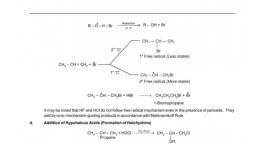
390, , CHEMISTRY, , Anti Markovnikov addition or peroxide, effect or Kharash effect, In the presence of peroxide, addition of HBr, to unsymmetrical alkenes like propene takes, place contrary to the Markovnikov rule. This, happens only with HBr but not with HCl and, Hl. This addition reaction was observed, by M.S. Kharash and F.R. Mayo in 1933 at, the University of Chicago. This reaction, is known as peroxide or Kharash effect, or addition reaction anti to Markovnikov, rule., (C H CO) O, , 6 5, 2 2, CH3 –CH = CH2 + HBr , →CH3 –CH2, , CH2 Br, 1-Bromopropane, (13.43), Mechanism : Peroxide effect proceeds via free, radical chain mechanism as given below:, , The secondary free radical obtained in the, above mechanism (step iii) is more stable than, the primary. This explains the formation of, 1-bromopropane as the major product. It may, be noted that the peroxide effect is not observed, in addition of HCl and HI. This may be due, to the fact that the H–Cl bond being, –1, stronger (430.5 kJ mol ) than H–Br bond, –1, (363.7 kJ mol ), is not cleaved by the free, radical, whereas the H–I bond is weaker, –1, (296.8 kJ mol ) and iodine free radicals, combine to form iodine molecules instead of, adding to the double bond., Problem 13.12, Write IUPAC names of the products, obtained by addition reactions of HBr to, hex-1-ene, (i) in the absence of peroxide and, (ii) in the presence of peroxide., , (i), , Solution, •, , •, , Homolysis, (ii) C6 H5 + H – Br , , →C6 H6 + Br, , 4. Addition of sulphuric acid : Cold, concentrated sulphuric acid adds to, alkenes in accordance with Markovnikov, rule to form alkyl hydrogen sulphate by, the electrophilic addition reaction., , 2019-20
Page 19 :
HYDROCARBONS, , 391, , ketones and/or acids depending upon the, nature of the alkene and the experimental, conditions, , (13.49), (13.44), , (13.45), 5. Addition of water : In the presence of a, few drops of concentrated sulphuric acid, alkenes react with water to form alcohols,, in accordance with the Markovnikov rule., , KMnO4 /H+, , CH3 – CH = CH – CH3 , →2CH3COOH, But -2-ene, Ethanoic acid, (13.50), 7. Ozonolysis : Ozonolysis of alkenes involves, the addition of ozone molecule to alkene to, form ozonide, and then cleavage of the, ozonide by Zn-H2O to smaller molecules., This reaction is highly useful in detecting, the position of the double bond in alkenes, or other unsaturated compounds., , (13.51), (13.46), 6. Oxidation: Alkenes on reaction with cold,, dilute, aqueous solution of potassium, permanganate (Baeyer’s reagent) produce, vicinal glycols. Decolorisation of KMnO4, solution is used as a test for unsaturation., , (13.47), , (13.48), b) Acidic potassium permanganate or acidic, potassium dichromate oxidises alkenes to, , (13.52), 8. Polymerisation: You are familiar with, polythene bags and polythene sheets., Polythene is obtained by the combination, of large number of ethene molecules at high, temperature, high pressure and in the, presence of a catalyst. The large molecules, thus obtained are called polymers. This, reaction is known as polymerisation. The, simple compounds from which polymers, , 2019-20
Page 20 :
392, , CHEMISTRY, , are made are called monomers. Other, alkenes also undergo polymerisation., High temp./pressure, , n(CH2 = CH2 ), → —( CH2 –CH2 —, )n, Catalyst, Polythene, , (13.53), High temp./pressure, , n(CH3 – CH = CH2 ) , → —, ( CH– CH2 —, )n, Catalyst, |, CH3, Polypropene, , (13.54), Polymers are used for the manufacture of, plastic bags, squeeze bottles, refrigerator dishes,, toys, pipes, radio and T.V. cabinets etc., Polypropene is used for the manufacture of milk, crates, plastic buckets and other moulded, articles. Though these materials have now, become common, excessive use of polythene, and polypropylene is a matter of great concern, for all of us., 13.4 ALKYNES, Like alkenes, alkynes are also unsaturated, hydrocarbons. They contain at least one triple, bond between two carbon atoms. The number, of hydrogen atoms is still less in alkynes as, compared to alkenes or alkanes. Their general, formula is CnH2n–2., The first stable member of alkyne series, is ethyne which is popularly known as, acetylene. Acetylene is used for arc welding, purposes in the form of oxyacetylene flame, obtained by mixing acetylene with oxygen gas., Alkynes are starting materials for a large, number of organic compounds. Hence, it is, interesting to study this class of organic, compounds., , are named as derivatives of the corresponding, alkanes replacing ‘ane’ by the suffix ‘yne’. The, position of the triple bond is indicated by the, first triply bonded carbon. Common and, IUPAC names of a few members of alkyne series, are given in Table 13.2., You have already learnt that ethyne and, propyne have got only one structure but there, are two possible structures for butyne –, (i) but-1-yne and (ii) but-2-yne. Since these two, compounds differ in their structures due to the, position of the triple bond, they are known as, position isomers. In how many ways, you can, construct the structure for the next homologue, i.e., the next alkyne with molecular formula, C5H8? Let us try to arrange five carbon atoms, with a continuous chain and with a side chain., Following are the possible structures :, Structure, IUPAC name, 1, , 2, , 3, , 4, , 5, , I. HC ≡ C– CH – CH – CH Pent–1-yne, 2, 2, 3, 1, , 2, , 4, , 3, , 3, , 4, , 5, , II. H C–C ≡ C– CH – CH, 3, 2, 3, 2, , Pent–2-yne, , 1, , III. H C– CH – C ≡ CH, 3-Methyl but–1-yne, 3, |, CH3, Structures I and II are position isomers and, structures I and III or II and III are chain, isomers., , 13.4.1 Nomenclature and Isomerism, In common system, alkynes are named as, derivatives of acetylene. In IUPAC system, they, , Problem 13.13, Write structures of different isomers, th, corresponding to the 5 member of, alkyne series. Also write IUPAC names of, all the isomers. What type of isomerism is, exhibited by different pairs of isomers?, Solution, th, 5 member of alkyne has the molecular, formula C6H10. The possible isomers are:, , Table 13.2 Common and IUPAC Names of Alkynes (CnH2n–2), Value of n, , Formula, , Structure, , 2, 3, 4, 4, , C2H2, C3H4, C4H6, C4H6, , H-C≡CH, CH3-C≡CH, CH3CH2-C≡CH, CH3-C≡C-CH3, , 2019-20, , Common name, Acetylene, Methylacetylene, Ethylacetylene, Dimethylacetylene, , IUPAC name, Ethyne, Propyne, But-1-yne, But-2-yne
Page 21 :
HYDROCARBONS, , 393, , (a) HC ≡ C – CH2 – CH2 – CH2 – CH3, Hex-1-yne, (b) CH3 – C ≡ C – CH2 – CH2 – CH3, Hex-2-yne, (c) CH3 – CH2 – C ≡ C – CH2– CH3, Hex-3-yne, , 3-Methylpent-1-yne, , 4-Methylpent-1-yne, , 4-Methylpent-2-yne, Fig. 13.6, , 3,3-Dimethylbut-1-yne, Position and chain isomerism shown by, different pairs., 13.4.2 Structure of Triple Bond, Ethyne is the simplest molecule of alkyne, series. Structure of ethyne is shown in, Fig. 13.6., Each carbon atom of ethyne has two sp, hybridised orbitals. Carbon-carbon sigma (σ), bond is obtained by the head-on overlapping, of the two sp hybridised orbitals of the two, carbon atoms. The remaining sp hybridised, orbital of each carbon atom undergoes, overlapping along the internuclear axis with, the 1s orbital of each of the two hydrogen atoms, forming two C-H sigma bonds. H-C-C bond, angle is of 180°. Each carbon has two, unhybridised p orbitals which are, perpendicular to each other as well as to the, plane of the C-C sigma bond. The 2p orbitals, of one carbon atom are parallel to the 2p, , Orbital picture of ethyne showing, (a) sigma overlaps (b) pi overlaps., , orbitals of the other carbon atom, which, undergo lateral or sideways overlapping to, form two pi (π) bonds between two carbon, atoms. Thus ethyne molecule consists of one, C–C σ bond, two C–H σ bonds and two C–C π, bonds. The strength of C≡C bond (bond, -1, enthalpy 823 kJ mol ) is more than those of, –1, C=C bond (bond enthalpy 681 kJ mol ) and, –1, C–C bond (bond enthalpy 348 kJ mol ). The, C≡C bond length is shorter (120 pm) than those, of C=C (133 pm) and C–C (154 pm). Electron, cloud between two carbon atoms is, cylindrically symmetrical about the, internuclear axis. Thus, ethyne is a linear, molecule., 13.4.3 Preparation, 1. From calcium carbide: On industrial, scale, ethyne is prepared by treating calcium, carbide with water. Calcium carbide is, prepared by heating quick lime with coke., Quick lime can be obtained by heating, limestone as shown in the following, reactions:, CaCO3, , 2019-20, , ∆→ CaO, , +, , CO2, , (13.55)
Page 23 :
HYDROCARBONS, , 395, , Formation of the addition product takes place, according to the following steps., , The addition product formed depends upon, stability of vinylic cation. Addition in, unsymmetrical alkynes takes place according, to Markovnikov rule. Majority of the reactions, of alkynes are the examples of electrophilic, addition reactions. A few addition reactions are, given below:, (i) Addition of dihydrogen, H2, Pt/Pd/Ni, HC ≡ CH+ H2 , →[H2C = CH2 ] , →CH3 –CH3, , (13.62), CH3 – C ≡ CH + H2 →[CH3 – CH = CH2 ], Propyne, Propene, ↓ H2, CH3 – CH2 – CH3, Propane, (13.63), (ii) Addition of halogens, Pt/Pd/Ni, , (13.66), (iv) Addition of water, Like alkanes and alkenes, alkynes are also, immiscible and do not react with water., However, one molecule of water adds to alkynes, on warming with mercuric sulphate and dilute, sulphuric acid at 333 K to form carbonyl, compounds., , (13.67), , (13.64), Reddish orange colour of the solution of, bromine in carbon tetrachloride is decolourised., This is used as a test for unsaturation., (iii) Addition of hydrogen halides, Two molecules of hydrogen halides (HCl, HBr,, HI) add to alkynes to form gem dihalides (in, which two halogens are attached to the same, carbon atom), , H – C ≡ C – H + H – Br → [CH2 = CH – Br] → CHBr2, |, Bromoethene, CH3, , 1,1-Dibromoethane, , (13.65), , (13.68), (v) Polymerisation, (a) Linear polymerisation: Under suitable, conditions, linear polymerisation of ethyne, takes place to produce polyacetylene or, polyethyne which is a high molecular weight, polyene containing repeating units of, (CH = CH – CH = CH ) and can be represented, as —( CH = CH – CH = CH)—, n Under special, conditions, this polymer conducts electricity., , 2019-20
Page 24 :
396, , CHEMISTRY, , Thin film of polyacetylene can be used as, electrodes in batteries. These films are good, conductors, lighter and cheaper than the metal, conductors., (b) Cyclic polymerisation: Ethyne on passing, through red hot iron tube at 873K undergoes, cyclic polymerization. Three molecules, polymerise to form benzene, which is the, starting molecule for the preparation of, derivatives of benzene, dyes, drugs and large, number of other organic compounds. This is, the best route for entering from aliphatic to, aromatic compounds as discussed below:, , in a majority of reactions of aromatic, compounds, the unsaturation of benzene ring, is retained. However, there are examples of, aromatic hydrocarbons which do not contain, a benzene ring but instead contain other highly, unsaturated ring. Aromatic compounds, containing benzene ring are known as, benzenoids and those not containing a, benzene ring are known as non-benzenoids., Some examples of arenes are given, below:, , Benzene, , Toluene, , Naphthalene, , (13.69), Problem 13.14, How will you convert ethanoic acid into, benzene?, , Biphenyl, 13.5.1 Nomenclature and Isomerism, , Solution, , The nomenclature and isomerism of aromatic, hydrocarbons has already been discussed in, Unit 12. All six hydrogen atoms in benzene are, equivalent; so it forms one and only one type, of monosubstituted product. When two, hydrogen atoms in benzene are replaced by, two similar or different monovalent atoms or, groups, three different position isomers are, possible. The 1, 2 or 1, 6 is known as the ortho, (o–), the 1, 3 or 1, 5 as meta (m–) and the 1, 4, as para (p–) disubstituted compounds. A few, examples of derivatives of benzene are given, below:, , 13.5 AROMATIC HYDROCARBON, These hydrocarbons are also known as, ‘arenes’. Since most of them possess pleasant, odour (Greek; aroma meaning pleasant, smelling), the class of compounds was named, as ‘aromatic compounds’. Most of such, compounds were found to contain benzene, ring. Benzene ring is highly unsaturated but, , 2019-20, , Methylbenzene, (Toluene), , 1,2-Dimethylbenzene, (o-Xylene)
Page 25 :
HYDROCARBONS, , 397, , Friedrich August Kekulé,a German chemist was born in 1829 at Darmsdt in, Germany. He became Professor in 1856 and Fellow of Royal Society in 1875. He, made major contribution to structural organic chemistry by proposing in 1858 that, carbon atoms can join to one another to form chains and later in 1865,he found an, answer to the challenging problem of benzene structure by suggesting that these, chains can close to form rings. He gave the dynamic structural formula to benzene, which forms the basis for its modern electronic structure. He described the discovery, of benzene structure later as:, “I was sitting writing at my textbook,but the work did not progress; my thoughts, were elsewhere. I turned my chair to the fire, and dozed. Again the atoms were, gambolling before my eyes. This time the smaller groups kept modestly in the, background. My mental eye, rendered more acute by repeated visions of this kind,, could now distinguish larger structures of manifold, , FRIEDRICH, AUGUST KEKULÉ, (7th September, 1829–13th July, 1896), , conformations; long, , rows,sometimes more closely fitted together; all twisting and turning in snake like motion. But look! What, was that? One of the snakes had seized hold of it’s own tail, and the form whirled mockingly before my eyes., As if by a flash of lightning I woke;.... I spent the rest of the night working out the consequences of the, hypothesis. Let us learn to dream, gentlemen, and then perhaps we shall learn the truth but let us beware of, making our dreams public before they have been approved by the waking mind.”( 1890)., One hundred years later, on the occasion of Kekulé’s centenary celebrations a group of compounds having, polybenzenoid structures have been named as Kekulenes., , 1,3 Dimethylbenzene 1,4-Dimethylbenzene, (m-Xylene), ( p-Xylene), , found to produce one and only one, monosubstituted derivative which indicated, that all the six carbon and six hydrogen atoms, of benzene are identical. On the basis of this, observation August Kekulé in 1865 proposed, the following structure for benzene having, cyclic arrangement of six carbon atoms with, alternate single and double bonds and one, hydrogen atom attached to each carbon, atom., , 13.5.2 Structure of Benzene, Benzene was isolated by Michael Faraday in, 1825. The molecular formula of benzene,, C6H6, indicates a high degree of unsaturation., This molecular formula did not account for its, relationship to corresponding alkanes, alkenes, and alkynes which you have studied in earlier, sections of this unit. What do you think about, its possible structure? Due to its unique, properties and unusual stability, it took several, years to assign its structure. Benzene was, found to be a stable molecule and found to, form a triozonide which indicates the presence, of three double bonds. Benzene was further, , The Kekulé structure indicates, the, possibility, of, two, isomeric, 1, 2-dibromobenzenes. In one of the isomers,, the bromine atoms are attached to the doubly, bonded carbon atoms whereas in the other,, they are attached to the singly bonded carbons., , 2019-20
Page 26 :
398, , CHEMISTRY, , perpendicular to the plane of the ring as shown, below:, , However, benzene was found to form only, one ortho disubstituted product. This problem, was overcome by Kekulé by suggesting the, concept of oscillating nature of double bonds, in benzene as given below., , Even with this modification, Kekulé, structure of benzene fails to explain unusual, stability and preference to substitution, reactions than addition reactions, which could, later on be explained by resonance., , The unhybridised p orbital of carbon atoms, are close enough to form a π bond by lateral, overlap. There are two equal possibilities of, forming three π bonds by overlap of p orbitals, of C1 –C2, C3 – C4, C5 – C6 or C2 – C3, C4 – C5,, C6 – C1 respectively as shown in the following, figures., , Resonance and stability of benzene, According to Valence Bond Theory, the concept, of oscillating double bonds in benzene is now, explained by resonance. Benzene is a hybrid, of various resonating structures. The two, structures, A and B given by Kekulé are the, main contributing structures. The hybrid, structure is represented by inserting a circle, or a dotted circle in the hexagon as shown in, (C). The circle represents the six electrons which, are delocalised between the six carbon atoms, of the benzene ring., , (A), (B), (C), The orbital overlapping gives us better, picture about the structure of benzene. All the, 2, six carbon atoms in benzene are sp hybridized., 2, Two sp hybrid orbitals of each carbon atom, 2, overlap with sp hybrid orbitals of adjacent, carbon atoms to form six C—C sigma bonds, which are in the hexagonal plane. The, 2, remaining sp hybrid orbital of each carbon, atom overlaps with s orbital of a hydrogen atom, to form six C—H sigma bonds. Each carbon, atom is now left with one unhybridised p orbital, , Fig. 13.7 (a), , Fig. 13.7 (b), , Structures shown in Fig. 13.7(a) and (b), correspond to two Kekulé’s structure with, localised π bonds. The internuclear distance, , 2019-20
Page 27 :
HYDROCARBONS, , 399, , between all the carbon atoms in the ring has, been determined by the X-ray diffraction to be, the same; there is equal probability for the p, orbital of each carbon atom to overlap with the, p orbitals of adjacent carbon atoms [Fig. 13.7, (c)]. This can be represented in the form of two, doughtnuts (rings) of electron clouds [Fig. 13.7, (d)], one above and one below the plane of the, hexagonal ring as shown below:, , (i) Planarity, (ii) Complete delocalisation of the π electrons, in the ring, (iii) Presence of (4n + 2) π electrons in the ring, where n is an integer (n = 0, 1, 2, . . .)., This is often referred to as Hückel Rule., Some examples of aromatic compounds are, given below:, , (electron cloud), Fig. 13.7 (c), , Fig. 13.7 (d), , The six π electrons are thus delocalised and, can move freely about the six carbon nuclei,, instead of any two as shown in Fig. 13.6 (a) or, (b). The delocalised π electron cloud is attracted, more strongly by the nuclei of the carbon, atoms than the electron cloud localised, between two carbon atoms. Therefore, presence, of delocalised π electrons in benzene makes, it more stable than the hypothetical, cyclohexatriene., X-Ray diffraction data reveals that benzene, is a planar molecule. Had any one of the above, structures of benzene (A or B) been correct, two, types of C—C bond lengths were expected., However, X-ray data indicates that all the six, C—C bond lengths are of the same order, (139 pm) which is intermediate between, C— C single bond (154 pm) and C—C double, bond (133 pm). Thus the absence of pure, double bond in benzene accounts for the, reluctance of benzene to show addition, reactions under normal conditions, thus, explaining the unusual behaviour of benzene., , 13.5.4 Preparation of Benzene, Benzene is commercially isolated from coal tar., However, it may be prepared in the laboratory, by the following methods., (i) Cyclic polymerisation of ethyne:, (Section 13.4.4), (ii) Decarboxylation of aromatic acids:, Sodium salt of benzoic acid on heating with, sodalime gives benzene., , 13.5.3 Aromaticity, Benzene was considered as parent ‘aromatic’, compound. Now, the name is applied to all the, ring systems whether or not having benzene, ring, possessing following characteristics., , 2019-20, , (13.70)
Page 28 :
400, , CHEMISTRY, , (iii) Reduction of phenol: Phenol is reduced, to benzene by passing its vapours over, heated zinc dust, , (ii) Halogenation: Arenes react with halogens, in the presence of a Lewis acid like anhydrous, FeCl3, FeBr3 or AlCl3 to yield haloarenes., , (13.71), , Chlorobenzene, (13.73), (iii) Sulphonation: The replacement of a, hydrogen atom by a sulphonic acid group in, a ring is called sulphonation. It is carried out, by heating benzene with fuming sulphuric acid, (oleum)., , 13.5.5 Properties, Physical properties, Aromatic hydrocarbons are non- polar, molecules and are usually colourless liquids, or solids with a characteristic aroma. You are, also familiar with naphthalene balls which are, used in toilets and for preservation of clothes, because of unique smell of the compound and, the moth repellent property. Aromatic, hydrocarbons are immiscible with water but, are readily miscible with organic solvents. They, burn with sooty flame., Chemical properties, Arenes are characterised by electrophilic, substitution reactions. However, under special, conditions they can also undergo addition and, oxidation reactions., Electrophilic substitution reactions, The common electrophilic substitution, reactions of arenes are nitration, halogenation,, sulphonation, Friedel Craft’s alkylation and, acylation reactions in which attacking reagent, +, is an electrophile (E ), (i) Nitration: A nitro group is introduced into, benzene ring when benzene is heated with a, mixture of concentrated nitric acid and, concentrated sulphuric acid (nitrating, mixture)., , (13.74), (iv) Friedel-Crafts alkylation reaction:, When benzene is treated with an alkyl halide, in the presence of anhydrous aluminium, chloride, alkylbenene is formed., , (13.75), , (13.76), , (13.72), , Nitrobenzene, , Why do we get isopropyl benzene on, treating benzene with 1-chloropropane instead, of n-propyl benzene?, (v) Friedel-Crafts acylation reaction: The, reaction of benzene with an acyl halide or acid, anhydride in the presence of Lewis acids (AlCl3), yields acyl benzene., , 2019-20
Page 29 :
HYDROCARBONS, , 401, , (13.77), , In the case of nitration, the electrophile,, +, , (13.78), If excess of electrophilic reagent is used,, further substitution reaction may take place, in which other hydrogen atoms of benzene ring, may also be successively replaced by the, electrophile. For example, benzene on, treatment with excess of chlorine in the, presence of anhydrous AlCl 3 can be, chlorinated to hexachlorobenzene (C6Cl6), , (13.79), Mechanism of electrophilic substitution, reactions:, According to experimental evidences, SE (S =, substitution; E = electrophilic) reactions are, supposed to proceed via the following three, steps:, (a) Generation of the eletrophile, (b) Formation of carbocation intermediate, (c) Removal of proton from the carbocation, intermediate, ⊕, (a) Generation of electrophile E : During, chlorination, alkylation and acylation of, benzene, anhydrous AlCl3, being a Lewis acid, ⊕, ⊕, helps in generation of the elctrophile Cl , R ,, ⊕, RC O (acylium ion) respectively by combining, with the attacking reagent., , nitronium ion, N O2 is produced by transfer, of a proton (from sulphuric acid) to nitric acid, in the following manner:, Step I, , Step II, , Protonated, Nitronium, nitric acid, ion, It is interesting to note that in the process, of generation of nitronium ion, sulphuric acid, serves as an acid and nitric acid as a base., Thus, it is a simple acid-base equilibrium., (b) For mation, of, Carbocation, (arenium ion): Attack of electrophile, results in the formation of σ-complex or, 3, arenium ion in which one of the carbon is sp, hybridised., , sigma complex (arenium ion), The arenium ion gets stabilised by, resonance:, , 2019-20
Page 30 :
402, , CHEMISTRY, , Sigma complex or arenium ion loses its, aromatic character because delocalisation of, 3, electrons stops at sp hybridised carbon., (c) Removal of proton: To restore the, aromatic character, σ -complex releases proton, 3, from sp hybridised carbon on attack by, –, [AlCl4] (in case of halogenation, alkylation and, –, acylation) and [HSO4] (in case of nitration)., , Addition reactions, Under vigorous conditions, i.e., at high, temperature and/ or pressure in the presence, of nickel catalyst, hydrogenation of benzene, gives cyclohexane., , chemical equation:, CxHy + (x +, , y, y, ) O2 → x CO2 +, H O (13.83), 4, 2 2, , 13.5.6 Directive influence of a functional, group in monosubstituted benzene, When monosubstituted benzene is subjected, to further substitution, three possible, disubstituted products are not formed in equal, amounts. Two types of behaviour are observed., Either ortho and para products or meta, product is predominantly formed. It has also, been observed that this behaviour depends on, the nature of the substituent already present, in the benzene ring and not on the nature of, the entering group. This is known as directive, influence of substituents. Reasons for ortho/, para or meta directive nature of groups are, discussed below:, Ortho and para directing groups: The, groups which direct the incoming group to, ortho and para positions are called ortho and, para directing groups. As an example, let us, discuss the directive influence of phenolic, (–OH) group. Phenol is resonance hybrid of, following structures:, , Cyclohexane, (13.80), Under ultra-violet light, three chlorine, molecules add to benzene to produce benzene, hexachloride, C6H6Cl6 which is also called, gammaxane., , Benzene hexachloride,, (BHC), (13.81), Combustion: When heated in air, benzene, burns with sooty flame producing CO2 and, H2 O, , C6 H6 +, , 15, O2 → 6CO2 + 3H2O, 2, , (13.82), , General combustion reaction for any, hydrocarbon may be given by the following, , It is clear from the above resonating structures, that the electron density is more on, o – and p – positions. Hence, the substitution, takes place mainly at these positions. However,, it may be noted that –I effect of – OH group, also operates due to which the electron density, on ortho and para positions of the benzene ring, is slightly reduced. But the overall electron, density increases at these positions of the ring, due to resonance. Therefore, –OH group, activates the benzene ring for the attack by, , 2019-20
Page 31 :
HYDROCARBONS, , 403, , an electrophile. Other examples of activating, groups are –NH2, –NHR, –NHCOCH3, –OCH3,, –CH3, –C2H5, etc., In the case of aryl halides, halogens are, moderately deactivating. Because of their, strong – I effect, overall electron density on, benzene ring decreases. It makes further, substitution dif ficult. However, due to, resonance the electron density on o– and p–, positions is greater than that at the m-position., Hence, they are also o– and p – directing groups., Resonance structures of chlorobenzene are, given below:, , In this case, the overall electron density on, benzene ring decreases making further, substitution difficult, therefore these groups, are also called ‘deactivating groups’. The, electron density on o – and p – position is, comparatively less than that at meta position., Hence, the electrophile attacks on, comparatively electron rich meta position, resulting in meta substitution., 13.6 CARCINOGENICITY AND TOXICITY, Benzene and polynuclear hydrocarbons, containing more than two benzene rings, fused together are toxic and said to possess, cancer producing (carcinogenic) property., Such polynuclear hydrocarbons are formed, on incomplete combustion of organic, materials like tobacco, coal and petroleum., They enter into human body and undergo, various biochemical reactions and finally, damage DNA and cause cancer. Some of, the carcinogenic hydrocarbons are given, below (see box)., , Meta directing group: The groups which, direct the incoming group to meta position are, called meta directing groups. Some examples, of meta directing groups are –NO2, –CN, –CHO,, –COR, –COOH, –COOR, –SO3H, etc., Let us take the example of nitro group. Nitro, group reduces the electron density in the, benzene ring due to its strong –I effect., Nitrobenzene is a resonance hybrid of the, following structures., , 2019-20
Page 32 :
404, , CHEMISTRY, , SUMMARY, Hydrocarbons are the compounds of carbon and hydrogen only. Hydrocarbons are mainly, obtained from coal and petroleum, which are the major sources of energy., Petrochemicals are the prominent starting materials used for the manufacture of a, large number of commercially important products. LPG (liquefied petroleum gas) and, CNG (compressed natural gas), the main sources of energy for domestic fuels and the, automobile industry, are obtained from petroleum. Hydrocarbons are classified as open, chain saturated (alkanes) and unsaturated (alkenes and alkynes), cyclic (alicyclic), and aromatic, according to their structure., The important reactions of alkanes are free radical substitution, combustion,, oxidation and aromatization. Alkenes and alkynes undergo addition reactions, which, are mainly electrophilic additions. Aromatic hydrocarbons, despite having unsaturation,, undergo mainly electrophilic substitution reactions. These undergo addition reactions, only under special conditions., Alkanes show conformational isomerism due to free rotation along the C–C sigma, bonds. Out of staggered and the eclipsed conformations of ethane, staggered conformation, is more stable as hydrogen atoms are farthest apart. Alkenes exhibit geometrical, (cis-trans) isomerism due to restricted rotation around the carbon–carbon double bond., Benzene and benzenoid compounds show aromatic character. Aromaticity, the, property of being aromatic is possessed by compounds having specific electronic structure, characterised by Hückel (4n+2)π electron rule. The nature of groups or substituents, attached to benzene ring is responsible for activation or deactivation of the benzene ring, towards further electrophilic substitution and also for orientation of the incoming group., Some of the polynuclear hydrocarbons having fused benzene ring system have, carcinogenic property., , EXERCISES, 13.1, 13.2, , How do you account for the formation of ethane during chlorination of methane ?, Write IUPAC names of the following compounds :, (a), CH3CH=C(CH3)2, (b), CH2=CH-C≡C-CH3, (c), , (d), , –CH2–CH2–CH=CH2, , (f ), , CH3 (CH2 )4 CH(CH2 )3 CH3, |, CH2 − CH (CH3 )2, , (e), (g), , 13.3, , 13.4, , CH3 – CH = CH – CH2 – CH = CH – CH – CH2 – CH = CH2, |, C2H5, For the following compounds, write structural formulas and IUPAC names for all, possible isomers having the number of double or triple bond as indicated :, (b) C5H8 (one triple bond), (a) C4H8 (one double bond), Write IUPAC names of the products obtained by the ozonolysis of the following, compounds :, (i), Pent-2-ene, (ii), 3,4-Dimethylhept-3-ene, (iii) 2-Ethylbut-1-ene, (iv) 1-Phenylbut-1-ene, , 2019-20
Page 33 :
HYDROCARBONS, , 405, , 13.5, , An alkene ‘A’ on ozonolysis gives a mixture of ethanal and pentan-3one. Write structure and IUPAC name of ‘A’., 13.6 An alkene ‘A’ contains three C – C, eight C – H σ bonds and one C – C, π bond. ‘A’ on ozonolysis gives two moles of an aldehyde of molar mass, 44 u. Write IUPAC name of ‘A’., 13.7 Propanal and pentan-3-one are the ozonolysis products of an alkene?, What is the structural formula of the alkene?, 13.8 Write chemical equations for combustion reaction of the following, hydrocarbons:, (i), Butane, (ii), Pentene, (iii) Hexyne, (iv) Toluene, 13.9 Draw the cis and trans structures of hex-2-ene. Which isomer will have, higher b.p. and why?, 13.10 Why is benzene extra ordinarily stable though it contains three double, bonds?, 13.11 What are the necessary conditions for any system to be aromatic?, 13.12 Explain why the following systems are not aromatic?, (i), , (ii), , (iii), , 13.13 How will you convert benzene into, (i), p-nitrobromobenzene, (ii), m- nitrochlorobenzene, (iii) p - nitrotoluene, (iv), acetophenone?, 13.14 In the alkane H3C – CH2 – C(CH3)2 – CH2 – CH(CH3)2, identify 1°,2°,3° carbon, atoms and give the number of H atoms bonded to each one of these., 13.15 What effect does branching of an alkane chain has on its boiling point?, 13.16 Addition of HBr to propene yields 2-bromopropane, while in the presence, of benzoyl peroxide, the same reaction yields 1-bromopropane. Explain, and give mechanism., 13.17 Write down the products of ozonolysis of 1,2-dimethylbenzene (o-xylene)., How does the result support Kekulé structure for benzene?, 13.18 Arrange benzene, n-hexane and ethyne in decreasing order of acidic, behaviour. Also give reason for this behaviour., 13.19 Why does benzene undergo electrophilic substitution reactions easily, and nucleophilic substitutions with difficulty?, 13.20 How would you convert the following compounds into benzene?, (i), Ethyne, (ii), Ethene, (iii) Hexane, 13.21 Write structures of all the alkenes which on hydrogenation give, 2-methylbutane., 13.22 Arrange the following set of compounds in order of their decreasing, +, relative reactivity with an electrophile, E, (a), Chlorobenzene, 2,4-dinitrochlorobenzene, p-nitrochlorobenzene, (b), Toluene, p-H3C – C6H4 – NO2, p-O2N – C6H4 – NO2., 13.23 Out of benzene, m–dinitrobenzene and toluene which will undergo, nitration most easily and why?, 13.24 Suggest the name of a Lewis acid other than anhydrous aluminium, chloride which can be used during ethylation of benzene., 13.25 Why is Wurtz reaction not preferred for the preparation of alkanes, containing odd number of carbon atoms? Illustrate your answer by, taking one example., , 2019-20