Page 1 :
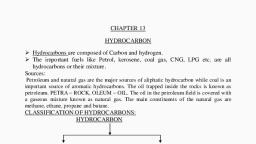
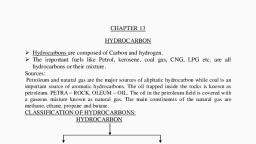
CHAPTER 1, , HYDROCARBON, , > Hydrocarbons are composed of Carbon and hydrogen., , > The important fuels like Petrol, kerosene, coal gas, CNG, LPG etc. are all, hydrocarbons or their mixture., , Sources:, , Petroleum and natural gas are the major sources of aliphatic hydrocarbon while coal is an, , important source of aromatic hydrocarbons. The oil trapped inside the rocks is known as, , petroleum. PETRA — ROCK, OLEUM - OIL. The oil in the petroleum field is covered with, , a gaseous mixture known as natural gas. The main constituents of the natural gas are, , methane, ethane, propane and butane., , CLASSIFICATION OF HYDROCARBONS:, , HYDROCARBON, Acyclic or Aliphatic Carbocyclic or Cyclic, ( Open chain), , J } Alicycli Aromatic, , Alkanes Alkenes Alkyne, , Cycloalkanes Cycloalkenes Cycloalkynes, Alkanes:, > Paraffins, > General formula C,H2n+2, > sp’ hybridisation, > C-C bond length 1.154 A°, ©, , > Chemically unreactive, > Show chain, position and optical isomerism., , > He e has 9 isomer, Octane 18 and Decane 75., Nomenclature:, , , , Hq | ou, , Lento, me, 109.5°, , 163, , , , (a) Propane
Page 2 :
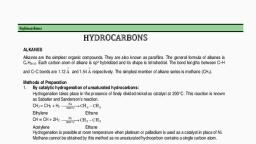
Preparation:@ Wurtz reaction:, 2CH,CH,Br + 2Na — CH3CH,CH,CH, +2NaBr, er, , > Follow mainly free radical mechanism, , > Useful in preparing an alkane containing, even number of carbon atoms, , > Stepping up reaction, , Frankland reaction, , RX +Zn+Rx—R-R+ZnX2, @From Grignard reagent (RMgX), , RMaX +HOH > RH-+Ma(OH)X, RMaX+R'OH-» RH-+Ma(OR')X, RMgX +R'NH, —>RH+Mg(NHR')X, , ©From unsaturated hydrocarbons:Sabatier-Senderens reduction, , R-CH=CH, +H, —W/4_R-CH, -CHg, R-C=CH+H,—“4 4p —CH, -CHy, 4. From carboxylic acidsDecarboxylation.CH,COO Na* +NaOQH-CH, +Na,CO,, Sodium ethanoate, Kolbe’s electrolytic method2CH,COO"Na*+ 2H,O, Sodium acetate, J Electrolysis, CH,-CH,+2CO, +H, + 2NaOH, , “ Physical Properties:, (1) Nature:- Non-Polar due to covalent nature of C—C bond and C—H bond. C—, C bond enrgy = 83 kj/mole and C—H bond energy = 99 kj/mole., C;—Cy, = gases, Cs—C7 = colourless odourless liquid and > C,7= Solid., , (2) Solubility:- Like dissolve like, , Viz, Polar compounds dissolve in polar solvent and Non-Polar compound dissolve in, , non polar solvent., , (3) Boiling point:- Low boiling point due to non polar in nature.
Page 3 :
The molecules are held together only by weak Van der Waalls’ forces., Since we known that the magnitude of Van der Waalls’ forces is directly, proportional to the molecular size. Therefore, the boiling point increases with, increase the molecular size i.e. with increase in number of carbon atoms., Noted:- the boiling points of the branched chain Alkanes are less than the straight, chain isomers., , This is due to the fact that branching of the chain makes the molecule more, compact and thereby decreases the surface aria and consequently, the magnitudes of, Van der Waalls’ forces also decrease., , CH,CH,CH,CH,CH, H,c— i —CH,CH, CH,, n-pentane CH, H,C—C—CH,, (. boiling point = 309K |, . . iso-pentane CH,, regular variation with : boiling point = 301 K neo-pentane ven number of, carbon atoms having higher melting point a boiling point = 282.5K Jkanes having, , immediately next lower and immediately next higher odd number of carbon atoms., , “> Chemical properties, © Combustion:- CHy +20, -> CO. +2H,O, , AH = -217.0 K cal/mole, © Oxidation:, CH, +O, —CY-+2CH,OH, 573 K, CH, +O, —M%22_5 HCHO +H,O, Methanal, , © Substitution:© Halogenation:, CH, +Ch _, CHCl + HCI, , cH#a—~+ cc, ——> cuca, _™ scr, Noted:- Iodination is a reversible reaction. So it is carried out by heating alkane in, the presence of some oxidizing agent like iodic acid (HIO3) or nitric acid (HNOs) or, mercuric oxide (HgO) which oxidizes HI formed during the reaction., , CH, +i —Heat_» CHI + HI, 5HI + HIO; ——» 3H,0 + 31,, 2HI + 2HNO; —— 2H.0 +I, + 2NO,, , Noted:- Fluorination of alkane takes place explosively resulting even in the rupture, of C—C bond in higher alkanes.
Page 4 :
e Features of Halogenations:(i) The reactivity of Halogens:- F > Ch > Br) > bh., (ii) The rate of replacement of Hydrogens of alkanes is:, sr 2? Se, , CH,CH,CH,CH, ard CH,CH,CH,CH,CI + CH.CH,CHCH,, , , , , , , , n - Butane cl, CH,, ° CH,— rm, CH, 3 4° cl, cl, H - ——, tae, 36% (3°), Cl PS, lsobutane CH.7 CH- CH, Cl, 64% (1°), , Mechanism:- halogenations reaction take place by free radical mechanism. The, reaction proceeds in the following steps:, , Initiation, , @ Chain initiation step:, e, a—c Ye 2c, , (i) Chain Propagation step:CH, + CI’ —>CH, + HCI, CH, + Cl, ——> CHCl + Cle, (ii) | Chain Termination step:cr + Cl’ —>Cl, CH, + GH; ——>CH, -CH,, CH, + Cl’ —>CcH,CI, , @ Nitration:- ;, ®@ The reaction takes places by free radicals mechanism at high temp (450°C)., ®@ At high temp C—C bond is also broken so that mixture of nitroalkanes is obtained., , 450°C, Conc. HNO,, , CH;CH,CH,, , , , CH,CHCH.NO, + CHAHCH, + CH,CH,NO;+ CH.NO,, , NO,, 25% 40% 10% 25%