Notes of 11th, Chemistry Chemical Bonding.pdf.pdf - Study Material
Page 1 :
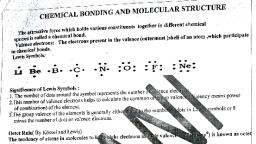
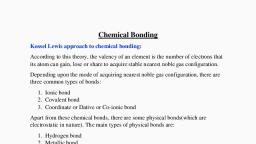
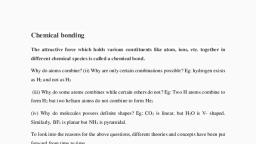
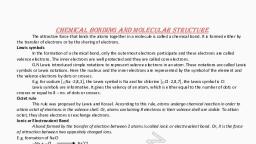
CHEMICAL BONDING, SESSION - 1, AIM, e To define Chemical Bond, ¢ To understand the reason for chemical bond formation, , ¢ To introduce Ionic bond, , CHEMICAL BOND is an attractive force which holds various constituents (atoms,, , molecules or ions) together in different species., , Chemical bonds devided into two types:, , a) Bonds which constitute molecules or formula units. These are ionic bonds, covalent bonds, and co-ordinate or dative bonds., , b) Bonds which hold various particles in solid or liquid state of the substances. These are, also called INTERMOLECULER FORCES. These are: metallic bonds, dipole-dipole forces,, van der Waal forces, hydrogen bonds., , Cause of Chemical Combination: Chemical bonding takes place due, , e To acquire a state of minimum energy and maximum stability, , ¢ To convert atoms into molecule to acquire stable noble gas configuration., , LEWIS THEORY, , Lewis theory gave the first explanation of a covalent bond in terms of electrons that was, , generally accepted. If two electrons are shared between two atoms, this constitutes a bond, , and binds the atoms together. For many light atoms, a stable arrangement is attained when, the atom is surrounded by eight electrons., , OCTATE RULE- ‘Atoms combine with each other either by sharing or by the transfere of, , electrons to attain stable noble gas configuration I n outer most shell.’, , REL), , a Obeys octet rule |, (NH) H:N:H, or H—N—H, , I, (CO,) : O=—— C=O : (CH,CHO) H—C—, |
Page 3 :
It is failed to explain the stability of odd electron species., , For example, NO, NOz and ClOz., NO NO, CIO, €), (lle) (17e) (19e), , Te &, It is failed to explain the stability of duplet structure of Hydrogen atom., It is failed to explain the stability of Cations of transition metals, which contains 18, electrons in outermost orbit, Examples : Ga‘, Cu’, Ag’, Zn*?, Cd’, Sn‘*, Pb* etc,, Electronic configuration of Ga - 1s*, 2s? 2p®, 3s? 3p° 3d'°,4s? 4p! Electronic, configuration of Ga‘? - 1s*, 2s? 2p®,, , Octate rule based on the chemical inertness of noble gases but some noble gases able to, form compounds like XeF2 , KrF2 etc, Failed to explain the geometry of molecules., , It is failed to explain the relative stability of molecules., , METHOD OF DRAWING LEWIS STRCUTURES of polyatomic species, , (i), , (ii), (iii), , (iv), , (v), , First calculate ni., , n= Total valence electron of all the atoms of the species + net charge on the species., For anion, electrons are added and for cations electrons are subtracted., , Then calculate nz., , n2=(8 x no, of atoms other than H) + (2 x no, of H atoms), , Subtract m1 from nz, which gives ns., , ng = n2— m1 = number of electrons shared between atoms = number of bonding electrons., , a = a = number of shared electron or bps = number of bonds., , Subtracting n3 from ni gives na., 4 = mi—n3 =number of unshared electrons or nonbonding electrons., , ae a aoe = no, of unshared electron pairs = number of lone pairs., , Identify the least electronegative atom in a molecule as central atom, when the other, atoms do not contain hydrogen., , When other atoms are hydrogen only, then the central atom would be the more, electronegative atom.
Page 4 :
(vi) Now around the central atom, place the other atoms and distribute the required number, of bonds (as calculated in step (iii) & required number of lone pairs (as calculated in step, (iv), keeping in mind that every atom gets an octet of electrons except hydrogen., (vii) Calculate the formal charge on each atom., (ix) Lewis structure should obey like resonance (delocalization), bond length, px—dz back, bonding etc., Exp- Determine Lewis structure of Noj; ion., (im = 5+ (6x 3)+1= 24, (ii)nz = (4 x 8) = 32, (iii)n3 = ne—m = 32-24=8, .. Number of bonds = 3 =4, , (iv)na = m— nz = 24-—8=16 -. Number of lone pairs = 2 =8, (v)Nitrogen is central atom (less electronegative than O). Arranging three O atoms around it, , and distributing 4 bonds and 8 lone pairs as oe, :Ox(6), , (vi)Calculating formal change on each atom., Formal charge on N=5-4-O=+1, Formal charge on O (a)=6-2-4=0, Formal charge on O (b) = 6—1-6=-1, Formal charge on O (c)=6-1-6=-1, Thus, the structures can now be shown as, , o 4 3 go ot ai 4g, :0 ==N — 0: :0 —N— 0: :0 —N==, 10: 4 0 20: 4, , Final structure of NO3 is therefore shown as, , , , 20 N— ‘o:, , he, which even accounts for resonance in NO; ion.
Page 5 :
Classification of bonds: , SHEMTEAL BONDE, STRONG BOND WEAK BOND, (Inter atomic) (Inter Molecular), (Energy = i KJ/mole) (Energy = 2 - 40 KT/mole), , (A) (b) (2) (D) © (F), Ionic Covalent Co-ordinate Metallic Hydrogen Vander waal's, bond bond bond bond bond bond, , (10 - 40 KJ) (2 - 10 KJ), , e IONIC or ELECTROVALENT BOND, , Tonic bond is formed by transference of electrons from electropositive atom to, , electronegative atom., , Atom losing electrons becomes cation while the atom gaining electrons becomes anion., Electro +ve atom loses electron (group IA to IIIA), Electro -ve atom gains electron (group VA to VITA), ‘The electrostatic force of attraction holding the oppositely charged ions’ is called, electrovalent bond or ionic bond., Exp- *IA and VITA group elements form maximum ionic compound., , Na + cl ~——> Na’* + cr, 28.1 2,87 2,6 2, 8,8, , \ te (Ne configuration) (Ar configuration), , e More the distance between two elements in periodic table more will be ionic character, of bond., ¢ Total number of electron lose or gained by an atom during the formation of ionic bond, is called electrovalency., (a) In MgCle formation, electovalelency of Mg and Cl are 2 and 1 respectively., Ng 0, (b) 282 26 electrovalency og Mg =2, , Las slectrovalency og 0 =2



 Learn better on this topic