Page 1 :
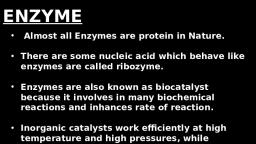
9.BIOMOLECULES., 6th Class, LONGJAM MADHUMITA DEVI , JHSS, ENZYMES, Enzymes are biomolecules which catalyse biochemical reactions in the cells without themselves undergoing any change., Almost all enzymes are proteinaceous in nature except ribozymes, which are nucleic acids with catalytic power., Enzymes has an active site that is basically a crevice or pocket into which the substrate fits., An active site is the area of the enzyme which is capable of attracting substrate molecules by its specific charge, size and shape., PROPERTIES, Enzymes are generally globular proteins ( except ribozymes )., Enzymes increase the rate of chemical reactions , but not change the equilibrium., Enzymes are highly specific in their action ( maltase acts only on maltose not lactose or sucrose )., Each enzyme function at specific pH ( pH 2 for pepsin) ., Enzymes isolated from the organisms living in high temperature e.g., hot thermal vents has the ability to retain their catalytic power at high temperature., All enzymes are heat sensitive. Most operate optimally between 25 – 35 degrees., ENZYME ACTIONS BRINGS ABOUT CHEMICAL CHANGES, Chemical changes are those changes in which bonds are broken and new bonds are formed during transformation, e.g., Glucose → 2 Pyruvic acid, The rate of chemical process refers to the amount of product formed in per unit time., Rate = δΡ /δt, The rate of chemical process are influence by temperature. A general thumb rule states that the rate gets doubled or decreased by half for every 10⁰C change in either direction., Catalysed reactions take place at higher rates than that of the uncatalysed ones , e.g.,, CO2 + H2 H2CO3, carbon dioxide water carbonic anhydrase carbonic acid, In the absence of this enzyme, the reaction is very slow but in the cytoplasm where this enzyme is present the reaction rate is increase by about 10 million times., MECHANISM OF ENZYME ACTION, During conversion of substrate ( S ) into a product , formation of an enzyme- substrate ( ES ) takes place., E ( enzyme ) + S ( substate ) → ES complex → E + P, ES complex is a transition state.Formation of ES complex is essential for catalysis., Most of the chemical reactions do not start automatically because the reactant molecules have an energy barrier to become reactive. An external supply of energy is needed for the start of the chemical reaction called activation energy. Enzymes lower the activation energy required for a reaction., Stability is related to energy status of the molecule or the structure. It is pictorially represented through a graph, ., Figure 9.19 Concept of activation energy, Y – axis : potential energy content, X-axis : progress of reaction., Following levels are noticed between the energy levels of S and P, When P is at a lower level than S , reaction is exothermic or spontaneous.( no need for external supply of energy ), When P is at higher level than S , reaction is endothermic or energy requiring reaction ( external supply of energy is needed ), *Nature of enzyme action - refer to text book page156 & 157, FACTORS AFFECTING ENZYME ACTIVITY, Temperature and pH : Each enzyme shows highest activity at a specific temperature and pH known as optimum temperature and optimum pH , e.g., amylase functions at 37⁰ C and 2.0 pH for pepsin., During low temperature enzymes is temporarily in inactive state whereas , at high temperature it gets destroyed .Change in pH of the medium alters molecules of enzyme and decrease enzyme activity., Concentration of substrate : Increase in substrate concentration increases the velocity of enzyme action upto a certain point , i.e., maximum velocity (Vmax ). Beyond this there is no further increase in reation rate by increasing substrate concentration., This is because at this stage , there is no active site left in enzyme to bind additional substrate molecules ., Enzyme inhibition : Some specific chemicals (other than substrate ) when binds to the enzyme shuts off enzyme activity, this process is called inhibition and the chemical is called inhibitor.e.g., heavy metals such as Ag+ , Hg+ ., When the inhibitor closely resembles the substrate in its molecular structure and inhibits the activity of the enzyme , it is known as competitive inhibitor .e.g., inhibition of succinate dehydrogenase by malonate., For graph refer to page157 (figure 9.7), CLASSIFICATION OF ENZYME, Enzymes are classified into 6 classes based on the type of reactions they catalyse., OXYDOREDUCTASES . They take part in oxidation and reduction reactions or transfer of electrons. E.g., nitrate reductase., S reduced + S oxidised →S oxidised + S reduced, TRANSFERASE . They transfer a group (other than H ) from one molecule to another. E.g., glutamate-pyruvate transaminase., S-G + S’ → S + S’-G, HYDROLASES.They break up large molecules with the help of hydrogen and hydroxyl group of water molecule, e.g., digestive enzymes like amylase, sucrose, LYASES. Enzymes that cause cleavage, removal of groups without hydrolysis , addition of groups to double bonds or reverse. E.g., aldolase, Fructose 1,6-diphosphate → Dihydroxy acetone phosphate + Glyceraldehyde phosphate., ISOMERASES.The enzymes cause rearrangement of molecular structure to effect isomeric changes – optical , geometric or positional. e.g.isomerases, epimerases,mutases, Glucose 6-phosphate → Fructose 6-phosphate, isomerase, LIGASES.The enzyme catalyse bonding of two chemicals with the help of energy obtained from ATP. E.g., pyruvate carboxylase, Pyruvic acid + CO2 +ATP +H2O ↔ Oxaloacetic acid +ADP +Pi, Co-factors, Some enzyme may additionally contain a nonprotein group, these type of enzyme is formed of two parts – a protein part called apoenzyme and a nonprotein part named cofactor., The enzyme consisting of apoenzyme and a cofactor, is called as holoenzyme. Active site is jointly formed by apoenzyme and cofactor., There are three kinds of cofactors –, Prosthetic group –these are nonprotein organic factor firmly attached to apenzymes e.g., heme in peroxidase,biotin, Co-enzymes –these are nonprotein organic group loosely attached to an apoenzyme, their association with apoenzyme is only transient (during catalysis only ).e.g NAD+ and NADP contain niacin., Metal ions –these are inorganic cofactors which form coordination bond with the enzyme and also substrate.e.g., zinc is a cofactor of carboxypeptidase