Page 1 :
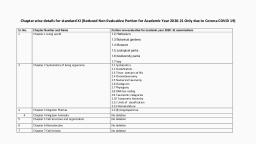
Chapter wise details for standard XI (Reduced Non Evaluative Portion for Academic Year 2020-21 Only due to Corona COVID 19), Sr. No., 1, , Chapter Number and Name, Chapter 1 Living world, , Portion non-evaluative for academic year 2020 -21 examinations, 1.2 Herbarium, 1.3 Botanical gardens, 1.4 Museum, 1.5 zoological parks, 1.6 biodiversity parks, , 2, , Chapter 2 Systematics of living organisms, , 3, , Chapter 3 Kingdom Plantae, , 1.7 key, 2.1 Systematics, 2.2 Classification, 2.3 Three domains of life, 2.4 Chemotaxonomy, 2.5 Numerical taxonomy, 2.6 Cladogram, 2.7 Phylogeny, 2.8 DNA bar coding, 2.9 Taxonomic categories, 2.10 Taxonomic hierarchy, 2.11 Units of classification, 2.12 Nomenclature, 3.3 (B) Angiospermae, , 5, , Chapter 4 Kingdom Animalia, Chapter 5 Cell structure and organization, , No deletion, No deletion, , 6, , Chapter 6 Biomolecules, , No deletion, , 7, , Chapter 7 Cell division, , No deletion, , 4
Page 2 :
8, , Chapter 8 Plant tissues and anatomy, , 8.1 Tissue, 8.2 Meristematic tissue, 8.3 Permanent tissue, 8.4 tissue systems, 8.5 Secondary growth in plants, 8.6 wood, 8.7 Cork cambium and secondary growth, , 9, , Chapter 9 Morphology of flowering plants, , 8.8 Anatomy of root , stem and leaf, 9.1 angiosperms, 9.2 Morphology, a) root, b) stem, c) leaf, f) fruit, g) seed, , 10, 11, , Chapter 10 Animal tissues, Chapter 11 Study of animal type -cockroach, , 9.3 family Fabaceae, No deletion, 11.3 External morphology, 11.4 Body cavity, 11.5 Digestive system of cockroach, 11.6 Circulatory or blood vascular system, 11.7 Respiratory or tracheal system, 11.8 Excretory system, 11.9 Nervous system, 11.10 Reproductive system
Page 3 :
12, 13, 14, , Chapter 12 Photosynthesis, Chapter 13 Respiration and energy transfer, Chapter 14 Human nutrition, , No portion is deleted, No portion is deleted, 14.1 Human digestive system, 14.2 Digestive glands, 14.3 Physiology of Digestion, 14.4 Absorption and assimilation, 14.5 Nutritional disorders and diseases of digestive system, , 15, 16, , Chapter 15 Excretion and Osmoregulation, Chapter 16 Skeleton and Movement, , No deletion, 16.1 Movements and locomotion, 16.8 Skeletal system, 16.9 Group of skeleton, 16.10 Types of joints, 16.11 Disorders related to muscles, 16.12 Disorders related to bones
Page 4 :
The following pattern of practical examination is being proposed from academic year 2020—21 for following reasons., 1. The experiments related to dissections need to be avoided., 2. A similar pattern is followed by CBSE is their examination., Scheme of practical examination for XI std, Time: 3 hrs, Sr. No., Q.1, Q.2, Q.3, Q.4, Q.5, Q.6, Q.7, Total, , Marks:30, Experiment, Major experiment, Minor experiment, Minor experiment, Spotting, Project, Viva voce, Certified complete Journal, Total, , Marks, 04, 03, 03, 10, 05, 02, 03, 30, , While conducting the experiments and examination please insure the following:1. Maintain physical distance., 2. Avoid practicals where use of microscope is necessary (as microscopes are shared by many students)., 3. While conducting biochemical experiments pipetting by mouth is to be strictly avoided., 4. Spotting can be conducted by use of material visible to naked eyes and by display of figures, charts, photographs, etc., 5. All other guidelines given by government from time to time.
Page 5 :
Please note :1. Only following experiments are to be conducted for XI std (academic year 2020 – 21), 2. Practical examination to be conducted as internal evaluation at the institutional level for year-end Practical exam. Feb/Mar 2020-21., A. List of major experiments to be performed for Q. 1, 1. Study of plant family Solanaceae (pollen grain mounting and section of ovary not expected)., B. List of minor experiments to be performed for Q. 2, 1. To study the effect of amylase (preferably fungal diastase) enzyme on starch under different conditions of temperature (room, hot, cold), 2. To study the effect of amylase enzyme on starch under different conditions of pH (acidic and basic), C. List of minor experiments to be performed for Q.3, 1. To test urine sample for abnormal constituent –sugar., 2. To test urine sample for abnormal constituent – albumin, 3. To test urine sample for abnormal constituent - bile salts., 4. To test urine sample for normal constituent - urea, D. List of spottings for Q.4 (A to J), A. Study of plant tissue from coloured photograph/diagram of T. S. of roots of sunflower and maize., B. Study of modifications of root stem and leaf (specimens, photographs, diagrams)., C. Study and identification of inflorescence (specimens, photographs, diagrams)., D. Study of specimens and identifications with reasons from plant classification (specimens, photographs, diagrams)., E. Demonstration of aerobic respiration using Ganong’s respirometer or To demonstrate aerobic respiration, F. Study of animal tissues by display of photograph/diagram only– cartilage ,mammalian bone, blood smear, striated muscle, non striated muscle and cardiac muscle)., G.Study of external morphology and digestive system of cockroach with the help of photograph / diagrams., H. Study of human skeleton – appendicular (specimens, photographs, diagrams)., I. Study of specimens and identifications with reasons from animal classification(specimens, photographs, diagrams).., J. Study of histology of digestive organs of mammals namely. T. S of pancreas, small intestine and liver (photographs/ diagrams only), E. Project for Q.5, A suitable project to be allotted by teacher and submission in form of written report (4 to 6 pages) is expected., E. Viva voce for Q.6, Based on major and minor experiments., F. Journal for Q.7, Complete and duly signed by teacher with institute’s stamp.
Page 6 :
Chapterwise details for HSC Exam Feb/Mar 2020-21., Sr. No., 1, 2, 3, , Chapter Number and Name, Chapter 1 Reproduction in lower and higher plants, Chapter 2 Reproduction in lower and higher animals, Chapter 3 Inheritance and Variation, , Portion non-evaluative for March 2020 -21 examination, 1.1: Asexual reproduction, 2.1: Asexual reproduction in, animals, ---------, , 4, , Chapter 4 Molecular Basis of Inheritance, , No topic is deleted from this chapter, , 5, , Chapter 5Origin and Evolution of life, , 5.1: Origin of life : (Protobiogenesis), 5.2: Chemical Evolution of Life, 5.3: Organic Evolution, 5.4: Darwinism, 5.5: Mutation Theory, 5.7: Mechanism of organic evolution, 5.8: Hardy-Weinberg’s principle, 5.9: Adaptive Radiation, 5.10: Evidences of organic evolution, 5.11: Speciation, 5.12: Geological time scale
Page 7 :
6, , Chapter 6 Plant water relations, , 6.4 Absorption of water by roots from soil, 6.5 Water potential, 6.6 Plasmolysis, 6.7 Path of water across the root, 6.8 Mechanism of absorption of water, 6.9 Translocation of water, 6.10 Transport of mineral ions, 6.11 Transport of food, 6.12 Transpiration, 6.13 Structure of stomatal apparatus, , 7, , Chapter 7 Plant growth, , 8, , Chapter 8 Respiration and circulation, , 7.1 Plant growth, 7.2 Phases of growth, 7.3 Conditions of growth, 7.4 Growth rate and types of growth, 7.5 Growth curve, 7.6 Differentiation, dediffrenntion and rediffrentiation, 7.7 Development, 7.8 Plasticity, 7.10 Photoperiodism, 7.11 Vernalization, 7.12 Mineral nutrition, 7.13 Nitrogen cycle, 8.5: Modified respiratory, movements, Artificial ventilation,, ventilator, FROM 8.16: Angiography, heart, transplant, silent heart attack
Page 8 :
9, , Chapter 9 Control and coordination, , From 9.6: Reflex action and, chart 9.15: Types of reflex actions, 9.7: Receptors, , 10, , Chapter 10 Human health and diseases, , 11, , Chapter 11 Enhancement of food production, , 11.2 Plant breeding, 11.3 Tissue culture, 11.4 Single cell protein, 11.6 Animal husbandry, , 12, 13, 14, , Chapter 12 Biotechnology, Chapter 13 Organisms and population, Chapter 14 Ecosystems and energy flow, , 15, , Chapter 15 Biodiversity conservation and Environmental, issues, , No topic is deleted from this chapter, No topic is deleted from this chapter, 14.1 Ecosystem, 14.2 Energy flow, 14.3 Ecological pyramids, 14.4 Nutrient cycles, 14.6 Ecosystem services, 15.7 Environmental issues, a. Air pollution and control measures, b. Noise pollution and control measures, c. Water pollution and its control, Thermal pollution,Measures to reduce sewage water,, Solid waste management, 15.8 Greenhouse effect and global warming, 15.9 Ozone depletion, 15.10 Deforestation, , -------------
Page 9 :
The following pattern of practical examination is being proposed from academic year 2020—21 for following reasons., 3. The experiments related to dissections need to be avoided., 4. A similar pattern is followed by CBSE is their examination., While conducting the experiments and examination please insure the following:6. Maintain physical distance., 7. Avoid practicals where use of microscope is necessary (as microscopes are shared by many students)., 8. While conducting biochemical experiments pipetting by mouth is to be strictly avoided., 9. Spotting can be conducted by use of material visible to naked eyes and by display of figures, charts, photographs, etc., 10. All other guidelines given by government from time to time., , Scheme of practical examination to be conducted for XII std Feb/Mar 2020-21, Time: 3 hrs, Sr. No., Q.1, Q.2, Q.3, Q.4, Q.5, Q.6, Q.7, Total, , arks:30, Experiment, Major experiment, Minor experiment, Minor experiment, Spotting, Project, Viva voce, Certified complete Journal, Total, , Marks, 04, 03, 03, 10, 05, 02, 03, 30
Page 10 :
Please note :3. Only following experiments are to be conducted for XI std (academic year 2020 – 21), 4. Practical examination to be conducted as internal evaluation at the institutional level for year-end Practical exam. Feb/Mar 2020-21., A. List of major experiments to be performed for Q. 1, 1. Dissect and display floral whorls (section of ovary and pollen grain mounting is not expected)., 2. Isolation of DNA from given sample., B. List of minor experiments to be performed for Q. 2, 1. To study the population density by quadrat method., 2. To study osmosis by potato osmoscope., C. List of minor experiments to be performed for Q.3, 1. To study soil sample for its type., 2. To study water sample for its pH., D. List of spottings for Q.4 (A to J), A. Study of adaptation of pollination by insects/wind from coloured photograph/diagram of suitable flowers., B. Study of meiosis (photographs/ diagrams)., C. Study of bagging or tagging or emasculation (specimens/ photographs/ diagrams)., D. Study of plant from xeric and aquatic habitat (specimens/ photographs/ diagrams)., E. Demonstration of paper chromatography or To four leaf experiment., F. Study of anatropous / orthtropous ovule through photographs/ diagrams., G. Study of common disease causing organisms (specimens/photographs/ diagrams)., H. Study of human brain (model/ photographs/ diagrams)., I. Study of pedigree chart or study of V. S. of bblastula, T. S. of testis, T. S. of ovary (photographs/ diagrams)., J. Study of animals found in xeric and aquatic habitat (specimens/photographs/ diagrams), E. Project for Q.5, A suitable project to be allotted by teacher and submission in form of written report (4 to 6 pages) is expected., E. Viva voce for Q.6, Based on major and minor experiments., F. Journal for Q.7, Complete and duly signed by teacher with institute’s stamp.