Page 1 :
Chapter-3, PLANT KINGDOM, , POINTS TO REMEMBER, , , , , , , , , , , , CLASSIFICATION :, ¢ Artificial System of Classification, ¢ Based on a few characteristics., ¢ e.g., By Carolous Linnaeus, based on androecium structure, * Natural System of Classification, ¢ Based on natural affinities among organisms, ¢ Included external as well as internal features, *e.g., By George Bentham and J. D. Hooker, * Phylogenetic System of Classification, ¢ Based on evolutionary relationships between the various organisms, ¢ e.g., By Hutchinson, Numerical Taxonomy : * Carried out using computers, ¢ Based on all observable characteristics, * Data processed after assigning number and codes, to all the characters., , Advantage : Each character gets equal importance and a number of characters can be considered., , Cytotaxonomy : * Based on cytological information., ¢ Gives importance to chromosome number, structure and, behaviour., Chemataxonomy : * Based on chemical constituents of the plants., Importance of Algae : ¢ At least half of the total carbon dioxide fixation, , on earth carried out by them., * Increase oxygen level in the environment., , * Many species like Laminaria, Sargassum etc., are used as food., [12]
Page 2 :
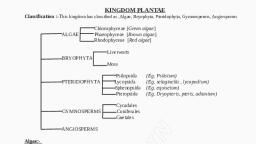
¢ Agar obtained from Gelidium and Gracilaria is, used in ice-creams and jellies., , ¢ Algin obtained from brown algae are carrageon, from red algae used commercially., , ¢ Chlorella and Spirullina are unicellular algae,, rich in protein and used even by space travellers., , Algae divided into 3 classes :, , (i), , ¢ Algae are unicellular like Chlamydomonas, colonial like Volvex or fila, mentous like Spirogyra., , ¢ Are simple, thalloid, autotrophic and occur in water, soil, wood ete., , ¢ Help in carbon dioxide fixation by carrying out photosynthesis and have, immense economic importance., , Chlorophyceae, , ¢ Green algae. Main pigment is chlorophyll ‘a’ and ‘b’., , ¢ Cell wall has inner layer of cellulose and outer layer of pectose., ¢ Has pyrenoids made up of starch and proteins., , e.g., Chlamydomona, Volvox, Spirogyra., , (ii) Phaeophyceae, , ¢ Brown algae due to main pigments chlorophyll ‘a’, ‘c’ and fucoxanthin., ¢ Cell wall has cellulose and lignin or gelantinous coating of algin., , ¢ Has mannitol and laminarin as reserve food material., , * Body divisible into holdfast, stipe and frond., , *¢.¢., Ectocarpus, Fucus, Laminaria., , (iii) Rhodophyceae, , * Red algae due to pigments chlorophyll ‘a’, ‘d’ and r-phycoerythrin., ¢ Found on surface as well as great depths in oceans., , ¢ Cell wall as cellulose., , ¢ Reserve food material is floridean starch., , * ¢.g¢., Polysiphonia, Porphyra, Gelidium., , [13]
Page 3 :
REPRODUCTION IN ALGAE, Vegetative reproduction : by fragmentation, Asexual Reproduction : Flagellated zoospores in Chlorophyceae, Biflagellated zoospores in Phaeophyceae, By non-motile spores in Rhodophyceae., , Sexual Reproduction: Isogamous, anisogamous or OOgamous in, Chlorophyceae and Phacophyceae., , By non-motile gametes in Rhodophyceae., BRYOPHYTES : ‘Amphibians of plant kingdom’, ¢ Occur in damp, humid places., ¢ Lack true roots, stem or leaves., * Main plant body is haploid., * Economic Importance : Food for herbaceous animals., , Sphagnum in form of peat is used as fuel and also used for trans-shipment, of living material as it has water holding capacity, prevent soil erosion, along, with lichens are first colonisers on barren rocks., , ¢ Is divided into two classes Liverworts (thalloid body, dorsiventral, e.g.,, Marchantia) and Mosses (have two stages in gametophyte — creeping, green,, branched, filamentous protonema stage and the leafy stage having spirally arranged leaves e.g., Funaria., , REPRODUCTION IN BRYOPHYTES, , ¢ Vegetative reproduction by fragmentation., , ¢ Asexual reproduction by gemmae formed in gemma cups., , ¢ Sexual reproduction : By fusion of antherozoids produced in antheridium, and egg cell produced in archegonium. This results in formation of zygote which, develops into a sporophytic structure differentiated into foot, seta and capsule., Spores produced in a capsule germinate to form free-living gametophyte., PTERIDOPHYTES :, , ¢ Main plant body is sporophyte which is differentiated into true stem and, leaves., , ¢ Leaves may be small (microsporophyll) as in Selaginella or large, (macrophyll) as in ferns., , [14]
Page 4 :
¢ Sporangia having spores are subtended by leaf-like appendages called sporophylls. (Sporophylls may be arranged to form strobili or cones.), , ¢ In Sporangia, the spore mother cells give rise to spores after meiosis., , ¢ Spores germinate to form haploid gametophytic structure called prothallus which is free living, small, multicellular and photosynthetic., , ¢ Prothallus bears antheridia and archegonia which bear antherozoids and, egg cell respectively which on fertilisation form zygote. Zygote produces, multicellular, well differentiated sporophyte., , ¢ The four classes are : Psilopsida (Psilotum), Lycopsida (Selaginella),, Sphenopsida (Equisetwm) and Pteropsida (Pteris)., , HETEROSPORY : Two kinds of spores i.e., large (macro) and small (micro), spores are produced. e.g., Selaginella and Salvinia., SEED HABIT : The development of zygote into young embryos takes place, within the female gametophyte which is retained on parent sporophyte. This is, an important step in evolution and is found in Selaginella and Salvinia among, the pteridophytes., GYMNOSPERMS : ¢ Have naked seeds as the ovules are not enclosed by any, ovary wall and remain exposed., , * Male cone has microsporophylls which bear microsporangia having microspores which develop into reduced gametophyte called pollen grain., , ¢ Female cone has megasporophylls which bear megasporongia having megaspores which are enclosed within the megasporangium (Nucellus). One megaspore develops into female gametophyte bearing two or more archegonia., , ¢ Pollen grains carried in air currents reach ovules, form pollen tube which, reach archegonia and release male gametes which fertilise egg cell and form, zygote which produce embryos. Ovules develop into seeds which are not covered., , ANGIOSPERMS : ¢ Called flowering plants and have seeds enclosed in fruits., , * Divided into two classes — Dicotyledons (have two cotyledons) and Monocotyledons (have one cotyledon)., , * Smallest angiosperm : Wolfia, ¢ Large tree : Eucalyptus, , [15]
Page 5 :
¢ Stamen has filament and anther. Anthers bear pollen grains. Pollen grains, have two male gametes., , * Pistil has stigma, style and ovary. Ovary has ovule in which female gametophyte (embry sac) develops., , ¢ Embryo sac has 7 cells and 8 nuclei. One egg cell, 2 synergids, 3 antipodals and two polar nuclei which fuse to form secondary nucleus., , * Pollen grain is carried by wind, water etc. reaches to stigma and produces, pollen tube which enters embryo sac., , * Double fertilisation : One male gamete fuses with egg cell to form zygote, which develops into embryo., , Other male gamete fuses with secondary nucleus which forms triploid primary endosperm nucleus (PEN). PEN develops into endosperm which nourishes the developing embryo., , * Ovules develop into seeds and ovaries into fruits., Alternation of generation : Haploid gametophytic and spore producing sporophytic generation alternate with each other in this process., , Haplontic : Gametophytic phase dominant. e.¢., Chlamydomonas, , Diplontic : Sporophytic phase dominant. e.g., Angiosperms and Gymnosperms, , Haplo-Diplontic : Intermediate like stage where gametophytic and sporophytic stage partially dominate at different stages. e.g., Bryophytes and Pteridophytes., , Exceptions : Ectocarpus, Polysipnonia are Haplo-diplontic algae., , Fucus is diplontic alga., , Very Short Answer Questions (1 mark each), , 1. What is a pyrenoid body ?, , 2. Define gemma., , 3. Which group of plants is regarded as first terestrial plants ? Why ?, , 4. Which organism is regarded as one of the tallest tree species ?, , 5. The gametes and spores of phaeophyceae have a distinct morphology. Give, , its name., 6. Which substance has structural similarity to floridean starch ?, , [16]