Page 1 :
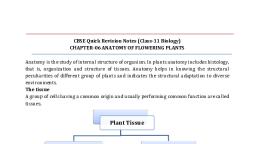
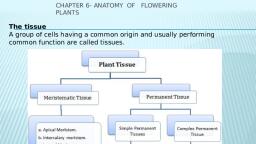
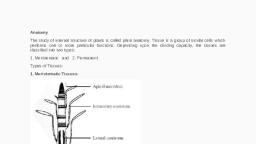
CBSE Quick Revision Notes (Class-11 Biology), CHAPTER-06 ANATOMY OF FLOWERING PLANTS, Anatomy is the study of internal structure of organism. In plants anatomy includes histology,, that is, organization and structure of tissues. Anatomy helps in knowing the structural, peculiarities of different group of plants and indicates the structural adaptation to diverse, environments., The tissue, A group of cells having a common origin and usually performing common function are called, tissues., , Plant Tissue, , Meristematic Tissue, , a. Apical Meristem., b. Intercalary meristem., , Permanent Tissue, , Simple Permanent, Tissues, , Complex Permanent, Tissue, , c. Lateral Meristem, , a. Parenchyma, , a. Xylem, , b. Collenchyma, , b. Phloem, , c. Sclerenchyma, , A meristem or meristematic tissue is a simple tissue composed of a group of similar, and immature cells which can divide and form new cells. The meristem which occurs at tips, of roots and shoots and produce primary tissues are called apical meristem., Intercalary meristem occurs between mature tissues especially in grasses. It is also, primary tissue. The meristem occurs on the sides and takes part in increasing girth of the, plants are called Lateral meristem. Intrafascicular cambium in the primary lateral, meristem. Vascular cambium, cork cambium are secondary meristem., The cells that have become structurally and functionally specialized and lose the, ability of cells division are called permanent tissue. Permanent tissues having all cells, similar in structure and function are called simple permanent tissues and those having, different kinds of cells are called complex tissue., , Portal for CBSE Notes, Test Papers, Sample Papers, Tips and Tricks
Page 2 :
Parenchyma is a simple permanent living, tissue which is made up thin-walled similar, isodiametric cells. Each cell encloses a large central, vacuole and peripheral cytoplasm containing nucleus., They are found in non-woody and soft areas of stem,, root, leaves, fruits and flowers. They store the food, and provide turgidity to softer parts of plant., Collenchyma consists of cells which are, much thickened at corner due to cellulose,, hemicellulose and pactin. Oval, spherical or, polygonal often contain chlorophyll. They provide, mechanical support to the growing parts of the, plants like young stem., , Sclerenchymas are supportive tissue, having highly thick walled cells with little or no, protoplasm due to deposition of cellulose or, lignin. They are of two types fibres and sclereids., Mechanical support to mature plant organs to, tolerate bending, shearing, compression etc., Complex Tissues – Xylem and phloem constitute, the complex tissues in plants and work together as a unit., Xylem, Phloem, a., It conducts water or sap., a., Phloem conducts organic food., b., Xylem is found deep in the plant. b., It is situated towards the outer, c., Xylem provides mechanical side., strength., c., It has no mechanical functions., d., Xylem is made up of vessels, d., Phloem is made up of sieve tube,, tracheid, xylem fibre and xylem companion cells, phloem parenchyma, parenchyma., and phloem fibres., •, Primary xylem is of two types- protoxylem and mataxylem. In stem, protoxylem lies, in centre and mataxylem towards periphery. This type of primary xylem is called endarch., •, In roots, protoxylem lies in periphery and metaxylem lies towards the centre. This, type of primary xylem is called exarch., •, In gymnosperms, albuminous cells and sieve cells, they lack sieve tube and, companion cells., , Portal for CBSE Notes, Test Papers, Sample Papers, Tips and Tricks
Page 3 :
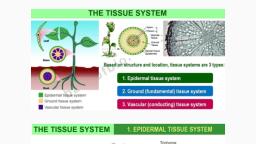
Epidermal Tissue System, •, It forms the outermost covering of whole plant body, which consists of epidermal, cells, stomata, epidermal appendages (trichomes and hairs)., •, Epidermis is single layered, parenchymatous with waxy thick layers of cuticle to, prevent water loss., •, Stomata is present in epidermis of leaves. It regulates the transpiration and gaseous, exchange. In dicots, stomata are bean-shaped having two guard cells closing the stomatal, pore. In monocots, stoma is dumbbell-shaped. Guard cells contain chloroplasts that help in, opening and closing of stomata., , Dicots (Bean shaped), Monocots (Dumb-bell shaped), •, Epidermis also contains a number of hairs. Root hairs are unicellular elongation, of epidermal cells. Trichomes are present on stems, which are multicellular, branched or unbranched preventing water loss due to transpiration., The ground Tissue System, •, All the tissue between epidermis and vascular bundle forms the ground tissues. It, consists of simple permanent tissues. Parenchyma is present in pericycle, cortex, pith and, medullary rays in stem and roots., •, Leaves the mesophyll, chloroplast containing cell forms the ground tissues., The Vascular Tissue System, The vascular system consists of complex tissues, xylem and phloem that together, form vascular bundles., , Portal for CBSE Notes, Test Papers, Sample Papers, Tips and Tricks
Page 4 :
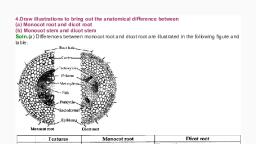
Conjoint, When xylem and phloem within a vascular bundle are arranged in alternate manner, on different radii, the arrangement are called radial as in roots. When xylem and phloem are, situated at the same radius of vascular bundle, it is called conjoint as in stem and leaves., , Radial, Dicotyledonous Root, The outermost layer of dicots root is epidermis containing unicellular root hairs., Below epidermis is the many cell thick parenchymatous cells with intercellular spaces., The innermost layer of cortex is called endodermis having waxy material suberin, as casparian strips, which is impermeable to water., , Dicots Root (Sunflower), Pericycle is present below endodermis. The parenchymatous cells lying between, xylem and phloem are called conjuctive tissue., Two to four xylem and phloem patches are present. All the tissues inside the, endodermis constitute the stele., , Portal for CBSE Notes, Test Papers, Sample Papers, Tips and Tricks
Page 5 :
Monocotyledonous Roots, Anatomically monocots roots epidermis cortex, endodermis, pith are similar to dicots, except having more than 6 vascular bundles with larger pith., , Dicotyledonous Stem, •, Epidermis is the outermost layer of dicot stems having thin layer of cuticle, may, contain trichomes and hairs., •, Cortex is divided into three sub layers- outer hypodermis (collenchymatous),, middle cortical layer (parenchymatous) and inner endodermis, which is rich in starch grains, so, also known as starch sheath., •, Vascular bundles are conjoint, open, endarch with protoxylem. Pith is the, parenchymatous with intercellular spaces., , Portal for CBSE Notes, Test Papers, Sample Papers, Tips and Tricks
Page 6 :
Dicots Stem (TS), Monocotyledonous Stem, , Monocots Stem (TS), •, They have sclerenchymatous hypodermis, large number of scattered vascular, bundles surrounded by sclerenchymatous bundle sheath. Vascular bundles closed and, conjoint. Phloem parenchyma is absent., Dicotyledonous Leaf (Dorsi-ventral), •, Vertical section through lemima shows three regions- epidermis, mesophyll and, vascular system., •, Epidermis covers both upper (adaxial) and lower (abaxial) surface. Abaxial surface, have more stomata., •, Mesophyll bears chlorophyll to carryout photosynthesis, are made up of, parenchyma. Spongy parenchyma are spherical and loosely arranged but palisade, parenchyma are elongated., •, Vascular system includes vascular bundles, which are seen as veins and midribs., Vascular bundles are surrounded by thick bundle sheath cells., , Portal for CBSE Notes, Test Papers, Sample Papers, Tips and Tricks
Page 7 :
Dicots leaf (VS), Monocotyledonous Leaf (Isobilateral), •, Monocots leaves are similar to, dicots leaves anatomically except stomata, are present on both surfaces of epidermis, and mesophyll cells are not differentiated, as spongy and palisade cells., •, In, grasses,, some, adaxial, epidermal cell with veins modify into, large, empty, colourless cells called, bulliform cells. These cells make the, leaves turgid when water absorbed and curls in case of water stress., Secondary Growth, •, It is the growth in girth (thickness) due to the formation of secondary tissues by, lateral meristems (vesicular cambium and cork cambium)., •, Vesicular cambium is responsible for cutting of vesicular tissues- xylem and, phloem., •, In dicot stem, cambium present between xylem and phloem is called, intrafascicular cambium. The cells of medullary rays become meristematic to form, interfascicular cambium, which together form the complete ring of cambium., •, Cambial ring cut off secondary xylem inside and secondary phloem outside the ring., , Spring wood, a. It is produced during the favorable, period of the year., b. It forms the major parts of the, annual ring., c., The wood is lighter in colour having, fewer fibres., d. It has lower density., , Autumn wood, a. It is produced towards the close of, the active period., b. It form a narrow strip in the annual, ring., c. The autumn wood is denser having, abundant fibres., d. It has higher density., , Portal for CBSE Notes, Test Papers, Sample Papers, Tips and Tricks
Page 8 :
Heartwood, (i) It is the central wood of old stem, and dark in colour., (ii) It forms the nonfunctional part of, secondary xylem., (iii) Tracheary, elements, have, deposition of tannis, ranins, gums etc., , Sapwood, (i), It is the outer wood of old stem and, light in colour., (ii) It forms the functional part of, secondary xylem., (iii) Tracheary elements do not have any, deposition., , Cork cambium or phellogen is formed in the outer cortex of stem. It cuts cells on, both sides. The cells outside the phellogen differentiate to form cork or phellem and inner, cell differentiate into secondary cortex or phelloderm., Cork is impervious to water due to deposition of suberin in cell wall. Phellogen,, phellem and phelloderm are collectively called periderm., , Fig. -Stages of secondary growth in dicots, Secondary growth also occurs in stem and root of Gymnosperms but not in, monocotyledons., , Portal for CBSE Notes, Test Papers, Sample Papers, Tips and Tricks