Page 1 :
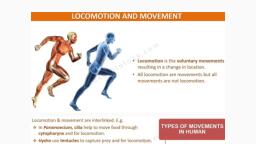
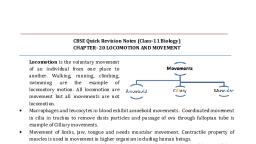
CBSE Quick Revision Notes (Class-11 Biology), CHAPTER- 20 LOCOMOTION AND MOVEMENT, , •, , •, , Locomotion is the voluntary movement, of an individual from one place to, another. Walking, running, climbing,, swimming are the example of, locomotory motion. All locomotion are, movement but all movements are not, locomotion., Macrophages and leucocytes in blood exhibit amoeboid movements. Coordinated movement, in cilia in trachea to remove dusts particles and passage of ova through fallopian tube is, example of Cilliary movements., Movement of limbs, jaw, tongue and needs muscular movement. Contractile property of, muscles is used in movement in higher organism including human beings., Muscles are specialized tissues of mesodermal origin. They have property like excitability,, contractility, extensibility and elasticity., Muscle, , Skeletal Muslces, , Visceral Muscles, , Cardiac Muscles, , Skeletal Muscles, Visceral Muscles, Cardiac, Associated with skeletal Form inner wall of internal Muscles of heart, having, system, alternate light, visceral organs, nonbranching, pattern,, and, dark, bands, striated,, involuntary, alternate light and dark, (striated), voluntary and, muscle,, assists, in, bands, involuntary in, locomotory and change, movement of food, action., in body posture function., through digestive tract, and gametes., Skeletal Muscles is made up of muscles, bundles (fascicles), held together by, collagenous connective tissue called fascia., Each muscle bundle contains a number of, muscle fibres. Each muscle fibres is lined by, plasma membrane sarcolemma inclosing, sarcoplasm. Partially arranged myofibrils are, present in muscles bundle having alternate, , Portal for CBSE Notes, Test Papers, Sample Papers, Tips and Tricks
Page 2 :
light and dark bands due to presence of, protein actin and myosin., Light bands contain actin and is called I-band, (isotropic band) and dark band is called, contain myosin, called A-band (anisotropic, band). Both bands are present parallel to, each other in longitudinal fashion., In centre of each I-band is elastic fibre called, ‘Z’ line. In the middle of A-band is thin fibrous, ‘M’ line. The protein of myofibrils between, two successive ‘Z’ lines is the functional unit, of contraction called a sarcomere., At resting stage thin filament overlaps the thick filament. The part of thick filament not, overlapped is called ‘H’ zone., Structure of contractile Protein, Each thin filament (actin) is made of two, ‘F’ actins helically wounded to each, other. Two filaments of other protein tropomyosin and troponin run parallel to each other., Each meromysin has globular head with short arm and tails. Globular head has ATP binding sites., The mechanism of muscle contraction is explained by sliding mechanism theory in which, thin filament slide over thick filament., Muscle contraction start with signal, sent by CNS via mortar neuron. Neural, signal release neurotransmitter ( Acetyl, choline) to generate action potential in, the sarcolemma., Red fibres (aerobic muscles) contain, myoglobin that has plenty of, mitochondria to produce large amount of oxygen stored in them. The muscle fibres, containing less number or myoglobin are called white fibres., Skeletal System, Framework of bones and cartilage forms the, skeletal system. In human beings, it, consists of 206 bones and some cartilage., The two principle division of skeletal, system are, a. Axial Skeleton (80 bones)- includes skull,, vertebral column, sternum and ribs, constitute axial system., , Portal for CBSE Notes, Test Papers, Sample Papers, Tips and Tricks
Page 3 :
The skull (22 bones) is composed of cranial and facial bones. Cranial (8 bones) forms, protective covering for brain (cranium). The facial region consists of 14 skeletal systems that, form front part of skull. Hyoid bone (U-shaped) forms the base of buccal cavity., The middle ear bone (Malleus, Incus and Stapes) collectively called Ear Ossicles. Skull joins, with vertebral column with two occipital condyle., Vertebral column consists of 26 serially arranged vertebrae. First vertebra is atlas that, combines with occipital condyle other include Cervical-7, thoracic -12, lumbar -5, sacral – 1, coccoygeal -1., 12 pairs of ribs connected dorsally to vertebral column and ventrally to sternum. 11th and, 12th rib bones are not connected with sternum and are called floating bones., Appendicular Skeleton- of bones of limbs and girdles. Each limb contains 30 bones., Upper Arm, Lower Limb, Humerous, radius Femur, tibia and fibula,, and, ulna,, 8- 7-tarsal, 5-metataral,, carpels,, 5- 14-phalanges,, cup, metacarpels, 14- shaped patella cover, phalanges,, the knee., Joints – are points of contact between bones,, or between bones and cartilage., I., Fibrous joints- do not allow any movements., Present in flat skull bones to form cranium., II., Cartilaginous joints- bones are held together with the help of cartilage present in vertebrae., Permits limited movements., III., Synovial joints- fluid field synovial cavity, provide considerable movements. Ball and socket, joint, hinge joints, pivot joints, gliding joints etc., Disorders of Muscular and Skeletal System, • Myasthenia gravis- auto immune disorder affecting neuromuscular junction causing fatigue,, weakening and paralysis of skeletal system., • Muscular Dystrophy- degeneration of skeletal muscles due to genetic disorder., • Osteoporosis – decreased bone mass in old age leading to chance of fracture due to, decreased estrogen., • Arthritis- inflammation of joints., • Gout- inflammation of joints due to accumulation of uric acid crystals., , Portal for CBSE Notes, Test Papers, Sample Papers, Tips and Tricks