Page 1 :
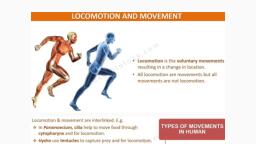
20.1, , 20.2, 20.3, 20.4, 20.5, , Hosock20, , Types of, Movement, , Muscle, Skeletal System, Joints, , Disorders of, Muscular and, Skeletal System, , Cuprfe 20, , COMOTION AND Movement, , Movement is one of the significant features of living beings. Animals and, plants exhibit a wide range of movements. Streaming of protoplasm in, the unicellular organisms like Amoeba is a simple form of movement., Movement of cilia, flagella and tentacles are shown by many organisms., Human beings can move limbs, jaws, eyelids, tongue, etc. Some of the, movements result in a change of place or location. Such voluntary, movements are called locomotion. Walking, running, climbing, flying,, swimming are all some forms of locomotory movements. Locomotory, structures need not be different from those affecting other types of, movements. For example, in Paramoecium, cilia helps in the movement of, food through cytopharynx and in locomotion as well. Hydra can use its, tentacles for capturing its prey and also use them for locomotion. We use, limbs for changes in body postures and locomotion as well. The above, observations suggest that movements and locomotion cannot be studied, separately. The two may be linked by stating that all locomotions are, movements but all movements are not locomotions., , Methods of locomotion performed by animals vary with their habitats, and the demand of the situation. However, locomotion is generally for, search of food, shelter, mate, suitable breeding grounds, favourable, climatic conditions or to escape from enemies/predators., , 20.1 Types or MovEeMENT, , Cells of the human body exhibit three main types of movements, namely,, amoeboid, ciliary and muscular., , 2020-21
Page 2 :
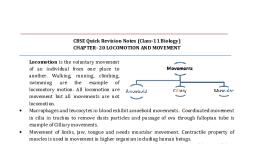
Some specialised cells in our body like macrophages and leucocytes, in blood exhibit amoeboid movement. It is effected by pseudopodia formed, by the streaming of protoplasm (as in Amoeba). Cytoskeletal elements, like microfilaments are also involved in amoeboid movement., , Ciliary movement occurs in most of our internal tubular organs which, are lined by ciliated epithelium. The coordinated movements of cilia in, the trachea help us in removing dust particles and some of the foreign, substances inhaled alongwith the atmospheric air. Passage of ova through, the female reproductive tract is also facilitated by the ciliary movement., , Movement of our limbs, jaws, tongue, etc, require muscular movement., The contractile property of muscles are effectively used for locomotion, and other movements by human beings and majority of multicellular, organisms. Locomotion requires a perfect coordinated activity of muscular,, skeletal and neural systems. In this chapter, you will learn about the, types of muscles, their structure, mechanism of their contraction and, important aspects of the skeletal system., , 20.2 Muscie, , You have studied in Chapter 8 that the cilia and flagella are the outgrowths, of the cell membrane. Flagellar movement helps in the swimming of, spermatozoa, maintenance of water current in the canal system of sponges, and in locomotion of Protozoans like Euglena. Muscle is a specialised, tissue of mesodermal origin. About 40-50 per cent of the body, weight of a human adult is contributed by muscles. They have, special properties like excitability, contractility, extensibility and, elasticity. Muscles have been classified using different criteria,, namely location, appearance and nature of regulation of their, activities. Based on their location, three types of muscles are, identified : (i) Skeletal (ii) Visceral and (iii) Cardiac., , Skeletal muscles are closely associated with the skeletal components, of the body. They have a striped appearance under the microscope and, hence are called striated muscles. As their activities are under the, voluntary control of the nervous system, they are known as voluntary, muscles too. They are primarily involved in locomotory actions and, changes of body postures., , Visceral muscles are located in the inner walls of hollow visceral organs, of the body like the alimentary canal, reproductive tract, etc. They do not, exhibit any striation and are smooth in appearance. Hence, they are called, smooth muscles (nonstriated muscle). Their activities are not under the, voluntary control of the nervous system and are therefore known as, involuntary muscles. They assist, for example, in the transportation of food, through the digestive tract and gametes through the genital tract., , 303, , SS nna