Page 1 :
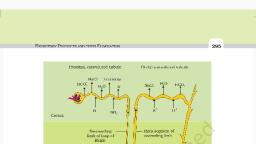
7.Match the items of column I with those of column II., Column I, Column II, (a) Ammonotelism, (i)Birds, (b) Bowman’s capsule, (ii)Water reabsorption, (c) Micturition, (iii)Bony fish, (d) Uricotelism, (iv)Urinary bladder, (e) ADH, (v)Renal tubule, Solution. (a) – (iii), (b) – (v), (c) – (iv), (d) – (i), (e) – (ii), 8.What is meant by the term osmoregulation?, Solution. The regulation of water and solute contents of the body fluids by the kidney is called, osmoregualtion., 9.Terrestrialanimalsaregenerallyeitherureotelic or uricotelic, not ammonotelic, why?, Solution. Ammonotelic animals are aquatic animals that excrete ammonia which is highly soluble, in water, thus large amount of water is also excreted. Terrestrial animals cannot afford to lose, such large quantities of water from their bodies as they live in environment having water scarcity., They, therefore, excrete either urea (ureotelic) or uric acid (uricotelic) as these are less soluble in, water., 10. What is the significance of juxta glomerular apparatus (JGA) in kidney function?, Solution. Juxta glomerular apparatus (JGA) is a special sensitive region formed by cellular, modifications in the distal convoluted tubule and the afferent arteriole at the location of their, contact. The JGA plays a complex regulatory role. A fall in glomerular blood flow/ glomerular blood, pressure/GFR can activate the JG cells to release renin which converts angiotensinogen in blood, to angiotensin I and further to angiotensin II. Angiotensin II, being a powerful vasoconstrictor,, increases the glomerular blood pressure and thereby GFR. Angiotensin II also activates the, adrenal cortex to release aldosterone. Aldosterone causes reabsorption of Na+ and water from the, distal parts of the tubule. This also leads to an increase in blood pressure and GFR., 11 .Name the following., (a) A chordate animal having flame cells as excretory structures., (b) Cortical portions projecting between the medullary pyramids in the human kidney., (c) A loop of capillary running parallel to the Henle’s loop., Solution. (a) Cephalochordate – Amphioxus, (b) Columns of Bertini, (c) Vasa recta, 12.Fill in the gaps., (a) Ascending limb of Henle’s loop is________to water whereas the descending limb, is________to it., (b) Reabsorption of water from distal parts of the tubules is facilitated by hormone________, , (c) Dialysis fluid contains all the constituents as in plasma except________, (d) A healthy adult human excretes (on an average)________gm of urea/day., Solution., (a) Ascending limb of Henle’s loop is impermeable to water whereas the descending limb is permeable to it., (b) Reabsorption of water from distal parts of the tubules is facilitated by hormone ADH., (c) Dialysis fluid contains all the constituents as in plasma except nitrogenous wastes., (d) A healthy adult human excretes (on an average) 25 – 30 gm of urea/day.