Notes of Class XI, BIOLOGY Body Fluid and Circulation.pdf - Study Material
Page 1 :
Chapter-18 Body Fluids and their Circulation, , e All parts of the body require nourishment and oxygen, and metabolic wastes need to be, , removed from the body. So there is a need to transport various substances like digested food, materials to provide energy and growth of the body, hormones, metabolic wastes, enzymes,, various gases from one part of the body to other., , These functions are carried out by an extracellular fluid, which flows throughout the body. This, flow is known as circulation and this transport of substances is done by a system called, circulatory system., , Functions of the circulatory system:, , It transports nutrients from their sites of absorption to different tissues and organs for storage,, oxidation or synthesis of tissue components., , It also carries waste products of metabolism from different tissues to the organs meant for, their excretion from the body., , It transports respiratory gases between the respiratory organs and the tissues., , It also transports informational molecules such as hormones, from their sites of origin to the, tissues., , TYPES OF BODY FLUID:, , Different group of animals have different form of body fluid for transport such as simpler, , organisms like sponges and coelenterates circulates water from their surrounding through bodies to, exchange the substances. In more complex animals use blood and lymph as a medium of exchange, where blood is commonly used body fluid for exchange and lymph only transport certain substances., , Blood, , Blood is a mobile connective tissue which is composed of a watery fluid matrix i.e. plasma and, formed elements (eg blood corpuscles)., , Plasma, , Plasma is astraw-coloured, slightly alkaline non-living intercellular substance which, constitutes about 60% part of the blood., , COMPOSITION:, , Water: About 90% to 92% of plasma is water and solids form about 8% of the plasma., , Proteins: They constitute about 7-8% part of plasma.The major plasma proteins are;, fibrinogen, globulins and albumins.Fibrinogenplay important role in blood, , coagulation.Globulins are mainly involved in defense mechanism and albumins help in, osmotic balance., , Mineral salts: Small amounts of minerals; like Na+, Ca+ +, Mg+ +, HCO3- and Cl-; are also, present in plasma., , Nutrients: Plasma also contains glucose, amino acids, lipids, cholesterol, fats etc., , Anticoagulant: Blood plasma contains a coagulated polysaccharide, the heparin which, prevents coagulation of blood inside blood vessels. Factors for clotting of blood are present in, the plasma in an inactive form. Plasma without the clotting factors is called serum., , W7] Edit with WPS Office
Page 2 :
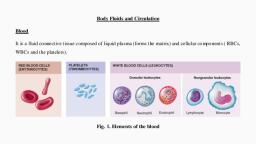
Formed Elements (Blood Corpuscles, , « The formed elements constitute about 45% of the blood. Erythrocytes,, leucocytes and platelets are collectively called formed elements., , 1. Erythrocytes or Red Blood Cells (RBCs), , « The RBCs are the most abundant cells in blood. In a healthy adult man and woman have 5, million to 4.5 million RBCs per cubic millimeter of blood respectively. An abnormal rise in RBC, count is called polycythemia. Decrease in the number of RBCs is called erythrocytopenia., , « RBCs are formed in the red bone marrow., , + In most of the mammals, nucleus is absent i.e. enucleated in the RBCs, RBCs are circular and, biconcave in shape., , « The red colour is because of an iron containing protein complex; called haemoglobin. In a, healthy adult, each 100ml of blood contains 12-16 gm Hb. Haemoglobin in males are relatively, higher than females, , « The average lifespan of RBCs is 120 days, RBCs are finally destroyed in the spleen and hence,, spleen is the graveyard of RBCs., , + RBCs play a significant role in transport of respiratory gases i.e Oz., 2. Leucocytes or White Blood Cells (WBCs):, 1, The WBCs are nucleated and are relatively lesser in number but larger than RBCs,, , 2. They are colorless and in a healthy adult about 5,000-10,000 WBCs mm” of blood.Abnormal, increase in WBCs is in malignancies like leukemia. Fall in WBC count is called leucopenia., , 3. They are rounded or irregular in shape., 4, Leucocytes are generally short lived., TYPES: Leukocytes are of two main types: Agranulocytes and granulocytes., , Granulocytes: They contain granules in their cytoplasm. Their nucleus is irregular or lobed or subdivided. Based on their staining property, they are of three types: Neutrophils, eosinophils and, basophils., , ¢ Neutrophils: Neutrophils are the most abundant cells among WBCs and comprise about 6065%. They are phagocytic in nature. The nucleus is many lobed. They stain weakly with both, acid and basic stain., , ¢ Eosinophils: Eosinophils comprise 1-6% of WBCs. The nucleus is two lobed. They take acidic, stain. They are non phagocytic. These resist infections and are also associated with allergic, reactions., , ¢ Basophils: The nucleus is usually three lobed. They take basic stain. Basophils secrete, histamine, serotonin, heparin, etc. They are involved in inflammatory reactions. They are 0-1%, of leucocytes., , Agranulocytes: The granules are not found in the cytoplasm of these cells. Lymphocytes and, , W7] Edit with WPS Office
Page 3 :
monocytes are different types of agranulocytes., , e Monocytes: They are the largest of all type of leukocytes. The nucleus is bean shaped., Monocytes comprise about 2-10% of WBCs. They are phagocytic cells which destroys foreign, bodies entering our body., , e’ Lymphocytes: They are smaller in size containing scant cytoplasm with large rounded nucleus., They are non motile and non-phagocytic. Lymphocytes comprise about 20-40% of WBCs., There are two major types of lymphocytes, viz. B and T types. Both the types are responsible, for immune responses of the body., , 3. Platelets(Thrombocytes) (‘Krambop ciedts ), , Platelets are also known as thrombocytes. They are cell fragments produced from, megakaryocytes (special cells in the bone marrow)., , e Usually, one cubic mm of blood contains 150,000-350,000 platelets. Platelets can release a, variety of substances. Most of these substances are involved in blood coagulation or clotting., , BLOOD GROUPS:, , In the world different types of blood grouping can be done, the two main blood groupings are, , the ABO grouping and the Rh factor grouping. &, _/A80 Grouping Lamdlieonwt, , e ABO grouping is based on the presence or absence of two surface antigens on the RBCs, viz. A, and B. Antigens are chemicals which can induce immune response., , e The plasma also contains two natural antibodies. Antibodies are proteins produced in, response to antigens., , , , ABO Blood ee, , Can have any, type of blood, , Is the universal, , Ds Obl WL Ky, Abo bleed ign) = Dra, Me thou aller, qe sk (‘a0 04 duds, , fi, Ft vy. ; producs.d thy | and,
Page 4 :
Table1: Blood group and donor compatibility., , Importance of Blood Group:, , During blood transfusion, the donor blood needs to be carefully matched with the blood of a, recipient. Transfusion of unmatched blood can lead to severe problems of clumping, i.e. destruction, of RBC. The blood group O can be donated to persons with any other blood group and hence, an, individual with O group is called universal donor. A person with AB blood group can accept blood, from all blood groups and hence, such an individual is called universal recipient., , , , , , , , , , , , , , , , , , , , , , , , , , Antigen Can | Can, Blood on Antibody donate receive, Group | surface | in Seram | blood | blooa | °°**7PE, of RBC to from, [ I“ or, A A b A, AB | A,O 40, | 1515 or Cd, ete |e jee sol we | Cems, Both A A, B,, Nil AB | re °, AP | ana | | AB. 0 Ap Mntarurs, Oo Nil Both | A.B, | oO 11° J a) ., a and b | AB™O | | @, Rh factor Grouping, , e The Rh antigen is similar to one present in Rhesus monkeys. It is also observed on the surface, of RBCs of majority (nearly 80%) humans. Such individuals are called Rh positive (Rh +ve). A, person without Rh antigen is called Rh negative (Rh -ve). During blood transfusion Rh factor, compatibility is very important as Rh -ve person when exposed to Rh +ve blood will form, specific antibodies against the Rh antigen, , e Erythroblastic foetalis: It is hemolytic anemia in the fetus caused by transplantational, transmission of maternal antibodies to fetal red blood cells., , Coagulation of Blood:, , e Blood coagulates in response to an injury or trauma. Coagulation is a mechanism to prevent, excessive loss of blood in case of injury. Clot is a dark reddish brown scum which is formed at, the site of an injury over a period of time which is formed by a network of threads called fibrins, in which dead and damaged formed elements of blood are trapped., , Process of Blood Clotting, , 1. At the site of an injury, the blood platelets disintegrates and release platelet, thromboplastin(platelet factor 3). The injured tissue also released thromboplastin. These two, factors combine with calcium ion and proteins of blood plasma forming pro-thrombinase., , 2. The prothrombinase inactivates heparin in the presence of calcium. The prothrombinase, catalyzes breakdown of prothrombin into an active protein called thrombin and some small, peptide fragments., , 3. Thrombin catalyses the formation of fibrin from fibrinogen. The thin and long solid fibres of, , Edit with WPS Office
Page 5 :
fibrin form a dense network upon wound and trap blood corpuscles forming clot. The clot seals, the wound and stops bleeding., , A genetic disorder Haemophilia is observed in humans where the person's blood is unable to clot, due to the absence of clotting factors i.e. fibrinogens, thrombin etc. in their bady., , Functions of blood:, , vi., , vii., , Blood transports the digested food from the alimentary canals to the different body cells, , Respiratory gases such Oxygen and Carbon dioxides are transported from lungs to the, different body cells and tissues by blood through blood vessels, , Hormones, excretory wastes and other essential compounds and minerals are transported by, blood., , The body heat, pH and water are regulated or balanced by blood., , Blood provides immunity to the body by transporting WBCs, antibodies etc. throughout the, body., , Blood helps in healing the body by providing supplies of essential nutrients and some parts of, WBCs like eosinophils and basophils to the wound., , Blood maintains the physiological co-operation between parts of the body by circulating from, one part to another., , LYMPH (TISSUE FLUID), , In a tissue during the circulation of blood through the capillaries some water and water soluble, substances seep out into the spaces between the cells, such fluid outside the blood vessels, are called tissue fluid or interstitial fluid. This fluid helps in the exchange of nutrients, gases,, etc. between the blood and the cells., , There is an elaborate network of vessels called the lymphatic system collects this fluid and, drains it back to the major veins. The fluid present in the lymphatic system is called lymph., , The Lymph is a colorless fluid, it contains specialized lymphocytes which helps in immune, response. Lymph also carries nutrients, hormones, etc. Fats are absorbed through lymph in the, lacteals present in the intestinal villi., , CIRCULATORY SYSTEM:, , This system is concerned with the circulation of body fluids (blood and lymphs) to distribute, , various substances to various parts of the body. The circulatory system is also known as the, cardiovascular system., , It is an organ system that allows blood to circulate and transport nutrients (such as electrolytes and, amino acids), oxygen, carbon dioxide, hormones, and blood cells. These are circulated to and from, cells in the body to nourish it. The components of the human circulatory system include the heart,, blood, red and white blood cells, platelets, and the lymphatic system., , Functions of Circulatory System, , (1) Transport of various substances such as nutrients, waste products, respiratory gases, metabolic, intermediates (Such as lactic acid from muscle to liver), and vitamins hormones etc., , (2) Regulation of body pH by means of buffer, body temperature homeostasis, water balance etc., , W7] Edit with WPS Office



 Learn better on this topic