Page 2 :
, , A cell is composed of variety of molecules (like carbon, hydrogen, oxygen), which perform various functions., , , , Other than these basic elements, some metals and non-metals are also present, as cellular materials, hence, all these materials combines in different ways in, order to form various biomolecules, which are found in cells of organisms., , , , These molecules are not living, but perform various living functions. Thus,, biomolecules are the organic substances (e.g., Carbohydrates, proteins, lipids,, etc.) that play a major role in the structure and function of the living organism., , , , Water is also an important and most abundant chemical compound present in, the body of living organism.
Page 3 :
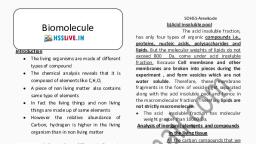
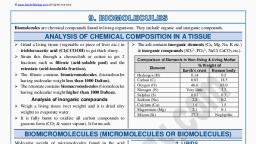
Chemical Analysis of Organic Compounds, To analyse the chemical composition of any organic compound in a living, organism, the chemical analysis of living tissue is done. As organic compounds, play a major role, it is essential to have knowledge of their molecular formula and, structure., This can be easily predicted out by performing following steps, (i) Weight of a living tissue (like a piece of a liver, fruit, vegetable or any other body, tissue) is taken., (ii) The tissue is then grinded in trichloroacetic acid (Cl3CCOOH) with the help of, mortar and pestle., (iii) The thick slurry obtained is then filtered through a cheese-cloth or cotton., This will generate two fractions of solution, (a) Filtrate or the acid-soluble fraction., (b) Retentate or the acid-insoluble fraction., (iv) The extract can then be subjected to numerous separation techniques, in order, to obtain the desirable compound from all other components., By successfully performing all the above steps, we can get an idea of the, molecular formula and the probable structure of the compound., (v) All the carbon compounds that we get from living tissues can be called, biomolecules.
Page 4 :
, , Ash Analysis for Inorganic Compound and Elements, After the analysis of chemical composition of an organic compound in a tissue, it is, necessary to do the analysis of inorganic elements and compounds. It can be done, easily by performing a destructive experiment that separate inorganic compounds, from organic compounds in the form of ash (contains inorganic compounds and, elements)., , , , Ash is the remaining part of apy living tissue which remains back after burning of, all organic compounds., , , , Ash analysis is done in order to analyse the chemical composition of different, inorganic compounds and elements. It is done in the following way, (i) For analysis, a small amount of a living tissue is taken, which is oven dried till all, the water evaporates., (ii) This gives the dry weight., (iii) After that tissue is burnt completely which results in the formation of ash., Thus, ash formed contains inorganic elements like potassium, sodium, calcium,, magnesium, etc (inorganic compounds are also seen in the acid soluble fraction)., , , , (i) Biomicromolecules :These are molecules which have their molecular weight, less than 800 Da., , , , (ii) Biomacromolecules These are molecules which have their molecular weight,, 800 Da and above.All these macromolecules are actually polymers of their, biomicromolecules. For example, Polysaccharides are polymers of, monosaccharides, proteins are polymers of amino acids and nucleic acids are, polymers of nucleotides
Page 5 :
Lipids, •, , The molecules in the insoluble fraction are polymeric substances except lipids., , •, , Lipids have their molecular weight not exceeding above 800 Da, but still it comes, under acid insoluble fraction, i.e., biomacromolecular category., , •, , This happens because these are small moleculer weight compounds and are present, not only as such, but also arranged in structures like cell membranes and other, membranes., , •, , When we grind a tissue, we disrupt the cell structure, cell membrane and other, membranes are broken down into pieces and form vesicles that are not water soluble., , •, , These are separated along with acid insoluble pool and are placed in macromolecules., Lipids are not strictly biomacromolecule., , •, , If representation of the chemical- composition of living tissue is done from abundance, point of view and arranged class-wise, it is observed that water is the most abundant, chemical in living organisms.
Page 6 :
Lipids are the esters of fatty acids and alcohol. These are generally insoluble in, water. They could be simply fatty acids., Fatty acids are the organic acids having hydrocarbon chains that end in a, carboxylic group (—COOH). The carboxylic group is attached to an R group that, could be a methyl (—CH3) or ethyl (—C2H5) or higher number of —CH2 groups (1, carbon to 19 carbons), e.g., Palmitic acid has 16 carbons including carboxyl, carbon., Arachidonic acid has 20 carbon atoms including the carboxyl carbon., Depending upon the types of bonds present, fatty acids are of following two types, i.Saturated Fatty Acids, Fatty acids which do not have double bonds, (C—C). These are generally solid at, room temperature., ii. Unsaturated Fatty Acids, Fatty acids which contain one or more than one double bonds (C = C). These are, generally liquid at room temperature.
Page 8 :
Simple Lipids, These are esters of fatty acids and various alcohol., (a) Neutral or True Fats These are esters of fatty acids with glycerol (glycerine)., They are also called glycerides., Glycerol is a simple lipid which is known as trihydroxypropane as it is an alcohol, with a backbone of three carbon atoms, each carrying an —OH group., When glycerol is esterified with fatty acid it is known as triglyceride., The ester is called monoglyceride, diglycerlde and triglyceride depending on the, number of fatty acids attached to a glycerol., Compound or Conjugated Lipids, These are the esters of fatty acids and alcohol but contain other substances also,, e.g., Phospholipids, glycolipids, cutin, suberin etc., Phospholipids are lipids which have phosphorus and phosphorylated organic, compound in them. One of the common example of phospholipid is lecithin., Some tissue have complex structure of lipids, e.g., Neural tissues.
Page 9 :
Biomicromolecules, 1. Carbohydrates, These are the organic compound mainly made up of C, H and O. They are defined, as polyhydroxy aldehydes and ketones. These are produced directly by the plants, during photosynthesis. Carbohydrates are also known as saccharides because, their major constituents are sugars., These are divided into following types, i- Monosaccharides, These are simplest carbohydrates which cannot be hydrolysed further into smaller, components. These are generally composed of three to seven carbon atoms per, molecule.
Page 10 :
Monosaccharides are also known as reducing sugars, because they have a free, aldehydic (—CHO) or ketonic (> C = O) group and can also reduce Cu2+ (cupric, ions) of Benedict’s or Fehling’s solution to Cu+ (cuprous ions)., e.g., Ribose,, glucose, erythrose, etc, ii-Oligosaccharides, These are formed by condensation of 2-6 monosaccharide molecules. The bond, between two monosaccharide units is called a glycosidic bond., They are classified according to the number of their monosaccharide units or, monomers as follows, (a) Disaccharides These are the sugars containing two monomeric units and can, be further hydrolysed into smaller components. These are known as non-reducing, sugars because the free aldehyde or ketone group is absent, e.g., Sucrose,, maltose, lactose, etc., (b) Trisaccharide It contain three monomers. e.g., Raffinose., (c) Tetrasaccharides, e.g., Stachyose and so on
Page 11 :
2 Amino Acids, Amino acids are organic compounds containing an amino group and an acidic, group as substituent on the same carbon, i.e., the -carbon. Hence, they are called, - amino acids. These are substituted methanes., - carbon also bears a hydrogen and a variable group designated as R group., Thus, there are four substituent, groups present on - carbon which occupy the four different valency position., These are hydrogen, carboxyl, amino and R group., Based on the nature of R group, there are many amino acids. However, those, which occur in proteins are only of twenty types
Page 12 :
The amino group accepts a proton whereas, the carboxyl group donates a proton., So, an amino acid can act as both acid and base. Hence, it is amphoteric in nature., The R group in these proteinaceous amino acids could be a hydrogen (glycine), a, methyl group (alanine), hydroxyl methyl (serine), etc.
Page 13 :
The chemical and physical properties of amino acids are essentially due to the, amino, carboxyl and functional groups present., Based on the number of amino and carboxyl group present, amino acids are, categorised into following types, i. Acidic Amino Acids, These contain one amino group and two carboxyl group per molecule, e.g., glutamic, acid and aspartic acid., ii. Basic Amino Acids, These contain two amino groups and one carboxyl group per molecule, e.g.,, Arginine, lysine and histidine., iii. Neutral Amino Acids, These contain one amino group and one carboxyl group per molecule, e.g.,, Methionine, isoleucine, serine, threonine, cysteine, glycine, alanine, valine, leucine,, aspargine, glutamine and proline., iv. Aromatic Amino Acids, These contain aromatic rings in their side chain, e.g., Phenylalanine, tyrosine and, tryptophan., Zwitter Ion, Zwitter ion formation is anoth’er particular property of amino acid. It is a neutral, molecule (with positive and negative charge), having the ionizable nature of —, NH2 and —COOH groups. Hence, in splutions of different pHs, the structure of, amino acid changes variably.
Page 15 :
4. Nucleotides, These are the monomers of nucleic acids.The nucleotides are made up of three, molecules, i.e., a pentose sugar, a cyclic nitrogenous base and a phosphoric acid, (phosphate group), e.g., Adenylic acid, thymidylic acid, guanylic acid, uridylic acid, and cytidylic acid.
Page 16 :
Pentose Sugar, It occurs in pentagon or fiiranose form with four carbon and one 02 forming a ring., It is present in the form of ribose or deoxyribose sugar in RNA and DNA, respectively., Nitrogenous Bases, These are the flat heterocyclic compounds having nitrogen and carbon in ring, structure., These are of basically two types, (a) Purines It is larger and composed of two rings. They are further of two types,, i.e., Adenine (A) and Guanine (G)., (b) Pyrimidines It is smaller and composed of single ring. They are of further three, types, i.e., Cytosine (C), Thymine (T) and Uracil (U)., Phosphoric Acid (Phosphate Group), It is composed of phosphoric acid. A nucleotide may have 1, 2 or 3 phosphate, groups. It gives acidic nature to the nucleotide., Nucleoside, If a pentose sugar is attached to a nitrogen base by a glycosidic bond, it is called, nucleoside., e.g., adenine + ribose —> adenosine., Likewise guanosine, thymidine, uridine and cytidine are the examples of, nucleoside., The nucleoside combines with a phosphate group at 5-position by an ester bond to, form a nucleotide.
Page 17 :
Primary and Secondary Metabolites, A large number of organic biomolecules are present in the cells which are used in, various metabolic reactions of cell. Hence, these compounds are called metabolites., These are divided into two types, 1., , Primary Metabolites, , These are metabolites which are found in animal tissues. Their functions are easily, indentifiable. They play specific known roles in the normal physiological processes,, e.g., Amino acids, carbohydrates, proteins, nitrogen bases, nucleic acids, etc., 2., , Secondary Metabolites, , These are metabolites which are generally found in plant, fungal and microbial cells., These are the products of certain metabolic pathways. Their functions are not, identifiable in host organism and are not yet understood, e.g., Alkaloids, flavonoids,, rubber, essential oils, antibiotics, coloured pigments, scents, gums, spices.
Page 18 :
Some Secondary Metabolites
Page 19 :
Functions, Both primary and secondary metabolities serves the followingjunctions, (i) Many of them are useful in human welfare, e.g., Rubber, drugs, spices, scents,, pigments., (ii) Some have ecological importance.
Page 20 :
BIOMACROMOLECULES, Proteins, •, , These are the most important and abundant intracellular organic biomolecules., , •, , These are polypeptides having chains of amino acid arranged linearly that are, linked by peptide bonds., , •, , Each protein is a polymer of amino acids (as studied earlier in the chapter),, , •, , There are 20 types of amino acids, e.g., Alanine, valine arginine, leucine,, histidine, etc.So, proteins are considered as heteropolymer., , These amino acids are divided into two main types, on the basis of their utility, (i) Essential Amino Adds These are those amino acids that are essential for our, health so, are need to be supplied through our diet. The dietary proteins are the, source of essential amino acids, e.g., Leucine, isoleucine, etc., (ii) Non-essential Amino Adds These are those amino acids, which our body can, synthesise, e.g., Proline, serine., Human adults require an additional essential amino acid named threonine while, children need two more arginine and histidine. These are. called semi-essential, amino acids
Page 21 :
Average Composition of Cells
Page 22 :
Structure of Proteins, , Proteins are heteropolymers containing strings of amino acids. Biologists describe, the protein structure at four different levels, i.e., primary, secondary, tertiary and, quaternary., i., , Primary Structure, , •, , It is the description of basic structure of a protein., , •, , This includes number and sequence of amino acids in each polypeptide., , •, , The distance between two adjacent peptide bonds is about 0.35 nm., , •, , A protein is imagined as a line whose left end is represented by the first amino, acid, also called as the N-terminal amino acid and the right end is represented, by the last amino acid called the C-terminal amino add, e.g., Insulin,, ribonudease.
Page 23 :
ii. Secondary Structure, •, , The thread of the primary protein is folded in the form of a-helix., , •, , The a-helix is stabilised by hydrogen bonds between oxygen of the carboxylic, group of one amino acid residue and —NH group of the next fourth amino acid, residue, e.g., Keratin., , •, , In β-pleated secondary structure, two or more polypeptide chains get, interconnected by hydrogen bonds., , •, , Adjacent strands of polypeptide may run in the same direction or in opposite, direction, e.g., Silk fibre., , •, , In proteins, only right handed helices are observed., , •, , The polypeptide chain curls the protein is more distended and longitudinally by, the action of the hydrogen bond forms a zig-zag hydrogen bonds forming a, shaped protein structure called spiral or helix. (which combines and forms psheet).
Page 24 :
iii. Tertiary Structure, •, , There is bending and folding of various types to form a hollow wollen ball-like, spheres, rods or fibres., , •, , Tertiary structure is stabilised by several types of bonds-hydrogen bonds, ionic, bonds, van der waals interactions, covalent bonds and hydrophobic bonds., , •, , It gives information about a 3-dimensional (3-D) conformation of the protein,, e.g., Myoglobin., , •, , Tertiary structure is helpful for many biological activities of proteins., , iv. Quaternary Structure, •, , Certain proteins consist of an asembly of more than one polypeptide or, subunits., , •, , The individual polypeptide or subunit are arranged with respect to one another, (linear strings of spheres, spheres arranged one upon each other in the form of, a cube or plate, etc.) e.g., Haemoglobin, lactic acid dehydrogenase enzyme., , •, , This type of structure is found only in the oligomeric proteins (proteins having, two or more polypeptide chains)
Page 25 :
Polysaccharides, • These are another class of macromolecule that are present in the acid insoluble, fraction., • Polysaccharides are long chains of sugars., • They are not sweet and are insoluble in water., • Polysaccharide chain (like glycogen) is made up of two ends, whose right end is, called reducing end and the other left end is called non-reducing end. They- ace, threads containing different monosaccharides as building blocks.
Page 26 :
Types of Polysaccharides, , i., , Polysaccharides are of two types as given below, Homopolysaccharides, These are those complex carbohydrates which are formed by polymerisation of, only one type of monosaccharide monomers, e.g., Starch, glycogen and, cellulose (these all are composed of single type of monosaccharide unit, namely glucose)., , Some of them are as fallows, a., , Cellulose, , •, , It is a polymeric polysaccharide which consists of only one type of, monosaccharide monomer, i.e., glucose., , •, , It is known to be a rigid and insoluble polysaccharide found in cell wall of most, algae, certain protists, fungi and some higher plant.\, , •, , Paper made from pulp of plant and cotton fibre are also made up of cellulose., As cellulose is not composed of complex helices so, it cannot hold iodine (I2), and cannot give colour with iodine.
Page 27 :
b., , Starch, , •, , It is a storage polysaccharide because it helps in storing energy in plant tissues., , •, , Chemically, the starch is formed of two glucose monomers, r.e.,α-amylose and, amylopectin., , •, , Starch forms helical secondary structures. Thus, it can hold iodine (I2), molecules in the helical portion. Therefore, gives blue colour with iodine, solution., , c., , Glycogen, , •, , It is also storage polysacchiaride found in animals only (in liver cells and, muscles). It is also known as animal starch. It gives red colour on reaction with, iodine., , d., , Insulin, , •, , It is a polymer of fructose. It is a naturally occurring polysaccharide produced by, many types of plants. It is used by some plants in storing energy., , •, , Plants that synthesis and store inulin are unable to store other forms of, carbohydrates like starch, etc., Agar, xylan, araban, etc, are some other types of homopolysaccharides found.
Page 28 :
ii., , Heteropolysaccharides, , These are complex carbohydrates formed by the polymerisation of two or more, than two types of monosaccharide monomers, e.g., Chitin, pectin, peptidoglycans, (murein), hyaluronic acid., iii., , One of them is explained below Chitin, , It is the second most abundant natural polymer, found in exoskeleton of arthropods, (e.g., prawns, crabs, etc.) and in cell wall of fungi. It has building blocks of amino, sugars and chemically modified sugar, iv., , acetylglucosamine units interlinked by glycosidic bond, , Glucosamine also acts as building block (like N-acetyl glucosamine) in other types, of heteropolysaccharide
Page 29 :
Nucleic Acids, •, , The other type of macromolecule found as a part of acid insoluble fraction of, any living tissue is the nucleic acids. These are polymeric compounds of, nucleotides, i.e., polynucleotides., , •, , A nucleotide (as discussed previously in the chapter) is composed of three, chemically distinct components, , i., , Heterocyclic compound-nitrogen base (adenine, guanine, uracil, cytosine and, thymine)., , ii., , Monosaccharide (ribose or deoxyribose)., , iii., , Phosphoric acid or phosphate., , A nucleic acid which contains deoxyribose sugar is called deoxyribonucleic acid, (DNA), while that which contains ribose sugar is ribonucleic acid (RNA).
Page 30 :
Deoxyribonucleic Acid (DNA), •, , DNA is genetic material found in the nucleus of all living cells except some, viruses., , •, , In eukaryotic organisms linear DNA is found in nucleus, in the mitochondria and, chloroplasts, whereas in prokaryotes, DNA is circular in structure and is found, in the cytoplasm., , Structure of DNA, •, , The structure of DNA was elucidated by Watson and Crick based on X-ray, diffraction studies., , •, , They proposed a double helix model of DNA. According to this model,, , •, , DNA exists as a double helix and consists of two strands of polynucleotides that, are antiparallel to each other, i.e., both run in opposite directions, one in 5′–> 3′, direction and other in 3’—> 5’direction., , •, , The backbone of DNA is formed by the sugar phosphate-sugar chain., , •, , The nitrogen bases are projected more or less perpendicular to the backbone of, DNA and faces inside., , •, , A and G of one strand base pairs with T and C respectively on the other strand.
Page 31 :
•, , Between A and T (A== T), there are two hydrogen bonds while, there are three, hydrogen bonds between G and C(G=C)., , •, , DNA has a uniform thickness of 20 A and pitch of is 34 nm. Thus, one turn of, DNA measures 3.4 nm (rise per base pair) and consists of 10 nucleotides (or, ten base pairs). This form of DNA is called B-DNA.
Page 32 :
NATURE OF BOND LINKING MONOMERS IN A POLYMER, 1.Peptide Bond, In a polypeptide or a protein, amino acids are linked by a peptide bond. Formed, when the carboxyl group (—COOH) of one amino acid reacts with the amino group, (—NH2) of the next amino acid with elimination of water.
Page 33 :
2., , Glycosidic Bond, , •, , It is formed between two carbon atoms of two adjacent monosaccharides, thus, it forms a polysaccharide by linking individual monosaccharides., , •, , This bond is also formed by dehydration (removal of wate, , 2., , Phosphodiester Bond, , •, , In a nucleic acid a phosphate moiety links the 3,carbon of one sugar of one, nucleotide to the 5’carbon of the sugar of the succeeding nucleotide., , •, , The bond between the phosphate and hydroxyl group of sugar is an ester b id., As there is one such ester bond on either side, it is called phosphodiester
Page 34 :
Dynamic State of Body Constituents, •, , Nature of Bond Linking Monomers in a Polymer, , •, , The polymers described above in the topic are formed by the combination or, linking of one or more type of monomer units., , •, , So, in order to link these units together various types of bonds are required, depending on the nature and the type of macromolecule., , Concept of Metabolism, • Each cell contain thousands of organic compounds., • These compounds or biomolecules are present in living organisms in various, concentrations. Turn over of biomolecules is one of the greatest discoveries., • It is the phenomenon in which biomolecules change constantly into some other, biomolecules or made from some other biomolecules., • All these, transfer of one biomolecule into other occur due to chemical reaction, which continuously take place in an organism. The chemical reactions together, are called metabolism., • Each metabolic reaction results in the process of transformation, e.g., an amino, acid when transforms intq an amine, C02 is removed, removal of amino group in, a nucleotide base, etc., • Majority of these metabolic reactions do not occur in isolation, instead they take, place in a series of linked reaction known as metabolic pathways. These, pathways are either linear or circular and criss-cross each other, i.e., there are, traffic functions
Page 35 :
•, , Flow of metabolites through metabolic pathway has a definite rate and, direction and this metabolic flow is called the dynamic state of body, constituents., , •, , Also these metabolic reactions are always catalysed reaction, i.e., no, uncatalysed metabolic conversion is present in living systems., , •, , The catalysts which hasten the rate of a given metabolic conversion are also, proteins. These proteins with catalytic power are called enzymes., , Metabolic Basis for Living, Metabolic pathways in living organisms are divided into two main types, i., , Anabolic Pathways, , • These include the formation of complex structure from simple ones, e.g.,, formation of cholesterol from acetic acid, protein synthesis, etc., • These are energy consuming pathways.
Page 36 :
ii., •, , Catabolic Pathways, These include the formation of simpler structures, i.e., the breakage of complex, structures into simpler ones, e.g., Conversion of glucose into lactic acid in, skeletal muscles. These are energy releasing, , Glycolysis, •, , Glucose is degraded to lactic acid in human skeletal muscle, liberating energy., This metabolic pathway from glucose to lactic acid which occurs in ten, metabolic steps is called glycolysis., , •, , This liberated energy is stored in the form of chemical bonds and this bond, energy can be utilised in various biosynthetic, osmotic and mechanical work, when needed., , Adenosine Triphosphate (ATP), • The most important form of energy currency present in living systems is the, bond energy in a chemical compound of ATP.
Page 37 :
The Living State, •, , Various chemical compounds (metabolites or biomolecules) are present at a, concentration characteristic of each of them, i.e., all living organisms exist in a, steady state characterised by concentrations of each of these biomolecules., , •, , It is the most important fact of biological systems. These metabolites are in a, state of metabolic flux. Hence, the living system is kept in a non-equilibrium state, by metabolic flux, which enables it to perform work as living organism., , •, , It has to work continuously and are unable to reach equilibrium., Therefore, metabolism is helpful in providing a mechanism which enables energy, production., , •, , It can be stated that the living state and . metabolism are synonymous and are, correlated. Thus, metabolism and living state are incomplete without each other.
Page 38 :
Enzymes, •, , Enzymes are commonly proteinaceous substances which are capable of, catalysing chemical reactions of biological origin without themselves, undergoing any change. They are commonly called as biocatalysts, , •, , Almost all enzymes are proteins, , •, , Ribozyme, , •, , Has primary, secondary and tertiary structure., , •, , Active site of an enzyme is a crevice or pocket into which substrate fits, , •, , Enzymes get damaged at high temperatures., , •, , Enzymes isolated from thermophilic organisms, (live under high temperatures) are thermostable., , •, , Enzymes accelerate the reactions many folds., , •, , Enzymes lower the activation energy of reactions., , •, , The chemicals on which the enzyme acts called substrates., , •, , Enzyme converts substrates into products., , -, , Nucleic enzymes., , acids that, , behave like enzymes
Page 39 :
Nature of enzyme action :, •, , The substrate binds to the active site of theenzyme, fitting into the active, site., , •, , The binding of the substrate induces the enzymes to, more tightly around the substrate., , •, , Active site now breaks the chemical bond of the substrate and enzymeproduct complex is formed., , •, , The enzyme releases the product, , alter its shape, fitting
Page 40 :
Factors influencing Enzyme Activity, 1., , Temperature- An enzyme is active within a narrow range of temperature., Temperature ate which enzyme is most active is called optimum temperature., The enzyme activity decrease above and below this temperature., , 2., , pH – every enzymes has an optimum pH at which it is maximum active. Most, of the intracellular enzymes work at neutral pH, , 3., , Concentration of Substrate - increase in substrate concentration increases, the rate of reaction due to occupation of more active sites by substrate., , Competitive Inhibitor- when the molecular structure of inhibitor resembles the, substrate, it inhibits the function of enzymes
Page 42 :
Co-factors, 1., , Non-protein constituents found to the enzyme to make it catalytically, active, , 2., , Protein portion of enzyme is called apoenzyme., , 3., , Prosthetic groups: Are organic compounds tightly bound to apoenzyme., E.g., haem in peroxidase and catalase., , 4., , Co-enzymes: Organic compounds which loosely bind with enzyme., E.g., NAO, NADP., , 5., , Metal ions: Required for enzyme activity. Form coordination bond with, side chains at active site and with substrate. E.g., zinc is a co-factor for, enzyme enters stomach