Notes of 11, Biology & Biotechnology Bacterial Recombination - Study Material
Page 2 :
Bacterial Recombination, Genetic recombination refers to the exchange of genes between two DNA molecules to form new combinations of genes on a chromosome., , Like mutation, genetic recombination contributes to a population„s genetic diversity, which is the source of variation in evolution., , In highly evolved organisms such as present-day microbes, recombination is more likely than mutation to be beneficial because recombination will less likely destroy a gene's function and may bring together combinations of genes that enable the organism to carry out a valuable new function.
Page 3 :
Vertical gene transfer – From parents to offspring., , Horizontal gene transfer – From one microbe to another., , Part of total DNA from Donor cell integrated into Recipient cell., , Remaining amount of DNA from donor cell degraded., , Recipient cell with DNA from donor is called Recombinant., , 1% of population might undergo Recombination., Bacterial Recombination
Page 4 :
Transformation., , Conjugation., , Transduction., Bacterial Recombination
Page 5 :
Transformation, Transfer of naked DNA from donor to recipient cell., , Transformation experiment by Griffith showed that DNA is the genetic material and can be transferred between host and recipient DNA., , E.coli cannot undergo transformation naturally, hence it is made competent in the lab., , The process is called „Artificial Transformation‟.
Page 7 :
Bacterial transformation done without mice., , Broth containing non-encapsulated living bacteria, to which dead encapsulated bacteria were added., , After incubation, encapsulated living virulent bacteria were found., , This proves that non-encapsulated bacteria received genes from dead encapsulated ones and got genes for forming a capsule., Transformation
Page 8 :
The material responsible for transmission of this character was not known., , In 1944, Oswald T Avery, Colin M Macleod, Maclyn Mccarty proved that DNA is the genetic material., Transformation, Peter J. Russell, iGenetics: Copyright © Pearson Education, Inc., publishing as Benjamin Cummings.
Page 9 :
Transformation
Page 10 :
After death, cell lysis leads to release of DNA from bacteria., , Other bacteria take up DNA and integrate into their chromosomes by recombination., , recA protein binds to donor and cells DNA and causes exchange of, strands., , Recipient cell with this combination of genes will now become a hybrid or recombinant., , All its daughter cells will be recombinant., Transformation
Page 11 :
Bacillus, Haemophilus, Streptococcus, Staphylococcus, Neisseria, etc. undergo transformation in nature., , Transformation works best when both donor and recipient are closely related., , A small portion of DNA is transferred, which is still large to cross the cell wall and membrane in the recipient cell., Transformation
Page 12 :
Physiological ability to take up DNA is called „Competence‟ and such cells are Competent cells., , E.coli cannot undergo transformation naturally, hence made competent in the lab., , This procedure is comparatively easy and simple., , Involves Calcium chloride or Electroporation., Transformation
Page 13 :
Mechanism is unclear., , Cells are incubated in a solution containing divalent cations like calcium in cold condition and a rapid heat shock is given., , Surface of E.coli is negatively charged (Phospholipids, Lipopolysaccharides) as well as DNA is negatively charged., Transformation by Calcium Chloride
Page 14 :
The divalent cation shields the negative charges and hence DNA adheres to cell surface., , Divalent cations might also weaken cell surface making it more permeable to DNA., , Heat shock creates thermal imbalance within the cell., , DNA enters the cell either by pores on the surface or damaged cell wall., Transformation by Calcium Chloride
Page 15 :
Electric shock is given to the cells which creates holes in the pores of the membrane., , DNA enters through the pores., , After the shock, pores are closed rapidly by repair mechanisms of cell membrane., Transformation by Electroporation
Page 16 :
Conjugation, Needs extra chromosomal elements called Plasmids., , Plasmids replicate independently of chromosome., , They carry non-essential genes for growth during normal conditions., , They give advantage for cells during stress., , Ex: Antibiotic resistance genes., , Plasmids can be transferred from one cell to another ( Conjugative, or transferable plasmids).
Page 17 :
Conjugation vs. Transformation, Conjugations needs direct cell to cell contact., , Conjugating cells must be of opposite mating type., , Donor cells carry plasmids, recipient cells don‟t., , Gram negative bacteria produce sex pili which contacts both cells directly., , Gram positive bacteria produce sticky surface molecules that bring two cells in contact.
Page 18 :
Single strand is transferred from donor to recipient., , In the recipient the SS plasmid is replicated., , In E.coli, Fertility (F) Factor was the first plasmid observed to be transferred., , Donor cells with F factor are F+ cells, recipients without F factor are F- cells., , Donor cells transfer F factor to recipient cell, hence recipient cells become F+ cells., Conjugation
Page 19 :
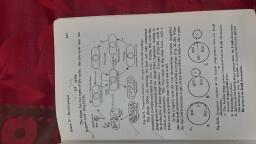
In donor cells, F factor may integrate into the host chromosome becoming hfr (High Frequency of Recombination)., , Thus F+ cells become hfr cells., , Conjugation between hfr and F- cells results in replication of the chromosome with F factor., , A single parental strand is transferred from hfr cell to the F- cells., Conjugation
Page 20 :
Complete transfer of the chromosome does not take place., , Only a small piece of F factor leads the chromosomal genes into F- cells., , The small strand containing chromosomal genes recombines with the DNA of F- cells., , Thus F- cells receive only a part of chromosomal genes and hence do not get converted to F+ cells., Conjugation
Page 22 :
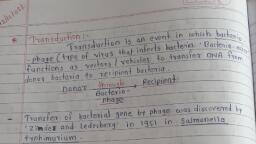
Transduction, Transduction is the process of moving bacterial DNA from one cell to another using a bacteriophage., , Bacteriophage or just “phage” are bacterial viruses., , They consist of a small piece of DNA inside a protein coat., , The protein coat binds to the bacterial surface, then injects the phage DNA., , The phage DNA then takes over the cell‟s machinery and replicates many virus particles.
Page 23 :
Transduction
Page 24 :
Phage attaches to the cell and injects its DNA., , Phage DNA replicates, and is transcribed into RNA, then translated into new phage proteins., , New phage particles are assembled., , Cell is lysed, releasing about 200 new phage particles., , Total time = about 15 minutes., Transduction
Page 26 :
Generalized Transduction, Some phages, such as phage P1, break up the bacterial chromosome into small pieces, and then package it into some phage particles instead of their own DNA., , These chromosomal pieces are quite small., , A phage containing E. coli DNA can infect a fresh host, because the binding to the cell surface and injection of DNA is caused by the phage proteins.
Page 27 :
After infection by such a phage, the cell contains an exogenote (linear DNA injected by the phage) and an endogenote (circular DNA that is the host‟s chromosome)., , A double crossover event puts the exogenote‟s genes onto the chromosome, allowing them to be propagated., Generalized Transduction
Page 29 :
Some phages can transfer only particular genes to other bacteria., , Phage lambda (λ) has this property. To understand specialized transduction, we need to examine the phage lambda life cycle., , lambda has 2 distinct phases of its life cycle. The “lytic” phase : the phage infects the cell, makes more copies of itself, then lyses the cell to release the new phage., Specialized Transduction
Page 30 :
The “lysogenic” phase of the lambda life cycle starts the same way: the lambda phage binds to the bacterial cell and injects its DNA., , Once inside the cell, the lambda DNA circularizes, then incorporates into the bacterial chromosome by a crossover., , Once incorporated into the chromosome, the lambda DNA becomes quiescent: its genes are not expressed and it remains a passive element on the chromosome, being replicated along with the rest of the chromosome., , The lambda DNA in this condition is called the “prophage”., Specialized Transduction
Page 31 :
After many generations of the cell, conditions might get harsh. For lambda, bad conditions are signaled when DNA damage occurs., , When the lambda prophage receives the DNA damage signal, it loops out and has a crossover, removing itself from the chromosome. Then the lambda genes become active and it goes into the lytic phase, reproducing itself, then lysing the cell., Specialized Transduction
Page 33 :
lambda can only incorporate into a specific site, called attλ. The gal gene is on one side of attλ and the bio gene (biotin synthesis) is on the other side., , Sometimes when lambda come out of the chromosome at the end of the lysogenic phase, it crosses over at the wrong point., , When this happens, a piece of the E. coli chromosome is, incorporated into the lambda phage chromosome, Specialized Transduction
Page 34 :
These phage that carry an E. coli gene in addition to the lambda genes are called “specialized transducing phages”., , , They can carry either the gal gene or the bio gene to other E. coli., Specialized Transduction
Page 36 :
ASSESSMENT, Q. 1. What is Bacterial Genetic recombination explain., Q.2. Write Short notes on-, Bacterial transformation, Conjugation, Transduction



 Learn better on this topic