Page 1 :
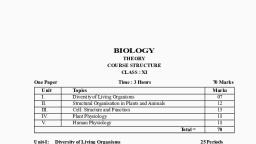
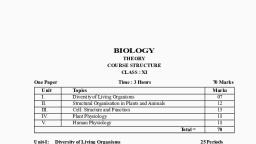
BIOLOGY (Code No. 044), 2021-22, The present curriculum provides the students with updated concepts along with an extended, exposure to contemporary areas of the subject. The curriculum also aims at emphasizing the, underlying principles that are common to animals, plants and microorganisms as well as, highlighting the relationship of Biology with other areas of knowledge. The format of the, curriculum allows a simple, clear, sequential flow of concepts. It relates the study of biology to, real life through the use of technology. It links the discoveries and innovations in biology to, everyday life such as environment, industry, health and agriculture. The updated curriculum, focuses on understanding and application of scientific principles, while ensuring that ample, opportunities and scope for learning and appreciating basic concepts continue to be available, within its framework. The broad aims of the curriculum are:, , , promote understanding of basic principles of Biology, , , , encourage learning of emerging knowledge and its relevance to individual and society, , , , promote rational/scientific attitude especially towards issues related to population,, environment and development, , , , enhance awareness about environmental issues, problems and their appropriate solutions, , , , create awareness amongst the learners about diversity in living organisms and develop, respect for other living beings, , , , appreciate that the most complex biological phenomena are built on essentially simple, processes, , , , develop skills that are relevant to the study and practice of Biology, , , , encourage a systematic approach to problem – solving, , , , encourage effective communication, , It is expected that the students would get an exposure to various branches of Biology in the, curriculum in a more contextual and systematic manner as they study its various units., BIOLOGY (Code No. 044), COURSE STRUCTURE, CLASS XI (2021-22) (THEORY), Time: 03 Hours, Unit, I, II, III, IV, V, , Max. Marks: 70, Title, Diversity of Living Organisms, Structural Organization in Plants and Animals, Cell: Structure and Functions, Plant Physiology, Human Physiology, Total, 1, , No. of Periods, 27, 27, 26, 40, 40, 160, , Marks, 12, 12, 12, 17, 17, 70
Page 2 :
Unit-I Diversity of Living Organisms, Chapter-1: The Living World, What is living? Biodiversity; Need for classification; taxonomy and systematics; concept of, species and taxonomical hierarchy; binomial nomenclature; tools for study of taxonomymuseums, zoological parks, herbaria, botanical gardens, keys for identification., Chapter-2: Biological Classification, Five kingdom classification; Salient features and classification of Monera, Protista and Fungi, into major groups; Lichens, Viruses and Viroids., Chapter-3: Plant Kingdom, Salient features and classification of plants into major groups - Algae, Bryophyta, Pteridophyta,, Gymnospermae and Angiospermae (salient and distinguishing features and a few examples of, each category): Angiosperms - classification up to class, characteristic features and examples., Plant life cycles and alternation of generations, Chapter-4: Animal Kingdom, Basis of Classification; Salient features and classification of animals, non-chordates up to phyla, level and chordates up to class level (salient features and distinguishing features of a few, examples of each category)., (No live animals or specimen should be displayed in school.), Unit-II Structural Organization in Plants and Animals, Chapter-5: Morphology of Flowering Plants, Morphology and modifications: Morphology of different parts of flowering plants: root, stem,, leaf, inflorescence, flower, fruit and seed. Description of families: Fabaceae, Solanaceae and, Liliaceae (to be dealt along with the relevant experiments of the Practical Syllabus)., Chapter-6: Anatomy of Flowering Plants, Anatomy and functions of different tissues and tissue systems in dicots and monocots., Secondary growth., Chapter-7: Structural Organisation in Animals, Animal tissues; Morphology, Anatomy and functions of different systems (digestive,, circulatory, respiratory, nervous and reproductive) of an insect-cockroach (a brief account only)., Unit-III Cell: Structure and Functions, Chapter-8: Cell-The Unit of Life, Cell theory and cell as the basic unit of life, structure of prokaryotic and eukaryotic cells; Plant, cell and animal cell; cell envelope; cell membrane, cell wall; cell organelles - structure and, function; endomembrane system- endoplasmic reticulum, ribosomes, golgi bodies, lysosomes,, vacuoles; mitochondria, plastids, microbodies; cytoskeleton, cilia, flagella, centrioles, (ultrastructure and function); nucleus., , 2
Page 3 :
Chapter-9: Biomolecules, Chemical constituents of living cells: biomolecules, structure and function of proteins,, carbohydrates, lipids, nucleic acids; concept of metabolism; Enzymes - properties, enzyme, action, factors, classification, Co-factors., Chapter-10: Cell Cycle and Cell Division, Cell cycle, mitosis, meiosis and their significance, Unit-IV Plant Physiology, Chapter-11: Transport in Plants, Movement of water, gases and nutrients; cell to cell transport - diffusion, facilitated diffusion,, active transport; plant-water relations, imbibition, water potential, osmosis, plasmolysis; long, distance transport of water - Absorption, apoplast, symplast, transpiration pull, root pressure and, guttation; transpiration, opening and closing of stomata; Uptake and translocation of mineral, nutrients - Transport of food, phloem transport, mass flow hypothesis., Chapter-12: Mineral Nutrition, Elementary idea of hydroponics as a method to study mineral nutrition; essential minerals,, macro- and micronutrients and their role; deficiency symptoms; mineral toxicity; nitrogen, metabolism, nitrogen cycle, biological nitrogen fixation., Chapter-13: Photosynthesis in Higher Plants, Photosynthesis as a means of autotrophic nutrition; early experiments, site of photosynthesis,, pigments involved in photosynthesis (elementary idea); photochemical and biosynthetic phases, of photosynthesis; cyclic and non-cyclic photophosphorylation; chemiosmotic hypothesis;, photorespiration; C3 and C4 pathways; factors affecting photosynthesis., Chapter-14: Cellular Respiration, Exchange of gases; do plants breathe; cellular respiration - glycolysis, fermentation (anaerobic),, TCA cycle and electron transport system (aerobic); energy relations - number of ATP molecules, generated; amphibolic pathways; respiratory quotient., Chapter-15: Plant - Growth and Development, Seed germination; characteristics, measurements and phases of plant growth, growth rate;, conditions for growth; differentiation, dedifferentiation and redifferentiation; sequence of, developmental processes in a plant cell; growth regulators - auxin, gibberellin, cytokinin,, ethylene, ABA; seed dormancy; vernalisation; photoperiodism., Unit-V Human Physiology, Chapter-16: Digestion and Absorption, Alimentary canal and digestive glands, role of digestive enzymes and gastrointestinal hormones;, Peristalsis, digestion, absorption and assimilation of proteins, carbohydrates and fats; egestion;, nutritional and digestive disorders - indigestion, constipation, vomiting, jaundice, diarrhoea., Chapter-17: Breathing and Exchange of Gases, Introduction to respiratory organs in animals; Respiratory system in humans; mechanism of, breathing and its regulation in humans - exchange of gases, transport of gases and regulation of, respiration, respiratory volumes; disorders related to respiration - asthma, emphysema,, occupational respiratory disorders., 3
Page 4 :
Chapter-18: Body Fluids and Circulation, Composition of blood, blood groups, coagulation of blood; composition of lymph and its, function; circulatory pathways; human circulatory system - Structure of human heart and blood, vessels; cardiac cycle, cardiac output, ECG; double circulation; regulation of cardiac activity;, disorders of circulatory system - hypertension, coronary artery disease, angina pectoris, heart, failure., Chapter-19: Excretory Products and their Elimination, Modes of excretion - ammonotelism, ureotelism, uricotelism; human excretory system –, structure and function; urine formation, osmoregulation; regulation of kidney function - renin angiotensin, atrial natriuretic factor, ADH, diabetes insipidus; micturition; role of other organs, in excretion; disorders - uremia, renal failure, renal calculi, nephritis; dialysis and artificial, kidney, kidney transplant., Chapter-20: Locomotion and Movement, Types of movement – amoeboid, ciliary, flagellar, muscular; types of muscles; skeletal muscle,, contractile proteins and muscle contraction; skeletal system and its functions; joints; disorders, of muscular and skeletal systems - myasthenia gravis, tetany, muscular dystrophy, arthritis,, osteoporosis, gout., Chapter-21: Neural Control and Coordination, Neuron and nerves; Nervous system in humans - central nervous system and peripheral nervous, system; generation, conduction and transmission of nerve impulse; reflex action; sensory, perception; sense organs; elementary structure and functions of eye and ear., Chapter-22: Chemical Coordination and Integration, Endocrine glands and hormones; human endocrine system - hypothalamus, pituitary, pineal,, thyroid, parathyroid, thymus, adrenal, pancreas, gonads; hormones of heart, kidney and, gastrointestinal tract; mechanism of hormone action (elementary idea); role of hormones as, messengers and regulators, hypo - and hyperactivity and related disorders; dwarfism,, acromegaly, cretinism, goiter, exophthalmic goiter, diabetes, Addison's disease., Note: Diseases related to all the human physiological systems to be taught in brief., , 4
Page 5 :
PRACTICALS, Time: 03 hours, , Max. Marks: 30, Evaluation Scheme, , Marks, , One Major Experiment Part A (Experiment No- 1,3,7,8), One Minor Experiment Part A (Experiment No- 6,9,10,11,12,13), Slide Preparation Part A (Experiment No- 2,4,5), Spotting Part B, Practical Record + Viva Voce, Credit to the students’ work over, the academic session may be given, Project Record + Viva Voce, Total, , 5, 4, 5, 7, 4, 5, 30, , A: List of Experiments, 1. Study and describe three locally available common flowering plants, one from each of the, families Solanaceae, Fabaceae and Liliaceae (Poaceae, Asteraceae or Brassicaceae can be, substituted in case of particular geographical location) including dissection and display of floral, whorls, anther and ovary to show number of chambers (floral formulae and floral diagrams)., Types of root (Tap and adventitious); types of stem (herbaceous and woody); leaf (arrangement,, shape, venation, simple and compound)., 2. Preparation and study of T.S. of dicot and monocot roots and stems (primary)., 3. Study of osmosis by potato osmometer., 4. Study of plasmolysis in epidermal peels (e.g. Rhoeo/lily leaves or flashy scale leaves of onion, bulb)., 5. Study of distribution of stomata in the upper and lower surfaces of leaves., 6. Comparative study of the rates of transpiration in the upper and lower surface of leaves., 7. Test for the presence of sugar, starch, proteins and fats in suitable plant and animal materials., 8. Separation of plant pigments through paper chromatography., 9. Study of the rate of respiration in flower buds/leaf tissue and germinating seeds., 10. Test for presence of urea in urine., 11. Test for presence of sugar in urine., 12. Test for presence of albumin in urine., 13. Test for presence of bile salts in urine., B. Careful observation of the following (spotting):, 1. Parts of a compound microscope., 2. Specimens/slides/models and identification with reasons - Bacteria, Oscillatoria, Spirogyra,, Rhizopus, mushroom, yeast, liverwort, moss, fern, pine, one monocotyledonous plant, one, dicotyledonous plant and one lichen., 3. Virtual specimens/slides/models and identifying features of - Amoeba, Hydra, liverfluke,, Ascaris, leech, earthworm, prawn, silkworm, honeybee, snail, starfish, shark, rohu, frog, lizard,, pigeon and rabbit., 4. Tissues and diversity in shape and size of plant cells (palisade cells, guard cells, parenchyma,, collenchyma, sclerenchyma, xylem and phloem) through temporary and permanent slides., 5
Page 6 :
5. Tissues and diversity in shape and size of animal cells (squamous epithelium, smooth, skeletal, and cardiac muscle fibers and mammalian blood smear) through temporary/permanent slides., 6. Mitosis in onion root tip cells and animals cells (grasshopper) from permanent slides., 7. Different modifications in roots, stems and leaves., 8. Different types of inflorescence (cymose and racemose)., 9. Human skeleton and different types of joints with the help of virtual images/models only., Practical Work for Visually Impaired Students - Class XI, Note: The ‘Evaluation scheme’ and ‘General Guidelines’ for visually impaired students given at, the end of this document may be referred to., A. Items for Identification/Familiarity with the apparatus /equipment/animal and plant, material / chemicals etc. for assessment in practicals (All experiments), , , Plants of Solanaceae family (Brinjal, Petunia or any other), Fabaceae family (Pea, Gram or, any other) or The Liliaceae family (Any of the Lilies), , , , Mushroom, Succulents such as Aloe vera/Kalanchoe, , , , Raisins and Potatoes, , , , Honey comb, Mollusc shell, Model of cockroach, Pigeon and Star fish, , , , Compound microscope, Test tube, Petri dish, Beaker, Scalpel, , , , Chromatography paper, Chromatography chamber, Alcohol, , B. List of Practicals, 1. Study three locally available common flowering plants of the families – Solanaceae, Fabaceae,, Liliaceae and identify:, 2. Types of stems as Herbaceous or Woody, Types of leaves as Compound or Simple, 3. Study the parts of a compound microscope- eye piece and objective lens, mirror, stage, coarse, and fine adjustment knobs., 4. Differentiate between monocot and dicot plants on the basis of venation patterns., 5. Study the following parts of human skeleton (Model): Ball and socket joints of thigh and, shoulder, Rib cage, 6. Study honey-bee/butterfly, snail shell, Starfish, Pigeon (through models)., 7. Identify the given specimen of a fungus – Mushroom, gymnosperm- pine cone, 8. Identify and relate the experimental set up with the aim of experiment:, For Potato Osmometer/ endosmosis in raisins., Note: The above practicals may be carried out in an experiential manner rather than recording, observations., Prescribed Books:, 1. Biology Class-XI, Published by NCERT, 2. Other related books and manuals brought out by NCERT (including multimedia), , 6
Page 7 :
Practical Examination for Visually Impaired Students of Classes XI and XII, Evaluation Scheme, Time Allowed: Two hours, Topic, Identification/Familiarity with the apparatus, Written test (Based on given / prescribed practicals), Practical Records, Viva, , Max. Marks: 30, Marks, 5, 10, 5, 10, 30, , Total, , General Guidelines, The practical examination will be of two-hour duration. A separate list of experiments is, included in the curriculum., The written examination in practicals for these students will be conducted at the time of, practical examination of all other students., The written test will be of 30 minutes duration., The question paper given to the students should be legibly typed. It should contain a total of, 15 practical skill based very short answer type questions. A student would be required to, answer any 10 questions., All questions included in the question paper should be related to the listed practicals. Every, question should require about two minutes to be answered., Questions may be generated jointly by the external/internal examiners and used for, assessment., A writer may be allowed to such students as per CBSE examination rules., These students are also required to maintain a practical file. A student is expected to record, at least five of the listed experiments as per the specific instructions for each subject. These, practicals should be duly checked and signed by the internal examiner., The format of writing any experiment in the practical file should include aim, apparatus, required, simple theory, procedure, related practical skills, precautions etc., The viva questions may include questions based on basic theory / principle / concept,, apparatus / materials / chemicals required, procedure, precautions, sources of error etc., , 11