Notes of Class 11, Mathematics Complete Solutions Binomial-Theorem.pdf - Study Material
Page 1 :
www.ncrtsolutions.in, , NCERT Solutions for Class 11 Maths Chapter 8, Binomial Theorem Class 11, Chapter 8 Binomial Theorem Exercise 8.1, 8.2, miscellaneous Solutions, , Exercise 8.1 : Solutions of Questions on Page Number : 166, Q1 :, Expand the expression (1- 2x)5, , Answer :, By using Binomial Theorem, the expression (1– 2x)5 can be expanded as, , Q2 :, , Expand the expression, , Answer :, , By using Binomial Theorem, the expression, , can be expanded as, , www.ncrtsolutions.in
Page 3 :
www.ncrtsolutions.in, , Answer :, , By using Binomial Theorem, the expression, , can be expanded as, , Q6 :, Using Binomial Theorem, evaluate (96)3, , Answer :, 96 can be expressed as the sum or difference of two numbers whose powers are easier to calculate and then,, binomial theorem can be applied., It can be written that, 96 = 100 – 4, , Q7 :, Using Binomial Theorem, evaluate (102)5, , Answer :, 102can be expressed as the sum or difference of two numbers whose powers are easier to calculate and then,, Binomial Theorem can be applied., It can be written that, 102 = 100 + 2, , www.ncrtsolutions.in
Page 4 :
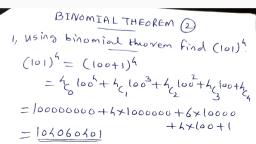
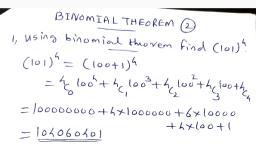
www.ncrtsolutions.in, , Q8 :, Using Binomial Theorem, evaluate (101)4, , Answer :, 101 can be expressed as the sum or difference of two numbers whose powers are easier to calculate and then,, Binomial Theorem can be applied., It can be written that, 101 = 100 + 1, , Q9 :, Using Binomial Theorem, evaluate (99)5, , Answer :, 99 can be written as the sum or difference of two numbers whose powers are easier to calculate and then, Binomial, Theorem can be applied., It can be written that, 99 = 100 – 1, , www.ncrtsolutions.in
Page 5 :
www.ncrtsolutions.in, , Q10 :, Using Binomial Theorem, indicate which number is larger (1.1)10000or 1000., , Answer :, By splitting 1.1 and then applying Binomial Theorem, the first few terms of (1.1)10000can be obtained as, , Q11 :, , Find (a + b)4– (a– b)4. Hence, evaluate, , ., , Answer :, Using Binomial Theorem, the expressions, (a+ b)4and (a – b)4, can be expanded as, , www.ncrtsolutions.in
Page 7 :
www.ncrtsolutions.in, , Show that, , is divisible by 64, whenever nis a positive integer., , Answer :, In order to show that, , is divisible by 64, it has to be proved that,, , where k is some natural number, , By Binomial Theorem,, , For a = 8 and m = n+ 1, we obtain, , Thus,, , is divisible by 64, whenever nis a positive integer., , Q14 :, , Prove that, , ., , Answer :, By Binomial Theorem,, , By putting b= 3 and a= 1 in the above equation, we obtain, , Hence, proved., , Exercise 8.2 : Solutions of Questions on Page Number : 171, Q1 :, , www.ncrtsolutions.in
Page 8 :
www.ncrtsolutions.in, Find the coefficient of x5in (x + 3)8, , Answer :, It is known that (r + 1)th term, (Tr+1), in the binomial expansion of (a + b)n is given by, , ., , Assuming that x5occurs in the (r+ 1)thterm of the expansion (x+ 3)8, we obtain, , Comparing the indices of xin x5and in Tr+1, we obtain, r= 3, , Thus, the coefficient of x5is, , Q2 :, Find the coefficient of a5b7in (a - 2b)12, , Answer :, It is known that (r + 1)th term, (Tr+1), in the binomial expansion of (a + b)n is given by, , ., , Assuming that a5b7occurs in the (r+ 1)thterm of the expansion (a– 2b)12, we obtain, , Comparing the indices of aand b in a5b7 and in Tr+1, we obtain, r= 7, Thus, the coefficient, , of a5b7is, , Q3 :, Write the general term in the expansion of (x2- y)6, , Answer :, It is known that the general term Tr+1 {which is the (r + 1)th term} in the binomial expansion of (a + b)n is given, by, , ., , Thus, the general term in the expansion of (x2– y6) is, , www.ncrtsolutions.in
Page 9 :
www.ncrtsolutions.in, , Q4 :, Write the general term in the expansion of (x2- yx)12, x ≠0, , Answer :, It is known that the general term Tr+1 {which is the (r + 1)th term} in the binomial expansion of (a + b)n is given, by, , ., , Thus, the general term in the expansion of(x2– yx)12is, , Q5 :, Find the 4thterm in the expansion of (x- 2y)12 ., , Answer :, It is known that (r + 1)th term, (Tr+1), in the binomial expansion of (a + b)n is given by, , ., , Thus, the 4thterm in the expansion of (x– 2y)12is, , Q6 :, , Find the 13thterm in the expansion of, , ., , Answer :, It is known that (r + 1)th term, (Tr+1), in the binomial expansion of (a + b)n is given by, , Thus, 13thterm in the expansion of, , is, , www.ncrtsolutions.in, , .
Page 10 :
www.ncrtsolutions.in, , Q7 :, , Find the middle terms in the expansions of, , Answer :, , It is known that in the expansion of (a+ b)n, if n is odd, then there are two middle terms, namely,, , and, , term., , Therefore, the middle terms in the expansion of, term, , Thus, the middle terms in the expansion of, , are, , are, , www.ncrtsolutions.in, , term and, , ., , term
Page 11 :
www.ncrtsolutions.in, Q8 :, , Find the middle terms in the expansions of, , Answer :, , It is known that in the expansion (a+ b)n, if n is even, then the middle term is, , Therefore, the middle term in the expansion of, , is, , term., , term, , is 61236 x5y5., , Thus, the middle term in the expansion of, , Q9 :, In the expansion of (1 + a)m + n, prove that coefficients of amand anare equal., , Answer :, It is known that (r + 1)th term, (Tr+1), in the binomial expansion of (a + b)n is given by, Assuming that amoccurs in the (r+ 1)thterm of the expansion (1 + a)m+ n, we obtain, , Comparing the indices of ain amand in Tr + 1, we obtain, r= m, Therefore, the coefficient of amis, , Assuming that anoccurs in the (k+ 1)thterm of the expansion (1 + a)m+n, we obtain, , www.ncrtsolutions.in, , .
Page 12 :
www.ncrtsolutions.in, Comparing the indices of ain anand in Tk+ 1, we obtain, k= n, Therefore, the coefficient of anis, , Thus, from (1) and (2), it can be observed that the coefficients of amand anin the expansion of (1 + a)m+ nare equal., , Q10 :, The coefficients of the (r- 1)th, rthand (r + 1)thterms in the expansion of, (x+ 1)nare in the ratio 1:3:5. Find nand r., , Answer :, It is known that (k + 1)th term, (Tk+1), in the binomial expansion of (a + b)n is given by, Therefore, (r – 1)thterm in the expansion of (x+ 1)nis, rth term in the expansion of (x+ 1)nis, (r+ 1)thterm in the expansion of (x+ 1)nis, Therefore, the coefficients of the (r– 1)th, rth, and (r + 1)thterms in the expansion of (x+, 1)nare, , respectively. Since these coefficients are in the ratio 1:3:5, we obtain, , www.ncrtsolutions.in, , .
Page 13 :
www.ncrtsolutions.in, , Multiplying (1) by 3 and subtracting it from (2), we obtain, 4r – 12 = 0, ⇒ r= 3, Putting the value of rin (1), we obtain, n– 12 + 5 = 0, ⇒ n= 7, Thus, n = 7 and r = 3, , Q11 :, Prove that the coefficient of xnin the expansion of (1 + x)2nis twice the coefficient of xnin the expansion of (1, + x)2n-1 ., , Answer :, It is known that (r + 1)th term, (Tr+1), in the binomial expansion of (a + b)n is given by, Assuming that xnoccurs in the (r+ 1)thterm of the expansion of (1 + x)2n, we obtain, , Comparing the indices of xin xnand in Tr+ 1, we obtain, r= n, Therefore, the coefficient of xnin the expansion of (1 + x)2nis, , www.ncrtsolutions.in, , .
Page 14 :
www.ncrtsolutions.in, Assuming that xnoccurs in the (k+1)thterm of the expansion (1 + x)2n – 1, we obtain, , Comparing the indices of xin xnand Tk+ 1, we obtain, k= n, Therefore, the coefficient of xnin the expansion of (1 + x)2n –1is, , From (1) and (2), it is observed that, , Therefore, the coefficient of xnin the expansion of (1 + x)2nis twice the coefficient of xnin the expansion of (1 + x)2n–1., Hence, proved., , Q12 :, Find a positive value of mfor which the coefficient of x2in the expansion, (1 + x)mis 6., , Answer :, It is known that (r + 1)th term, (Tr+1), in the binomial expansion of (a + b)n is given by, Assuming that x2occurs in the (r + 1)thterm of the expansion (1 +x)m, we obtain, , Comparing the indices of xin x2and in Tr+ 1, we obtain, r= 2, Therefore, the coefficient of x2is, , ., , It is given that the coefficient of x2in the expansion (1 + x)mis 6., , www.ncrtsolutions.in, , .
Page 15 :
www.ncrtsolutions.in, , Thus, the positive value of m, for which the coefficient of x2in the expansion, (1 + x)mis 6, is 4., , Exercise Miscellaneous : Solutions of Questions on Page Number : 175, Q1 :, Find a, band n in the expansion of (a+ b)nif the first three terms of the expansion are 729, 7290 and 30375,, respectively., , Answer :, It is known that (r + 1)th term, (Tr+1), in the binomial expansion of (a + b)n is given by, The first three terms of the expansion are given as 729, 7290, and 30375 respectively., Therefore, we obtain, , Dividing (2) by (1), we obtain, , www.ncrtsolutions.in, , .
Page 16 :
www.ncrtsolutions.in, , Dividing (3) by (2), we obtain, , From (4) and (5), we obtain, , Substituting n = 6 in equation (1), we obtain, a6= 729, , From (5), we obtain, , Thus, a = 3, b= 5, and n= 6., , Q2 :, Find aif the coefficients of x2and x3in the expansion of (3 + ax)9are equal., , Answer :, It is known that (r + 1)th term, (Tr+1), in the binomial expansion of (a + b)n is given by, Assuming that x2occurs in the (r+ 1)thterm in the expansion of (3 + ax)9, we obtain, , Comparing the indices of xin x2and in Tr+ 1, we obtain, r= 2, , www.ncrtsolutions.in, , .
Page 18 :
www.ncrtsolutions.in, , The complete multiplication of the two brackets is not required to be carried out. Only those terms, which involve x5,, are required., The terms containing x5are, , Thus, the coefficient of x5in the given product is 171., , Q4 :, If a and b are distinct integers, prove that a - b is a factor of an - bn, whenever n is a positive integer., [Hint: write an = (a - b + b)n and expand], , Answer :, In order to prove that (a– b) is a factor of (an– bn), it has to be proved that, an– bn= k (a– b), where k is some natural number, It can be written that, a= a – b + b, , Thisshows that (a– b) is a factor of (an– bn), where n is a positive integer., , Q5 :, , www.ncrtsolutions.in
Page 19 :
www.ncrtsolutions.in, , Evaluate, , ., , Answer :, Firstly, the expression (a+ b)6– (a– b)6is simplified by using Binomial Theorem., This can be done as, , Q6 :, , Find the value of, , ., , Answer :, Firstly, the expression (x+ y)4+ (x – y)4is simplified by using Binomial Theorem., This can be done as, , www.ncrtsolutions.in
Page 20 :
www.ncrtsolutions.in, , Q7 :, Find an approximation of (0.99)5using the first three terms of its expansion., , Answer :, 0.99 = 1 – 0.01, , Thus, the value of (0.99)5is approximately 0.951., , Q8 :, Find n, if the ratio of the fifth term from the beginning to the fifth term from the end in the expansion, , of, , www.ncrtsolutions.in
Page 21 :
www.ncrtsolutions.in, , Answer :, In the expansion,, , ,, , Fifth term from the beginning, Fifth term from the end, , Therefore, it is evident that in the expansion of, , is, , , the fifth term from the beginning, , and the fifth term from the end is, , ., , It is given that the ratio of the fifth term from the beginning to the fifth term from the end is, and (2), we obtain, , Thus, the value of n is 10., , www.ncrtsolutions.in, , . Therefore, from (1)
Page 22 :
www.ncrtsolutions.in, , Q9 :, , Expand using Binomial Theorem, , ., , Answer :, , Using Binomial Theorem, the given expression, , can be expanded as, , Again by using Binomial Theorem, we obtain, , From(1), (2), and (3), we obtain, , www.ncrtsolutions.in
Page 23 :
www.ncrtsolutions.in, , Q10 :, , Find the expansion of, , using binomial theorem., , Answer :, , Using Binomial Theorem, the given expression, , can be expanded as, , Again by using Binomial Theorem, we obtain, , From (1) and (2), we obtain, , www.ncrtsolutions.in



 Learn better on this topic