Notes of Class XI, Computer Science 1 Unit 1 evolution of computer.pdf - Study Material
Page 1 :
Unit 1:, , COMPUTER FUNDAMENTALS, , Evolution of Computer Systems, Early Developments, The need for counting, computing or processing data has been with man from the beginning. The, most significant early computing tool is the ABACUS, a wooden rack holding parallel rods on which, beads are strung. This simple device was used for addition and subtraction., A significant advance in the evolution of computing systems was the invention of a mechanical, adding machine in 1642 by the French scientist Blaise Pascal (1623-1662)., In 1671 Leibniz (Gottfried Wilhelm von Leibnix) better one which could also multiply, divide, and find, square root., In 1829, Thomas of Colmar(Charles Xsvier Thomas) produced the first commercially available, mechanical calculator. This desktop calculator could add, subtract, multiply, and divide. This was, followed by a succession of advanced and improved versions of mechanical calculators., Charles Babbage in 1822, built an automatic mechanical calculator called the "difference engine." In, 1833 he began to work on a general-purpose, programmable, automatic mechanical digital, computer called the “analytic machine”. He also came to be known as father of modern computer., A major step forward in the evolution of computer systems is the invention of punch cards the, calculating automatic machine which was first used during the U.S. census of 1890 by Herman, Hollerith and James Powers., Modern Digital Systems, By the late 1930’s, several research groups worked hard to build automatic digital computer. In, 1942, Eckert(electrical engineer J. Presper) and physicist John W. Mauchly developed ENIAC, (Electronic Numerical Integrator and Calculator). ENIAC went into operation in 1946. It was the first, all-purpose, digital electronic computer. It used vacuum tubes instead of relays as the logic, elements. Because of this, it was more than 1,000 faster than its electromechanical predecessors., However, ENIAC was of an unprecedented size and complexity., In 1950, ENIAC was succeeded by EDVAC (Electronic Discrete Variable Automatic Computer), a, stored-program computer. In 1947, Eckert and Mauchly established their own company, EckertMauchly Computer Corporation, to manufacture computers commercially. In 1951, the company, produced the UNIVAC I (Universal Automatic Computer) for the U.S. Census Bureau., UNIVAC I achieved the greatest fame among the early digital computers because it was used to, predict correctly the presidential election in 1952., , Generations of Computer, Introduction:, A computer is an electronic device that manipulates information or data. It has the ability to store,, retrieve, and process data., Nowadays, a computer can be used to type documents, send email, play games, and browse the Web., It can also be used to edit or create spreadsheets, presentations, and even videos. But the evolution of, this complex system started around 1940 with the first Generation of Computer and evolving ever, since.
Page 2 :
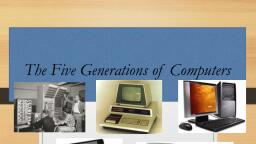
There are five generations of computers., 1. FIRST GENERATION, • Introduction:, 1. 1946-1959 is the period of first generation computer., 2. J.P.Eckert and J.W.Mauchy invented the first successful electronic computer called ENIAC,, ENIAC stands for “Electronic Numeric Integrated And Calculator”., • Few Examples are:, 1. ENIAC, 2. EDVAC, 3. UNIVAC, 4. IBM-701, 5. IBM-650, …, •, , •, , Advantages:, 1. It made use of vacuum tubes which are the only electronic component available during those, days., 2. These computers could calculate in milliseconds., Disadvantages:, 1. These were very big in size, weight was about 30 tones., 2. These computers were based on vacuum tubes., 3. These computers were very costly., 4. It could store only a small amount of information due to the presence of magnetic drums., 5. As the invention of first generation computers involves vacuum tubes, so another, disadvantage of these computers was, vacuum tubes require a large cooling system., 6. Very less work efficiency., 7. Limited programming capabilities and punch cards were used to take inputs., 8. Large amount of energy consumption., 9. Not reliable and constant maintenance is required., , 2. SECOND GENERATION, • Introduction:, 1. 1959-1965 is the period of second-generation computer., 2. 3.Second generation computers were based on Transistor instead of vacuum tubes., • Few Examples are:, 1. Honeywell 400, 2. IBM 7094, 3. CDC 1604, 4. CDC 3600, 5. UNIVAC 1108, … many more, •, , •, , Advantages:, 1. Due to the presence of transistors instead of vacuum tubes, the size of electron component, decreased. This resulted in reducing the size of a computer as compared to first generation, computers., 2. Less energy and not produce as much heat as the first genration., 3. Assembly language and punch cards were used for input., 4. Low cost than first generation computers., 5. Better speed, calculate data in microseconds., 6. Better portability as compared to first generation, Disadvantages:, 1. A cooling system was required., 2. Constant maintenance was required.
Page 3 :
3. Only used for specific purposes., 3. THIRD GENERATION, • Introduction:, 1. 1965-1971 is the period of third generation computer., 2. These computers were based on Integrated circuits., 3. IC was invented by Robert Noyce and Jack Kilby In 1958-1959., 4. IC was a single component containing number of transistors., • Few Examples are:, 1. PDP-8, 2. PDP-11, 3. ICL 2900, 4. IBM 360, 5. IBM 370, … and many more, •, , •, , Advantages:, 1. These computers were cheaper as compared to second-generation computers., 2. They were fast and reliable., 3. Use of IC in the computer provides the small size of the computer., 4. IC not only reduce the size of the computer but it also improves the performance of the, computer as compared to previous computers., 5. This generation of computers has big storage capacity., 6. Instead of punch cards, mouse and keyboard are used for input., 7. They used an operating system for better resource management and used the concept of timesharing and multiple programming., 8. These computers reduce the computational time from microseconds to nanoseconds., Disadvantages:, 1. IC chips are difficult to maintain., 2. The highly sophisticated technology required for the manufacturing of IC chips., 3. Air conditioning is required., , 4. FOURTH GENERATION, • Introduction:, 1. 1971-1980 is the period of fourth generation computer., 2. This technology is based on Microprocessor., 3. A microprocessor is used in a computer for any logical and arithmetic function to be, performed in any program., 4. Graphics User Interface (GUI) technology was exploited to offer more comfort to users., • Few Examples are:, 1. IBM 4341, 2. DEC 10, 3. STAR 1000, 4. PUP 11, … and many more, •, , •, , Advantages:, 1. Fastest in computation and size get reduced as compared to the previous generation of, computer., 2. Heat generated is negligible., 3. Small in size as compared to previous generation computers., 4. Less maintenance is required., 5. All types of high-level language can be used in this type of computers., Disadvantages:
Page 4 :
1. The Microprocessor design and fabrication are very complex., 2. Air conditioning is required in many cases due to the presence of ICs., 3. Advance technology is required to make the ICs., 5. FIFTH GENERATION, • Introduction:, 1. The period of the fifth generation in 1980-onwards., 2. This generation is based on artificial intelligence., 3. The aim of the fifth generation is to make a device which could respond to natural language, input and are capable of learning and self-organization., 4. This generation is based on ULSI(Ultra Large Scale Integration) technology resulting in the, production of microprocessor chips having ten million electronic component., • Few Examples are:, 1. Desktop, 2. Laptop, 3. NoteBook, 4. UltraBook, 5. Chromebook, … and many more, •, , •, , Advantages:, 1. It is more reliable and works faster., 2. It is available in different sizes and unique features., 3. It provides computers with more user-friendly interfaces with multimedia features., Disadvantages:, 1. They need very low-level languages., 2. They may make the human brains dull and doomed.



 Learn better on this topic