Notes of XI A B, Chemistry & Organic Chemistry organic chemistry part I.pdf - Study Material
Page 1 :
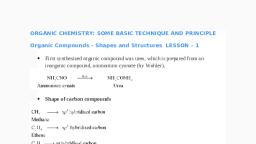
ORGANIC CHEMISTRY, Organic chemistry is the branch of chemistry that deals with the study of hydrocarbons and their, derivatives., Urea was the first organic compound synthesized in laboratory , It was synthesized by F. Wohler ., Urea can be synthesized by heating ammonium cynate ., NH4CNO, heat NH2COONH2, Ammonium cynate, Urea, Tetracovalency of Covalent Compounds, Electronic configuration of carbon is 2,4., Carbon has 4 electrons in the valence shell and thus needs 4 more electrons to complete its octet. Therefore, carbon is tetravalent., Carbon always combined with other atoms by mutual sharing of electrons and thus forms covalent, bond., Carbon is always tetra covalent i.e. it forms four covalent bonds with other atoms., Shapes of Simple Organic Compounds, Carbon (atomic number 6) has the ground state electronic configuration 1 s² 2s²p¹ x2p¹y2p°z. During the, formation the two electrons in the 2s orbital get unpaired and one is promoted to the empty 2p z orbital. This, corresponds to the excited state of carbon which has four half-filled orbitals (four valence electrons)., , In carbon compounds, s and p orbitals are involved in hybridisation ., Family, Types of hybridisation, Shapes of molecules, S character, 3, Alkane, sp, Tetrahedral, 25 %, 2, Alkene, sp, Planar, 33%, Alkyne, sp, Linear, 50%, More the s – character , the bond length will be shorter and Stronger., Greater the s – character greater is the electronegativity., Therefore sp hybrid carbon atom will have shorter bond length, Stronger bond and more electronegative., Shapes of some carbon compounds:, Alkane : Methane molecule (CH4), A molecule of methane contains four C-H , σ bonds., Orbital picture of methane, Bond length and bond angles, , Alkene : Ethene molecule(C2H4), The carbon-carbon double bond of ethene consists of a strong carbon-carbon σ- bond and a weak carboncarbon π(pi) bond.
Page 2 :
Alkyne : Ethyne molecule(C2H2), The carbon-carbon triple bond of ethyne consists of a strong carbon-carbon σ- bond and two weak carboncarbon π bond., , Characteristic Features of π-bonds, For π-bond formation, it is essential that the p-orbital on the adjacent carbon atoms must be parallel for a, proper sideways overlap., 1) All the atoms directly attached to the carbon atoms of the double bond lie in the same plane., 2) The p-orbital of a π-bond are mutually parallel and are perpendicular to the plane of the molecule., 3) Rotation of one C-H fragment w.r.t the other interferes with the maximum overlaps of the p-orbitals., Therefore , such a rotation about carbon-carbon double bond is restricted., 4) The electron charge cloud of the π-bond lies above and below the plane of the bonding atoms. This allows, the π-electrons being easily available to the attacking reagents., Structural Representation of Organic Compounds, Complete and Condensed Formulae, , e.g :, For Ex :CH3CH2CH2CH2CH2CH2CH 3 can be condensed to CH3(CH2)5CH3, Bond-Line structural Formulae, For Ex: Butyl chloride
Page 3 :
Three-Dimensional (3-D) representation of organic compounds, , CLASSIFICATION OF ORGANIC COMPOUNDS, , Acyclic or open chain compounds, These compounds contain open chains of carbon atoms in their molecules. The carbon chains may be either, straight or branched chains., (1) Straight chain compounds, , e.g: Pentane, (2) Branched chain compounds, , e.g:, isopentane, , neo pentane, , Open chain compounds are also called aliphatic compounds since the earlier compounds of this class were, obtained either from animals or vegetable fats.
Page 4 :
Cyclic or closed chain or ring compounds, These compounds contain one or more closed chains or rings of atoms in their molecules., Depending upon the constitution of the ring, these are further divided into following two categories:, (1) Homocyclic or carbocyclic compounds: These compounds contain rings which are made up of only, one kind of atoms i.e. carbon atoms., , These are further divided into the following two sub-classes., (a) Alicyclic compounds / Aliphatic compounds, Carbocyclic compounds which resemble aliphatic compounds in most of their properties ., (b) Aromatic compounds, These are special type of cyclic unsaturated compounds. The name aromatic for this class of cyclic, unsaturated compounds has been derived from the Greek word aroma meaning fragrant smell since most of, the compounds discovered has pleasant smell., They are of two types:, (1) Benzenoid aromatic compounds: Organic compounds containing one or more fused or isolated, benzene rings and their functionalized derivatives are called benzenoid aromatic compounds., Depending upon the number of benzene rings fused together, benzenoid compounds may be monocyclic,, bicyclic, tricyclic aromatic compounds., (1) Monocyclic aromatic compounds, , (2) Bicyclic or tricyclic aromatic compounds, , (2) Non-benzenoid aromatic compounds, Aromatic compounds which do not contain a benzene ring but instead contain other highly unsaturated rings, are called non-benzenoid aromatic compounds., , Examples:, Heterocyclic compounds, Cyclic compounds containing one or more heteroatoms in their rings are called heterocyclic compounds., The heteroatoms found in these compounds are oxygen, nitrogen and sulphur, boron, silicon etc.
Page 5 :
They are further classified into the following two categories:, (1) Alicyclic heterocyclic compounds: Aliphatic cyclic compounds containing one or more heteroatoms in, their rings are called alicyclic heterocyclic compounds., (2) Aromatic heterocyclic compounds, Aromatic cyclic compounds containing one or more heteroatoms in their molecules are called aromatic, heterocyclic compounds., , FUNCTIONAL OR CHARACTERISTIC GROUP, A functional group may be defined as an atom or a group of atoms present in a molecule which, largely determines its chemical properties., The chemical properties of any organic compound are the properties of its functional group., All the organic compounds containing the same functional group show similar chemical reactions., Example : Hydroxyl Groups ( - OH ) , Aldehyde ( - CHO ) , Carboxylic acid ( - COOH ), , Homologous Series, A homologous series is defined as a family or group of structurally similar organic compounds all, the members of which contain the same functional group, Show a gradation in physical and similarity in, chemical properties and any two adjacent members of which differ by a –CH2 group. The individual, members of such a series are called homologues and the phenomena is called homology., Alkanes ( CnH2n+2 ) , Alkenes (Cn H2n), Alkynes (CnH2n - 2 ) constitute a homologous series., , Nomenclature Of Organic Compounds, Nomenclature means the system of naming of organic compounds. In case of aliphatic compounds, two, system of nomenclature generally used are:, 1) Trivial or common system, 2) IUPAC system, IUPAC system, To systematize the nomenclature of organic compounds, IUPAC system of nomenclature was first, introduced in 1947., General rules for IUPAC Nomenclature of organic compounds, The most important feature of this system is that any given molecular structure has only one IUPAC name, and any given IUPAC name denotes only one molecular structure., The IUPAC name of any organic compound essentially consist of three parts ,i.e., 1) word root, 2) suffix, 3) prefix, Word root, It denotes the number of carbon atoms present in the parent chain (the longest possible continuous chain of, carbon atoms including the functional group and multiple bonds) of the organic molecule.
Page 6 :
Chain Length, C1, C2, C3, C4, C5, C6, C7, C8, C9, C10, , Word Root, Meth, Eth, Prop, But, Pent, Hex, Hept, Oct, Non, Dec, , Suffix, There are two types of suffix :, 1) Primary suffix : A primary suffix is always added to the word root to indicate whether the carbon chain is, saturated or unsaturated., The three basic primary suffixes, Primary suffix, General name, are : Type of carbon chain, Saturated, -ane, Alkane, Unsaturated with one double bond -ene, Alkene, Unsaturated with one triple bond, , -yne, , Alkyne, , If the parent chain contains two, three, four or more double or triple bonds ,numerical prefixes such as di, tri, ,tetra are added to the prefect primary., Type Of carbon chain, , Primary Suffix, , General name, , Unsaturated with two double bonds, , -diene, , Alkadiene, , Unsaturated with two triple bonds, , -diyne, , Alkadiyne, , 2) Secondary suffix : A secondary suffix is then added to the primary suffix to indicate the nature of the, functional group present in the organic compound., Class of Organic compound, Alcohols, Aldehydes, Ketones, carboxylic acid, Acid amides, Acid chloride, Esters, Nitriles, Thiols, Amines, , Functional Group, -OH, -CHO, -CO, -COOH, -CONH, -COCl, -COOR, -CN, -SH, -NH, , Secondary Suffix, -ol, -al, -one, -oic acid, -amide, -oyl chloride, alkyl oate, nitrile, thiol, amine, , While adding the secondary suffix to primary suffix ,the terminal e of the primary suffix is dropped if the, secondary suffix begins with a vowel but is retained if the secondary suffix begins with a consonant.
Page 7 :
Prefix, There are two types of prefixes:, 1) Primary prefix : A primary prefix is used simply to distinguish cyclic from acyclic compounds., For ex: In case of carbocyclic compounds, a primary prefix , cyclo is used immediately before the word root., Cyclo pentane, Cyclo (Primary prefix) + Pent (word root) + ane( Primary suffix), 2) secondary prefix : Certain groups are not considered as functional groups but instead are treated as, substituents. These are called secondary prefixes and are added immediately before the word roots in, alphabetical order to denote the side chain or substituent groups., The secondary prefixes for some groups which are always treated as substituent group are given below:, Substituent Group, Secondary group, Substituent Group, Secondary Prefix, -F, Fluoro, OCH3(OMe), Methoxy, -Cl, Chloro, -OC2H5(-OEt), Ethoxy, -Br, Bromo, -CH3(-Me), Methyl, -I, Iodo, -C2H5(-Et), Ethyl, -NO2, Nitro, -CH2CH2CH3(n-Pr), n-Propyl, , IUPAC name of an organic compound consist of:, Secondary prefix + Primary prefix + Primary suffix + Secondary Suffix



 Learn better on this topic