Page 1 :
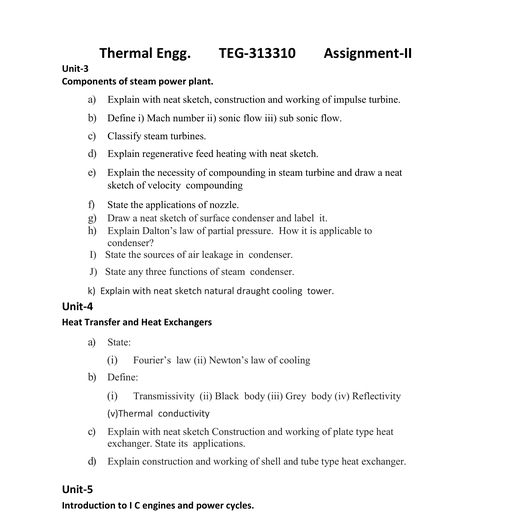
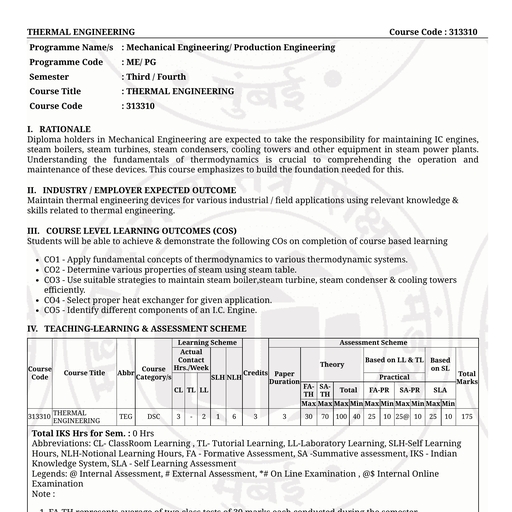
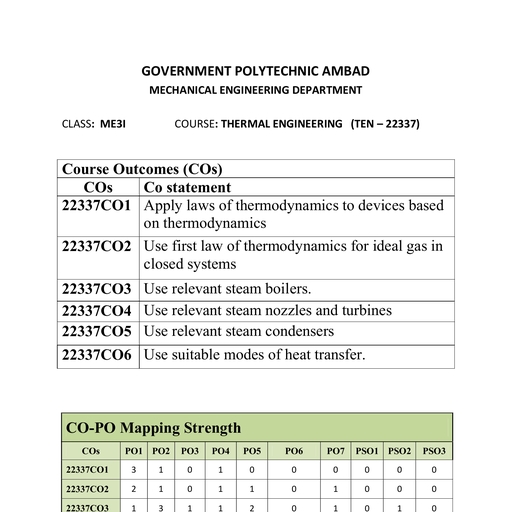
Unit – 6, , HEAT TRANSFER AND HEAT EXCHANGER, 6.1 Modes of heat transferConduction, convection and Radiation., 6.2 ConductionFourier’s law,, thermal conductivity,, conduction through cylinder, composite walls,, thermal resistance,, List of conducting and insulating materials., 6.3 Convection –, Newton’s law of cooling. Natural and forced convection., 6.4 Radiation –, Thermal radiation,, absorptivity,, transmissivity,, reflectivity,, emissivity,, black and gray bodies,, Stefan- Boltzmann law., 6.5 Heat exchangersClassification,, construction and working of shell and tube., Shell and coil,, pipe in pipe type and plate type heat exchanger,, automotive heat exchanger and its applications.
Page 2 :
Conduction :, It is a mode which requires a material medium for, the transfer of heat. The material medium is called, a body and it could be a Solid or a Liquid or a Gas., , In Solids, if the temperature of a certain portion of, the body is increased by transfer of heat then it, means the internal energy of that portion of body, has increased. The molecules which are present at, that location of body vibrate to and fro and in the, process they will interact and collide with, neighbouring molecules thus transferring energy in, the process. The solids also contain free electrons,, these free electrons are also responsible for, conduction of heat as they move from their, location to elsewhere, get diffused and collide with, other free electrons., , Convection, This mode also requires a material medium for, heat transfer. It results due to the bulk movement
Page 3 :
of the molecules of the medium from one part of, body to the other part due to existence of a, temperature difference between those two portions, of the body. Convection occurs in Fluids., , Whenever convection takes place there is always a, solid object or a solid surface in contact with the, fluid or immersed in the fluid. The solid object, usually transfers heat and causes the fluid to, move. When there is no bulk motion in fluid the, heat transfer occurs by mode of conduction. For, convection to happen there should be an, appreciable bulk motion in the fluid., Convection is called Forced Convection if the fluid, is forced to flow over the solid or around the solid, by external means such as fans, pumps or, blowers. Convection is called Natural Convection or, Free Convection if the fluid motion is caused by, Buoyancy forces that are induced by density, differences due to variation of temperature in the, fluid.
Page 4 :
Radiation, It is the only mode of heat transfer which does not, require a material medium. Radiation is an energy, emitted by matter in form electromagnetic waves., , Radiation, , Modes of Heat Transfer:-, , Thermal Radiation is a form of Radiation emitted, by the body due to the temperature of the body., Since electromagnetic waves travel at the speed of, light, this mode of heat transfer is the fastest as, compared to the other modes; conduction and, convection., All the objects which are above absolute zero in, temperature emit thermal radiation. Thermal, radiation is a volumetric phenomenon but for, objects which are opaque to thermal radiation, it, can be considered a surface phenomenon because, the radiation emitting in the interior of such, objects never reach the surface.
Page 5 :
The idealized surface emits thermal radiation at, maximum rate and it is called a Black body.
Page 7 :
Insulating materials:, Wood fibre, Cellulose (blown/sprayed), Wool (available in batts; rolls), Hemp (available in: batts; rolls), Cellular glass (available in: boards), Rock mineral wool, Phenolic foam, Polystyrene
Page 9 :
Newton's law of cooling states that the rate, of heat loss of a body is directly proportional to the, difference in the temperatures between the body, and its surroundings.
Page 10 :
Unlike thermal conduction or convection, radiative, heat transfer (heat transfer by radiation) requires no, medium to transfer heat. Thermal radiation can travel, as easily through a vacuum as it can through air or, water., When thermal radiation falls onto an object, some, combination of 3 things will happen.
Page 11 :
1. The radiation will be absorbed by the surface of the, object, causing its temperature to change., 2. The radiation will be reflected from the surface of, the body, causing no temperature change., 3. The radiation will pass completely through the, object, causing no temperature change., Light incident on a surface is energy, and energy is, conserved., It can be split into three fractions:, reflected,, absorbed, and, transmitted.
Page 12 :
Reflectivity, Absorptivity, and Transmissivity are defined, as being fractions of the original incident light., So you could have 30% reflected, 10% absorbed, and, then you would know 60% was transmitted since the, remaining light had to go somewhere (conservation of, energy), for a total of 100% which is equal to 1., , Absorptivity (α) is a measure of how much of the, radiation is absorbed by the body., α = energy absorbed/total energy incident, Reflectivity (ρ) is a measure of how much is, reflected., ρ = energy reflected/ total energy incident, transmissivity (τ) is a measure of how much, passes through the object., τ = energy transmitted/ total energy incident, Each of these parameters is a number that ranges, from 0 to 1, and f or any given wavelength (λ ),, , αλ +ρλ +τλ =1., A blackbody is an ideal object that has perfect, absorption of all radiation that falls on it,, regardless of direction or wavelength., i.e. absorptivity = 1, reflectivity = 0 and transmissivity = 0, total emissivity =1
Page 13 :
Emissivity (ε) is a measure of how much thermal, radiation a body emits to its environment., It is the ratio of the radiation emitted from its, surface to the theoretical emissions of an ideal, black body of the same size and shape., This parameter thus defines radiative heat transfer, away from a given object., For all real objects, emissivity is also a function of, wavelength., Note that when an object is in thermal equilibrium with, its environment (steady state conditions, at the same, temperature, no net heat transfer) the absorptivity is, exactly equal to the emissivity (α=ε)., , The Stefan-Boltzman law describes the total, emissive power (Eb ) of a blackbody, in W/m2, , Eb = σT4
Page 14 :
Note that it depends only on the absolute, temperature (T) of the body, and is, proportional to the 4th power of the absolute, temperature,, while σ, the Stefan-Boltzman constant., This constant has a value of 5.670 X 10⁻⁸, W/m2 0K., For a surface that is not an ideal black body, the, total emissive power is: Eb = ϵ ∙σT4 ,, where ϵ is the emissivity., , Heat exchangers, 1. Shell and tube heat exchangers
Page 15 :
1. Shell and tube heat exchangers, Shell and tube exchangers are the most commonly, used heat exchangers in process plants today. The, reasons for this are that shell and tube heat, exchangers can operate on a wide range of, operating temperature and pressure and It has well, established procedure and availability of codes and, standard for design and fabrication., Below is a figure-1a showing important parts of a, shell and tube heat exchanger. Basically it has a, cylindrical shell around a nest of tubes generally, called tube bundle. Tube bundles are made of many, small diameter tubes which are hold at each end by, holed plates called tube sheet., One fluid enters from the tube side connection and, passes through the tubes; the other fluid enters the
Page 16 :
shell through shell side connection and passes, through the cylindrical shell over the tubes, exchanging heat with the other fluid., Baffle plates are installed in tube side front channel, to accommodate several passes on the tube side., Baffle plates are also installed inside shell, perpendicular to the tubes to direct the fluid in the, shell against the tubes. Baffles are used to give, time for the fluid to exchange heat, to improve flow, path and to have proper fluid velocity so that heat, recovery can be increased., , Shell and tube heat exchangers
Page 17 :
2. Plate type heat exchangers, , This type of exchangers is generally used for, low pressure & low temperature application., These usually consist of end covers, carrying, bars, inlet/outlet nozzles, plates and gaskets., See fig below, The carrying bar carries two end plates and a, no of thin plates with gasket between them., These plates have flow patterns carved out on, them on which the fluid flows. The plates are, arranged alternatively so that hot fluid flows in, 1, 3 and 5 numbered plate while cold fluid, flows in 2, 4 & 6 numbered plates. This, arrangement lets the hot and cold fluid, exchange heat while not mixing.
Page 18 :
The plate type heat exchanger requires less, installation and maintenance space than shell, and tube type of equivalent surface., , Plate type heat exchangers, 3. Double pipe heat exchangers, Double pipe heat exchangers are used when, one liquid has a greater resistance to heat flow, than another or when the surface area is, small. In such cases the addition of fins to the, inner pipe increases the surface area available
Page 19 :
for heat transfer and in terms increases, efficiency of heat transfer., Double pipe heat exchanger consists of an, outer pipe and an inner pipe. Both outer and, inner pipe have a return bend at one end. The, inner pipe is fitted with fins while the outer pipe, acts as a shell. Shell nozzles are mounted, vertically from the outer pipe and the tube, nozzles are directly welded to the inner pipe, ends., Below is a figure and working animation for, Double pipe heat exchangers., , Double pipe heat exchangers, 4. SHELL AND COIL HEAT EXCHANGER
Page 20 :
Shell and Coil heat exchanger is commonly applied for, cooling and (re)heating of smaller installations. The straight, or corrugated tubes of the standard design are manufactured, from stainless steel and can be used in a wide range of, applications with pressure up to 16 bar G and temperatures up, to 203°C., Example industries for shell and coil heat exchangers are:, , , , , , Pilot plants and analyses systems, Dairy industry, Pools, Water industry, The advantages of a shell and coil heat exchanger are:, , , , , , , Straight or corrugated tubes in flexible designs, Helix coil for increased efficiency, Compact design for smaller installations, Low maintenance
Page 21 :
Automotive Heat Exchanger, Applications, , , , , , Air Conditioning Systems, Exhaust Gas Heat Exchangers, Intercoolers, Oil Coolers, Radiators, , Radiator:The radiators are heat exchangers used to, transfer thermal energy from one medium to another for, the purpose of cooling and heating., A radiator is a device consisting of a large amount of, cooling surface which contains large amounts of air so, that it spreads through the water to cool efficiently.
Page 22 :
Radiator
Page 23 :
In this type of radiator, you’re going to have an, aluminium mesh. In this aluminium device, It consists of, two ports inlet an outlet. Inside the radiator, there are, tubes that mounted in a parallel arrangement. And the, aluminium fins are attached to all of the tubes., The Radiator working is very simple. In radiator, the, coolant flows from the inlet to the outlet through many, tubes mounted in a parallel arrangement., The hot water enters the radiator through the inlet, port. And a fan is attached on behind the radiator to, cool down the hot water in the tubes. The fan blows the, air and cools down the water. So the water is going to, come out cooler than it entered before and then go back, to the engine., ==xx==