Page 1 :
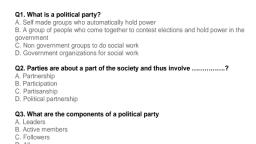
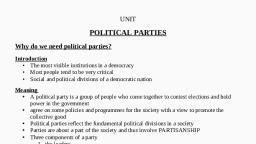
& myCBSEguide.com, , A Complete guide for CBSE students, , CBSE Class 10 Social Science, Revision Notes, Political Science Chapter-6, Political Parties, , Overview, , 1. In class IX, we noticed the role of political parties in the rise of democracies, in the, formation of constitutional designs, in electoral politics and in the making and working of, government., , 2. Before we concluding this tour, let us take a close look at the nature and working of, political parties, especially in our country., , Why do we need political parties?, , 1. Political parties are easily one of the most visible institutions in a democracy., , 2. Parties have become identified with social and political divisions., , 3. About hundred years ago there were a few countries of the world that had any political, party: Now there are few that do not have parties., , Meaning:, , 1. A political party is a group of people who come together to contest elections and hold, power in the government., , 2. They agree on some policies and programs for the society with a view to promoting the, collective good., , 3. Parties reflect fundamental political divisions in a society. Parties are a part of the society, and thus involve PARTNERSHIP., , 4. A political party has three components:, , I) The leaders,, , ID) The active members and, , II) The followers, , Functions:, , Material downloaded from myCBSEguide.com. 1/5
Page 2 :
& myCBSEguide.com, , A Complete guide for CBSE students, , Basically, political parties fill political offices and exercise political power. Parties do so by, performing a series of functions:, , (i) Parties contest elections. In most democracies, elections are fought mainly among the, candidates put up by political parties., , (ii) Parties put forward different policies and programmes and the voters choose from them., (iii) Parties play a decisive role in making laws for a country. Formally, laws are debated and, passed in the legislature., , (iv) Parties form and run the government. As we noted last year, the big policy decisions are, taken by the political executive that comes from the political parties., , (v) Those parties that lose in the elections play the role of opposition to the parties in power,, by voicing different views and criticizing the government for its failures or wrong policies., (vi) Parties shape public opinion. They raise and highlight issues. Parties have lakhs of, members and activists spread all over the country., , (vii) Parties provide people access to government machinery and welfare schemes, implemented by governments., , Necessity, , 1. We need political parties because they perform all these functions., , 2. The rise of political parties is directly linked to the emergence of representative, democracies., , 3. As we have seen, large scale societies need representative democracies., , 4. Political parties fulfill these needs that every representative government has., , How many parties should we have?, , 1. Ina democracy, any group of citizens is free to form the political party., , 2. In this formal sense, there are a large number of political parties in each country., , 3. More than 750 parties are registered with the Election Commission of India., , 4. In some countries, only one party is allowed to control and run the government. These are, called one-party system., , 5. In class IX, we noted that in China, only the Communist Party is allowed to rule., , 6. We cannot consider one party system as a good option because this is not a democratic, option., , 7. Any democratic system must allow at least two parties to compete in the election and, , Material downloaded from myCBSEguide.com. 2/5
Page 3 :
& myCBSEguide.com, , A Complete guide for CBSE students, , provide a fair chance for the competing parties to come to the power., , 8. In some countries, power usually changes between two main parties., , 9. But only the two main parties have a serious chance of winning the majority of seats to, form the government. Such a party system is called two-party system., , 10. If several parties compete for power, and more than two parties have a reasonable, chance of coming to power either on their own strength or in alliance with others, we call it, multi-party system., , 11. When several parties in a multi-party system join hands for the purpose of contesting, elections and winning power, it is called an alliance or a front., , 12. The multi-party system often appears very messy and leads to political instability., , 13. At the same time, this system allows a variety of interests and opinions to enjoy political, representation., , National political parties, , 1. Democracies that follow a federal system all over the world tend to have two kinds of, political parties: parties that are present in only one of the federal units and parties that are, present in several or all units of Federation., , 2. Every party in the country has to register with the Election Commission. While the Election, Commission treats all parties equally it offers some special facilities to large and established, parties., , 3. Parties that get this privilege and some other special facilities are ‘recognised’ by the, Election Commission for this purpose. That is why these parties are called, ‘recognised, political parties’., , 4. According to this classification, there were six national recognised parties in the country in, 2006. These are:, , I) Indian National Congress, , ID Bharatiya Janta Party, , II) Bahujan Samaj Party, , IV) Communist Party of Indian-Marxist, , V) Communist Party of India, , VI) Nationalist Congress Party, , State party, , Material downloaded from myCBSEguide.com. 3/5
Page 4 :
& myCBSEguide.com, , A Complete guide for CBSE students, , 1. Other than these six parties, most of the major parties of the country are classified by the, Election Commission as ‘State parties’., , 2. Parties like the, , T) Samajwadi party,, , II) Samata party and Rashtriya Janta Dal have national level political organization with units, in several states., , 3. Some of these parties like Biju Janta Dal, Sikkim Democratic Front and Mizo national Front, are conscious about their state identity., 4. Over the last three decades, the number and strength of these parties has expanded., , Challenges to political parties, , 1. All over the world, people express strong dissatisfaction with the failure of political parties, to perform their functions as well., , 2. The first challenge is lack of internal democracy within parties. All over the world there is, a tendency in political parties towards the concentration of power in one or few leaders at, the top., , 3. The leaders assume greater power to make decisions in the name of the party., , 4. Since one or few leaders exercise paramount power in the party, those who disagree with, the leadership find it difficult to continue in the party., , 5. The second challenge of the dynastic succession is related to the first one. Since most, political parties do not practice open and transparent procedures for their functioning, there, are very few ways for an ordinary worker to rise to the top in a party., , 6. The third challenge is about the growing role of money and muscle power in parties,, especially during elections., , 7. Rich people and companies who give funds to the parties tend to have influence on the, policies and decisions of the parties tend to have influence on the policies and decision of the, party., , 8. In some cases, parties support criminals who can win elections., , 9. The fourth challenge is that very often parties do not seem to offer a meaningful choice to, the voters., , How can parties be reformed?, , Material downloaded from myCBSEguide.com. 4/5
Page 5 :
& myCBSEguide.com, , A Complete guide for CBSE students, , 1. Let us look at some of the recent efforts and suggestions in our country to reform political, parties and its leaders:, , I) The Constitution was amended to prevent elected MLAs and MPs from changing parties., This was done because many elected representatives were indulging in DEFECTION in order, to become ministers or for cash rewards., , ID) The Supreme Court passed an order to reduce the influence of money and criminals., , III) The Election Commission passed an order making it necessary for political parties to hold, their organizational elections and file their income tax returns., , Besides these, many suggestions are often made to reform political parties:, , TI) Alaw should be made to regulate the internal affairs of political parties. It should be made, compulsory for political parties to maintain a register of its members., , ID It should be made mandatory for political parties to give a minimum number of tickets,, about one-third, to women candidates., , III) There should be state funding of elections. The government should give parties money to, support their elections expenses., , 2. These suggestions have not yet been accepted by political parties., , 3. There are two other ways in which political parties can be reformed., , 4. One, people can put pressure on political parties. This can be done through petition,, publicity, and agitation., , Material downloaded from myCBSEguide.com. 5/5