Page 1 :
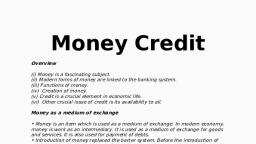
MONEY AND CREDIT, Barter System, • Goods are directly exchanged without the use of money., • Double Coincidence of wants is an essential feature of barter system., • Double Coincidence of wants: What a person desires to sell is exactly what the other, wishes to buy, Money as Medium of Exchange, • Money eliminates the need of Double Coincidence of wants by providing intermediate, step., • Since, Money acts as an intermediate in the exchange process, it is called a medium of, Exchange., Historical Forms of Money:, • Grains and Cattles, Metallic Coins-Gold, silver, copper coins., Modern Forms of Money, 1. Currency, • The paper notes and coins, • They are neither made up of precious metals nor used in day-to-day life like grain and, cattle, • They are accepted as medium of exchange because they are authorised by the, government of the country., • In India, the Reserve Bank of India issues currency notes on behalf of the central, government., • As per law, no other individual or organisation is allowed to issue currency., • Also the law legalise the use of rupee as medium of payment that cannot be refused., 2. Deposits with Banks, • People deposit the excess money with the bank by opening a bank account in their name., The deposits can be withdrawn on demand. Hence, it is called demand deposit., • By using cheques or other various means( Net Banking, UPI, Cards), the amount in the, demand deposits may be used as medium of exchange., • Hence, demand deposit is also considered as modern form of money., Loan activities of bank, • Banks keep only a small proportion of their deposits as cash themselves., • Banks use major portions of the deposits to extend loans., • In this way, banks mediate between those who have surplus money and those who are in, need of these funds., • Banks charge a higher interest rate on loans than what they offer on deposits., • This difference is their main source of income., Two different Credit Situations, 1. In some situations, credit plays a vital and positive role., • Credit helps in increasing the earnings
Page 2 :
2. In some situations, credit pushes the borrower into a situation from which recovery is, very painful., • Credit here worsen the borrower’s position and pushes her into debt trap., Terms of Credit, Comprises the following, 1. Interest Rate, 2. Collateral: an asset that the borrower owns (such as land, building, vehicle, livestocks,, deposits with banks) and uses this as a guarantee to a lender until the loan is repaid., 3. Required Documentation, 4. Mode of Repayment, They may vary depending on the nature of the lender and the borrower., Types of Credit, Formal Credit, RBI supervises these institutions, Reasonable rate of interest, Have to follow rules laid by RBI to lend and, recover the loans, Processing time for the loan is longer, Hard for the underprivileged people to access, , Informal Credit, No organisation to supervise, Higher interest rate, Uses unfair means to recover loans, Quick in processing loan, Main source of credit for the underprivileged, , Importance of Cheap Credit, • Higher cost of borrowing leads in reduction of income., • It also leads to the repayment would be higher than the income of the borrower in certain, circumstances. This will lead to Debt Trap., • This will stop people who wish to start an enterprise., • Hence, Formal sector credit needed to expand which will raise income and motivate people, to start and run businesses, small scale industries., • Hence, Cheap and affordable credit is crucial for country’s development., Formal and Informal Credit: Who gets what?, • The rich households are availing cheap credit from formal lenders whereas the poor, households have to pay a large amount for borrowing from the informal lenders., • The formal sector meets only about half of the total credit needs of the rural people., Ways to expand the formal sector credit, 1. Banks and cooperatives should increase their lending particularly in the rural areas, so, that the dependence on informal sources of credit reduces., 2. Everyone should able to receive the loans from the banks and cooperatives., Self Help Groups, • Absence of collateral is the important reason preventing poor from availing Formal, Credit., • Self Help Groups is a one of the solutions to address this problem., • A typical SHG has 15-20 members
Page 3 :
• They will save Rs.25-100 as per their ability., • Members can take small loans from the group itself to meet their needs., • After one or two years, the group will eligible to get a loan from banks as their savings, will become collateral. This will be further lend to its members by the SHG for various, purposes like releasing the mortgaged property, working capital, for housing material and, for acquiring assets like sewing machine, handlooms, cattle, etc., • The group decides as regards the loans to be granted — the purpose, amount, interest to, be charged, repayment schedule etc., • Further the banks are willing to lend members of the SHGs without collateral as if they fail, to repay, the other members will follow it seriously., • Importance, o Helps the poor to overcome the problem of lack of collateral, o Poor can avail cheap loan for various purpose on time., o They are building blocks of rural poor., o They help rural women to become financial self reliant., o The regular meetings of SHG help them to discuss various social issues like health,, nutrition, domestic violence, etc.