Page 1 :
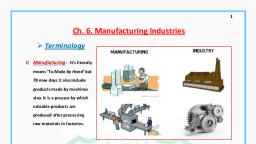
Page No. 1, Geography, Class 10th, , MANUFACTURING INDUSTRIES, , Q. What is meant by the term ’Industry’? What is the importance of industries?, Industry is the enhancement of the value of the raw materials through the, manufacturing process in a factory for instance, making cloth from cotton., Importance of Industries:i) The industrial products provide us with comfort., ii) They help in generating employment., iii) They help in the raising of the standard of living., iv) They help in increase the national income., Classification of Industires:Industries can be classified in to several groups. A brief account is given below:, On the basis of strength of Labour:a) Large-scale Industries. Industries which employ a large number of labour in, each unit, are called large – scale Industries. Cotton or jute textile industries are, large – scale industries., b) Medium – scale Industries. The industries, which employ neither a very large, number of labour nor a small number and have investment of about one million, rupees, are put in the industry, radio and television industries are some examples, of medium-scale industries., c) Small – scale Industries. Industries, which are owned and run by individual and, which employ a small number of labour, are called small –scale industries., Powerloom industry is an example of small scale industry., On the basis of Raw – Material and Finished Goods:a) Heavy Industries. Industries which use heavy and bulky raw – materials and, produce products of the same category are called heavy industries. Iron and steel, industry presents good example of heavy industries., b) Light Industries. The light industries use light raw-materials and produce light, finished products. They usually employ female labour. Textile industry, electronics, fans, sewing machines are light industries., Own the basis of Ownership:a) Private Sector Industries. Industries owned by individual or firms as Bajaj Auto, or TISCO situated at Jamshedpur are called private sector industries.
Page 2 :
Page No. 2, Geography, Class 10th, , MANUFACTURING INDUSTRIES, , b) Public sector Industries. Industries owned by the state and its agencies like, Bharat Heavy Electricals Ltd, or Bhilal Steel Plant of Durgapur Steel Plant are, public sector industries., c) Joint Sector Industries. Industries owned jointly by the private firms and a the, state or this agencies such as Gujarat Akalies Ltd., or Oil India Ltd., fall in the, group of joint sector industries., d) Cooperatives Sector Industries. Industries owned and run cooperatively by a, group of people who are generally producers of raw materials of the given industry, such as a sugar mill owned and run by farmers are called co-operative sector, industries., On the basis of source of Raw Material:On the basis of source of raw materials, industries are classified as under:, a) Agro – based Industries. Agro – based Industries are those indsustreis which, obtain raw – materials from agriculture. Cotton textile, jute textile, silk , sugar,, vegetable oil and paper industry are representative industries of agro-based group, of industries ., b) Mineral – based Industries. The Industries that receive raw materials primal fro, minerals such as iron and steel, aluminum and cement industries fall in this, category., c) Forest based industries. These industries draw their raw materials from the, forests. Paper, cardboard, lac, rayon, resin, tanning of leather, hide, leave –, utensils, basket industries are included in this type of industries., Miscellaneous Industries:, The industries are also classified in to the following categories., a) Village Industries. Village industries are located n villages and primarily cater to, the needs of the rural people. They usually employ machinery such as oil, extraction. Flour – grinding and agricultural implements., b) Cottage Industries. Industries which artisans set up in their own houses work, with wood, cane, brass, stone, etc, are called cottage industries. Handloom, Khadi, and leather work at the artisans house fall in this category., c) Consumer Industries. Consumer Industries convert raw materials or primary, products into commodities directly used by the people. Textile industry, bakeries, etc, are some of the consumer industries., d) Ancillary Industries. The industries which manufacture parts and components, to be used by big industries for manufacturing heavy articles like trucks, buses,, railways engines, and tractors are called ancillary industries.
Page 3 :
Page No. 3, Geography, Class 10th, , MANUFACTURING INDUSTRIES, , e) Basic Industries. Industries on which depend many other industries for their, manufacturing processes are called basic industries. Iron and steel industry and, power generating industry are included in this category., f) Capital Intensive Industries. Industries requiring huge investments are called, capital intensive industries. Iron and steel, cement and aluminium are capital –, intensive industries., g) Labour – Intensive Industries. Such industries as require huge labour force for, running them are called labour-intensive industries. In these industries, labour is, more important than capital. Shoe-making and bidi-manufacturing, etc., are, included in these industries., Q. Answer briefly the following:, i) Name three physical factors that affect location of industries., a) Availability of raw materials., b) Power resources and water and, c) Favourable climate., ii) Name three human inputs that control location of Industries., a) Labour, b) Market, c) Transport facilities and, d) Banking facilities and government policies (any three)., iii) What arelight industries?, Industries which use light raw materials and produce light good are called light, industries. Industries producing electric fans and sewing machine are examples of light, industries., iv) Name four important cotton textile centres of Maharashtra., Mumbai, Solapur, Pune, Wardha, Nagpur, Aurangabad and Jalgavn. (Any four, preferably first four), v) Why are most of the Jute mills of India located in West Bengal?, a) Location of jute producing area close to the jute mills;, b) Inexpensive water transport;, c) Cheap labour
Page 4 :
Page No. 4, Geography, Class 10th, , MANUFACTURING INDUSTRIES, , d) Banking, insurance and port facilities for export of just products., vi) Name two most important sugar producing states of India., Uttar Pradesh, Maharashtra., (Others Karnatka, Tamil Nadu, Andhra Pradesh and Gujarat), vii), , Name two iron and steel producing plants of Karnataka and west Bengal., , Karnatka – Visweshwaraya Iron and Steel Ltd., Bhadravati., West Bengal – Durgapur steel plants (British Collaboration), viii) Name five electronic goods producing centres of India:, Bangalore, Hyderabad, Delhi, Mumbai, Chennai. (Others : Kolkata, Kanpur, Pune, ,Licknow, colmbatore), ix) What is the annual production of cement in the country at present?, The annual production of cement in the country at present is 100 million tones., Q. Describe briefly the distribution of railway equipment industries in India., Equipment of rolling stock of railways consists of railway engines, wagons and, coaches. Their distribution is as under:, a) Railway engines are manufactured at chittranhan in West Bengal , Varsanasi in, Uttar Pradesh and Jamshedpur in Jharkhand., b) Railsw and sleeper bars are manufactured at iron and steel plants., c) Coaches are manufactured at Perambure, Banglore, Kapurthal and Kolkata., d) Wagons are produced in private sectors and railway workshops., Q 3. Why is the iron and steel industry located in peninsular India only:, Iron and steel industry is mainly located in peninsular India for the following reason., a) Neamess of raw materials: Large quantities of raw materials are needed for iron, and steel quantities in peninsular India., b) Power resources: coal, oil and water power are available in peninsular India., c) Skilled labour: Cheap and skilled labour is available .it can be also had from, Bihar Orissa, West Bengal and M.P. Besides skilled labour is also locally available., d) Nearness to market: besides large indigenous market, port facilities are available, for the export of iron and steel manufactured goods., e) Early start : there was an early start of this industry in the peninsular India., Hence it picked up momentum there.
Page 5 :
Page No. 5, Geography, Class 10th, , MANUFACTURING INDUSTRIES, , f) Climate for this industry in peninsular India is suitable., Q 4. Describe briefly the distribution of silk textile industry in India., India well known fro the production of silk and silk goods produces four varieties of silk, namely mulberry, tusar eri and muga. There are about 90 silk textiles mills in India,, besides small and medium units engated in the production of silk textiles. More than, nine-tenths (out of 8.5 lakh kg of silk yams) of the production comes from Karnataka,, West Bengal, Jammu and Kashmir., Main Silk manufacturing centres are:, a) Karnataka : Bangalore , Kolar, Mysore and Belgaun., b) West Bengal : Murshidabad and Bankura;, c) Jammu and Kashmir : Anantnag, Baramulla and Srinagar., Q 5. Describe the distribution of ship building industry in India., Ship building is a large industry which requires large capital., a) At present there are five major shipbuilding centres in India. They are, Visakapatnam, Kolkata, Kochi, Mumbai and Mainmagao . They are all in public, sector., b) Private sector shipyards look after the local needs. Large ships take years to, complete once the work begins., c) The maximum ship that ca be constructed at Kochi and Visakhapatnam are, 10000 dead weight tonnage (DWT) and 50000 DWT respectively., d) For repair of ships there are 17 dry docks in India., Q 6. How does industrial pollution degrade environment?, Manufacturing industries are the main polluters and degraders of environment,, Industries create fourtypes of pollution namely air, water, land and noise., Role of Industries in Air Pollution., a) Smokes emitted are the main pollute air and water very badly., b) Air pollution is caused by the presence of a higher proportion of undesirable gases, such as carbon monoxide and sulphur dioxide, which is found in smoke emitted, by industries., c) Dust, fuma mist, spray and smoke which contain both solid and liquid particle are, air. Born particulate materials which pollute the air., d) Human made sources of pollutants are normally industrial and solid wastes,, which have their share in the pollution of air.
Page 6 :
Page No. 6, Geography, Class 10th, , MANUFACTURING INDUSTRIES, , Role of Industries in Water Pollution., a) The smokes emitted by the industries pollute water very badly., b) The second is industrial effluents that are discharged tint rivers. They are both, organic and inorganic., c) Coal, dyes, pesticides, fertilizer, plastics and rubber are some common pollutants, in water., d) The principal industries which create water pollution are paper pulp, textile,, chemical, petroleum refining, tannery and electroplating., Role of Industries in Land Pollution., a) Industrial wastes containing toxic metals pollute land and soil., Role of Industries and means of Transport., a) Noise pollution arisis primarily form industries and means of transport., b) Industrial noise particularly from mechanical saws and pneumatic arms is, unbearable and is a nuisance to the public. Noise causes impairment of hearing., Q. What is the meaning of chemical Industry? Write two points regarding the, importance of chemical industry., The industry which deals with the production of various chemicals like drugs, dye,, stuffs, particles. Paints and plastic etc., is called the chemical industry. The chemical, industry is the fourth biggest industry in size next to iron and steel, engineering and, textile. India manufacturing different chemicals like dry, dye , stuffs, pesticides, paints, and plastic etc. pesticides are an important input in agriculture. These day, petrochemicals are substituting raw materials like glass, wood and metal. They are used, in domestic agricultural and industrial fields. Plastics have played a tidal role in, industrialization. We are deriving thousand of products from crude petroleum such as, lubricating oil, diesel oil, kerosene, cooking gas, petrol, neptha, spirit, nylon, polyester., Etc, petrochemical industry is chiefly located near Mumbai and Vadodara., Q. Short not on Sugar Industry., Importance of sugar Industry:- In Sugar , Khandsar and gur or jaggary production, put together. India leads the world. In sprite or all this, our consumption of sugar, exceeds our production. So we have to import sugar. As it involves the depleting of our, foreign exchange resources, so we should be economical in its use., Q. Why is iron and the steel industry located around the Chotanagar Plateau?, Iron and steel industry is located near the iron and steel deposits of Jamsjhedpur, in Bihar of the Chotanagar plateau (bordering W. Bengal, Bihar, Orissa and M.P), because of the following reasons:
Page 7 :
Page No. 7, Geography, Class 10th, , MANUFACTURING INDUSTRIES, , a) All the essentials raw materials (iron-ore, cooking coal and lime stone) are, available in the area., b) Since all the raw materials of this industry are heavy and bulky, so its location is, governed by the close proximately to raw materials., c) There is a network of railways and roads in this area. So finished goods can easily, be distributed within the country and also exported to other countries., d) Labour, power and banking facilities are also available in this area., Q. how would you distinguish between Primary and Secondary Industries?, Primary Industries:, i., , It is an organized human effort to obtain the products provided by nature., , ii., , These industries include mining, cattle rearing, farming, lumbering, fishing, dairy, –fishing etc., , iii., , We do not pay anything to nature for the products. These products off this, industry are called as primary products like cotton, jute , sugarcane etc., , Secondary Industry:, i. It is an organized human efforts where the primary products are converted into, secretary ones by making them more useful and refined, value added products., ii. These industries include iron and steel industry, sugared, cotton textile, jute and, paper industry., iii. Huge investments are made in secondary industry., Q. Distinguishes between public sector and private sector industries with suitable, examples., Public Sector Industry:i. These are industries which are either nationalized or owned by the government of, the country., ii. Indian railways. Oil India Ltd., steel plants at Bhilai, Bokar, Durgapur etc are good, examples of these industries., iii. All or more than 50 % of the capital is invested by the government., Private Sector Industry:i. These industries are owned by individuals, groups of individuals or firms., ii. Tata Iron and steel industry, D.C.M. Biria Mills, are good examples of these, industries.
Page 8 :
Page No. 8, Geography, Class 10th, , MANUFACTURING INDUSTRIES, , iii. All the capital is invested by the individuals or private firms. All the profit goes to, the owners and they pay all the debts incurred by the industries., , Q. Distinguish between Large scale and Small scale industries. Large Scale, Industries:i. These industries manufacture large quantities of finished goods., ii. In these industries quantity of raw material and capital investment is very large., iii. Woman workers are not generally employed in these industries., iv. Iron and steel, cotton textile, cement are such industries., Small Scale Industries:i. These industries manufacture small quantities of finished foods., ii. No huge quantity of raw material and capital is required in these industries., iii. Woman workers are employed in large number., iv. Garment industry, soap making, hosiery, television, radio industries are such, industries., Q. Distinguish between Agro-based and Mineral–based industries and give one, example of each., Agro – based industries:, i. These industries derive their raw materials from agriculture., ii. They provide employment in rural areas., iii. They mostly produce consumer goods., iv. Example: Textile, sugar, Jute, vegetable oil, plantation industries., Mineral - based Industries:, i. These industries derive their raw materials fro minerals., ii. They provide employment both in rural and urban areas., iii. These produce both consumer and value based goods., iv. Example: Iron and steel, engineering industry, ship building, machine tools etc., Q. Note on the Aluminium smelting industry in India.
Page 9 :
Page No. 9, Geography, Class 10th, , MANUFACTURING INDUSTRIES, , i. Aluminium smelting is the second important metallurgical industry of India., Because of its flexibility and good conductivity of electricity and heat. Aluminium is and, universal accepted metal for a large number of industries., ii. Aluminium is gaining popularity as a substitute to steel , copper, zinc and lead in, number of industries., iii. For the production of one tone of Aluminium approximately 6 tonnes of baxi and, 18600 kwh of electricity are needed. Electricity alone snares 30 to 40 percent of the, production cost. This indicates that location of the industry is influenced by the, availability of bauxite and inexpensive electricity., iv., , Jharkhand and Orissa share over 58 percent of bauxite production for India., , v., There are 8 Aluminium plants in the country today. They are located in Orissa W., Bengal, Kerala, Uttar Pradesh, Chhatisgarh, Maharashtra and Tamil Nadu. These, together produce about 620 thousand tones of Aluminium per annum., Q. Note on the copper smelting industry in India., i., , The copper smelting plant in India was set up by the Indian copper corporation at, Ghatshila in Jharkhand. The Hindustan Copper Ltd. Took over the Indian copper, corporation in 1972 and since then it is the sole producer of copper in the country., , ii., , This industry has two centres at Manbhandar near Ghatshilla in Singhbhum, district and the other at Ketri in Jhunjhunu district of Rajasthan. Copper ore, obtained form the mines of those districts, where the plants there smelting are, located., , iii., , Malankhand mines of Balaghat district (M.P) supplement the supply of copper ore, to Khetri., , iv., , A new copper project based on importedon is being setup at Tuticorin in Tamil, Nadu., , v., , India produces 43 thousand tones of copper bhisier (partly purified) which is only, half of the requirement and the remaining half is imported from Zambia, Chila,, United States of America and Canada., , Q. Describe the growth and distribution of Fertilizer industry in India., i., , The first fertilizer plant in India was setup at Ranipat in Tamil Nadu in 1906. The, real growth of the industry began with the establishment of a plant at sindri by the, Fertilizer d Corporation of India in 1951., , ii., , The increased demand of fertilizer as a result of Green REvoluiton led to the, spread of this industry in several parts of india., , Distribution:
Page 10 :
Page No. 10, Geography, Class 10th, , MANUFACTURING INDUSTRIES, , i. Gujarat, Tamil Nadu, Uttar Pradesh, Punjab and Kerala produce more than half of, the total fertilizer production in India., ii. Andra Pradesh and Karnataka are other important producers., iii. Because of the easy availability of natural gas the fertilizer industry is widely, spread in the country., Production:, India produces about 1 million tones of nitrogenous, 4 million tones of phosphatic, and 1.7 million tones of potassic fertilizers. The country is required to import potassium, from abroad., , Q. Describe the importance, distribution and production of cement industry in, India., Cement is essential for building houses , factories, road and dams., Requirement of Industry:, i. Manufacturing of cement requires heavy materials like limestone, silica, alumina, and gypsum and hence this is a raw material oriented industry., ii. Coal and electric power are its other requirements., Q. Short note on the industry connected with road transport., Road transport is far more wide spread than the railways., i. At present commercial vehicles like trucks, passenger buses, cars, motor cycles,, scooter etc. are manufactured in large numbers., ii. India is second larges producers of three wheelers in the world., iii. Tractors and bicycles are also manufactured in large number/., iv. India currently produces about 15 million bicycles and 3.8 million scooter and, motorcycles in a year., v. The industry is widely distributed around Delhi, Gurgaon, Mumbai, Puna,, Chennai, Kolkata, Lucknow, Indore, Hyderabad, Jamshedpur and Bangalore., Q. Short note on the aircraft industry in India., i. India has not yet entered into civil aircraft industry., ii. But for defence requirement we have developed aircraft industry at Bangalore,, Koraput , Nasik, Hyderabad, Kanpur and Lucknow, each place specializes in the, manufacture of a certain type of aircraft.
Page 11 :
Page No. 11, Geography, Class 10th, , MANUFACTURING INDUSTRIES, , iii. India manufactures jet trainer planes and helicopters also., , ☺☺☺☺☺☺☺☺☺☺☺ End of the Lesson☺, ☺☺☺☺☺☺☺☺☺☺☺