Notes of 10th, Social Science & Hindi Globalization and Indian economy.pdf - Study Material
Page 1 :
. GLOBALISATION AND THE, INDIAN ECONOMY, , , , SUMMARY, , Indian market has changed completely since the last few years. In the world today the, consumers have a wide choice of goods and services: Globalisation is the main reason for it., , For a single product or service, there are ‘n’ number of brands that have cropped up and, competition has lent customers with the best of services at best possible pricing., , Production Across Countries ;, , , , , , * With the beginning of imperialism and colonialism in the late nineteenth and early, twentieth centuries, trade between countries commenced., , * Colonies used to supply the mother country with raw materials, labour and requisite, capital for economic activities, Trade, thus, became the link bétween countries., , * Post-imperialism and with the changed global equations, several multi-national, companies (MNC’s) emerged on the scene., , ¢ An MNC is a company: that owns or controls production in more than one nation., , Interlinking Production Across Countries, , * There are multiple factors that determine the investing destinations for MNC’s., Countries that are strategically located with proximity to markets, where skilled, and cheap labour is easily available; where government policies are favourable to, businesses; and where other favourable factors are existent, become favourable for, investments by MNC’s or foreign investments. i, , * Investment made by MNC’s is called foreign investment which can-take place in, different ways like start a unit of production, collaboration with the local firms, buy up, the local companies, join venture etc., , * With these high levels of profit making, certain MNC’s across the globe have gathered, huge wealth, influence and power., , ¢ Another way of controlling production by the MNC’s is to outsource the production, activities to smaller firms abroad. ‘, , Foreign Trade and Integration of Market :, , * As mentioned earlier, foreign trade was the main channel that came to connect, countries lying at a distance., , * In today’s world, foreign trade provides MNC’s with opportunities to cater to the, demands generated beyond domestic markets,, , * It also supplies the customer with multiple choices in terms of products at their ease of cost., , w
Page 2 :
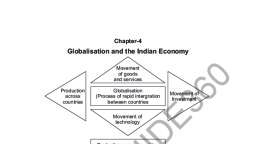
”. Thus, forei t MODAN SAO ANG Ue UIA GUI UEy ems, s tr ° . . . ‘, ’ ign trade leads to the integration of markets across countries and gives rise, , to competing production centres,, , What is Globalisation? ;, Globalisation, , {, , It is the rapid integration or interconnection between countries, , |, y y y ] |, , Flow of capital Migration of Sharing Integration Improvement, from one country people from techniques of markets, in, to another one country of investments technology, ‘to another production, , Factors that have enabled Globalisation, , * Improvement in technology has emerged as one of the major driving forces behind, rapid Globalisation., , * If we look around ourselves, we can clearly see how the changes in transportation, mediums and connectivity has led to better standards of living for the masses at, large. With easily available cab services at the doorstep, commuting distances in a, sustainable manner has become a possibility in daily life., , * Moreover, betterment in the Information and Communication Technology (ICT) sector, has reduced the time taken for an interaction. The facilities of email and telephonic, conversations has eased the business as well as personal life communications., Computers have come to dominate each and every aspect of our lives. The world of, internet has made cultural transformations across nations., , ¢ If these mediums are utilized in the correct manner, they can open up a world of, opportunities for an individual coming from marginalized sections of the society., , Factors that have led to Globalisation, , t, 1, , , , , , - ‘Technology Liberalisation, Liberalisation, sport, (1) Gols delved fast and at (1) Removal of trade barriers by the, | 1 ‘ost government, | ow c (2) Less interefrence by government, , (2) Container services have reduced, , post handling costs, (3) Cost of the transpor, e¢ Communication, (i) Mobile, fax, computers, internet, Liberalisation of Foreign Trade and Foreign Investment Policy, rade are imposed by the governments world over in order to, , regarding imports and exports, t has fallen, , 4 £5 a, * Barriers or restrictions 0, , nT ETI IETS FEET FY ere
Page 3 :
PRES NELLIS SONATE SS BREN BNP PIT WF USES NIN SETTLED Dance reg eT TTD, , , , TAT, save their respective economies. These policies are referred to as the trade barriers. The, taxation on imports is one such trade barrier., , Governments have the right to impose trade barriers to determine and control the, , goods entering their territories and the manner in which trade is conducted with other, countries. ,, , All developed countries at the budding stage of their economies adopted such policies, to provide protection to their domestic producers. Once the domestic producers became, well to do, gradually such barriers were lifted., , Around 1991, some economic reforms were undertaken by the Government of India, (Gol). The time was considered ripe for the Indian markets to be opened up to foreign, competition. This decision. received encouragement from influential international, organizations. Barriers to foreign trade and foreign investment were removed to a, large extent., , Removing restrictions or barriers set up by government from foreign trade and foreign, investment is known as liberalisation., World Trade Organisation :, , * The World Trade Organization (WTO) played a very important role in the policy move, towards liberalisation in India and many countries across the globe, , « WTO was established at the initiative of the developed nations with the aim of, liberalizing international trade and commerce. As on June 2016, nearly 165 countries, were member states of the WTO., , * Though the organization allows free trade for all, there are limitations in the ways it, , , , , , , , , , works., SPECIAL FEATURES OF WTO, (World Trade Organisation), AIM. To liberalise international trade., FOUNDED An initiative of the developed countries., FUNCTION Establishes rules regarding international trade and sees, , that they are obeyed., DRAWBACKS (1) It is seen that developed countries have retained, trade barriers., , (2) They have forced the developing countries to remove, the trade barriers., (3) Biased towards developed countries., , Impact of Globalisation in India:, * Of late, Globalisation has made in-depth roots in the Indian economy., , * Consumers have greater choices to make, with improved quality of products at 4, cheaper rate, thus, improving the standard of living for a large number of peopleHowever the impact of Globalisation is not uniform across segments., , ¢ On the side of producers, the MNC’s have increased their investments into the countty, , , , , , , , , , , , Ml
Page 4 :
across sectors. This has led pee ee samen ae, companies have reaped gre, men of jobs for the people. Several top notch Indian, are operating in different « a benefits due to increased competition. Our companies, especially in the service a a pitta abroad. Companies running domestic operations,, go global. The Gove: nd IT sector, have been provided with immense opportunities to, , tnment of India has taken several steps to attract foreign investment., , The struggle for a fair Globalisation, * Since Globalisation has not affé, affected everyone equally, therefore, people who have been, hit hard need to be given fair opportunities. “ee ™, ¢ The government needs to play a lead role in creating such opportunities., + People, on the other hand, can also play a crucial role in achieving a fair globalized world., , ¢ The former can create a conducive environment by taking positive policy reforms, and supporting small producers. It can negotiate with organizations like WTO for, fairer rules. The latter, by being more aware and responsive, can demonstrate,, campaign and represent their grievances and fight for their rightful shares., , . Such a fair globalized world will ensure that every individual gets his/her due share of, opportunities created by integrated production and integrated markets., , , , 1. Globalisation : The rising interconnectedness of people, goods and services across, the globe through increased trade, investment and ideas., , 2. Multinational Corporations (MNC’s) : Organizations that have control or ownership, of production of goods and services in two or more than two countries., , duction : A system of production wherein different segments, , 3. Integration of pro d I, d out at different places with the end of satisfying the target, , of production are carrié, customer., 4, Integration of Markets : A system of economy whereby distant markets get, , interconnected and follow similar patterns of pricing, quality, etc., , 5. Liberalisation of trade A, are reduced and a free-hand is, , policy of governance wherein trade barriers or restrictions, given to the exchange of goods and services., , : szation (WTO) : An influential international organization with, 6. World Trade Organiz aim is to fair and liberalize international trade., , 165 member states whose . !, 7. World Bank : An international organization that provides loans to different countries, . WOr) 3 :, , of the world for developmental purposes. . |, , abour Organization (ILO) : An international organization that, , to workers, employers and governments so that uniform and fair, red across the globe., , A service provided by the producer via an IT application that, , 8. International L, lends an equal voice, labour laws are ensu, , 9. Payment Gateway ene, aut ine payment transaction,
Page 5 :
10. Beewivukton ‘is a SS, * It 1s a process of assembling various materials to create an end-product, , or service for consumption., , Ll. Cost Savings : A reduction in expenses, especially cutting the costs of production, for businesses., , 12. Domestic Markets : Markets lying within defined territories of a nation., 13. Foreign. Trade : Foreign trade is a process of buying and selling goods and services, from one country to another., , 14, Telecommunication facilities : Facilities that are able to contact each other around, the world, to access information instantly, and to communicate from remote areas., 15, Electronic Mail/e-mail : Transmission of messages over communication networks., , 16. IT Sector : Information technology sector consists of IT services and BPO. It has, played a major role in spreading the production of services globally., , 17. Economic Reforms : The policy changes introduced by the government to bring more, transparency, competitiveness and market driven forces into the economic functions., 18. Trade Barrier : Restrictions imposed by governments of countries over imports and, exports of goods and services., , 19. Domestic producers : Producers who cater goods and services to fulfil the needs, and demands of the domestic consumers., , 20. Call Centre : A centralized office catering to the requests of consumers over, telephone. For example, mobile networks like BSNL have call centres., , 21. Business Process Outsourcing (BPO) : It is a form of outsourcing wherein the, operational responsibilities of a firm are given to a third-party service provider., , 22. Balance of Trade : The difference between the value of a country’s imports and, exports over a given period of time., 23. Demographic Dividend : The growth in the economy of a nation in relation to its, , population., 24. Lobbying : Representation of interest in terms of policies, decisions or exerting, , influence in actions.



 Learn better on this topic