Page 1 :
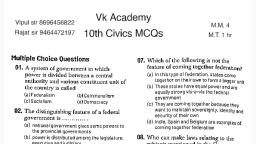
Objective Questions, , Multiple Choice Questions, , 01. A system of government in which, power is divided between a central, authority and various constituent unt, , the country is called, (a) Federalism, {c) Socialism, , 02. The distinguishing feature of a federal, government is ......-.++++ ., , (b) Communalism, (d) Democracy, , (a) national government gives some powers to, , the provincial governments, , (b) power is distributed among the legislature,, , executive and judiciary, , (c) elected officials exercise supreme power, in the government, , (d) governmental power is divided between, different levels of government, , 03. Which country is an example of coming, , together federation?, (a) Belgium (b) USA, (c) Sri Lanka (d) India, , 04. Belgium shifted from a unitary form of, government tO ....-e eee ‘, , (a) Democratic (b) Federal, ({c) Authoritarian (d) Communist, , 05. In unitary form of government, , (a) all the power is divided between the, centre/union and the state provincial, government, , (b) all the power is with the citizens, , (c) State Government has all the powers, , (d) power is concentrated with the Central, Government, , 06. Which countries follow the unitary, , system of government?, , (a) Belgium, Spain and India, , (b) USA, Japan and Belgium, , {c) United Arab Emirates, China and Sri Lanka, (d) France, Germany and India, , it of, , , , , , , , , , , , , , , , , , , , , , , , , , , , 07. Which of the following is not the ., feature of coming together feder,, (a) In this type of federation, states oo,, together on their own to forma bigge, , (b) These states have equal power and, equally strong vis-a-vis the federal —, government ee, , (c) They are coming together because tp,, want to maintain sovereignty, identity, security of their own, , (d) India, Spain and Belgium are exam, coming together federation, , , , , , 08, Who can make laws relating to thea, subjects mentioned in the Concurrent, List?, (a)Local Government (b) State Govern;, (c)Union Government —(d) Both(b) and{e), , 09. Which level of government has, power to legislate on the residt, subjects?, , (a)Union Government — (b) State Governn, (c)Local Government —(d) Both(a)andlb, , If there is a clash between the laws —, made by the state and centre ona 3, subject in the Concurrent List _, (a) The central law prevails, , (b) The state law prevails ‘, (c) The Supreme Court has to intervene @, , 10, , decide ., (d) Both the laws prevail in their respet, jurisdiction ., , 11, , Choose the incorrect stateme?, , (a) Usually a federation has two levels, governments 3, , (b) Both the levels of governments, powers independent of one ano, , (c) Ina federal system, a State GOV, has powers of its own, , (d) Ina federal system, the Sta, is answerable to the Centra, , te GO", | Gov, , Scanned with CamScanner
Page 2 :
er., , &, , -pNew Pattern ~ Social Science Class 10th (Term 1) 49, , , , gone, , , , : . Consider the following statements,, , Ina federation, the power of the, federal and provincial governments, are clearly demarcated,, , India is a federation because the, powers of the Union and State, Governments are specified in the, Constitution and they have exclusive, jurisdiction on their respective subjects., , , , C. Sri Lanka is a federation because the, country is divided into provinces., , D. India is no longer a federation, because some powers of the states, have been devolved to the local, government bodies., , Which of the statements given above, are correct?, , (b)A, Cand D, (d)Bandc, , | 13. Which is true regarding sources of, , i revenue in a Federal system?, , have no financial powers or, , dent sources of revenue., , ependent for revenue or funds, , ntral government., , s of revenue for each level of, , 3 nment ere clearly specified to ensure, financial autonomy., , {d) Stetes have no financial autonomy., , , , , , , , , , 14, Find the incorrect statement, , __(é) Evenin democracy, the Constitution can be, , misused., , janisation, Central Government, , 's its power with State Governments., , ) In coming together federation, all the, Constituent states have equal powers., , __ (9) Panchayati Raj is an example of people's, , e. direct participation in decision making., , , , , , , , , , Adentify the correct option of power, , ‘Sharing on the basis of different levels, of government. (CBSE 2020), , (8) Among different pressure groups, , . b) Among different social groups, , (0) Legislature, Executive and Judiciary, , (d) Union Government, State Government and, _ Local bodies., , , , , , 16. The first'and major test for democratic, politics in our country was, (a)caste problem, (b) language problem, {c) problems related to Union Territories, (d) creation of linguistic state, , 17. Which language has status of the, national language in India?, (a) Tamil (b) Hindi, , (c) English (d) None of these, , 18. The state which violently demanded, that the use of English for official, purpose should be continued, is, , (a) Kerala, , (b) Karnataka, , (c) Tamil Nadu, , ({d) Andhra Pradesh, , 19. How many languages are included in, the Eighth Schedule of the Indian, Constitution?, , (a)15 (b)20 (c)22 (d)25, , 20. Which of the following reactions to the, , language policy holds true in the case, of India?, , (a) The language-based states have divided us, as they make everyone conscious of their, language, , (b) The policy of accommodation has, strengthened the national unity, , (c) The language policy has helped to, consolidate the dominance of English over, all the other languages, , (d) All of the above, , 21, , Consider the following statements, regarding language policy of Indian, Federation., , A. Hindi was identified as the official, language., , B. Besides Hindi, there are 21 other, languages recognised as scheduled, languages., , C. English can be used along with Hindi, for official purpose,, , Scanned with CamScanner