Page 1 :
CHAPTER 1., DEVELOPMENT., (Understanding, economic development.II), Meaning :, Development means continuous progress or increase in per capita, income. In other words there is improvement in the economic welfare of the, people and their standard of living., Characteristics Of, Development., 1. Developmental goals are different for different people., 2. What may be development for one may not be development for the, other., 3. For development people look at a mix of goals., 4. Different persons could have different as well as conflicting notions of, country's development., Types of Development, Goals., 1. Common Goals., There are some needs which are common to all like income, freedom,, equality, security, friendship, etc., 2. Different Goals., Development or progress does not mean the same thing for every, individual. Each individual has his own idea of development. For example,, development for a farmer might be irrigation facilities, for an unemployed, youth it may mean employment opportunities, etc., 3. Conflicting Goals., What may be development for some may become destruction for some, others. For example, industrialists may want dams for electricity but such, dams would displace the natives of a region by submerging their land., Different persons have different notions of development or progress., It is because different people have different lifestyles., People seek things that are most important for them i.e. Which can fulfill, their aspirations or desires., Income And Other Goals.
Page 2 :
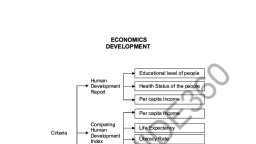
The quality of our life depends on both national and non national, goals that are not easily measured but means a lot to our lives., People look at a mix of goals for development., The developmental goals that people have are not only about better, income but also about other important things in life., UNDP compares countries on educational level, health status and per, capita income whereas the World Bank uses only per capita income, for measuring development., How to compare different countries or state., * Depending upon the purpose of comparison, we use different, parameters or criteria., * For comparing countries their income Is considered to be one of the, most important attributes., * Countries with per capita income of ₹4, 53,000 per annum and above, in 2004 are called rich countries and those with per capita income of, ₹37,000 or less are called low income countries., * India is included in low income countries., *Total income is the income of all the residents of the country., *Today 2019 -20 India falls under the middle- lower income category, prescribed by the World Bank., * Per capita income of India is estimated in 2020 - 2021 falls under, 86,000 to 90,000 according to IMF world Economic Outlook., Limitations of the criteria used by the World Bank., It does not tell us about how this average income is distributed, among the people in the individual countries., Two countries with the same per capita income might be very, different with regard to income distribution. One might have an, equitable distribution of income while the other might have great, disparities between the rich and the poor., Economic Development refers to the rate of production is greater, than the rate of increase in population and the rate of growth of GDP, is high enough to fulfill the basic needs of the population. Two bases, of measuring development of a country are:, 1).Per capita income or average income 2).National income and, public facilities.
Page 3 :
UNDP: United Nations Development Programme, It has used the criteria of the Human Development Index to measure, the development of countries. HDI is calculated on the basis of:, * Per capita income, * Life expectancy, *Literacy rate, *Gross and rolement, ratio, *Health status., Per Capita Income:, It is an income earned per person/per head of the population in an, area per year., Average Income:, Average income is the total income of the area divided by the number, of people., Life Expectancy., It can be defined as the average expected length of life of a person., Net Attendance Ratio., It can be defined as the total number of children of 6-14 years age, group attending the school out of the total number of children in the, same age group., Literacy Rate., It can be defined as the proportion of literate people (who can read, and write) population in the age group of 7 years and above., Infant Mortality Rate., It can be defined as the total number of children that die before the, age of one year out of 1000 live children born in that particular year., BMI: Body Mass Index., It can be calculated by taking the weight of a person (in Kg) and, height( in mts) and then dividing the weight by the sq. of the height of, the person., SustainableDevelopment.
Page 4 :
Sustainable development may be defined as development that meets, the needs of the present generation without compromising the ability, of the future generations to meet their own needs., Features., 1). It is linked to sustainability since it has to be maintained for future, generations., 2). Resources need to be used wisely so that they can be replenished., For example, if trees are cut they should also be re-planted and, allowed to grow., 3). Overuse of resources which exhaust them for example, petroleum., If it is used indiscriminately, it will soon get finished and future, generations will have nothing left in their hands., 4). If development is not sustainable, it will give rise to environmental, degradation and become a global problem., 5). People must be protected against pollution, thereby ensuring their, quality of life and health., Importance., Sustainable development is important for economic growth because., 1) Environment must be conserved while development is taking, place., 2) Resources must be used in such a way that something is, conserved for future generations., 3)The standard of living of all people must be raised., Measures to ensure sustainable development., 1).We should focus on using renewable resources and keep inventing, new techniques to decrease the use of conventional resources., 2). The present resources must be used judiciously, with planning,, and over exploitation should be avoided., Consequences of environmental degradation do not respect national, or state boundaries. This issue is no longer a regional or national, issue. Our future is linked together. The sustainability of development, is essential for all mankind and it is our common responsibility to, save the environment. These days, it is a matter of discussion among, different countries of the world. Global warming, acid rain, pollution, etc.are Global matters of thinking and finding the solutions.