Page 1 :
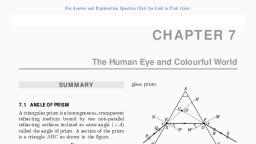
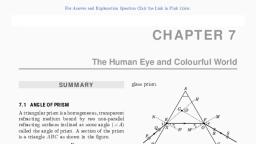
11. Human Eye and Colourful, World, PDF, Notes & Study Material Chapter 11, Hints to Long Answer Type Questions, 1. (a) (i) Increases, (ii) Decreases, (b) (i) Cones, (ii) Rods, 2. Labelled diagram of eye, 3. A person can see nearby objects clearly but cannot see distinct objects, clearly., Reason :, (a) Elongation of eye ball., (b) Excessive curvature of eye lens., Diagram of myopic eye and correction using concave lens., Prism : It is a pyramidal piece of glass with two triangular bases and three, rectangular lateral surfaces., Angle of Prism : The angle between two adjoining lateral surfaces., Angle of prism, Refraction through a glass prism, E, Angle of, deviation, N', M', Emergent ray, Incident ray, Glass prism, D, A, Q, Angle of deviation (d) : It is the angle between incident ray and emergent, ray., Science Class- 10 (SA - II), 1
Page 2 :
11. Human Eye and Colourful, World, PDF, Notes & Study Material Chapter 11, White screen, S, Least deviation, Red, B., A beam of, white light, orange, Yellow, Green, Maximum, deviation, Blue, Indigo, Violet, 4., (Sunlight or Bulb light), R, When white light is passed through a glass prism, it splits into its seven, constituent colours to form a band of seven colours. This phenomenon is called, dispersion., Spectrum : The band of seven colours formed due to dispersion of white, light is called spectrum., Acronym : It is a group of alphabets that represent sequential colours in, spectrum., VIBGYOR, Angle of deviation oc, 1, wavelength, Red is the least deviated colour as it has largest/longest wavelength., • Violet is the most deviated colour as it has smallest wavelength in visible, spectrum., Q. Why spectrum is formed when white light is passed through a glass, prism ?, Ans. Each colour has a definite wavelength and for each wavelength the, angle of deviation differs. Red is the least deviated and violet is the most deviated, colour so different colours deviate at different angles to form spectrum., P Q', R', Patch of, white, light, Recombination, White light, White light, Second, prism, Dispersion, White, screen, Q, First prism, Light of, seven colours, The Human Eye and the Colourfur world, 2
Page 3 :
11. Human Eye and Colourful, World, PDF, Notes & Study Material Chapter 11, Issac Newton was the first person who proved that sunlight is made up of, seven colours :, (i) He passed sunlight through a glass prism to form a band of seven, colours., (ii) He tried to split the colours further by putting another prism ahead of, the prism forming spectrum but he failed to obtain more colours., (iii) He formed a spectrum from sunlight and placed an identical but inverted, prism in front of prism forming the spectrum. All the seven colours, combined by the inverted prism and emerged as white light., Q. What is referred as white light ?, Ans. Any light that forms a spectrum similar to that of sunlight is referred, as white light., Total Internal Reflection, When light enters obliquely from a denser medium to a rarer medium and the, angle of incidence exceeds critical angle, the light reflects in the denser medium., This is called internal reflection., Denser, medium, Rarer, medium, i = critical, angle, Conditions necessary for Internal Reflection, (i) Light should enter obliquely from a denser to a rarer medium., (ii) The angle of incidence should exceed critical angle, the light reflects in, the denser medium., Critical angle : The angle of incidence for which the angle of refraction is 90°., Rainbow : It is a natural spectrum appearing in the sky after rain showers., Science Class - 10 (SA- II), 3
Page 4 :
11. Human Eye and Colourful, World, PDF, Notes & Study Material Chapter 11, Q. Why the colour of sky appears blue on a clear day ?, Ans. The upper layer of atmosphere contains very fine particles of water, vapours and gases. These particles are more effective in scattering of light of, shorter wavelength mainly blue than larger wavelength. So, the sky appears blue., Q. How does the sky appear to an astronaut in the space or to a passenger, of jet plane flying at high altitude ?, Ans. The sky would appear dark to an astronaut in the space as scattering is, not very prominent at such high altitude due to absence of particles., Q. Why clouds appear white ?, Ans. Clouds are formed by water vapours. Water vapours condense to form, water droplets due to larger size of droplets, all colours of light are scattered and, clouds appear white., Q. Why colour of sun appear red during sunrise and sunset?, Ans. While sunset and sunrise, the colour of the sun and its surrounding, appear red. During sunset and sunrise, the sun is near horizon and therefore, the sunlight has to travel larger distance in atmosphere. Due to this most of the, blue light (shorter wavelength) are scattered away by the particles. The light, of longer wavelength (red colour) will reach our eye. This is why sun appear, red in colour., QUESTIONS, VERY SHORT ANSWER TYPE QUESTIONS, 1. Which of the two is scattered more easily – light of shorter wavelength or, light of longer wavelength ?, 2. What is the near and far point of a normal eye ?, 3. State two effects produced by the scattering of light by the atmosphere., 4. What is tyndall effect ?, 5. Which light has longer wavelength – red light or blue light ?, 6. What do you understand by dispersion of light ?, 7. As light rays pass from air into a glass prism, are they refracted towards or, away from the normal ?, 12, Science Class- 10 (SA- II), 4
Page 5 :
11. Human Eye and Colourful, World, DF, Notes & Study Material Chapter 11, The star appears bright when more light from star reaches our eyes and the, same star appears dull when less amount of light reaches our eyes., Both these effects are responsible for twinkling of stars., Q. Why do planets not twinkle ?, Ans. The planets are much closer to the earth and are thus seen as extended, source. If we consider a planet as a collection of a large number of point-sized, sources of light, the total variation in the amount of light entering our eye from, all individual point sized sources will average out to zero and will nullify the, twinkling effect., Scattering effect : Spreading of light in various directions by colloid, particles., Scattering oc, wavelength, Tyndall effect : When light passes through a colloid its path becomes visible., This is called Tyndall effect., E.g., (i) Path of light becomes visible when light enters a dark and dusty room, through a slit or ventilator., (ii) Path of light becomes visible when light passes through dense canopy, of trees in a forest., The colour of scattered light depends on the size of scat-, tering particles, (i) If particles are very fine, they scatter mainly the blue colour of light, (shorter wavelength)., (ii) Medium sized particles scatter mainly the red colour (longer wavelength)., (iii) Even larger particles scatter all the colours of light that is why it appears, white., • Wavelength of red light is about 1.8 times to that of blue light., Q. Why danger signs are made in red colour ?, Ans. Red is the least scattered colour. It is least scattered by fog and smoke, and can be seen in the same colour over a long distance. So, danger signs are, made in red colour.