Page 1 :
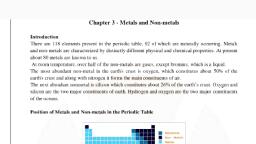
Chapter 3 - Metals and Non-metals, Introduction, There are 118 elements present in the periodic table, 92 of which are naturally occurring. Metals, and non-metals are characterized by distinctly different physical and chemical properties. At present, about 80 metals are known to us., At room temperature, over half of the non-metals are gases, except bromine, which is a liquid., The most abundant non-metal in the earth's crust is oxygen, which constitutes about 50% of the, earth's crust and along with nitrogen it forms the main constituents of air., The next abundant nonmetal is silicon which constitutes about 26% of the earth’s crust. Oxygen and, silicon are the two major constituents of earth. Hydrogen and oxygen are the two major constituents, of the oceans., Position of Metals and Non-metals in the Periodic Table, , Metals occupy the groups on the left of the periodic table. Group IA consists of highly reactive, metals called the alkali metals, while group II A elements are called alkaline earth metals. Elements, between group IIA and IIIA are all called transition metals., The non-metals are elements (with the exception of hydrogen) that are found to the right on the, Periodic Table i.e., groups IVA, VA, VIA &VIIA. The non-metallic character of these elements, increases from top to the bottom of the group. For example, in group VA the first and second, members are non-metals, the third and fourth are metalloids and the last member is a metal. The, metalloids are a group of elements which have properties similar to both the metals and non-metals., These metalloids are: Boron, silicon, germanium, arsenic, antimony, tellurium and astatine. The, non-metals are elements found to the right of these metalloids, including the element, hydrogen., Group, VA, , Non Metals, Metalloids, Metal, , Nitrogen,, Phosphorous,, Arsenic, Antimony, Bismuth, , Physical Properties of Metals, Physical State - Metals are solids at room temperature with the exception of mercury and gallium,, which are liquids at room temperature., Lustre - Metals have the quality of reflecting light from its surface and can be polished e.g., gold,, silver and copper.
Page 2 :
Malleability - Metals have the ability to withstand hammering and can be made into thin sheets, known as foils. Except Zinc which is brittle., Ductility - Metals can be drawn into wires. Except Zinc which is brittle., Hardness - All metals are hard except sodium and potassium, which are soft and can be cut with a, knife., Conduction - Metals are good conductors because they have free electrons. Silver and copper are, the two best conductors of heat and electricity. Lead is the poorest conductor of heat. Bismuth,, mercury and iron are also poor conductors, Density - Metals have high density and are very heavy. Iridium and osmium have the highest, densities whereas lithium has the lowest density., Melting and Boiling Point - Metals have high melting and boiling point. Tungsten has the highest, melting point where as silver has low boiling point. Sodium and potassium have low melting points., Alloy Formation - Metals form homogeneous mixture with each other called an alloy. ExampleBrass is an alloy of copper and zinc., Sonorous - Metals are sonorous i.e. they produce sound when hit with some solid object., Physical Properties of Non-metals, Physical State - Most of the non-metals exist in two of the three states of matter at room, temperature: gases (oxygen) and solids (iodine, carbon, sulphur). These have no metallic lustre,, (except iodine) and do not reflect light. (Except carbon in the form of diamond)., Nature - Non-metals are very brittle, and cannot be rolled into wires or pounded into sheets., Except- diamond is the hardest substance known., Conduction - They are poor conductors of heat and electricity. (Except graphite conducts heat, both, graphite & gas carbon conduct electricity.), Electronegative Character - Non-metals have a tendency to gain or share electrons with other, atoms. They are electronegative in character., Reactivity - They generally form acidic or neutral oxides with oxygen., Melting and Boiling Points – Non-metals have low melting and boiling points., Comparative Properties of Metals and Non-Metals, Property, Metals, State of matter, , Non-metals, , These are usually solid, except mercury, These exist in all the three states.
Page 3 :
Property, , Metals, , Non-metals, , which is a liquid at room temperature. Bromine is the only liquid. Solids, Gallium and Caesium melt below 30oC. – iodine, carbon, sulphur., So if room temperature is around 30oC,, they may also be in liquid state, Density, , They usually have high density, except Their densities are usually low., for sodium, potassium, calcium etc., , Melting point, , They usually have a high melting point Their melting points are low., except mercury, cesium, gallium, tin,, lead., , Boiling point, , Their boiling points are usually high., , Hardness, , They are usually hard, except mercury, They are usually not hard. But the, sodium, calcium, potassium, lead etc., exception is the non-metal, diamond, the hardest substance., , Malleability, , They can be beaten into thin sheets., , Ductility, , They can be drawn into thin wires, They cannot be drawn into thin, except sodium, potassium, calcium etc. wires., , Conduction of heat, , They are good conductors of heat., , They are poor conductors of heat., (exception- carbon in the form of, graphite), , of They are good conductors of electricity., , They are non-conductors, except, for carbon in the form of graphite, and the gas carbon., , Conduction, electricity, , Their boiling points are low., , They are generally brittle., , Lustre, , Newly cut metals have high lustre. Usually not lustrous, except, Some get tarnished immediately., iodine and diamond - the most, lustrous of all the substances., , Alloy formation, , They form alloys., , Tenacity, , These usually have high tensile strength These have low tensile strength., except sodium, potassium, calcium,, lead etc., , Brittleness, , They are hard but not brittle, except They are generally brittle., zinc at room temperature., , Electronic, , They usually have 1, 2 or 3 electrons in They usually have 4, 5, 6 or 7, their valence shell. The greater the electrons in the valence shell. If it, , Generally, they do not form, alloys., However,, carbon,, phosphorus, sulphur etc. can be, present in some alloys.
Page 4 :
Property, , Metals, , Non-metals, , configuration, , number of shells and lesser the number has 8 electrons, it is called a, of valence electrons, the greater is the noble gas. Lesser the number of, reactivity of the metal., shells and greater the number of, valence electrons, greater is the, reactivity of the non-metal., , Ionization, , They always ionize by losing electrons: They always ionize by gaining, electrons:, , Charge of ions, , Positively charged., , Negatively charged., , Type of valency, , Metals always exhibit electrovalency., , Non-metal, exhibit, both, electrovalency or covalency., , Deposition during They are always deposited at the They are always deposited at the, electrolysis, cathode., anode., Redox reaction, , These lose electrons and hence get These gain electrons and hence, oxidized., get reduced., , Redox agents, , They are reducing agents., , Nature of oxides, , They generally form basic oxides, some They generally form acidic, of which are also amphoteric, such as oxides., aluminum oxide, zinc oxide, lead oxide, Neutral oxides are nitrous oxide,, etc., nitric oxide, carbon monoxide, water etc., , Hydrides, , They do form hydrides except some They do form hydrides, e.g. NH3,, transition elements., PH3, HCl, HBr, HI, H2S, H2O etc., , Atomicity, , These are always monatomic., , Solubility, , They do not dissolve in solvents except They dissolve in solvents and can, by chemical action., be re-obtained by evaporation., Example: Sulphur in carbon, disulphide., , Action, chlorine, , They are oxidizing agents., , These can be mono, di, tri, or, polyatomic., , with They produce chlorides, which are They produce chlorides, which, electrovalent., are covalent., , Action with dilute On reaction with dilute acids they give They do not react with dilute, acids, respective salt and hydrogen., acids.
Page 5 :
Chemical Properties of Metals, Metals are Electropositive Elements, Metals are very reactive. Metals tend to lose electrons easily and form positively charged ions;, therefore, metals are called electropositive elements. Sodium metal forms sodium ions Na +. The, electropositive nature allows metals to form compounds with other elements easily., Reaction of Metals with Oxygen, Metals like sodium (Na) and potassium (K) are some of the most reactive metals. Potassium,, sodium, lithium, calcium and magnesium react with oxygen and burn in air., Metals from aluminum to copper in the activity series of metals react slowly when heated in air to, form the metal oxides. Aluminum is the fastest and copper is the slowest of them., • Sodium metal reacts with the oxygen of the air at room temperature to form sodium oxide., Hence, sodium is stored under kerosene to prevent its reaction with oxygen, moisture and, carbon dioxide., , •, , Sodium oxide is a basic oxide which reacts with water to form sodium hydroxide., , •, , Mg does not react with oxygen at room temperature. On heating, Mg burns in air with intense, light and heat to form MgO., , •, , Zinc metal burns in air only on strong heating to form zinc oxide., , •, , In moist air, iron is oxidized to give rust., , •, , On, , •, , Copper is the least reactive metal and does not burn in air even on heating. However, on, prolonged strong heating copper reacts with oxygen and forms copper (II) oxide (CuO) outside, and copper (I) oxide (Cu2O) inside., , heating, , in, , air, , it, , burns, , with a, , brilliant, , flame, , forming, , triferric, , tetroxide.
Page 6 :
•, , Gold and platinum do not react with oxygen in air., , Reaction of Metals with Water, Potassium, sodium, lithium and calcium react with cold water., • Sodium reacts vigorously with cold water forming sodium hydroxide and hydrogen., •, , Metals from magnesium to iron in the activity series of metals, react with steam (but not cold, H2O) to form the metal oxide and hydrogen gas., , •, , Red hot iron reacts with steam to form Iron (II, III) oxide., , Note: The reaction between iron and steam is irreversible. Tin, lead, copper, silver, gold and, platinum do not react with water or steam., Reaction of Metals with Acids, • Potassium, sodium, lithium and calcium react violently with dilute H 2SO4 and dilute HCl,, forming the metal salt (either sulphate or chloride) and hydrogen gas. The reaction is similar to, the reaction with water., , •, , Magnesium, aluminum, zinc, iron, tin and lead react safely with dilute acid. Magnesium is the, fastest and lead is the slowest of the six.
Page 7 :
Zinc with dilute sulphuric acid is often used for the laboratory preparation of hydrogen. The, reaction is slow at room temperature, but its rate can be increased by the addition of a little, copper (II) sulphate. Zinc displaces copper metal, which acts as a catalyst., Metals below hydrogen (copper, silver, gold and platinum), will not react with dilute acid to, liberate hydrogen. In general,, •, •, •, , Hydrochloric acid makes a metal chloride., Sulphuric acid makes a metal sulphate., Reactions with nitric acid are more complex, the nitrate is formed but the gas is rarely hydrogen,, and more often, an oxide of nitrogen., Reaction of Metals with Salt Solutions, Reactive metals can displace any metal less reactive than itself, from the oxide, chloride or, sulphate of the less reactive metal in solution or their molten state. If metal A displaces metal B, from, its, solution,, it, is, more, reactive, than, B., , Copper (II) sulphate solution is blue; iron sulphate solution is almost colourless when dilute. During, the displacement, the blue solution loses its color and the iron metal is seen to turn pink-brown as, the displaced copper becomes deposited on it., On heating the mixture of magnesium powder and black copper (II) oxide, white magnesium oxide, is formed with brown bits of copper:, , Adding magnesium to blue copper (II) sulphate solution, the blue color fades as colourless, magnesium sulphate is formed and brown bits of copper metal form a precipitate:
Page 8 :
Electronic Nature of Metals and Non-metals, The atoms of all elements, except noble gases, have an incomplete outermost shell. . Noble gases, have their outermost shell complete and hence they are not reactive or "inert"., Most elements are reactive and try to achieve the stability of the noble or inert gases by electron, transfer or by electron sharing. Elements that can donate electrons are called metals. They form, positive ions by losing electrons., The elements that accept electrons are called non-metals. They form negative ions by gaining, electrons. Metals have 1 to 3 electrons in the outermost shell of their atom and non-metals have 4 to, 8 electrons in the outermost shell., There are two exceptions to this rule: Hydrogen and helium. Hydrogen is a non-metal having 1, electron in the valence shell and helium too is an inert gas having 2 electrons in the valence shell., , Type, Elements, , of, , Element, , Number, Atomic, Electrons, Number, Shells, K, , Noble Gases, , Helium (He) 2, , 2, , Neon (Ne), , 2, , 10, , of, in, , L, , 8, , M, , N
Page 9 :
Type, Elements, , Metals, , Non-metals, , of, , Element, , Number, Atomic, Electrons, Number, Shells, , of, in, , Argon (Ar), , 18, , 2, , 8, , 8, , Sodium (Na) 11, , 2, , 8, , 1, , Magnesium, 12, (Mg), , 2, , 8, , 2, , Aluminium, (Al), , 13, , 2, , 8, , 3, , Potassium, (K), , 19, , 2, , 8, , 8, , 1, , Calcium (Ca) 20, , 2, , 8, , 8, , 2, , Nitrogen (N) 7, , 2, , 5, , Oxygen (O) 8, , 2, , 6, , Fluorine (F) 9, , 2, , 7, , Phosphorus, 15, (P), , 2, , 8, , 5, , Sulphur (S) 16, , 2, , 8, , 6, , Chlorine (Cl) 17, , 2, , 8, , 7
Page 10 :
Important Point, Metals that donate electrons gain positive charge equal to the number of electrons donated. For, example, atomic number of aluminum is 13, so the electronic configuration of Al is 2, 8, and 3., Aluminum has 3 electrons in the valence shell; it loses 3 electrons to form Al3+., Alo – 3e- , Al3+, Other examples,, , Non-metals gain electrons and hence gain negative charge equal to the number of electrons, accepted., For example,, , The Reactivity Series of Metals, Although most metals are usually electropositive in nature and lose electrons in a chemical reaction, they do not react with the same vigour or speed. Metals display different reactions towards different, substances. The greater the ease with which an element loses its electrons and acquires a positive, charge, the greater is its reactivity. Further, the greater the number of shells and lesser the number, of valence electrons, the greater is the reactivity of the metal. The activity series of metals, arranges, all metals in order of their decreasing chemical activity. As we go down the activity series from, potassium to gold the ease with which a metal loses electrons, and forms positive ions in solutions,, decreases., The most active metal, potassium, is at the top of the list and the least reactive metal, gold, is at the, bottom of the list. Although hydrogen is a non-metal it is included in the activity series due to the, fact that it behaves like a metal in most chemical reactions i.e., the hydrogen ion has a positive, charge [H+] like other metals.
Page 11 :
Element, , Symbol, , Group Number, , Potassium, , K, , IA, , Sodium, , Na, , IA, , Lithium, , Li, , IA, , Calcium, , Ca, , IIA, , Magnesium, , Mg, , IIA, , aluminium, , Al, , IIIA, , Carbon, , C, , IVA, , Zinc, , Zn, , IIB, , Iron, , Fe, , VIII, , Tin, , Sn, , IVA, , Lead, , Pb, , IVA, , Hydrogen, , H, , IA, , Copper, , Cu, , IB, , Silver, , Ag, , IB
Page 12 :
Element, , Symbol, , Group Number, , Gold, , Au, , IB, , Platinum, , Pt, , VIII, , •, •, , •, •, , The higher the metal in the series, the more reactive it is i.e., its reaction is fast and more, exothermic., This also implies that the reverse reaction becomes more difficult i.e., the more reactive a metal,, the more difficult it is to extract from its ore. The metal is also more susceptible to corrosion, with oxygen and water., The reactivity series can be established by observation of the reaction of metals with water,, oxygen or acids., Within the general reactivity or activity series there are some periodic table trends:, , Metals, , Reactivity and reactions, , Potassium K, , Very reactive, very rapid with cold water forming the alkali potassium, hydroxide, and, hydrogen, gas, (which, is, ignited)., 2K+2H2O(l), 2KOH(aq) +H2(g), , Sodium Na, , Fast reaction with cold water forming the alkali sodium hydroxide and, hydrogen, gas., 2Na(s), +, 2H2O(l), 2NaOH(aq), +, H2(g), The reaction of sodium with water-the sodium melts to a silvery ball and, fizzes as it spins over the water. The rapid exothermic reaction produces, a colourless gas that gives a squeaky pop! with a lit splint-hydrogen., Universal indicator will turn from green to purple/violet-the strong, alkali sodium hydroxide is formed. The sodium floats because it is less, dense than water., , Calcium Ca, , Quite reactive with cold water forming the moderately soluble alkali, calcium hydroxide and hydrogen gas., Ca(s) +2H2O(l), , Ca(OH)2(aq/s) + H2(g), , Very reactive with dilute hydrochloric acid forming the colourless, soluble salt calcium chloride and hydrogen gas., Ca(s) +2HCl(g), , CaCl2(aq) +H2(g), , Not very reactive with dilute sulphuric acid because the colourless, calcium sulphate formed is not very soluble and coats the metal, inhibiting the reaction., Ca(s) + H2SO4(aq), , CaSO4(s) + H2(g)
Page 13 :
Metals, , Reactivity and reactions, , Magnesium Mg Slow reaction with water forming the slightly soluble base magnesium, oxide and hydrogen gas., With steam, the reaction is faster with heated magnesium and a white, powder magnesium oxide is formed along with hydrogen., Magnesium will burn with a bright white flame in steam, if previously, ignited in air., Mg(s) + H2O(g), MgO(s) + H2(g), In fact it will even burn in carbon dioxide forming black specks of, carbon!, 2Mg(s) +CO2(g), 2MgO(s) + C(s), Very reactive with dilute hydrochloric acid forming the colourless, soluble salt, magnesium chloride and hydrogen gas., Mg(s) +2HCl(aq), MgCl2(aq) +H2(g), Very reactive with dilute sulphuric acid forming colourless soluble, magnesium sulphate and hydrogen., Mg(s) +H2SO4(aq), MgSO4(aq) + H2(g), Aluminum Al, , Aluminum has no reaction with water or steam due to a protective, aluminum oxide layer of Al2O3. Slow reaction with dilute hydrochloric, acid to form a colourless soluble salt aluminum chloride and hydrogen, gas., 2Al(s) +6HCl(aq), , 2AlCl3(aq) + 3H2(g), , The reaction with dilute sulphuric acid is extremely slow to form, colourless aluminum sulphate and hydrogen., 2Al(s +3H2SO4(aq), (Carbon, non-metal), , Zinc Zn, , Al2(SO4)3(aq) + 3H2(g), , C,a Elements higher than carbon i.e aluminum and the more reactive metals, must be extracted by electrolysis (or displacing it with an even more, reactive metal). Metals below it, i.e., zinc or a less reactive can be, extracted by reducing the hot metal oxide with carbon., No reaction with cold water. When the metal is heated in steam zinc,, oxide and hydrogen are formed., Zn(s) + H2O(g), , ZnO(s) + H2(g), , Quite reactive with dilute hydrochloric acid forming the colourless, soluble salt zinc chloride and hydrogen gas. Zn(s) +2HCl(aq), ZnCl2(aq), + H2(g), Quite reactive with dilute sulphuric acid forming the colourless soluble, salt zinc sulphate and hydrogen gas.
Page 14 :
Metals, , Reactivity and reactions, Zn(s) + H2SO4(g), , ZnSO4(s) + H2(g), , (this reaction is catalyzed by adding a trace of copper sulphate solution), Zinc can be extracted by reducing the hot metal oxide on heating with, carbon, 2ZnO(s) + C(s), 2Zn(s) + CO2(g), A zinc coating (galvanizing) is used to protect iron from rusting., Iron Fe, , No reaction with cold water (rusting is a joint reaction with oxygen)., When the metal is heated in steam an iron oxide (unusual formula) and, hydrogen are formed. This oxide is 'technically' Iron (III, II) oxide!, 3Fe(s) + 4H2O(g), , Fe3O4(s) +4H2(g), , Slow reaction with dilute hydrochloric acid forming the soluble pale, green salt Iron (II) chloride and hydrogen gas., Fe(s) + 2HCl(aq), , FeCl2(aq) + H2(g), , Slow reaction with dilute sulphuric acid forming the soluble pale green, salt Iron (II) sulphate and hydrogen gas., Fe(s) + 2H2SO4(g), , FeSO4(s) + H2(g), , Iron can be extracted by reducing the hot metal oxide on heating with, carbon monoxide formed from carbon in the blast furnace e.g.,, Fe2O3(s) +3CO(g), , 2Fe(s) +3CO2(g), , Fe3O4(s) +4CO(g), , 3Fe(s) +4CO2(g), , (Hydrogen, non-metal), , H None of the metals below hydrogen can react with acids to form, hydrogen gas. They are least easily corroded metals and partly accounts, for their value and uses in jewellery, electrical contacts etc., , Copper Cu, , No reaction with cold water or when heated in steam. No reaction with, dilute hydrochloric acid or dilute sulphuric acid. Copper can be, extracted by reducing the hot black metal oxide on heating with carbon., 2CuO(s) + C(s), 2Cu(s) +CO2(g), , Silver Ag, , No reaction with cold water or when heated in steam. No reaction with, dilute hydrochloric acid or dilute sulphuric acid. Silver can be extracted, by reduction but can be found 'native' as the element., , Gold Au, , No reaction with cold water or when heated in steam. No reaction with, dilute hydrochloric acid or dilute sulphuric acid. Gold can be readily, extracted from its ores easily by reduction but it is usually found 'native'., Pure gold is 24 carat.
Page 15 :
Metals, , Reactivity and reactions, , Platinum Pt, , No reaction with cold water or when heated in steam. No reaction with, dilute hydrochloric acid or dilute sulphuric acid. Like gold, it is a very, rare metal. It is used in expensive jewellery, laboratory ware (inert, crucible container) as a industrial catalyst, and catalytic converters in, car exhausts., , Bonding, The tendency of an atom to take part in chemical combination is determined by the number of, valence electrons (electrons in the outermost shell of an atom). The atoms acquire the stable noble, gas configuration of having eight electrons in the outermost shell (called octet rule) during chemical, combination., The combination of atoms occurs in two ways: either by electrovalent bonding or covalent bonding., In all chemical reactions, it is the electrons from the outermost shell of an atom that are involved in, interacting with other atoms, either by their transfer or by sharing., Electrovalent Bonding, When an atom donates one, two or three electrons from its valence shell to another atom, which has, the ability to accept these electrons, it is known as electrovalency. As a result of electrovalency,, both these atoms achieve the structure of an inert gas. When the chemical bond occurs by the, transfer of electrons from the atom of an element to the atom or atoms of another it is called Ionic or, Electrovalent bond., Thus, the electrovalency of sodium is 1+, and that of chlorine is 1- in NaCl. Similarly, calcium,, magnesium in their chloride exhibits an electrovalency of 2+. There are many elements, which, show different electrovalencies in different compounds. This phenomenon is called 'variable, electrovalency' e.g., iron exists as Fe2+ and Fe3+ in ferrous sulphate and ferric sulphate respectively., Formation of Sodium Chloride, During the formation of an ionic bond between the metal sodium and the non-metal chlorine,, sodium loses one electron to complete its octet as it has only one electron in its valence shell. It, acquires a noble gas configuration of neon (2, 8). While the chlorine atom has seven electrons in its, valence shell and gains one electron to complete its octet and also acquires stable electronic, configuration of argon.
Page 16 :
Formation of Magnesium Chloride, Magnesium, whose atomic number is 12, has 2, 8, 2 configurations. Its valence shell has two, electrons. The electronic configuration of chlorine (At. no. 17) is 2, 8, 7. It has seven valence, electrons. Since, magnesium has two electrons in excess of the neon configuration (2, 8), and, chlorine is one electron short of the argon configuration (2,8,8), hence one atom of magnesium will, look for two atoms of chlorine to transfer its two electrons to (one to each) as shown below:, , The Mg2+ and the two Cl- so formed, then form ionic bonds between them., , In terms of Lewis dot structure,, , Formation of Magnesium Oxide, Mg (at no 12) has configuration 2, 8, 2., The atom of Mg loses 2 electrons to become stable like Neon (2, 8), Mg – 2e- Mg2+, Oxygen (at no 8) has configuration 2,6.The atom of Oxygen gains 2 electrons to become stable like, Ne (2, 8 ), O + 2e- O 2Mg2+ + O2- MgO, , Formation of Calcium oxide, Ca (at no 20) has configuration 2,8,8,2., The atom of Ca loses 2 electrons to become stable like Argon (2,8,8), Ca – 2e- Ca2+, Oxygen (at no 8) has configuration 2, 6., The atom of Oxygen gains 2 electrons to become stable like Ne (2, 8), O + 2e- O 2Ca 2+ + O2- CaO
Page 17 :
Properties of Electrovalent Compounds, Property, , Electrovalent or ionic compounds, , Structure, ions, , of, , Physical, hardness, , state, , Melting, points, , and, , charged, , They consist of oppositely charged molecules., , and The inter-atomic attraction is high, hence they are brittle, hard,, crystalline solids., boiling Due to strong attraction between the particles,, temperatures are required to melt or boil them., , high, , Solubility, , They are usually soluble in water, but insoluble in organic, solvents., , Passage of electricity, , Ionic compounds do not conduct electricity in the solid state, because movement of ions in the solid is not possible due to, their rigid structure. In the molten form or in aqueous solution, form, since the electrostatic forces of attraction between the, oppositely charged ions are overcome they allow the flow of, electricity, and get decomposed by it., , Rate of reaction, , Their reaction usually occurs with high speeds., , Since electrovalent compounds are made up of charged ions,, Dissociation in solution they dissociate to give negative and positive ions in solution., , Electrolysis, , These compounds can undergo electrolysis. The cations get, discharged at cathode and anions at anode.
Page 18 :
Covalent Bond, A covalent bond is defined 'as the force of attraction arising due to mutual sharing of electrons, between the two nonmetallic atoms'. The combining atoms may share one, two or three pairs of, electrons. The covalent bond is formed between two similar or dissimilar atoms of nonmetals by, a mutual sharing of electrons, which are counted towards the stability of both the participating, atoms., When the two atoms combine by mutual sharing of electrons, then each of the atoms acquires a, stable configuration of the nearest noble gas. The compounds formed due to covalent bonding, are called covalent compounds. The shared pair of electrons are called Bond Pairs., Formation of Covalent Bonds, The Hydrogen Molecule, The hydrogen atom (Atomic number = 1) has 1 electron in the K shell. It tries to acquire the, configuration of He (Atomic number 2). This is possible if the two combining atoms share their, valence electron to form one covalent bond between themselves., H-H, , ;, , H: H 1 covalent bond between two 2 H atoms forms H2, , The Oxygen Molecule, Oxygen (Atomic number 8) has 6 valence electrons, 2 short of the octet configuration. The two, oxygen atoms share two pairs of electrons to form 2 covalent bonds between them., , To form Oxygen molecule O2., Covalency, The number of electrons, which an atom contributes towards mutual sharing during the, formation of a chemical bond, is called its covalency in that compound. Thus, the covalency of, hydrogen in H2 (H - H, H : H) is one; that of oxygen in O2 is two (O O, O :x, x O) and that of, x, nitrogen in N2 is three (N N, N x, x N) .
Page 19 :
Sometimes one or more pairs of electrons in the valence shell of the atom do not take part in, bonding, and are known as a lone pairs; they are also called non-bonding pair of electrons., Example:, , Each atom of oxygen has 2 pairs of non bonding electrons., Multiple Covalent Bonds, The covalent bonds developed due to mutual sharing of more than one pair of electrons, are, termed 'multiple covalent bonds'. These are:, Double covalent bond, The bond formed between two atoms due to the sharing of two electron-pairs is called a double, covalent bond or simply a double bond. It is denoted by two small horizontal lines (=) drawn, between the two atoms, e.g., O = O,, O = C = O etc., Triple covalent bond, Bond formed due to the sharing of three electron pairs is called a triple covalent bond or simply a, triple bond. Three small horizontal lines between the two atoms denote a triple bond e.g.,, N N, and H-C C-H (acetylene)., Formation of Molecules Having Double Bond, Formation of oxygen (O2) molecule, Each oxygen atom has six electrons in its valence shell. Thus, it requires 2 more electrons to, achieve the nearest noble gas configuration. This is achieved by sharing two pairs of electrons by, the two oxygen atoms as shown below:
Page 20 :
Formation of carbon dioxide molecule (CO2), The electronic configurations of carbon and oxygen are,, C 2, 4 and O 2, 6, Thus, each carbon atom requires four, and each oxygen atom requires two more electrons to, acquire noble gas configurations. This is achieved as follows:, , Formation of molecules having triple bond, Formation of nitrogen (N2) molecule, Nitrogen atom has five electrons in its valence shell. Thus, it requires three more electrons to, acquire a stable configuration of the nearest noble gas (neon). This is done by mutually sharing, three pairs of electrons as shown below:, , Formation of hydrogen cyanide (HCN) molecule, The carbon atom in HCN, shares one electron-pair with hydrogen, thus forming a single covalent, bond with H atom. The C atom shares three electron pairs with N atom to form a triple bond, between C and N. The combining of atoms and Lewis structure of HCN molecule is given, below:
Page 21 :
General Properties of Covalent Compounds, The main characteristic properties of covalent compounds are:, •, , •, , •, , •, •, , State of existence: The covalent compounds do not exist as ions but exist as molecules. There, are weak intermolecular forces between the molecules and hence they exist as liquids or, gases at room temperature. However, a few compounds also exist in the solid state e.g., urea,, sugar etc., Low melting and boiling points: The melting and boiling points of covalent compounds are, generally low. This is because of the fact that the forces between the molecules are weak and, thus are easily overcome at low temperatures., Solubility: Covalent compounds are generally insoluble or less soluble in water and in other, polar solvents. They are however, soluble in non-polar solvents such as benzene, carbon, tetrachloride etc., Non-conductors: Since covalent compounds do not give ions in solution, these are poor, conductors of electricity in the fused or dissolved state., Molecular reactions: The reactions between covalent compounds occur between their, molecules. These involve the breaking of covalent bonds in reacting molecules and forming, new covalent bonds to give molecules of the products. These reactions are quite slow, because energy is required to break covalent bonds., , Occurrence of Metals, Minerals and Ores, Metals and their compounds are found in the earth’s and are known as minerals. Ores are, minerals from which metals are extracted profitably and conveniently. Ores contain metal, compounds with a lower percentage of impurities. All the ores are minerals, but all minerals are, not necessarily ores., Types of ores, Oxides, , Carbonates, , Halides, , Zincates (ZnO), , Marble, or, Fluorspar, limestone, (CaF2), (CaCO3), , Sulphides, , Sulphates, , Zinc, (ZnS), (PbS), , blende, Anglesite, Galena, (PbSO4), , Iron, (FeS2), , pyrites Barium sulfate, (BaSO4), , Haematite, Calamine, (Fe2O3.xH2O)Magnetite (Fe3O4) (ZnCO3), , Cryolite, (Na3AlF6), , Bauxite (Al2O3.2H2O), , Horn Silver Cinnabar (HgS) Gypsum, , Siderite
Page 22 :
Cuprite (Cu2O), , (FeCO3), , (AgCl), , Magnesite, (MgCO3), , Rock, (NaCl), , (CaSO4.2H2O), salt, , Epsom, salt, (MgSO4.7H2O), , In the Free State, Very few metals exist in the free or native state. Only metals like gold, platinum and mercury are, occasionally found in the Free State i.e., in the pure form. Sometimes, copper and silver may also, be found in the Free State. Such metals are not acted upon by air or water., In the Combined State, The rest of the metals occur in the combined form as compounds such as oxides, carbonates,, sulphides, sulphates, silicates, chlorides, nitrates, phosphates etc. Copper and silver are two, metals which occur in free as well as combined state as sulphide, oxide or halide ores. Metals at, the top of the activity series (K, Na, Ca, Mg and Al) are so reactive that they are never found in, nature as free elements. The metals in the middle of the activity series (Zn, Fe, Pb, etc.) are, moderately reactive. They are found in the earth's crust mainly as oxides, sulphides or, carbonates., Extraction of Metals - Metallurgy, The various processes involved in the extraction of metals from their ores and their subsequent, refining are known as metallurgy.
Page 23 :
Concentration - Enrichment of Ores, Ore is an impure metal containing large amount of sand and rocky material. The impurities like, sand, rocky materials, limestone, mica etc present in the ore is called gangue or matrix. These, impurities must be removed from the ore before the extraction of the metal. The substance added, to the ore to remove the matrix called flux results in the formation of a fusible compound called, slag., Gangue + Flux = Slag., The processes used for removing the gangue from the ore are based on the differences between, the physical or chemical properties of the gangue and the ore. At first the ore is crushed to, powder. The pulverized ore is separated by physical processes like hydraulic washing, frothfloatation, and magnetic separation or by chemical processes, depending on the nature of the ore, and its impurities. Concentration of the ore is also known as 'dressing' or 'enrichment' of ore., Physical Methods of Concentration, Hydraulic Washing (Gravity Separation), The ore particles are poured over a hydraulic classifier which is a vibrating sloped table with, grooves and a jet of water is allowed to flow over it. The denser ore settle in the grooves while, the lighter gangue particles are washed away. This method is used for concentration of heavy, oxide ores of lead, tin, iron etc.
Page 24 :
Froth Floatation, This method employs a mixture of water and pine oil which is made to froth in a tank to separate, sulphide ores. The differences in the wetting properties of the ore and gangue particles separate, them., , A mixture of water, pine oil, detergent and powdered ore is first taken in a tank. A blast of, compressed air is blown through the pipe of a rotating agitator to produce froth. The sulphide ore, particles are wetted and coated by pine oil and rise up along with the froth (froth being lighter)., The gangue particles wetted by water sink to the bottom of the tank (water being heavier)., Sulphide being more electronegative attracts the covalent oil molecules. The gangue being less, electronegative is attracted by the water. The froth containing the sulphide ore is transferred to, another container, washed, and dried., Magnetic Separation, Magnetic ores like pyrolusite (MnO2) and chromite (FeO.Cr2O3) are enriched by this method by, making use of the difference in the magnetic properties of the ore and gangue particles.
Page 25 :
The powdered ore is dropped over a conveyor belt running over two rollers, one of which is, magnetic. The magnetic ore particles get attracted to the magnetic roller and run along with the, conveyor belt for a little longer than the non magnetic gangue. Gangue particles drop down first, forming a heap. Then, the magnetic ore particles drop down forming a separate heap. Thus, two, separate heaps of ore and gangue particles are formed., , Extracting Metals Low in the Activity Series, Metals that are low in the activity series are very un-reactive. The oxides of these metals can be, reduced to metals by heating alone. For example, mercury is obtained from its ore, cinnabar, (HgS), by the process of heating., Reduction Using Heat, , Copper can also be obtained in a similar manner from its sulphide ore (Cu 2S)., Note: The oxides of Mercury & copper metals decompose on heating., Extracting Metals in the Middle of the Activity Series, Metals such as iron, zinc, lead, copper, etc., are in the middle of the reactivity series. These are, moderately reactive metals and are usually present as sulphides or carbonates., These metals are obtained from their ores by the processes of reduction. In the reduction process,, it is the oxide ore that is reduced., It is easier to reduce an oxide ore as compared to its sulphides and carbonates. If the ore is not an, oxide ore, it is first converted to the oxide by the process of calcination or by roasting.
Page 26 :
Roasting, Sulphide ores are converted into oxides by heating strongly in the presence of excess air, so that, oxygen gets added to form the corresponding oxides. Sulphur impurities escape as gas. This, process is known as roasting., , Calcination, In this process the ore is heated to a high temperature in the absence of air, or where air does not, take part in the reaction. Usually, carbonate ores or ores containing water are calcined to drive, out carbonate and moisture impurities., , Differences between Roasting and Calcination, Roasting, , Calcination, , Heating in the presence of air, , Heating in the absence of air, , Sulphide ores are roasted Sulphur dioxide is, , Carbonate ores are calcined., Carbon, , dioxide, , is, , released, , released, Is done at high temperatures, sometimes higher Is done at lower temperatures, generally, that the melting point of the ore., below the melting point of the ore., Purpose is to remove impurities as volatile oxides, Purpose is to remove impurities as volatile, & to oxidize the ore and to remove any moisture, oxides and to remove the moisture present., that may be present., , Reduction of Ores, The oxide obtained by calcination or roasting is then reduced by either carbon or hydrogen., Carbon is usually used in the form of coke, or carbon monoxide. Not all metallic oxides can be, reduced by carbon or carbon monoxide. Thus, in order to extract metal from its ore the method, adopted depends on the reactivity of the metal i.e., its position in the metal activity series.
Page 27 :
Metal, , Method of reduction of oxide, , Zn, , By carbon reduction method. This metal can be reduced by coke only, , Fe, Pb, Cu, , By carbon reduction method. These metals can be reduced by coke as well, as carbon monoxide. They can also be reduced by hydrogen., , Reduction Using Carbon (Coke), This method is used for oxides of moderately reactive metals. Coke is an inexpensive reducing, agent and is most widely used., , Reduction Using Carbon Monoxide, Carbon monoxide is a powerful reducing agent. It is used for the reduction of hematite in the, blast furnace., , Extracting Metals towards the Top of the Activity Series, Metals such as sodium, magnesium, calcium, aluminum high up in the reactivity series are very, reactive and cannot be obtained from their compounds by heating with carbon. This is because, these metals have more affinity for oxygen than carbon. These metals are obtained by, electrolytic reduction., , Reduction by Electrolysis, This process is used for oxides of highly reactive metals that are above aluminum in the, reactivity series. It is also used for reduction of aluminum oxide. Example:, , Alumina has a very high melting point and the cost of maintaining the electrolyte in the molten, state is very high. However, if alumina is mixed with cryolite (Na3AlF6) and fluorspar (CaF2) the, melting point is lowered drastically and the cost reduced too. These substances increase the, conductivity of the electrolyte., Reduction Using Aluminum (Aluminothermy), Aluminum is an expensive reducing agent. It is used for reduction of oxides of highly reactive, metals. But these metals need to be below aluminum in the reactivity series. Example:
Page 28 :
Aluminothermy is also used for welding broken iron rails. As the reaction is highly exothermic,, the heat generated in the reaction causes the metallic iron formed to melt. This molten iron drips, down over the two pieces to be welded and joins them on solidifying., , Refining of Metals, Most metals obtained by the reduction process are not very pure. These have to be further refined, or purified. Purification of the metal is the last step in metallurgy. Refining is based on the, difference between the properties of metals and their impurities. The following process we use, for refining., Electro refining, Electrolysis can be used for both extractions of metal (which cannot be separated by chemical, reduction process) as well as for further purification of metals obtained by any other method. In, the electro refining process a block of impure metal is made the anode and a thin sheet of pure, metal is made the cathode. The electrolytic cell contains an aqueous solution of the metal salt., When electric current of a suitable voltage is passed, impure metal at the anode gets dissolved to, deposit the pure metal at the cathode. Metal ions from the anode enter the electrolyte as follows:, , These ions get deposited on the cathode as follows, , The impurities are left behind as anode mud near the anode. The anode finally disintegrates, while the cathode gains in weight due to the collection of pure metal., , This method is used for refining volatile metals like copper, silver, tin, nickel that have boiling, points lower than their impurities. e.g., zinc, mercury.
Page 29 :
•, , An electrolyte is a compound (salt, acid or base), which in solution or in a molten state, conducts an electric current and is simultaneously decomposed by it., Electrolytes are ionized into electrically charged ions, which carry the current., • Charged ions move towards the oppositely charged electrodes to give up their electric charge, and become atoms; these are either liberated or deposited at the electrodes., Corrosion of Metals, We have learnt that metals that are chemically active get corroded in the presence of a moist, atmosphere. Corrosion is an oxidation reaction with atmospheric oxygen in the presence of water, on the surface of a metal. Iron corrodes more quickly than most other transition metals to form, an iron oxide. Corrosion or rusting of iron is accelerated in the presence of CO 2 and also in the, presence of salt solution., , i.e., rust is hydrated iron (III) oxide, Rusting is oxidation because it involves iron gaining oxygen (Fe, Fe2O3) or iron atoms losing, 3+, electrons (Fe - 3e, Fe ). The equation is not meant to be balanced and the amount of water 'x', is variable, from dry to soggy., The major problem of corrosion occurs with iron (or steel) as it is used as a structural material in, industries like construction, infrastructure, bridges, rail transport power transmission,, shipbuilding, automobiles, heavy industries etc., Aluminum, another useful structural metal, also undergoes an oxidation reaction, but does not, oxidize and corrode as quickly as its reactivity suggests. Once a thin oxide layer of Al2O3 has, formed on the surface, it forms a barrier to oxygen and water to prevent further corrosion of the, aluminum. Hence aluminum is called a self-protective metal. Aluminum can be made harder,, stronger and stiffer by mixing it with small amounts of other metals (e.g., magnesium) to make, alloys., The alkali metals like sodium used in chemistry laboratories and in some chemical industries, rapidly corrodes in air and need to be stored under oil., Copper and lead are both used in roofing situations because neither is very reactive. The, compounds formed on the surface do not flake away as easily as rust does from iron. Lead, corrodes to a white lead oxide or carbonate and copper corrodes to form a basic green carbonate, (combination of the hydroxide Cu(OH)2 and carbonate CuCO3). In the past both metals have, been used for piping but as lead is considered too toxic copper is usually used., Non-reactive metals like gold, platinum, mercury do not corrode., Prevention of Corrosion, Iron and steel (alloy of iron) are most easily protected by paint which provides a barrier between, the metal and air/water. Moving parts on machines can be protected by a water repellent oil or, grease layer. Covering the surface with enamel and lacquers is another method.
Page 30 :
Sacrificial Protection, 'Rusting' can be prevented by connecting iron to a more reactive metal (e.g., zinc or magnesium)., This is referred to as sacrificial protection or sacrificial corrosion, because the more reactive, protecting metal is preferentially oxidized away, leaving the protected metal intact., Alloying, Iron or steel along with other metals can also be protected by 'alloying' or mixing with other, metals (e.g., chromium) to make non-rusting alloys. Stainless steel is an example of a nonrusting alloy of iron and carbon. Brass, an alloy containing copper is another metal alloy which is, less expensive and non-reactive., Galvanizing, Coating iron or steel with a thin zinc layer is called 'galvanizing'. This layer is produced by, electrolytic deposition. Dipping the iron/steel object in molten zinc and using it as the negative, cathode zinc is coated on it. Zinc preferentially corrodes or oxidizes to form a zinc oxide layer, that does not flake off like iron oxide rust. Also, if the surface is scratched, the exposed zinc, again corrodes before the iron and continues to protect it., Electroplating, Coating the surface with metals like tin, chromium, nickel etc. by electroplating is also utilized, to prevent corrosion. Steel cans are protected by relatively un-reacted tin and works well as long, as the thin tin layer is complete.