Page 1 :
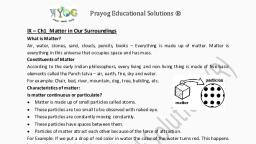
1. Matter in our surrounding, , Class Notes, , Matter, Matter is anything that has mass and occupies space., Physical Nature of Matter, x, x, x, , A physical property is that aspect of the matter that can be observed or measured without, changing its nature or composition., It is independent of the amount of matter present., Physical properties include appearance, colour, odour, density, texture, melting point, boiling, point, solubility, etc., Characteristics of Particles of Matter, The particles of which the matter is comprised influence its state and properties (physical and, chemical)., , x, , x, x, , 1. Particles of matter have spaces between them, This characteristic is one of the concepts behind the solubility of a substance in other, substances. For example, on dissolving sugar in water, there is no rise in water level because, the particles of sugar get into the interparticle spaces between the water particles., 2. Particles of matter are always in motion, Particles of the matter show continuous random movements due to the kinetic energy they, possess., A rise in temperature increases the kinetic energy of the particles, making them move more, vigorously., Example: Particles of the matter show continuous random movements. The kinetic energy, they possess helps them in this movement. The spreading of ink in a beaker of glass, the, smell that comes from agarbattis, etc. are few illustrations that show the movement of, particles of a substance., “When the particles of two different types of matters intermix on their own, the phenomenon, is called diffusion” Diffusion of particles becomes fast when the temperature is increased., , 3. Particles of matter attract each other, In every substance, there is an inter-particle force of attraction acting between the particles., To break a substance we need to overcome this force. The strength of the force differs from, one substance to another, , @ Sachin Pathak, , Page 1
Page 2 :
Note: The inter-particle force of attraction and the kinetic energy of the particles primarily, determine the physical state of any matter., States of Matter, x, x, , x, , Matter can be classified as solid, liquid and gas on the basis of interparticle forces and the, arrangement of particles., These three forms of matter are interconvertible by increasing or decreasing pressure and, temperature. For example, ice can be converted from solid to a liquid by increasing the, temperature., Matter can be classified into different states such as solid, liquid and gas on the basis of, intermolecular forces and the arrangement of particles., 1. Four states of matter can be found in daily life: solid, liquid, gas, and plasma., 2. Many other states, such as Bose – Einstein condensate and neutron degenerate matter, are, considered to occur only in extreme conditions such as ultra-cold or ultra-dense matter., 3. Other states, such as quark – gluon plasmas, are thought to be possible but remain, theoretical for the time being., Three States of Matter with Examples, There are three states of matter and below are the description of various states of matter:, , x, x, x, x, x, x, , x, x, x, x, , 1. Solids, The solid state is one of the fundamental states of matter., Solids differ from liquids and gases by the characteristic of rigidity., The molecules of solids are tightly packed because of strong intermolecular forces; they, only oscillate about their mean positions., Whereas, liquids and gases possess the property of fluidity and can easily flow., Solids can be defined as the state of matter which has definite shape and volume and has a, rigid structure., Solids possess the least compressibility and thermal expansion., Example: Iron (Fe), , 2. Liquids, The molecules in a liquid are closely packed due to weak intermolecular forces., These forces are weaker than solids but stronger than that of gases., There is much space in between the molecules of liquids which makes their flowing ability, easy., Liquids can easily acquire the shape of a vessel, and they have a fixed volume., , @ Sachin Pathak, , Page 2
Page 3 :
x, x, , x, x, x, x, x, , Conversion of solids into liquids takes place when we increase the temperature of solids to a, point where solids begin to melt., Generally, the density of liquid lies between the density of solids and gases. Compressibility, and thermal expansion of liquids are slightly higher than that of solids., Example: Water (H2O), , 3. Gases, In this state of matter, distances between the molecules are large (intermolecular distance is, in the range of 10−7–10−5cm))., The intermolecular forces experienced between them are negligible., Thus, translatory, rotatory and vibratory motions are observed prominently in gases., Gases do not have any fixed shape or volume., They also possess high compressibility and thermal expansion., Example: Oxygen (O2), , @ Sachin Pathak, , Page 3
Page 4 :
Plasma, x, , x, , Plasma is a not so generally seen form of matter. Plasma consists of particles with, extremely high kinetic energy. Electricity is used to ionize noble gases and make glowing, signs, which is essentially plasma., Superheated forms of plasma are what stars are., , Bose-Einstein Condensates, x, x, x, , x, x, , Discovered in 1995, Bose-Einstein condensates were made with the help of the, advancements in technology., Carl Weiman and Eric Cornell cooled a sample of rubidium with the help of magnets, and lasers to within a few degrees of absolute zero -273k., At the said temperature, the motion of the molecules becomes negligible. As this brings, down the kinetic energy, the atoms no longer stay separate, but they begin to clump, together. As the atoms join together they form a super-atom., Light slows down as it passes through a BEC helping scientists to study more about the, nature of light as a wave and particle., BEC’s also show properties of a superfluid which implies, it flows without friction., , What are Changes of State?, A change of state is a physical change in a matter. They are reversible changes and do not, involve any changes in the chemical makeup of the matter., 1. Common changes of the state include melting, freezing, sublimation, deposition,, condensation, and vaporization., Factors effecting change in state of matter., , x, x, x, , 1. Effect of change of temperature on state of matter, On increasing temperature, the kinetic energy of the particles of the matter increases and they, begin to vibrate with a higher energy. Therefore, the inter-particle force of attraction between, the particles reduces and particles get detached from their position and begin to move freely., As a result, the state of matter begins to change., Solids undergo a phase change to form liquids., Similarly, liquids also undergo a phase change to form gases., 2. Effect of change of pressure on state of matter., By applying pressure, the inter-particle spaces between particles of matter decreases. Thus,, by applying pressure and reducing temperature we can convert a solid to liquid and a liquid to, gas., , @ Sachin Pathak, , Page 4
Page 5 :
A. Changes between Liquids and Solids, 1. Freezing, Heat transfer occurs between the warmer tray and the colder air in the freezer. The warm, water loses heat to the cold air in the freezer. This heat transfer occurs until no energy is, available for the particles to slide past each other. This forces them to remain in fixed, positions, locked in place by the force of attraction between them. This way liquid water is, changed into solid ice., x, , The process of liquid water changing to solid ice is termed as freezing., , x, , The temperature at which it occurs is known as the freezing point., , 2. Melting, If you took out the ice cubes from the freezer and placed them in a warm room, the ice would, absorb energy from the warmer air around them. This absorbed energy would facilitate them, to overcome the force of attraction holding them together, enabling them to slip out of the, fixed position that they held as ice., , x, , x, , The process in which a solids change to a liquid is called melting., , x, , The melting point is the temperature at which a solids change to a liquid., , “The melting point of a solid is defined as the temperature at which solid melts to become, liquid at the atmospheric pressure.”, At melting point, these two phases, i.e., solid and liquid are in equilibrium, i.e., at this point, both solid state and liquid state exist simultaneously., B. Changes Between Liquids and Gases, 3. Vaporization, If the water is hot enough, it starts to boil. Bubbles of water vapor are formed in the boiling, water. This happens as particles of liquid water gain enough energy to completely overcome, the force of attraction between them and change to the gaseous state. The bubbles rise, through the water and escape from the pot as steam., x, , The process in which a liquid boils and changes to a gas is called vaporization., , x, , The temperature at which a liquid boils is its boiling point., , x, , “The boiling point of a liquid is defined as the temperature at which the vapour pressure, of the liquid is equal to the atmospheric pressure.”, Or, in other words, , x, , The boiling point of a liquid is defined as the temperature at which liquid melts to become, vapour at the atmospheric pressure.”, , 4. Condensation, When you take a hot shower in a closed bathroom, the mirror is likely to fog up. You may, wonder why does this happen? Some hot water from the shower evaporates and when it, comes in contact with cooler surfaces such as the mirror, it cools and loses energy. The cooler, , @ Sachin Pathak, , Page 5
Page 6 :
water particles no longer have the energy to overcome the forces of attraction between them., They come together and form droplets of liquid water., “Process in which a gas changes to liquid is known as condensation.”, C. Changes between Solids and Gases, Solids that change to gas passes through the liquid state first. However, sometimes “solids, change directly to gases and skip the liquid state. The reverse can also occur i.e, gases, change directly to solids.”, 5. Sublimation, “The process in which solids directly change to gases is known as sublimation.” This, occurs when solids absorb enough energy to completely overcome the forces of attraction, between them., Example: Iodine, Ammonium chloride, camphor, naphthalene bolls, dry ice is an example of, solids that undergo sublimation, , @ Sachin Pathak, , Page 6
Page 7 :
Five changes of state:, , Flowchart for inter-conversion of the three states of matter., , Latent heat, 1. Latent heat of fusion, It is the amount of heat energy that is required to change 1 kg of a solid into liquid at, atmospheric pressure at its melting point., 2. Latent heat of vaporisation, It is the amount of heat energy that is required to change 1 kg of a liquid into gas at, atmospheric pressure at its boiling point., Evaporation, The phenomenon by which molecules in liquid state undergo a spontaneous transition to the, gaseous phase at any temperature below its boiling point is called evaporation., , @ Sachin Pathak, , Page 7
Page 8 :
For example, the gradual drying of damp clothes is caused by the evaporation of water to, water vapour., , x, , How does Evaporation Cause Cooling?, Evaporation causes cooling naturally. The underlying principle behind this is, in order to, change its state, the matter must either gain or lose energy. In the case of change of phase, from liquid to gas, molecules of matter require energy. So, the liquid takes this energy, from its surroundings., Generally, when energy transfer occurs, it results in an increase or decrease in, temperature of the substance, depending on whether the energy is being transferred from, the substance to the surroundings or vice versa., The molecules of the substance absorb heat energy continuously from the surroundings, and thus cool the surroundings until they reach the boiling point, after which they start to, break free from the liquid and turn into vapour. Since there is no change in temperature, till the evaporation process is complete i.e. the entire liquid gets converted into vapour,, the amount of energy required for this phase change is called the latent heat of, vaporization, where the word ‘latent’ means ‘hidden’, meaning this heat will not change, the temperature reading on a thermometer., , x, , x, , x, , Applications of Evaporative Cooling, 1. We sweat in order to cool our bodies. Perspiration is essentially evaporation. Water from, our body evaporates, taking energy from our body in the process and thus results in the, lowering of our body temperature., 2. During the summer, we wear cotton clothes. Cotton, being a good absorber of water, allows more sweat to be in contact with the atmosphere, consequently helping in more, evaporation. It is for this reason that we feel cooler when we wear cotton clothes., 3. Water is stored in earthen pots to make it cool. The pores of the earthen pot, just like the, pores of cotton cloth provide a larger surface area for more evaporation., 4. An air cooler is more effective on hot, dry days. The basic principle behind the working, of an air cooler is evaporative cooling. As on a hot, dry day, the temperature is high and, humidity is low, the evaporation rate is higher. The water takes energy from the air and, gets converted to vapour. This makes the air cooler., Factors affecting evaporation, x, x, x, x, , Temperature: The rate of evaporation increases with an increase in temperature., Surface area: The rate of evaporation increases with an increase in surface area., Humidity: The rate of evaporation decreases with an increase in humidity., Wind speed: The rate of evaporation increases with an increase in wind speed., , x, , ____________________________Something more_________________________________, Heat Capacity Formula, x, , Heat energy is the measure of the total internal energy of a system. This includes the, total kinetic energy of the system and the potential energy of the molecules., , @ Sachin Pathak, , Page 8
Page 9 :
It has been seen that the internal energy of a system can be changed by either supplying, heat energy to it, or doing work on it., x The internal energy of a system is found to increase with the increase in temperature., This increase in internal energy depends on the temperature difference, the amount of, matter, etc., x Heat capacity is defined as the amount of heat energy required to raise the temperature, of a given quantity of matter by one degree Celsius., x Heat capacity for a given matter depends on its size or quantity and hence it is an, extensive property. The unit of heat capacity is joule per Kelvin or joule per degree, Celsius., Mathematically,, x, , Q=CΔT, Where Q is the heat energy required to bring about a temperature change of ΔT and C is the, heat capacity of the system under study., Specific Heat, Heat capacity is the ratio of the quantity of heat required to alter the temperature by one, degree Celsius., But when we consider a certain amount of mass we make use of the word Specific Heat or, Specific Heat Capacity. The heat capacity of most systems is not constant and it depends on, quantities like the pressure, volume and temperature., “Specific heat is the quantity of heat essential to raise the temperature of one gram of any, substance by 1 degree Celsius.”, Specific Heat formula :, C = ΔQmΔT, Where,, Δ Q is the heat gained or lost, Δ T is the temperature difference, m is the mass, The temperature difference is given by Δ T = (Tf – Ti), where the final temperature is Tf and, the initial temperature is Ti ., Specific Heat formula is made use of to find the specific heat of any given material, its mass,, heat gained or temperature difference if some of the variables are given. It is calculated, in Joule/Kg Kelvin (J/Kg K)., Solved Examples, Example 1: Calculate the heat required to raise 0.6 Kg of sand from 30oC to 90oC? (Specific, Heat of sand = 830 J/KgoC), Answer:, Known:, Mass of sand m = 0.6 Kg,, Δ T (Temperature difference) = 90oC – 30oC = 60oC, C (Specific Heat of sand) = 830 J/KgoC, , @ Sachin Pathak, , Page 9
Page 10 :
The specific heat is given by, C=ΔQmΔT, Henceforth, Heat required is given by Q = C m Δ T, = 830 J/KgoC × 0.6 Kg × 60oC, = 29880 J., Example 2: Compute the temperature difference if 50 Kg of water absorbs 500 K J of heat?, Answer:, Known:, m (Mass) = 50 Kg,, Q (Heat transfer) = 500 KJ,, C (Specific Heat of water) = 4.2 × 10³ J/KgoC, The temperature difference is given by:, ΔT=QCm=500×1034.3×103×50, , @ Sachin Pathak, , Page 10