Page 1 :
CHAPTER 04, , Heredity and, Evolution, , In this Chapter..., , © Accumulation of Variations During Reproduction, , ¢ Heredity (Inheritance of Traits), Mendel’s Contribution towards the Inheritance of Traits, , ° Experiment Conducted by Mendel, , © Sex-Determination, , Through the process of reproduction individuals give rise to, new individuals that are similar (not same) to the parents., This similarity in progeny or offspring or child is due to, transmission of characters or traits from parents to their, progeny., , The transfer of characters from parents to offspring is known, as heredity and the process through which characters or traits, pass from one generation to another is called inheritance,, , Accumulation of Variations During, Reproduction, , The difference in the characters among the individuals of a, species is termed as variations. These variations, , are accumulated by the process of sexual reproduction,, Depending upon the nature of variations, different, individuals would have different advantages, the most, important advantage of variation to a species is that it, increases the chances of its survival in a changing, , environment., , Heredity (Inheritance of Traits), , Traits or characteristics, which are passed on from parents to, their offspring (generation to generation) are controlled by, genes., , A gene is a unit of DNA which governs the synthesis of one, protein that constants a specific character of an organism, e.g. Inheritance of free or attached earlobes., , (a) Free earlobe (b) Attached earlobe, , Rules for inheritance of traits Inheritance of a trait is ret, to the fact that both father and mother contribute equally, towards the genetic makeup of their offspring, i.e. for each, trait two versions are available in the child.
Page 2 :
_ Some Important Terms and Definitions Used in Heredity __ Experiments Conducted By Mendel, , , , Terms, et ; ——, Chromosome A long thread-like structure in the nucleus. It appears, , during cell division and carries genes,, , , , , , , , , , , , , , , , , , , , , , , , , , , , , , ———— . ; ae, , Gene A functional unit of heredity. It is present on chromosome., It isa piece of DNA that codes for one protein that inturn, determines a particular character (phenotype)., , Character The feature or characteristic of an individual like height,, colour, shape, etc. ’, , ait An inherited character, ile. feature, which is normally, inherited and has its detectable variant too, e.g. tall and, dwarfare traits of a character, i.e. height., , ‘Allele One of the different forms of a particular gene, occupying, the same position on a chromosome., , Hybrid _Anindividual having two differentalleles for the same trait., , Dominant Anallele, whose phenotype will be expressed even in the, , allele presence of another allele of that gene. It is represented by, acapital letter, e.g. T., , Recessive Anallele, which gets masked in the presence ofa dominant, , allele allele and can aly affect the phenotype in the absence of a, dominant gene. It is represented by a small letter, e.g. t., , Genotype Genetic composition of an individual., , Phenotype The expression of the genotype, which is an observable or, measurable characteristic., , Backeross Crossing Ki hybrid with one ofits parents,, eg Ttxtt or Tt xTT., , Monohybrid A hybridisation cross in which inheritance of only one pair, , cross of contrasting characters is studied., , Dihybrid A cross in which inheritance of two pairs of contrasting, , cross characters is simultaneously studied., , Homozygous A condition in which an individual possesses apair of, , identical alleles controlling a given character and will, breed true for this character (e.g. occurrence of two, identical alleles for tallness ina R, tall pea plant)., , Heterozygous A condition in which an individual has a pair of contrasting, alleles for any one character and will not breed true for this:, character (e.g, simultaneous existence of dominant and, recessive alleles in f,-hybrid tall pea plant)., , , , , , , , , , , , , , Cametes Reproductive cells containing only one set (haploid) of, dissimilar chromosome,, Testeross Crossing heterozygote with homozygous recessive, , parent, e.g, hybrid tall plant (Tt) wi th pure dwarf, = plant (tt), eS:, , Mendel's Contribution towards the, , Inheritance of Traits, , ie Austrian monk, Gregor Johann Mendel is known as Father of, , plane He performed many experiments on pea (Pisum sativum), trelated to hybridisation,, , He studied seven pairs of contrasting characters in pea plants and, one character at a time., , More than a century ago, Mendel worked out the main, rules for inheritance. He performed following two, experiments, , ib, , Monohybrid Cross: Inheritance of Traits for, One Contrasting Character, , Mendel took pea plants with different characteristics, such as height (tall and short plants),, , The progeny produced from them (F,-generation, plants) were all tall. Mendel then allowed F, progeny, plants to undergo self-pollination., , In the F,-generation, he found that all plants were not, tall, three quarter were tall and one quarter of them, were short. This observation indicated that both the, traits of shortness and tallness were inherited in, F,-generation. But, only the tallness trait was, , expressed in F, -generation., , Two copies of the traits are inherited in each sexually, reproducing organism., , , , , Tall Short A\l tall offsprings, (m7) x (th uo), PxP F, , Mendel's experiment showing law of dominance, , s, whereas tt is, gle copy of, , , , TT and Tt are phenotypically tall plan, ashort plant. For a plant to be tall, the, ‘T’ is enough. Therefore, in traits Tt, “1, trait, while 't is a recessive trait., , s a dominant, , , , Tall, (TT), , Tall, (Tt), , Mendel's experiment showing law of segregation, , Tall, mm),, , U, Tall Tall Short, (Tt) x amy JF (tt) |r., , , , In F,-generation, both the characters are recovered,, though one of these is not seen in F, stage, During, gamete formation, the factor or allele ofa pair segregate, from each other., , Thus, the phenotypic ratio is 3 : 1 and the genotypic, is 1:2: 1 for the inhe 2e of traits for one contr, character, ie. monohybrid cross.
Page 3 :
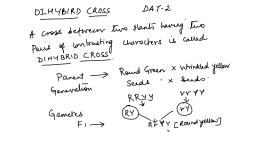
2. Dihybrid Cross : Inheritance of Traits for Two, , Visible Contrasting Characters, , * Mendel took pea plants with two contrasting characters, i.e., one with a green round seed and the other one with a yellow, wrinkled seed., , * When the F progeny was obtained, they had round and, , yellow seeds, thus establishing that round and yellow are, , dominant traits., , Mendel then allowed the F, progeny to be self-crossed, , (self-pollination) to obtain F, progeny. He found that seeds, , were round yellow, round green, wrinkled yellow and some, , were wrinkled green., , * The ratio of plants with above characteristics was 9:3:3:1,, respectively (Mendel observed that two new combinations, had appeared in F,)., , In F,-generation, all the four characters were assorted out, independent of the others. Therefore, he said that a pair of, alternating or contrasting characters behaves independently, of the other pair. For example, seed colour is independent of, seed coat. The independent inheritance of two separate traits, shape and colour of seeds is schematically shown below, , ruens ©) ©, RAyy, , x ny, (Round green), |, , (Wrinkled yellow), t \, Gametes Ry v, Ss x, Rryy, (Round yellow), , oS, , O®, OO, , RRYy | RAY, , Oo, , Ry] Riv, , eels, , BOIOIO, , Fe-generation 315 round yelow, 108 round green, 101 wrinkled yellow, 2 winked green, 556 seeds, , Expression of Traits, , Cellular DNA is the source of information for making, proteins in the cell. A section of DNA that provides, information for one particular protein is called a gene for that, protein. Expression of trait in body depends on the, functioning of a gene. If the gene is working normally,, , F generation, , ©, @, , , , , , , , , , , , , , , , OROORO|®, 3°, , , , 2, , 2, , =, z, , 0. 2@/:O0|2:O2O/@, , @@O, , , , ein will be produced for normal body funcs, a specific protein is altered, the protein...", II not be functional at all i., , sufficient prot, If the gene for y, less efficient or wil, , Mechanism of Inheritance, , Both the parents contribute a copy of the same gene ;, progeny. Each germ cell thus, has one set of gene, pre, chromosome. Each cell of the body will have two ¢, , h chromosome, one inherited from each parent, , , , , , , , eacl, When two germ cells combine, they restore the norma], number of chromosomes in the progeny. This ensures the, stability of the DNA of species. Such mechanism of, inheritance explains the result of Mendel’s experiment; ), is used by all sexually and asexually reproducing o, , Sex-Determination, , It is the process by which sex of a newborn individual js, determined. Different strategies can determine sex in, different species. For example, in reptiles environment, factors such as temperature at which fertilised eggs are kep:, determine sex of the offspring. The determination of sex _, occurs largely by genetic control in human beings. In hum:, beings, there are 23 pairs of chromosomes, out of which, 22 pairs are autosomes and one pair is sex-chromosomes, , , , , , , , , , , , Females have a perfect pair of sex chromosome, (homogametic), but males have a mismatched pair, (heterogametic) in which one is X (normal sized) and the, other is Y-chromosome (short in size)., , Hence, an egg fertilised by X-chromosome carrying spe, results in a zygote with XX, which becomes a female andilz, eggis fertilised by Y-chromosome carrying sperm, it resultsin!, XY zygote that becomes male., Thus, the sex of the children will be determined by what te, inherit from their father. A child who inherits an, X-chromosome will be a girl and one who inherits a, Y-chromosome will be a boy. The inheritance of sex in, humans is diagrammatically shown below, , ; i, Ak, Male ie, , panel \ ©, , Zygote, x XY, < +, one f}, 1, cee Male, , Sex-determination in himan hainne